What types of freshwater aquarium fish are there?
Freshwater aquarium fish fall into a handful of types that share water preferences and behaviour, and the 22 species here cover the most common of them. Grouping matters because species from the same type usually want similar water, which makes them the easiest place to start when planning tank mates.
The groups used on AquaCompat are:
- Tetras: small schooling characins from soft South American water, here the neon, cardinal and GloFish tetras. The tetra species comparison sets them side by side.
- Livebearers: guppies, Endler's livebearers, platies and mollies, which give birth to free-swimming young and prefer harder, more alkaline water. See the livebearer group page.
- Cichlids: angelfish, discus and oscars, larger fish with complex behaviour and very different needs, compared on the cichlid overview.
- Catfish and bottom dwellers: corydoras, the bristlenose pleco and the kuhli loach, which work the substrate. The bottom dweller group covers all three.
- Shrimp and snails: cherry and Amano shrimp, nerite and mystery snails, the invertebrates often added as a clean-up crew, covered under freshwater shrimp and snails.
Four species sit outside those groups. The betta fish and dwarf gourami are labyrinth fish, able to breathe air at the surface. The harlequin rasbora is a schooling fish of the family Danionidae from Southeast Asia that fills the same role as a tetra, and the zebra danio, from the same family, is an active fish that tolerates cooler water than most tropical species. The goldfish is the one coldwater species.
These groups are a small slice of what is traded: a 2019 Journal of Fish Biology review counts more than 5,300 freshwater and 1,802 marine species of fish in the ornamental trade, based on a 2013 analysis.
How do the 22 species compare at a glance?
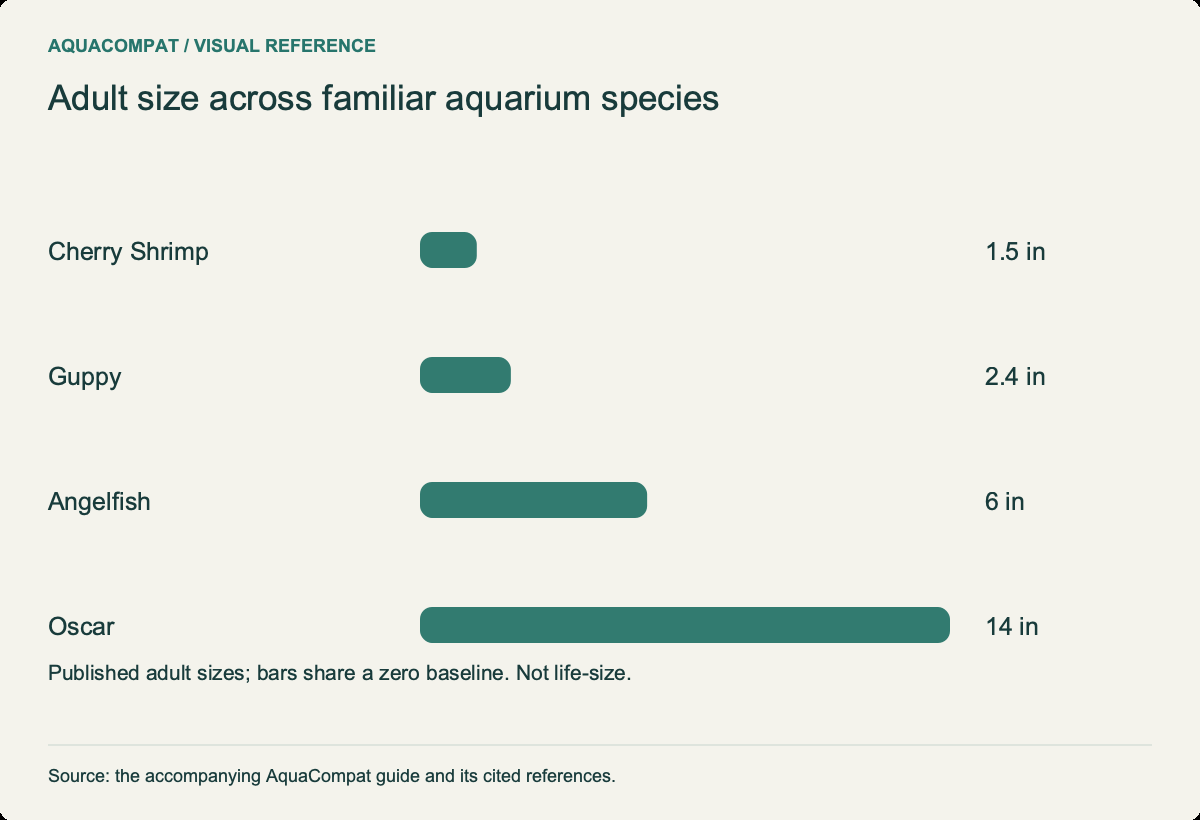
The 22 species differ most in temperature and adult size: the coolest-kept species, the goldfish, overlaps with only a few of the tropical fish, and adult sizes run from the 1 in (2.5 cm) nerite snail to the 14 in (35.6 cm) oscar. The table lists every species alphabetically with the five values that decide most stocking questions.
| Species | Temperature | pH | Adult size | Minimum tank | Temperament |
|---|---|---|---|---|---|
| Amano shrimp | 65–81 °F (18–27 °C) | pH 6.0–7.5 | 2 in (5.1 cm) | 10 US gal (38 L) | peaceful |
| Angelfish | 75–86 °F (24–30 °C) | pH 6.0–8.0 | 6 in (15.2 cm) | 53 US gal (201 L) | semi-aggressive |
| Betta fish | 72–86 °F (22–30 °C) | pH 6.0–8.0 | 2.8 in (7.1 cm) | 10 US gal (38 L) | semi-aggressive |
| Bristlenose pleco | 72–79 °F (22–26 °C) | pH 6.0–7.2 | 5 in (12.7 cm) | 20 US gal (76 L) | peaceful |
| Cardinal tetra | 73–84 °F (23–29 °C) | pH 4.0–7.5 | 1.4 in (3.6 cm) | 15 US gal (57 L) | peaceful |
| Cherry shrimp | 70–79 °F (21–26 °C) | pH 6.5–8.0 | 1.5 in (3.8 cm) | 5 US gal (19 L) | peaceful |
| Corydoras (bronze cory) | 70–81 °F (21–27 °C) | pH 6.5–7.5 | 3 in (7.6 cm) | 20 US gal (76 L) | peaceful |
| Discus | 79–86 °F (26–30 °C) | pH 5.0–7.6 | 5.5 in (14 cm) | 67 US gal (254 L) | peaceful |
| Dwarf gourami | 72–81 °F (22–27 °C) | pH 6.0–7.5 | 3.5 in (8.9 cm) | 15 US gal (57 L) | semi-aggressive |
| Endler's livebearer | 75–81 °F (24–27 °C) | pH 7.0–8.5 | 1 in (2.5 cm) | 10 US gal (38 L) | peaceful |
| GloFish tetra | 68–79 °F (20–26 °C) | pH 6.0–7.0 | 2.4 in (6.1 cm) | 20 US gal (76 L) | peaceful |
| Goldfish | 59–70 °F (15–21 °C) | pH 6.0–8.0 | 10 in (25.4 cm) | 48 US gal (182 L) | peaceful |
| Guppy | 68–82 °F (20–28 °C) | pH 7.0–8.0 | 2.4 in (6.1 cm) | 10 US gal (38 L) | peaceful |
| Harlequin rasbora | 72–79 °F (22–26 °C) | pH 5.0–7.5 | 2 in (5.1 cm) | 15 US gal (57 L) | peaceful |
| Kuhli loach | 74–79 °F (23–26 °C) | pH 3.5–7.0 | 3.9 in (9.9 cm) | 15 US gal (57 L) | peaceful |
| Molly | 70–82 °F (21–28 °C) | pH 7.5–8.5 | 5 in (12.7 cm) | 20 US gal (76 L) | peaceful |
| Mystery snail | 70–78 °F (21–26 °C) | pH 7.2–8.0 | 2.6 in (6.6 cm) | 5 US gal (19 L) | peaceful |
| Neon tetra | 70–77 °F (21–25 °C) | pH 5.0–7.5 | 1.2 in (3 cm) | 15 US gal (57 L) | peaceful |
| Nerite snail | 72–79 °F (22–26 °C) | pH 7.2–8.0 | 1 in (2.5 cm) | 5 US gal (19 L) | peaceful |
| Oscar | 74–80 °F (23–27 °C) | pH 6.0–8.0 | 14 in (35.6 cm) | 75 US gal (284 L) | semi-aggressive |
| Platy | 68–77 °F (20–25 °C) | pH 7.0–8.2 | 2.4 in (6.1 cm) | 14 US gal (53 L) | peaceful |
| Zebra danio | 65–75 °F (18–24 °C) | pH 6.0–8.0 | 2 in (5.1 cm) | 20 US gal (76 L) | peaceful |
How should you read the care data?
Each column answers one practical question, and each has a caveat worth knowing before you compare species.
Temperature and pH
Temperature and pH are given as ranges, and the useful number for a mixed tank is where two ranges overlap, not either range on its own. A Neon Tetra at 70–77 °F (21–25 °C) and a Guppy at 68–82 °F (20–28 °C) can share the overlap between them, and the pair page for any two species prints that shared band directly. Temperatures are shown in °F with °C alongside. The aquarium temperature guide and the pH guide explain both parameters in more depth.
Adult size
Adult size is the maximum length a species reaches in aquaria, usually standard length, which excludes the tail fin. The figure matters because sources measure differently: for the cardinal tetra, Seriously Fish gives 35 mm standard length while Aquarium Co-Op gives 1.75 in, which is likely total length including the tail. Use the size column to judge predation risk, because a fish can eat any tank mate that fits in its mouth.
Minimum tank
Minimum tank is the smallest tank suited to a proper group of that species kept on its own, in US gallons with litres. For many small fish it comes from a footprint rather than a volume: Seriously Fish lists a 60 × 30 cm base for neon tetras, which works out to 15 US gal (57 L). A mixed tank needs at least the largest minimum among its species, and more space once several schools share it.
Temperament
Temperament is recorded as peaceful or semi-aggressive. Peaceful species do not normally harass other fish; semi-aggressive species, such as the Betta Fish and Dwarf Gourami, may defend territory or attack fish they see as rivals. Temperament says nothing about water or size, so a peaceful species can still be a poor match.
Why are these aquarium-care ranges rather than wild habitat ranges?
The ranges are aquarium-care figures because almost every fish in the hobby is farmed, and farmed fish live in different water from their wild ancestors. FishBase often records the narrow conditions measured in a species' native rivers, while care sources such as Seriously Fish and Aquarium Co-Op describe what captive stock tolerates.
The neon tetra shows the gap clearly. FishBase records a hardness of 1–2 dGH from its wild blackwater streams, but the aquarium-care sources give 1–12 dGH, and Seriously Fish notes that commercially farmed neons adapt to a wider range of water than wild fish. The cardinal tetra is similar: FishBase gives a wild pH of 4.0–6.0, while Aquarium Co-Op's care range is pH 4.0–7.5.
Using wild figures would make most community tanks look impossible and push keepers toward chasing extreme water chemistry. Using care ranges reflects the fish actually sold in shops. Where sources disagree, each species page lists the disagreement and names who said what, so the choice of range is visible rather than hidden.
Which species suit soft water and which suit hard water?
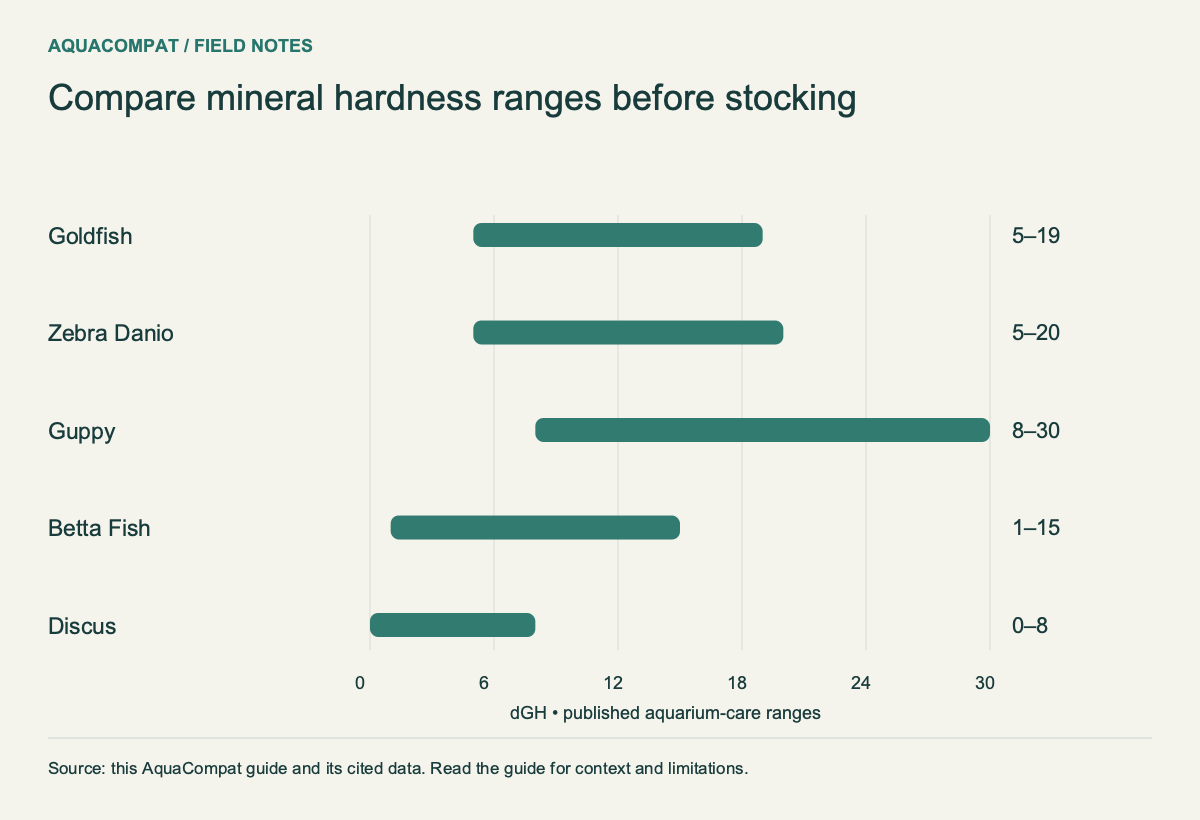
The clearest divide among the 22 species is soft, acidic water versus hard, alkaline water, and it rules out more pairings than temperament does. Hardness here means dissolved minerals in the water, measured as general hardness (GH), not anything physical.
Soft-water species come mainly from South American and Southeast Asian forest streams. They include the Cardinal Tetra at pH 4.0–7.5, the Kuhli Loach at pH 3.5–7.0 and the Discus at pH 5.0–7.6.
Hard-water species include the livebearers and the snails. The Molly needs pH 7.5–8.5 and 15–25 dGH, the Endler's Livebearer pH 7.0–8.5, and the Nerite Snail pH 7.2–8.0. Snails need minerals for their shells: Aquarium Co-Op and Applesnail.net both link pitted or eroded shells to water that is too soft.
Several species bridge the two, which is what makes them useful in mixed tanks. The Corydoras lists pH 6.5–7.5, the Bristlenose Pleco pH 6.0–7.2 and the Zebra Danio pH 6.0–8.0. The GH and KH guide explains how to measure the minerals in your own tap water before choosing.
How do you choose species for a community tank?
Choose species for a community tank by starting from the water you have and the one species you most want, then filtering everything else against it. Working in this order avoids the common mistake of buying fish one at a time and discovering a mismatch afterwards.
- Test your tap water. Its pH and hardness decide whether soft-water or hard-water species will be easier to keep.
- Pick a centrepiece species. This is often a betta, a gourami or a school of tetras. Its temperature range becomes the band everything else must share.
- Filter by temperature and pH overlap. Drop any species whose range does not overlap the centrepiece's by a comfortable margin.
- Filter by size. Remove any species large enough to eat another, judged at adult size.
- Check temperament. Avoid fin nippers with long-finned fish and avoid putting two territorial species in a small tank.
- Fit the schools to the tank. Schooling fish need their full group: the neon tetra's minimum group is 8 and the corydoras' is 6.
The two-species compatibility checker runs steps three to five for any pair, and the tank mates index lists ranked companions for each species. For a ready-made shortlist of hardy species, see the guide to easy fish for a first aquarium.
Which of these species are not community fish?
Four of the 22 species do not suit a typical small-fish community, each for a different reason.
- Oscar: predatory and very large at 14 in (35.6 cm), needing at least 75 US gal (284 L). It eats any fish small enough to swallow.
- Goldfish: a coldwater fish kept at 59–70 °F (15–21 °C), below most tropical species, and large enough at 10 in (25.4 cm) to eat small fish.
- Discus: peaceful, but kept at 79–86 °F (26–30 °C), warmer than most community fish tolerate, and rated an advanced species.
- Betta Fish: males are highly aggressive to other males and to fish they mistake for rivals, according to Seriously Fish, though some individuals tolerate peaceful nano fish in planted tanks.
None of these is a bad aquarium fish. Each needs a tank planned around it rather than added to an existing community.
How long do aquarium fish live?
Lifespans among the 22 species range from about a year to decades, so the commitment varies far more than the purchase price suggests. At the short end, the Cherry Shrimp lives 1–2 years and the Betta Fish up to 2 years, according to FishBase's maximum reported age. At the long end, the Oscar typically lives 10–20 years and the Goldfish 6–20 years. Some long figures, such as Practical Fishkeeping's record of up to 17 years for the kuhli loach, come from owner reports rather than typical lifespans, and each species page notes which kind of figure it uses.
What other freshwater groups are planned?
The 22 species cover the fish most often asked about together, but the hobby is wider. Planned pages extend the reference to freshwater aquarium plants and to frogs, crabs and other oddballs. Those groups are not yet part of the compatibility matrix, so no verdicts are given for them.
Questions people ask
Why does AquaCompat cover only 22 species?
Is the corydoras entry one species or many?
Why is minimum tank size larger than some shops suggest?
Are GloFish tetras a separate species?
Which species on this list are invertebrates?
Sources 99 documents from 17 publishers
- Applesnail.net (applesnail.net): “How to take care of apple snails”; “Quick guide”; “Pomacea diffusa”; “Apple snail FAQ”
- Aquarium Co-Op (aquariumcoop.com): “Oscar Fish Care Guide”; “Care Guide for Amano Shrimp”; “Freshwater Angelfish Care Guide”; “Betta Fish Care Guide”; “Care Guide for Plecostomus”; “Care Guide for Cardinal Tetras”; “Care Guide for Cherry Shrimp”; “Care Guide for Cory Catfish”; “Discus Fish Care Guide”; “Care Guide for Dwarf Gouramis”; “Endler's Livebearer Care Guide”; “Care Guide for GloFish”; “Care Guide for Fancy Goldfish”; “Goldfish Tank Mates”; “Guppy Care Guide”; “Care Guide for Harlequin Rasboras and Lambchop Rasboras”; “Care Guide for Kuhli Loaches”; “Care Guide for Mollies: Feeding, Breeding, and Tank Mates”; “Care Guide for Mystery Snails”; “Care Guide for Nerite Snails”; “Care Guide for Platy Fish: Feeding, Breeding, and Tank Mates”; “Care Guide for Zebra and Leopard Danios”; “What Is Neon Tetra Disease and How Can It Be Prevented?”; “Neon and Cardinal Tetras: Beginner Schooling Fish”; “Top 5 Dither Fish to Help Shy or Aggressive Fish in Freshwater Tanks”; “Betta fish tank mates”
- AquariumInfo.org (aquariuminfo.org): “Apple Snail”
- FishBase (fishbase.se): “Astronotus ocellatus, Oscar: species summary”; “Betta splendens, Siamese fighting fish: species summary”; “Osteogaster aenea, Bronze corydoras”; “Symphysodon aequifasciatus, Blue discus: species summary”; “Trichogaster lalius, Dwarf gourami: species summary”; “Poecilia wingei, Endlers guppy: species summary”; “Carassius auratus, Goldfish: species summary”; “Poecilia reticulata, Guppy: species summary”; “Trigonostigma heteromorpha summary page”; “Paracheirodon innesi summary page”; “Xiphophorus maculatus, Southern platyfish: species summary”; “Danio rerio summary page”; “Paracheirodon axelrodi summary (Bayesian length-weight estimate)”; “Length-weight relationships for Osteogaster aenea”
- fishkeeping.co.uk (fishkeeping.co.uk): “Goldfish Size, Life Expectancy and Tank Recommendations”; “Keeping Goldfish - The Right Way”
- GloFish (Spectrum Brands) (glofish.com): “GloFish FAQs”
- Journal of Fish Biology, Evers, Pinnegar and Taylor (Cefas and University of East Anglia) (ueaeprints.uea.ac.uk): “Where are they all from? – sources and sustainability in the ornamental freshwater fish trade”
- Maidenhead Aquatics (fishkeeper.co.uk species data sheet) (fishkeeper.co.uk): “Zebra Nerite Snail”; “Angelfish data sheet”; “Black Widow Tetra (Black Skirt Tetra) data sheet”; “Guppy data sheet”; “Harlequin Rasbora data sheet”; “Molly data sheet”; “Neon Tetra data sheet”; “Oscar data sheet”; “Platy data sheet”
- Ornamental Aquatic Trade Association (OATA) (ornamentalfish.org): “How to look after fancy goldfish”; “How to look after goldfish in an aquarium / fish tank”
- PlanetCatfish (via Internet Archive snapshot, 2025) (web.archive.org): “Ancistrus sp. (3) Common Bristlenose Catfish Cat-eLog data sheet”; “Osteogaster aenea (Bronze Cory) Cat-eLog data sheet”
- Practical Fishkeeping (practicalfishkeeping.co.uk): “Amano shrimp: Spineless heroes (Nathan Hill)”; “Bristlenose catfish: the hardworking Ancistrus”; “Frequently asked questions on Neocaridina shrimps”; “Quick guide to livebearers”; “A guide to the small rasboras from the genus Trigonostigma”; “How long will my fish live?”; “Cardinal tetra, Paracheirodon axelrodi”; “What can I keep in my hard water aquarium?”
- Practical Fishkeeping (Julian Dignall) (practicalfishkeeping.co.uk): “Focus on commonly kept Corydoras”
- Seriously Fish (seriouslyfish.com): “Astronotus ocellatus”; “Pterophyllum scalare”; “Betta splendens”; “Ancistrus sp. '3' (Common Bristlenose Catfish)”; “Paracheirodon axelrodi (Cardinal Tetra)”; “Osteogaster aenea (Bronze Cory)”; “Symphysodon aequifasciatus”; “Trichogaster lalius”; “Poecilia wingei”; “Gymnocorymbus ternetzi (Black Widow Tetra)”; “Poecilia reticulata”; “Trigonostigma heteromorpha (Harlequin)”; “Pangio semicincta ('Kuhli' Loach)”; “Poecilia sphenops”; “Poecilia latipinna”; “Paracheirodon innesi (Neon Tetra)”; “Xiphophorus maculatus”; “Danio rerio (Zebra Danio)”
- Shrimp and Snail Breeder (aquariumbreeder.com): “Nerite Snails: detailed guide, care, diet and breeding”; “Amano Shrimp: detailed guide, care, diet and breeding”; “Red Cherry Shrimp: detailed guide, care, diet and breeding”; “Cherry Shrimp in a Community Tank”
- Shrimp Science (shrimpscience.com): “Amano Shrimp”; “Red Cherry Shrimp - Care Guide”; “General Hardness (GH) For Shrimp Tanks”
- UF/IFAS EDIS (ask.ifas.ufl.edu): “Evolution, Culture, and Care for Betta splendens (FA212)”
- Wikipedia (en.wikipedia.org): “Vittina natalensis”
All sources accessed . Every number on this page comes from these documents.