What decides whether two fish species can share a tank?
Fish compatibility is decided by shared water first and behaviour second. A pairing works only when both species can live in the same water at the same time, and when neither one treats the other as food, a rival or a target for its fins. Size and tank space then decide whether a workable pairing stays workable as the fish grow.
Each AquaCompat compatibility verdict draws on six attributes from the species' fact files:
- Temperature: the band where both species' published ranges overlap. A tropical Betta Fish at 72–86 °F (22–30 °C) and a coldwater Goldfish at 59–70 °F (15–21 °C) share no temperature at all.
- Temperament: peaceful or semi-aggressive, plus any sourced record of fin-nipping or targeted aggression.
- Adult size and predation: whether one species reaches a size where the other fits in its mouth, judged at adult length.
- pH: the overlap between the two pH ranges.
- Hardness: the overlap between the two general hardness (GH) ranges, meaning dissolved minerals in the water.
- Swim level: whether both species crowd the same layer of the tank.
The weights, the deal-breakers and the rules that turn these attributes into a score are described in full on the page explaining how compatibility verdicts are built, and they are kept there because the method is versioned and can change. Every pair guide below shows the result of that method for one pair and explains the published reasons behind it.
Should you use a pair guide, a tank mates list or the checker?
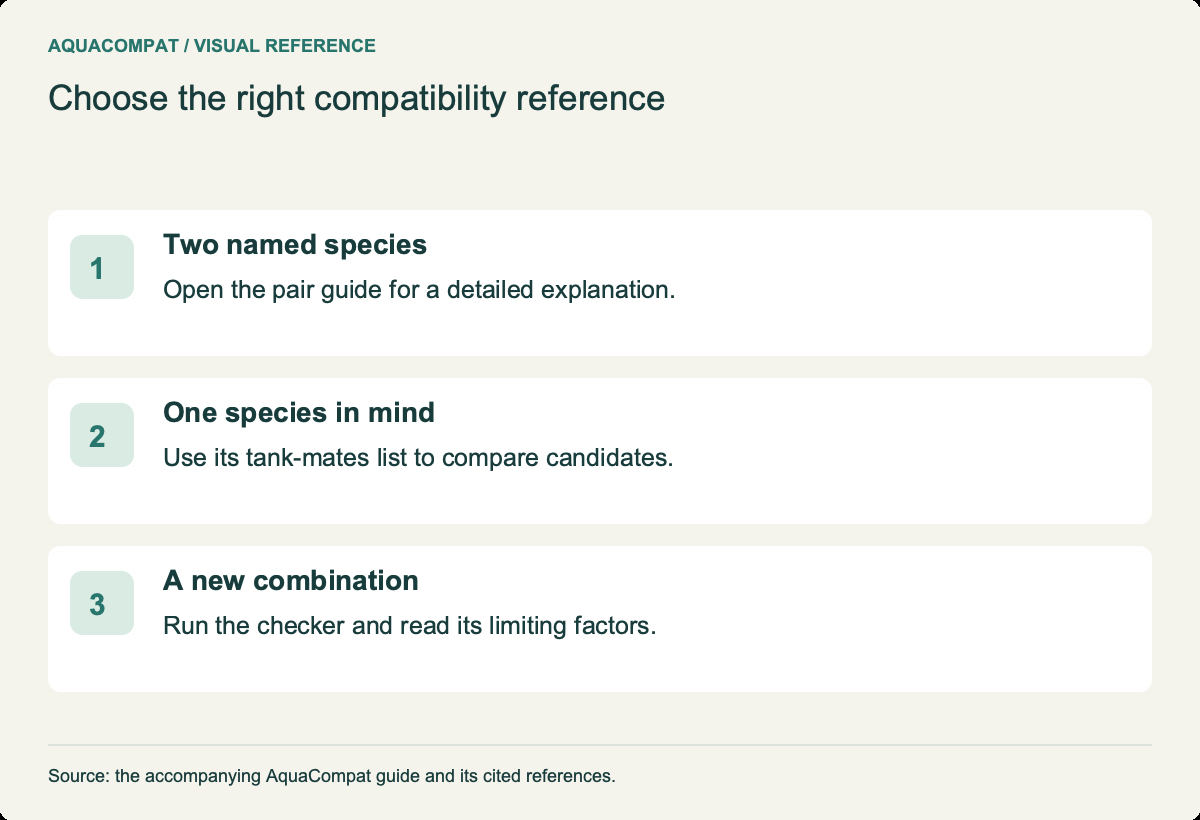
Use a pair guide when you are asking about two named species, a tank mates list when you are asking what can live with one species, and the checker when the pair you want has no written guide yet. All three read the same species data, so a pair's verdict is identical wherever it appears.
Pair guides answer one boolean question
A pair guide answers a single yes-or-no question such as whether a betta can live with guppies. It opens with the verdict and the score, then sets out the shared temperature, pH and hardness in a table, compares temperament, swim level and adult size, works out the smallest tank for both species together and closes with what happens when the pairing goes wrong. Pair guides exist for the combinations people ask about most, which is why the first three all involve the betta.
Tank mates lists answer a grouping question
A tank mates list starts from one species and ranks every other species against it, from the strongest match to the pairings that fail. It is the right page when you have a centrepiece fish and want a shortlist. The index of tank mates lists by species covers ten starting species, from the betta to the oscar, plus African cichlids and aquarium snails as groups.
The checker answers any pair on demand
The interactive fish compatibility checker returns the verdict, score, factor breakdown and smallest shared tank for any two species in the data, including the many pairs that have no written guide. It shows the same numbers a pair guide would, without the sourced explanation of why a factor scored the way it did.
Which pair guides are available now?
Three pair guides are published at launch, all built around the betta fish because it is the species most often asked about alongside other fish. Each one reaches a different verdict for a different reason, which makes them a useful set for learning how pairings succeed and fail.
- The guide asking can betta fish and guppies live together turns on behaviour. The water overlaps at 72–82 °F (22–28 °C) and pH 7.0–8.0, but Seriously Fish notes that male bettas may treat fish with trailing fins as rivals, and male guppies carry those fins.
- The guide asking whether neon tetras can live with a betta turns on a narrow temperature band. The two species share only 72–77 °F (22–25 °C), and the neons need a school of at least 8, which pushes the shared tank to 29 US gal (110 L).
- The guide asking can a betta fish live with goldfish turns on temperature alone: the betta's 72–86 °F (22–30 °C) and the goldfish's 59–70 °F (15–21 °C) never meet, and the goldfish grows to 10 in (25.4 cm).
The table gives the current verdict and score for each launch pair, with the smallest tank that suits both species.
| Pair | Verdict | Score | Shared temperature | Smallest tank together |
|---|---|---|---|---|
| Betta and guppy | caution | 7/10 | 72–82 °F (22–28 °C) | 20 US gal (76 L) |
| Betta and neon tetra | caution | 7/10 | 72–77 °F (22–25 °C) | 29 US gal (110 L) |
| Betta and goldfish | incompatible | 3/10 | no overlap | 75 US gal (284 L) |
How should you read a compatibility verdict?
A compatibility verdict is a starting point for planning, not a promise about two individual fish. The three labels tell you how much homework a pairing needs before you buy.
- Compatible: the published water ranges overlap comfortably and no source records predation or aggression between the two species. Read the pair guide for school sizes and tank size, then proceed.
- Caution: the pairing can work, but at least one factor needs managing, such as a narrow temperature band, a semi-aggressive species or a sourced behaviour note. Read every section of the pair guide and plan a fallback tank.
- Incompatible: at least one problem cannot be managed in a normal aquarium, such as no shared temperature range or a species that eats the other. Keep the two species in separate tanks.
The score out of 10 sits beside the label and shows where a pair falls within it. Two pairs with the same label can differ a great deal: the betta and guppy and the betta and neon tetra both currently read caution, but for different reasons, one behavioural and one about water. That is why every pair guide names the factor that drives its result instead of leaving the label to speak for itself.
The shared tank figure is a minimum for the two species, not for a whole community. It depends on each species' own minimum and on temperament: the Neon Tetra alone needs 15 US gal (57 L), yet the betta and neon tetra pairing needs 29 US gal (110 L).
Does a peaceful label mean two species are compatible?
No. A peaceful temperament label says only that a species does not normally harass other fish; it says nothing about water, size or appetite. The Goldfish is listed as peaceful, yet care sources such as fishkeeping.co.uk and Aquarium Co-Op record that it eats anything that fits in its mouth, and its coldwater range of 59–70 °F (15–21 °C) rules out most tropical companions on its own.
The reverse also holds. A semi-aggressive species is not automatically a bad tank mate: the Betta Fish is listed as semi-aggressive, and several of its pairings with calm, short-finned fish still reach a caution verdict rather than failing. Temperament is one of six factors, and it is the combination that decides. The fastest way to see the combination for a specific pair is the compatibility checker tool, which lists each factor separately.
How do you check a whole community rather than one pair?
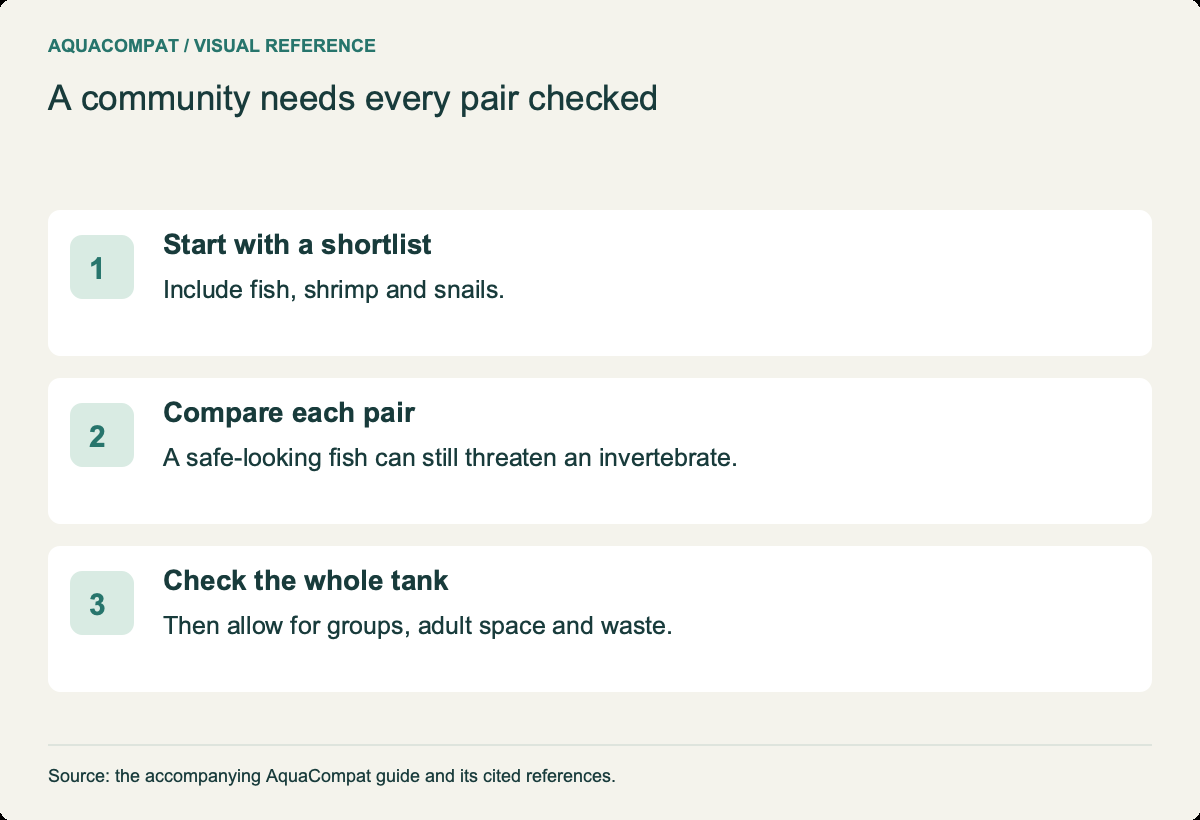
Check a community by checking every pair inside it, then adding the space each school needs. A tank with three species holds three pairs; a tank with five species holds ten. One incompatible pair is enough to rule out the stocking, however well the others score.
Work through the community in this order:
- Start with the centrepiece species. Open its tank mates list and note which candidates rank highest and which fail.
- Check each remaining pair. Use the pair guides where they exist and the checker for the rest, so that tank mates are also matched against each other, not only against the centrepiece.
- Find the shared band. The usable temperature and pH are where all the species' ranges overlap at once, which is narrower than any single pair's overlap.
- Size the tank for the full groups. Schooling species need their full group, such as 8 neon tetras or 6 corydoras, and the tank must hold all of them together.
A worked example of this process, three stockings checked pair by pair, appears in the guide to stocking a 10-gallon community tank. The aquarium stocking calculator automates the pair-by-pair check for a full species list and tank volume.
Why do some compatible pairings still fail?
Compatible pairings fail mainly because individual fish do not always behave like their species' published description. The verdict compares published ranges and labels, so it cannot see a particularly aggressive individual, a crowded tank or a heater that drifts out of the shared band.
The most common reasons a well-matched pairing breaks down are these:
- Individual temperament. Seriously Fish advises that a betta is best kept alone, and notes that some individuals tolerate peaceful tank mates while others do not. A compatible or caution verdict cannot tell you which kind of betta you have.
- Growth. A fish bought small can reach a size where tank mates fit in its mouth. The verdict is judged at adult size, so a pairing that looks fine in the shop can become a predator-and-prey pairing within months.
- Narrow water margins. When the shared temperature is only a few degrees wide, as with the betta and neon tetra, an ordinary heater swing can push one species outside its range.
- Incomplete groups. A pair guide assumes each schooling species is kept at its published minimum group, such as 8 harlequin rasboras. A tank that cannot hold the full group falls outside the conditions the verdict describes.
- Breeding and crossbreeding. Some pairs that score well still should not share a tank: Endler's livebearers and guppies crossbreed and produce fertile hybrids, according to the sources in the Endler's fact file.
When a pairing fails, separate the fish first and diagnose second. Published fish health sources list aggressive tank mates among the stresses behind fin infections, and the fin rot guide covers that damage and its treatment.
Which water parameters matter most for compatibility?
Temperature matters most, because every fish lives at the tank's temperature all the time and few species tolerate long periods outside their range. pH comes next, then general hardness. The temperature chart for aquarium species lists the published ranges side by side, which is the fastest way to see which tropical species can share a heater setting.
pH and hardness depend largely on your source water, so the easiest compatible community is one built from species that suit what comes out of your tap. Soft-water species such as the Cardinal Tetra at pH 4.0–7.5 and hard-water species such as the Molly at pH 7.5–8.5 sit at opposite ends. The aquarium pH guide explains how to test and adjust pH safely, and the explanation of GH and KH covers hardness.
All fish compatibility pair guides
- Can Betta Fish and Guppies Live Together?Shared water, fin aggression toward male guppies, tank size and better options.
- Can Betta Fish and Neon Tetras Live Together?The narrow shared temperature, school size and the tank both species need.
- Can Betta Fish and Goldfish Live Together?Why a tropical betta and a coldwater goldfish share no temperature range.
Questions people ask
Why are all the launch pair guides about the betta?
Can a pair's verdict change after I read it?
What if the pair I want has no guide?
Is a caution verdict a no?
Do compatibility verdicts cover shrimp and snails?
Sources 48 documents from 14 publishers
- Aquarium Co-Op (aquariumcoop.com): “Care Guide for Fancy Goldfish”; “Betta Fish Care Guide”; “Guppy Care Guide”; “Care Guide for Dwarf Gouramis”; “10 Best Top-Dwelling Fish for Your Freshwater Community Aquarium”; “Neon and Cardinal Tetras: Beginner Schooling Fish”; “Goldfish Tank Mates”; “Amano Shrimp Care Guide”; “Care Guide for Cory Catfish”; “Care Guide for Harlequin Rasboras and Lambchop Rasboras”; “Endler's Livebearer Care Guide”; “5 Quick and Easy Steps for Treating Fin Rot in Aquarium Fish”; “Care Guide for Cardinal Tetras”
- FishBase (fishbase.se): “Betta splendens summary (Bayesian length-weight estimate)”; “Poecilia reticulata, Guppy: species summary”; “Paracheirodon innesi summary page”; “Carassius auratus, Goldfish: species summary”; “Length-weight relationships for Carassius auratus”; “Poecilia wingei summary (Bayesian length-weight estimate)”
- fishkeeping.co.uk (fishkeeping.co.uk): “Goldfish Size, Life Expectancy and Tank Recommendations”; “Keeping Goldfish - The Right Way”
- Maidenhead Aquatics (fishkeeper.co.uk species data sheet) (fishkeeper.co.uk): “Guppy data sheet”; “Siamese Fighting Fish/Betta data sheet”; “Neon Tetra data sheet”; “Molly data sheet”
- Merck Veterinary Manual (merckvetmanual.com): “Disorders and Diseases of Fish (pet owner version)”
- Ornamental Aquatic Trade Association (OATA) (ornamentalfish.org): “How to look after fancy goldfish”; “How to look after goldfish in an aquarium / fish tank”
- PlanetCatfish (via Internet Archive snapshot, 2025) (web.archive.org): “Osteogaster aenea (Bronze Cory) Cat-eLog data sheet”
- Practical Fishkeeping (practicalfishkeeping.co.uk): “What water temperature do goldfish need?”; “How can I breed goldfish in my aquarium?”; “Quick guide to livebearers”; “Endler's livebearers are nearly all hybrids!”; “The A-Z of Fish Health, Part 2: F-L, Dr Peter Burgess”
- Seriously Fish (seriouslyfish.com): “Betta splendens”; “Poecilia reticulata”; “Paracheirodon innesi (Neon Tetra)”; “Trigonostigma heteromorpha (Harlequin)”; “Poecilia wingei”; “Paracheirodon axelrodi (Cardinal Tetra)”; “Poecilia sphenops”
- Shrimp and Snail Breeder (aquariumbreeder.com): “Cherry Shrimp in a Community Tank”
- Southern Regional Aquaculture Center (srac.msstate.edu): “Columnaris Disease: A Bacterial Infection Caused by Flavobacterium columnare, SRAC Publication No. 479”; “Motile Aeromonas Septicemia (MAS) in Fish, SRAC Publication No. 478 (2019)”
- Tropical Fish Hobbyist Magazine (tfhmagazine.com): “Betta splendens”
- UF/IFAS EDIS (ask.ifas.ufl.edu): “Evolution, Culture, and Care for Betta splendens (FA212)”
- University of Florida IFAS Extension (EDIS) (ask.ifas.ufl.edu): “Use of Antibiotics in Ornamental Fish Aquaculture (Circular 84 / FA084), Yanong”; “Ammonia in Aquatic Systems (FA16/FA031), Francis-Floyd, Watson, Petty and Pouder”
All sources accessed . Every number on this page comes from these documents.