Which aquarium planning tools does AquaCompat offer?
AquaCompat offers one tool for a pair of species and one for a whole tank, and together they cover the two planning questions keepers ask most: can these fish live together, and will they fit in my tank. An aquarium planning tool, as used here, is a calculator that applies published species data to the choices you enter, so the answer comes from cited figures rather than opinion.
- The fish compatibility checker takes two species and returns a score out of 10, a verdict of compatible, caution or incompatible, a breakdown of six factors and the smallest tank that suits both. Its result for a pair matches the verdict printed on that pair's guide.
- The aquarium stocking calculator takes a tank volume plus any number of species and head counts, then checks space, group sizes, every pair in the list and the shared water range in one pass.
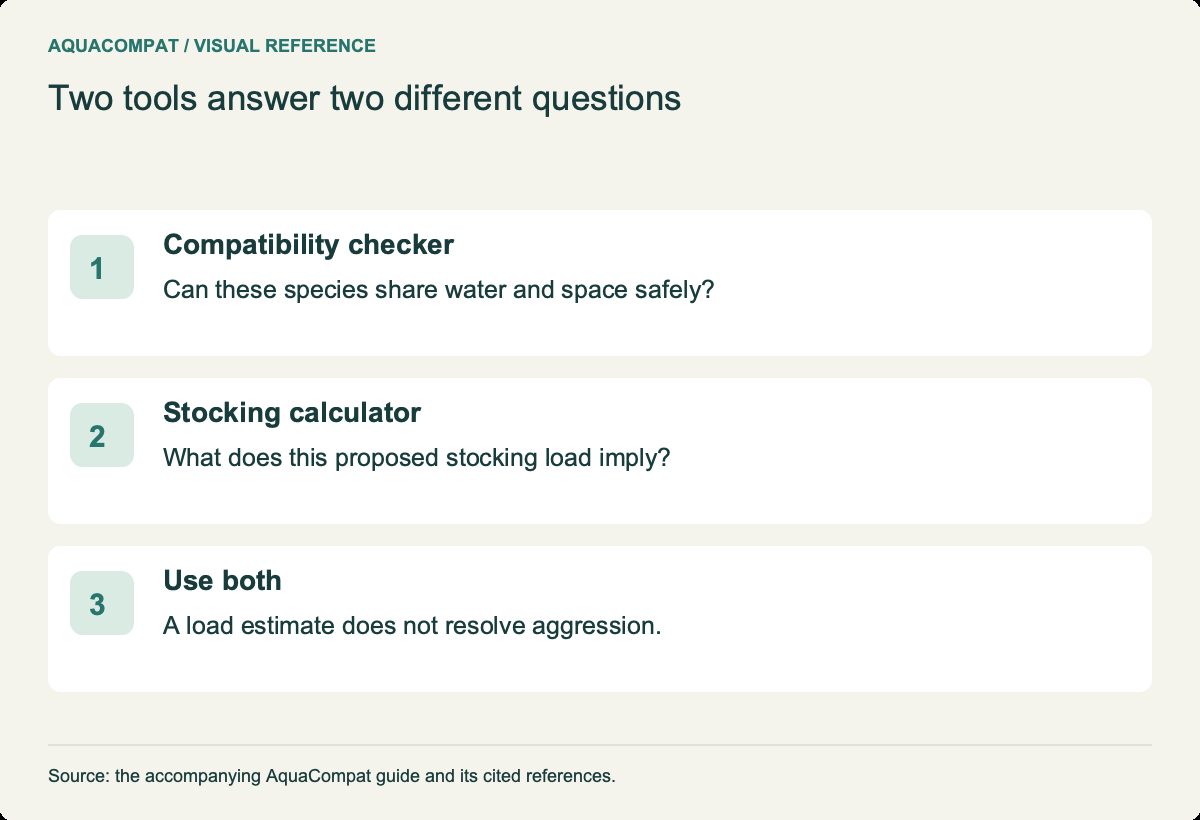
Use the checker first when you are deciding whether to add one species to another, and the calculator once you have a full list in mind. The checker answers a narrow question in depth; the calculator answers a broad question by repeating the checker's pair logic across every combination and adding tank-level checks on top.
How do the compatibility checker and stocking calculator differ?
The two tools differ in scope: the checker examines one pair closely, while the calculator checks a whole stocking list against one tank. The table sets out what each takes and returns.
| Question | Compatibility checker | Stocking calculator |
|---|---|---|
| What you enter | Two species | Tank volume in US gallons or litres, then species and how many of each |
| Main result | Score, verdict and smallest shared tank | An overall result: no problems found, works with care, or problems to fix |
| Water check | Temperature, pH and hardness overlap for the pair | The temperature, pH and hardness range shared by every species in the list |
| Behaviour and size | Temperament, size and predation, and swim level factors | The verdict and score for every pair in the list |
| Space check | Smallest tank for the pair | Flags any species whose published minimum tank is larger than your tank |
| Group check | Not included | Flags any species kept below its published minimum group |
| Load estimate | Not included | Adult inches per gallon, plus estimated adult fish mass where a length-weight estimate exists |
Where does the data in the tools come from?
Both tools read one data file built from the AquaCompat species fact files, so every range and size in a tool result is the same value printed on the species, pair and tank mates pages. Each fact file records a species' temperature, pH and hardness ranges, adult size, minimum tank, group size, temperament and swim level, with each value tied to published sources such as Seriously Fish, FishBase and Aquarium Co-Op. The pair verdicts come from a fixed scoring method applied to those files; the scoring and verdict method explains the factors, their weights and the rules that override a score.
The tools run entirely in your browser. When you press the check button, the page downloads that data file from AquaCompat and does the arithmetic on your device; the species and numbers you choose are not sent anywhere or stored. Because the data is rebuilt whenever a fact file is corrected, a tool result can change after a correction, in the same way the pages do.
How do you use the compatibility checker?
Pick two species from the lists and the compatibility checker shows its result straight away, with the reasons beneath. Reading the reasons matters more than the score, because two pairs with the same score can fail for very different reasons.
Take the betta and the guppy. Their temperature ranges overlap, with the Betta Fish at 72–86 °F (22–30 °C) and the Guppy at 68–82 °F (20–28 °C), so water is not the main concern. The checker currently rates the pair caution at 7 out of 10, and its factor breakdown shows that temperament is what pulls the result down: Seriously Fish notes that male bettas may attack fish they mistake for rivals, and long-finned guppies fit that description. The full betta and guppy compatibility guide explains that risk in detail.
The betta and the goldfish show a different kind of result. The Goldfish is kept at 59–70 °F (15–21 °C), and the checker marks the pair incompatible at 3 out of 10 because the two species share no temperature range at all: one of them would always sit outside its published limits. No tank size or careful stocking fixes that, which is why the result names the reason rather than just a number.
The smallest-tank figure is the third part of each result. For the betta and neon tetra it is 29 US gal (110 L), larger than either species' own minimum, because the tank has to suit both fish together.
How do you use the stocking calculator?
Enter the tank volume, add each species with the number you plan to keep, and press the check button; the stocking calculator then reports every problem it finds in the list. The steps are listed below.
- Enter the tank volume in US gallons or litres. Litres are converted to gallons for the checks.
- Add each species and its count. Use the add button for more rows; entering the same species twice adds the counts together.
- Read the summary panel. It shows the tank size in both units, the shared temperature, pH and hardness ranges for all species together, the adult inches per gallon and, where every species has a published length-weight estimate, the estimated adult fish mass per gallon.
- Read any warnings. The calculator flags a tank smaller than a species' published minimum, a group below its published minimum, and a list with no shared temperature or pH range.
- Check the pair table. Every pair in the list appears with its verdict and score, linked to the pair guide where one exists.
A quick example shows how the warnings work. Eight neon tetras in a 10-gallon tank meet the Neon Tetra's minimum group of 8, but the species' published minimum tank is 15 US gal (57 L), so the calculator flags the tank as too small. Adding a Betta Fish to the same list adds the betta and neon tetra pair, currently caution, to the pair table. The 10-gallon community tank stockings show lists that pass these checks.
Is the one-inch-per-gallon rule enough to stock a tank?
No. The one-inch-per-gallon rule, which allows one inch of adult fish per gallon of water, is a rough reference at best, and the stocking calculator shows it only as one figure among several. The rule treats every inch of fish as equal, but a long, deep-bodied fish carries far more body mass and produces far more waste than several slender fish of the same total length.
The size data makes the point. A single Goldfish reaches 10 in (25.4 cm), while a Neon Tetra reaches 1.2 in (3 cm). By the inch rule, one goldfish counts the same as several neon tetras of equal total length, yet the goldfish is far heavier and needs a published minimum tank of 48 US gal (182 L). This is why the calculator also estimates adult fish mass from FishBase length-weight relationships where they are published, and why it checks each species' own minimum tank and group size rather than relying on inches alone.
The rule also ignores everything that is not size: a tank can be well under one inch per gallon and still fail because two species share no temperature range or one eats the other. Treat a low inches-per-gallon figure as a necessary condition, never a sufficient one.
When do the tools give a misleading answer?
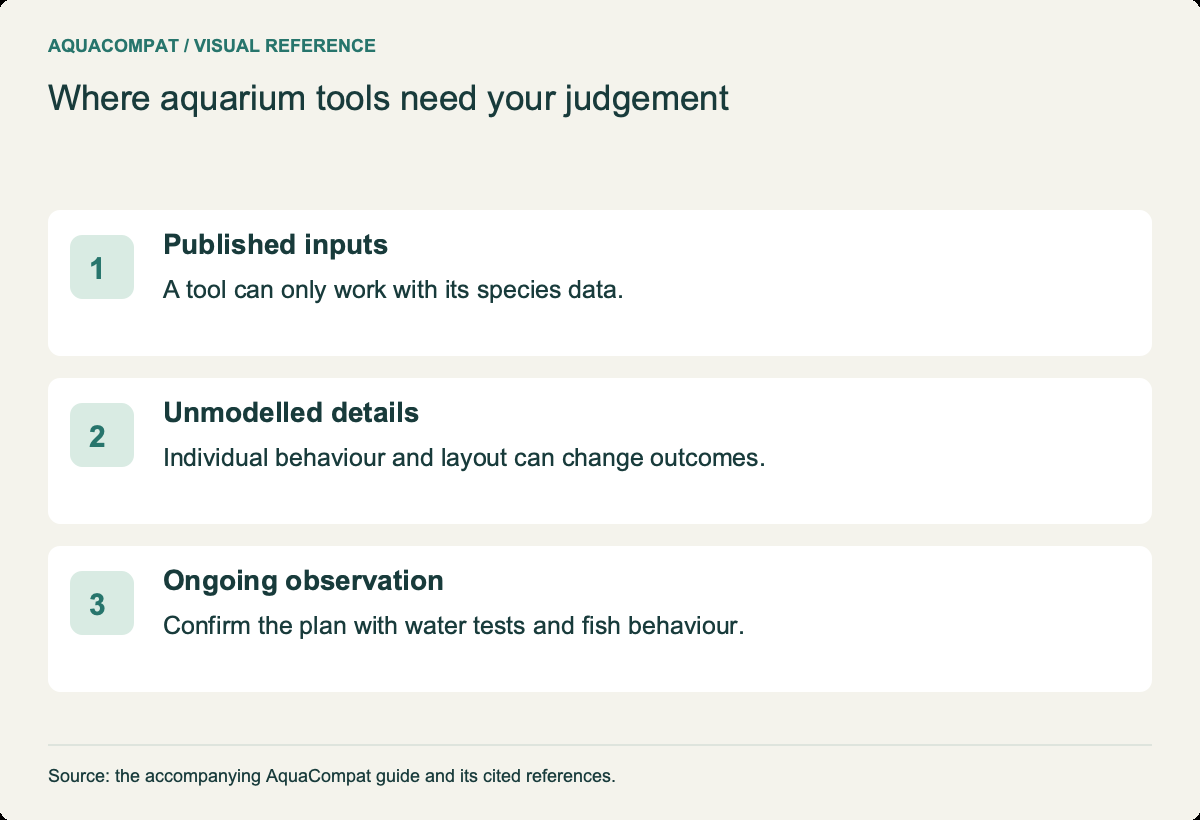
The tools give a misleading answer whenever the real tank differs from what published species data can describe. Their results are a strong starting point, not a guarantee, and the main gaps are listed below.
- Individual fish vary. A peaceful-labelled fish can still bully a tank mate, and one semi-aggressive fish can turn out calm. The tools describe species, not your fish.
- Filtration and maintenance are not modelled. The calculator does not ask about your filter, plants or water-change routine, so it cannot say how much waste a tank can process. A new tank also needs its filter bacteria established before stocking, as the guide to the nitrogen cycle explains.
- Wild-caught fish may need different water. The ranges target captive-bred stock; wild fish can need conditions outside them.
- Missing data stays missing. Where a species has no published value, the result names the gap instead of filling it in, so part of the answer rests on incomplete data.
- Only listed species are covered. A species not in the fact base cannot be checked, even if a similar one is.
- Health problems are outside their scope. A compatible verdict says nothing about a sick fish; the fish disease and tank problem guides cover that.
Which guides should you read after running a tool?
After running a tool, read the guide that explains the result for your main species. A ranked list of companions for each popular species sits in the tank mates by species index, and the pair-by-pair compatibility guides explain individual verdicts in full, including how each pairing fails. Species care data, from temperature to adult size, is gathered on the freshwater species index. For water chemistry that the tools assume, such as pH and hardness, the water and setup guides explain how to test and adjust your own tap water.
AquaCompat tools
Questions people ask
Are the AquaCompat tools free to use?
Why does the stocking calculator say my tank is too small for one fish?
Does the compatibility checker cover shrimp and snails?
Will a pair get the same verdict in both tools?
Sources 19 documents from 7 publishers
- Aquarium Co-Op (aquariumcoop.com): “Betta Fish Care Guide”; “Guppy Care Guide”; “Care Guide for Fancy Goldfish”; “Goldfish Tank Mates”; “Neon and Cardinal Tetras: Beginner Schooling Fish”
- FishBase (fishbase.se): “Betta splendens, Siamese fighting fish: species summary”; “Poecilia reticulata, Guppy: species summary”; “Carassius auratus, Goldfish: species summary”; “Paracheirodon innesi summary page”
- fishkeeping.co.uk (fishkeeping.co.uk): “Goldfish Size, Life Expectancy and Tank Recommendations”; “Keeping Goldfish - The Right Way”
- Maidenhead Aquatics (fishkeeper.co.uk species data sheet) (fishkeeper.co.uk): “Guppy data sheet”; “Neon Tetra data sheet”
- Ornamental Aquatic Trade Association (OATA) (ornamentalfish.org): “How to look after fancy goldfish”; “How to look after goldfish in an aquarium / fish tank”
- Seriously Fish (seriouslyfish.com): “Betta splendens”; “Poecilia reticulata”; “Paracheirodon innesi (Neon Tetra)”
- UF/IFAS EDIS (ask.ifas.ufl.edu): “Evolution, Culture, and Care for Betta splendens (FA212)”
All sources accessed . Every number on this page comes from these documents.