Which species are small enough for a 10-gallon community tank?
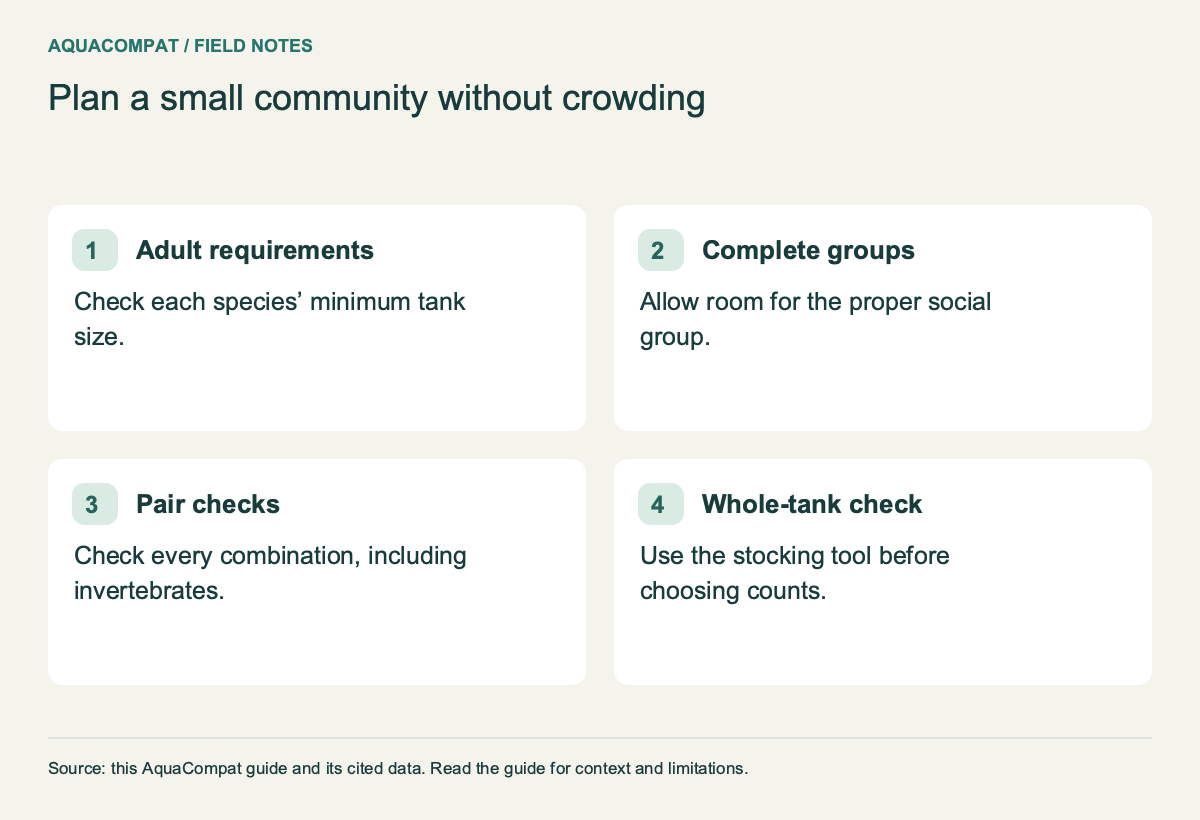
A species qualifies as a 10-gallon resident only if its published minimum tank is 10 US gal (38 L) or smaller. That single rule removes most popular community fish. Each species’ minimum comes from its care sources, usually the base footprint Seriously Fish recommends, converted to US gallons and rounded. A 10-gallon tank that holds only qualifying species keeps every fish inside its own published space requirement, before tank mates are even considered.
The table below applies that rule to every species we cover. The first column is the species’ own minimum; it is not the size needed for a mixed group, which is often larger. Profiles such as the guppy care guide and the cherry shrimp profile explain where each figure comes from.
| Species | Minimum tank | Group minimum | 10-gallon resident? |
|---|---|---|---|
| Cherry Shrimp | 5 US gal (19 L) | 10 | Yes |
| Mystery Snail | 5 US gal (19 L) | 1 | Yes |
| Nerite Snail | 5 US gal (19 L) | 1 | Yes |
| Guppy | 10 US gal (38 L) | 5 | Yes |
| Endler's Livebearer | 10 US gal (38 L) | 3 | Yes |
| Amano Shrimp | 10 US gal (38 L) | 1 | Yes |
| Betta Fish | 10 US gal (38 L) | 1 | Yes, but alone (see below) |
| Platy | 14 US gal (53 L) | 3 | No |
| Neon Tetra | 15 US gal (57 L) | 8 | No |
| Cardinal Tetra | 15 US gal (57 L) | 8 | No |
| Harlequin Rasbora | 15 US gal (57 L) | 8 | No |
| Kuhli Loach | 15 US gal (57 L) | 5 | No |
| Dwarf Gourami | 15 US gal (57 L) | 1 | No |
| Corydoras | 20 US gal (76 L) | 6 | No |
| Zebra Danio | 20 US gal (76 L) | 8 | No |
| GloFish Tetra | 20 US gal (76 L) | 6 | No |
| Molly | 20 US gal (76 L) | 3 | No |
| Bristlenose Pleco | 20 US gal (76 L) | 1 | No |
| Goldfish | 48 US gal (182 L) | 1 | No |
| Angelfish | 53 US gal (201 L) | 1 | No |
| Discus | 67 US gal (254 L) | 6 | No |
| Oscar | 75 US gal (284 L) | 1 | No |
Why don’t neon tetras, platies and corydoras make the list?
Neon tetras, platies and corydoras miss the cut because their published minimums are all above 10 gallons. The neon tetra needs 15 US gal (57 L): Seriously Fish bases that on a 60 × 30 cm footprint, and FishBase also gives a 60 cm minimum length. A standard 10-gallon tank such as the Tetra kit measures 20 x 10 x 12 in (W x D x H), so its length falls short of that footprint. The neon tetra profile covers the species in a tank that does fit.
The platy is the closest miss at 14 US gal (53 L), from the same 60 × 30 cm Seriously Fish footprint; Aquarium Co-Op is looser and suggests 10 to 20 gallons or larger. Corydoras need 20 US gal (76 L) and a group of at least 6, so a school of them alone would fill a 10-gallon floor; the corydoras water parameters and care page shows the full figures. The harlequin rasbora water parameters page explains why that species, at 15 US gal (57 L) with a group of 8, also belongs in a larger tank.
Does a betta count as a 10-gallon community fish?
A betta qualifies for a 10-gallon tank on its own, but not as part of a community by our calculation. Its own minimum is 10 US gal (38 L), yet the betta is the one qualifying species rated semi-aggressive. Our pair method multiplies the larger minimum by 1.5 whenever a semi-aggressive species is involved, then rounds up to the next standard tank, so every betta pairing in the matrix lands above 10 gallons. Betta with a nerite snail, for example, is rated caution but sized at 20 US gal (76 L).
Fish tank mates add further risk. Betta with guppies is caution, because males may attack long-finned fish, and betta with Endler’s livebearers is incompatible, because an endler is small enough to be eaten. The detail is on the betta and guppy pairing page. In a 10-gallon tank, a betta is best treated as a single-species display.
Can guppies, a nerite snail and a mystery snail share 10 gallons?
Yes: guppies, one nerite snail and one mystery snail form the strongest 10-gallon community, because all three pairs are rated compatible. Guppy with nerite is compatible at 10/10, guppy with mystery snail is compatible at 10/10, and the two snails together are compatible. Every pair is sized at no more than 10 US gal (38 L).
- Guppies: a group of 5, the FishBase minimum. Aquarium Co-Op advises about one male to two or three females so no single female is chased constantly.
- Nerite snail: 1. Shrimp and Snail Breeder suggests about one nerite per 5 gallons, and nerite eggs do not hatch in freshwater, so the snail cannot overrun the tank.
- Mystery snail: 1. Aquarium Co-Op notes that a single snail prevents breeding.
The water has to suit the hardest-water member. The figure below shows that all three share a band of temperature, pH and hardness; the snails want mineral-rich water, which suits guppies at 8–30 dGH. The limit on this stocking is the guppies themselves: Aquarium Co-Op says females give birth about every 30 days, so the group will grow. The guppy breeding guide covers how to manage fry before numbers outgrow the tank.
Does an Endler’s livebearer group work with amano shrimp and a nerite?
Endler’s livebearers, amano shrimp and a nerite snail can work, but this is a caution stocking that needs hard, stable water. Endler with nerite is compatible, amano with nerite is compatible, and endler with amano is caution at 7/10. The caution comes from shrimp predation: Shrimp and Snail Breeder reports that endlers hunt shrimp fry. That matters little here, because Aquarium Co-Op states that amano shrimp cannot reproduce in freshwater, so there are no amano young for the endlers to eat.
- Endler’s livebearers: a group of 3, kept as one male to two or three females according to Seriously Fish and Aquarium Co-Op.
- Amano shrimp: no group needed; Aquarium Co-Op says they can be kept singly. Shrimp and Snail Breeder suggests roughly one per 2 gallons as an upper guide.
- Nerite snail: 1.
The real constraint is hardness. Endlers need 15–25 dGH, while the nerite’s range is 10–15 dGH, so the shared band is only 15–15 dGH. Endler with amano shares 15–15 dGH. In practice that means holding hardness at the top of the invertebrates’ ranges, which the figure shows. If your tap water is soft, the guppy stocking above is the easier choice. The Endler’s livebearer profile lists the full ranges.
Is a shrimp and snail tank a good 10-gallon community?
A cherry shrimp colony with a mystery snail and amano shrimp is the most tolerant 10-gallon community in the fact base, with every pair rated compatible. Cherry shrimp with mystery snail is compatible at 10/10, cherry shrimp with amano is compatible, and amano with mystery snail is compatible.
- Cherry shrimp: start with at least 10, as Aquarium Co-Op and Shrimp and Snail Breeder both advise, so both sexes are present.
- Mystery snail: 1.
- Amano shrimp: optional. Aquarium Co-Op warns amanos are bold feeders that can outcompete slower dwarf shrimp if kept in large numbers.
Adding amanos narrows the shared pH, because Shrimp Science gives amanos pH 6.0–7.5 while the mystery snail needs pH 7.2–8.0. Without amanos, cherry shrimp and the mystery snail share pH 7.2–8.0. Cherry shrimp breed in the tank, which is the point of this stocking: Shrimp and Snail Breeder says guppies make shrimp breeding almost impossible, so adding guppies would turn caution into a colony that stops growing.
Why not keep guppies and Endler’s livebearers together?
Guppies and Endler’s livebearers should not share a tank, even though the pair scores 10/10 on water, size and temperament. The score cannot see breeding: Seriously Fish records that the two species cross and produce fertile hybrids, and Practical Fishkeeping reports that most Endler’s in the hobby are already guppy hybrids. A 10-gallon tank holding both would soon contain only hybrids. Pick one livebearer per tank; the guppy vs Endler’s livebearer comparison sets out the differences.
How many animals can a 10-gallon community hold?
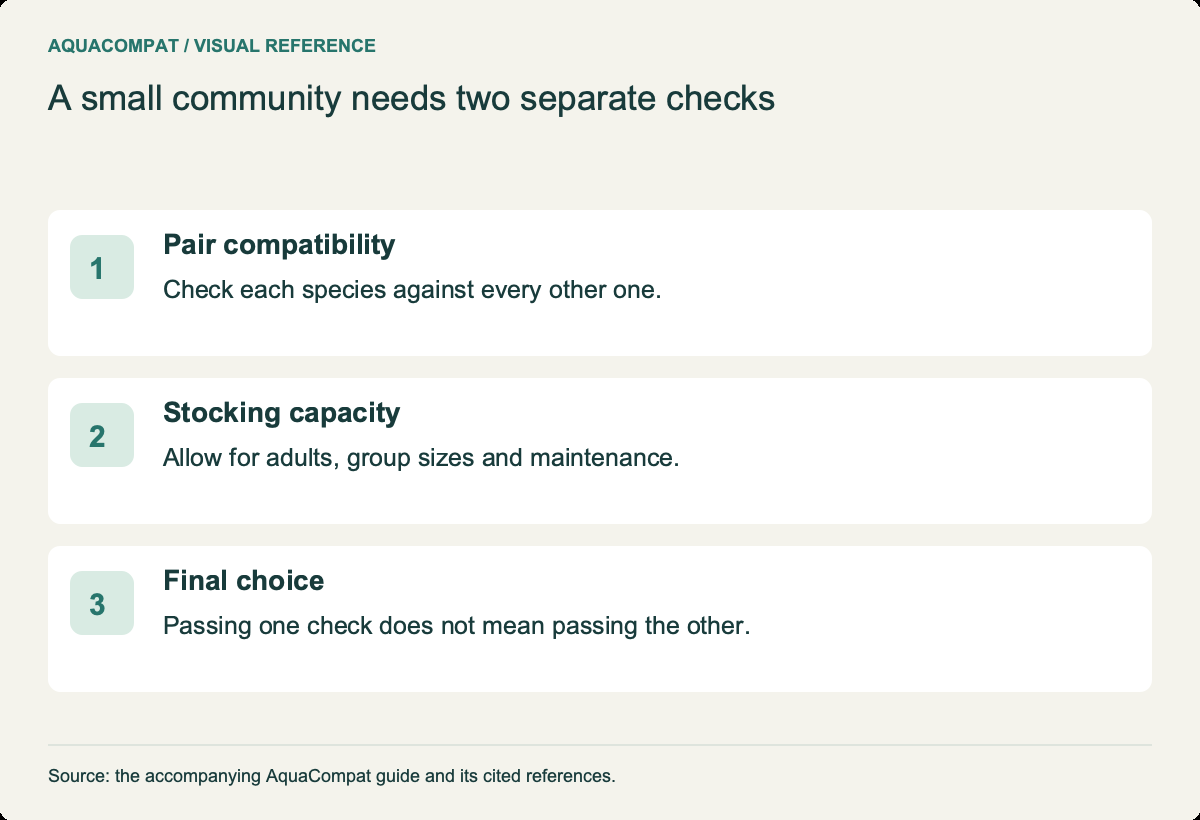
This page gives only the minimum group for each species, not a maximum total, because the safe total depends on filtration, feeding and maintenance. Use the bioload calculator to check a full list against tank volume and filter capacity before buying. Livebearer stockings need extra headroom: Aquarium Co-Op allows a guppy trio in 5 gallons short term but prefers 10 to 20 gallons because numbers grow, and it describes Endler’s broods arriving every 23 to 30 days.
Water changes carry more weight in a small volume. Practical Fishkeeping puts routine changes at about 25 % weekly, and Practical Fishkeeping and Aquarium Co-Op suggest keeping nitrate below about 40 ppm. In 10 gallons, a missed week moves those numbers faster than in a larger tank.
What equipment does a 10-gallon community tank need?
A 10-gallon community needs a filter rated for the volume, a small heater and a liquid test kit, in addition to the tank. The Tetra 10-gallon kit includes a Tetra Whisper PF10 Power Filter with Medium Bio-Bag cartridge, but Tetra does not list a heater among the kit contents. Aquarium Co-Op’s sizing rule of about 5 W/gal points to a 50 W unit for 10 gallons; the heater sizing guide by tank size works through the numbers.
Filtration is the item most often upgraded. The AquaClear 20 is rated for 5–20 US gal with 100 US gal/h of flow and adjustable output, which helps when long-finned guppies share the tank. The 10-gallon filter comparison sets it against sponge and internal options. Finally, a liquid test kit such as the API Freshwater Master Test Kit reads ammonia, nitrite and nitrate, the three numbers that tell you the tank is cycled.
Which products fit a 10-gallon community tank?
Each item was chosen for a 10-gallon tank from its published specifications. None was tested by AquaCompat; the notes explain what the specifications suggest.
As an Amazon Associate I earn from qualifying purchases. Prices change often, so they are not shown here; the button opens the current listing.

Tetra Complete LED Aquarium Kit 10 Gal
- Volume
- 10 US gal
- Size
- 20 x 10 x 12 in (W x D x H)
- Filter
- Tetra Whisper PF10 Power Filter with Medium Bio-Bag cartridge
- Light
- white LEDs in low-profile hinged hood
Fits: a first 10-gallon community where you want the tank, lid, LED light and a starter filter in one box.
Skip it if: you expect a complete setup; the listed contents include no heater, so tropical species need one added.
Check price on Amazon
Fluval AquaClear 20
- Rated tank
- 5–20 US gal
- Max flow
- 100 US gal/h
- Stages
- 4 (2 x mechanical, chemical, biological)
- Power (120 V)
- 7 W
Fits: a 10-gallon tank that needs more media room than a kit filter, with adjustable flow for guppies and endlers.
Skip it if: you keep a shrimp colony and do not plan to cover the intake; the published specs include no intake guard.
Check price on Amazon
Hydor Theo 50 W
- Power
- 50 W
- Rated tank
- 20–50 L / 5–14 US gal
- Protection
- PTC self-limiting; stops automatically on abnormal operation or dry running
- Length
- 7 in
Fits: a 10-gallon tank, sitting inside its rated range, and short enough to mount vertically or horizontally in a standard 10-gallon kit tank.
Skip it if: you want a digital readout; it uses a graduated scale, so pair it with a thermometer.
Check price on Amazon
API Freshwater Master Test Kit
- Tests
- pH, high range pH, ammonia, nitrite, nitrate
- Method
- liquid reagent
- Tests per kit
- 800 tests
Fits: cycling a new 10-gallon tank and checking ammonia, nitrite, nitrate and pH every week after.
Skip it if: you need GH or KH readings for shrimp or snails; those parameters are not in the listed tests.
Check price on AmazonHow long should a new 10-gallon tank run before stocking?
A new 10-gallon tank should run until its filter is cycled, which published sources put at several weeks. Practical Fishkeeping says most aquariums take 4–6 weeks, and UF/IFAS gives 6–8 weeks for a biofilter to build up. The tank is ready when a full ammonia dose is converted to nitrate within 24 hours with no detectable nitrite, the criterion Dr Tim’s Aquatics and Practical Fishkeeping describe. The fishless cycling method explains how to get there without fish in the tank, which matters most for shrimp, since every stocking above includes invertebrates.
Is any small fish suitable for a 10-gallon tank?
No. Adult size alone does not decide whether a fish suits 10 gallons. The neon tetra grows to only 1.2 in (3 cm), smaller than a guppy at 2.4 in (6.1 cm), yet it needs a larger tank because it is a schooling fish that swims the length of the aquarium in a group of 8 or more. The minimum tank in each fact file reflects swimming space and group size, not just body length. For more choices once the tank grows, the beginner aquarium fish list and the tank setups by size hub cover larger setups.
Setups for other tank sizes are gathered on the tank setups by size page.
Questions people ask
Can I keep neon tetras in a 10-gallon tank?
Not by our rule. Seriously Fish’s footprint puts the neon tetra minimum at 15 US gal (57 L), and the Tetra 10-gallon kit is only 20 x 10 x 12 in (W x D x H). Neons need a group of at least 8, so a 10-gallon tank leaves the school little length to swim. A 20-gallon long tank is a better fit.
Can a betta live with shrimp in 10 gallons?
The pairing is rated caution and sized at 20 US gal (76 L), above 10 gallons. Shrimp and Snail Breeder calls bettas hunters of small invertebrates and does not recommend them with cherry shrimp. A nerite snail is the safer companion, though our method still sizes that pair above 10 gallons.
How many guppies fit in a 10-gallon tank?
Start with the FishBase minimum group of 5, weighted toward females at about one male per two or three, as Aquarium Co-Op advises. The total that fits long term depends on filtration and fry, so check the final list with the stocking calculator; Aquarium Co-Op notes guppy females give birth about every 30 days.
Do I need a heater for a 10-gallon guppy tank?
Usually yes. Guppies take 68–82 °F (20–28 °C), and the Tetra kit lists no heater among its contents. A heater such as the 50 W Hydor Theo is rated for 20–50 L / 5–14 US gal, which covers a 10-gallon tank in a normally heated room.
Are platies a good choice for a 10-gallon community?
Platies narrowly miss: their minimum is 14 US gal (53 L), based on Seriously Fish’s 60 × 30 cm footprint. Aquarium Co-Op allows 10 to 20 gallons or larger, so sources differ, but platies also breed quickly. Our stockings keep to guppies or Endler’s livebearers, which list 10 US gal (38 L).
Sources 87 documents from 24 publishers
- Amazon (amazon.com): “Hydor Theo Shatterproof Aquarium Heater, 50-Watt (B00061UQ6G)”; “Tetra LED 10 Gallon Complete Fish Tank Kit”; “API Freshwater Master Test Kit 800-Test”
- API Fishcare (apifishcare.com): “API Freshwater Master Test Kit”
- Applesnail.net (applesnail.net): “How to take care of apple snails”; “Quick guide”; “Pomacea diffusa”
- Aquarium Co-Op (aquariumcoop.com): “Guppy Care Guide”; “Care Guide for Cherry Shrimp”; “Care Guide for Mystery Snails”; “Care Guide for Nerite Snails”; “Endler's Livebearer Care Guide”; “Care Guide for Amano Shrimp”; “Betta Fish Care Guide”; “Care Guide for Platy Fish: Feeding, Breeding, and Tank Mates”; “Neon and Cardinal Tetras: Beginner Schooling Fish”; “Care Guide for Cardinal Tetras”; “Care Guide for Harlequin Rasboras and Lambchop Rasboras”; “Care Guide for Kuhli Loaches”; “Care Guide for Dwarf Gouramis”; “Care Guide for Cory Catfish”; “Care Guide for Zebra and Leopard Danios”; “Care Guide for GloFish”; “Care Guide for Mollies: Feeding, Breeding, and Tank Mates”; “Care Guide for Plecostomus”; “Care Guide for Fancy Goldfish”; “Freshwater Angelfish Care Guide”; “Discus Fish Care Guide”; “Oscar Fish Care Guide”; “Guide to Aquarium Water Changes”; “How to Choose the Right Aquarium Heater”
- AquariumInfo.org (aquariuminfo.org): “Apple Snail”
- Dr Tim's Aquatics (manufacturer) (drtimsaquatics.com): “Fishless Cycling”
- FishBase (fishbase.se): “Poecilia reticulata, Guppy: species summary”; “Xiphophorus maculatus, Southern platyfish: species summary”; “Paracheirodon innesi summary page”; “Trigonostigma heteromorpha summary page”; “Betta splendens, Siamese fighting fish: species summary”; “Poecilia wingei, Endlers guppy: species summary”
- fishkeeping.co.uk (fishkeeping.co.uk): “Goldfish Size, Life Expectancy and Tank Recommendations”; “Keeping Goldfish - The Right Way”
- Fluval (Rolf C. Hagen) (fluvalaquatics.com): “AC20 Power Filter, 5-20 US Gal / 18-76 L”
- Gardensite (retailer) (gardensite.co.uk): “Hydor Theo 50W Aquarium Heater”
- GloFish (Spectrum Brands) (glofish.com): “GloFish FAQs”
- Hydor (hydor.com): “THEO”
- Maidenhead Aquatics (fishkeeper.co.uk species data sheet) (fishkeeper.co.uk): “Zebra Nerite Snail”; “Guppy data sheet”
- Neotropical Ichthyology (Crampton 2008) (scielo.br): “Ecology and life history of an Amazon floodplain cichlid: the discus fish Symphysodon”
- Ornamental Aquatic Trade Association (OATA) (ornamentalfish.org): “How to look after goldfish in an aquarium / fish tank”; “How to look after fancy goldfish”
- PlanetCatfish (via Internet Archive snapshot, 2025) (web.archive.org): “Osteogaster aenea (Bronze Cory) Cat-eLog data sheet”
- Practical Fishkeeping (practicalfishkeeping.co.uk): “Frequently asked questions on Neocaridina shrimps”; “A guide to the small rasboras from the genus Trigonostigma”; “Bristlenose catfish: the hardworking Ancistrus”; “Quick guide to livebearers”; “Amano shrimp: Spineless heroes (Nathan Hill)”; “How often should I change my water?”; “How to Cycle a Fish Tank: The Complete Guide”
- Seriously Fish (seriouslyfish.com): “Poecilia reticulata”; “Poecilia wingei”; “Betta splendens”; “Xiphophorus maculatus”; “Paracheirodon innesi (Neon Tetra)”; “Paracheirodon axelrodi (Cardinal Tetra)”; “Trigonostigma heteromorpha (Harlequin)”; “Pangio semicincta ('Kuhli' Loach)”; “Trichogaster lalius”; “Osteogaster aenea (Bronze Cory)”; “Danio rerio (Zebra Danio)”; “Gymnocorymbus ternetzi (Black Widow Tetra)”; “Poecilia sphenops”; “Poecilia latipinna”; “Ancistrus sp. '3' (Common Bristlenose Catfish)”; “Pterophyllum scalare”; “Symphysodon aequifasciatus”; “Astronotus ocellatus”
- Shrimp and Snail Breeder (aquariumbreeder.com): “Red Cherry Shrimp: detailed guide, care, diet and breeding”; “Nerite Snails: detailed guide, care, diet and breeding”; “Amano Shrimp: detailed guide, care, diet and breeding”; “Cherry Shrimp in a Community Tank”
- Shrimp Science (shrimpscience.com): “Red Cherry Shrimp - Care Guide”; “Amano Shrimp”; “General Hardness (GH) For Shrimp Tanks”
- Tetra (tetra-fish.com): “Complete LED Aquarium Kit 10 Gal”
- UF/IFAS EDIS (ask.ifas.ufl.edu): “Evolution, Culture, and Care for Betta splendens (FA212)”
- University of Florida IFAS Extension (EDIS) (ask.ifas.ufl.edu): “Ammonia in Aquatic Systems (FA16/FA031), Francis-Floyd, Watson, Petty and Pouder”
- Wikipedia (en.wikipedia.org): “Vittina natalensis”
All sources accessed . Every number on this page comes from these documents.