How does tank size decide which fish you can keep?
Tank size decides which fish you can keep through each species' minimum tank: the smallest tank suited to a proper group of that species kept on its own, given in US gallons with litres. For many small fish that minimum comes from a footprint rather than a volume. Seriously Fish lists a 60 × 30 cm base for neon tetras, for example, which works out to 15 US gal (57 L). A fish that swims the length of the tank in a school needs that length, whatever its body size.
A tank setup page starts from one tank size and works the other way: it lists every species whose minimum fits, then checks the candidates pair by pair. The 10-gallon community tank guide applies that filter to the smallest common tank, and the 20-gallon planted tank guide applies it to a planted tank twice the volume. Both use the same species fact files as the pair pages, so a minimum tank figure is identical wherever it appears.
The table below groups the species in the fact base by their published minimum tank, from the smallest to the largest.
| Published minimum | Species | What it means for a setup |
|---|---|---|
| 5 US gal (19 L) | Cherry Shrimp, Nerite Snail, Mystery Snail, Assassin Snail | Invertebrates that fit any setup on this site |
| 10 US gal (38 L) | Guppy, Endler's Livebearer, Betta Fish, Amano Shrimp, Chili Rasbora, Galaxy Rasbora, Crystal Red Shrimp | The ceiling for a 10-gallon tank |
| 14 US gal (53 L) to 15 US gal (57 L) | Platy, Neon Tetra, Cardinal Tetra, Harlequin Rasbora, Kuhli Loach, Dwarf Gourami | Too large for 10 gallons; fit a 20-gallon tank |
| 20 US gal (76 L) | Corydoras, Bristlenose Pleco, Molly, Zebra Danio, GloFish Tetra | The ceiling for a 20-gallon tank |
| 40 US gal (151 L) and above | Yellow Lab, Goldfish, Angelfish, Peacock Cichlid, Kenyi Cichlid, Discus, Oscar | Need a large tank planned around them |
What fits in a 10-gallon community tank?
A 10-gallon community tank fits only the species whose published minimum is 10 US gal (38 L) or less, which leaves guppies, Endler's livebearers and the betta among fish, plus dwarf shrimp and snails. Popular schooling fish such as the neon tetra, at 15 US gal (57 L), and the corydoras, at 20 US gal (76 L), do not qualify.
From that short list, a guppy group with a nerite snail and a mystery snail is the strongest combination, because every pair in it scores well. Guppy with nerite snail is rated compatible at 10/10, guppy with mystery snail compatible at 10/10, and the two snails together compatible. A guppy group should be at least 5 fish, the FishBase minimum.
The betta is the awkward case. It fits a 10-gallon tank alone, at 10 US gal (38 L), but it is rated semi-aggressive, and its pairings are sized larger than its own minimum. Betta with a nerite snail is caution, yet the smallest tank listed for the pair is 20 US gal (76 L). The betta tank mates guide ranks every companion with its own tank size.
What changes in a 20-gallon planted tank?
A 20-gallon planted tank opens up the small schooling fish and bottom dwellers that a 10-gallon tank cannot hold, and the plants give shy species cover. Every species in the table with a minimum up to 20 US gal (76 L) becomes a candidate, including neon tetras, harlequin rasboras, kuhli loaches and corydoras.
Several of those species pair well together. Corydoras with neon tetras is rated compatible at 10/10, corydoras with harlequin rasboras compatible at 10/10, and harlequins with kuhli loaches compatible at 10/10. They split the tank by level: the tetras and rasboras in mid-water, the corydoras and kuhli loaches on the bottom. Group sizes still add up fast, with corydoras at 6 or more and neon tetras at 8 or more.
What does the planted part add?
The planted part adds a substrate, a light and a lighting routine. Aquarium Co-Op advises at least 2–3 in of substrate, and Tropica suggests starting at 6 hours/day of light for the first weeks before raising it to 8–10 hours/day. Aquarium Co-Op defines a low-tech tank as one with low lighting, no added CO2 and minimal weekly fertilising, and puts low light at 10–20 PAR, enough for anubias and cryptocorynes. The step-by-step planted tank setup covers the build, and the low-tech planted tank guide covers running one without CO2.
What equipment does every tank size need?
Every tank size needs a filter rated for its volume, a heater sized to it for tropical fish, a liquid test kit and a water conditioner. The amounts scale with volume, but the list does not change between a 10-gallon and a 20-gallon tank.
- Heater: Aquarium Co-Op sizes heaters at about 5 W/gal for a 10 °F rise in a lidded tank, while All Pond Solutions uses 1 W/L in a heated room. The heaters matched to tank size page applies both rules to common tank volumes.
- Filter: a filter rated at or above the tank's volume. Sponge filters suit shrimp and fry tanks because they cannot pull in small animals; the sponge filter comparison lists rated tank sizes.
- Test kit: a liquid kit for ammonia, nitrite, nitrate and pH, used throughout cycling and after any problem.
- Lighting and substrate: only where plants are part of the plan. The planted tank light guide and the planted substrate comparison cover the 20-gallon planted build.
Any new tank also needs time before fish go in. Practical Fishkeeping says most aquariums take 4–6 weeks to cycle, and UF/IFAS gives 6–8 weeks for a biofilter to build up. The fishless cycling method gets a tank there without exposing fish to ammonia.
Is a smaller tank easier to look after?
No. A smaller tank is cheaper to buy but not easier to keep, because the same mistake moves the water chemistry further in a small volume. The Merck Veterinary Manual says small aquariums need more frequent, larger water changes, perhaps up to 50 % per week (up to), while Practical Fishkeeping puts a routine change for most tanks at about 25 % weekly. Waste, a missed feeding cut or a failed heater has less water to dilute it in a 10-gallon tank than in a 20-gallon one.
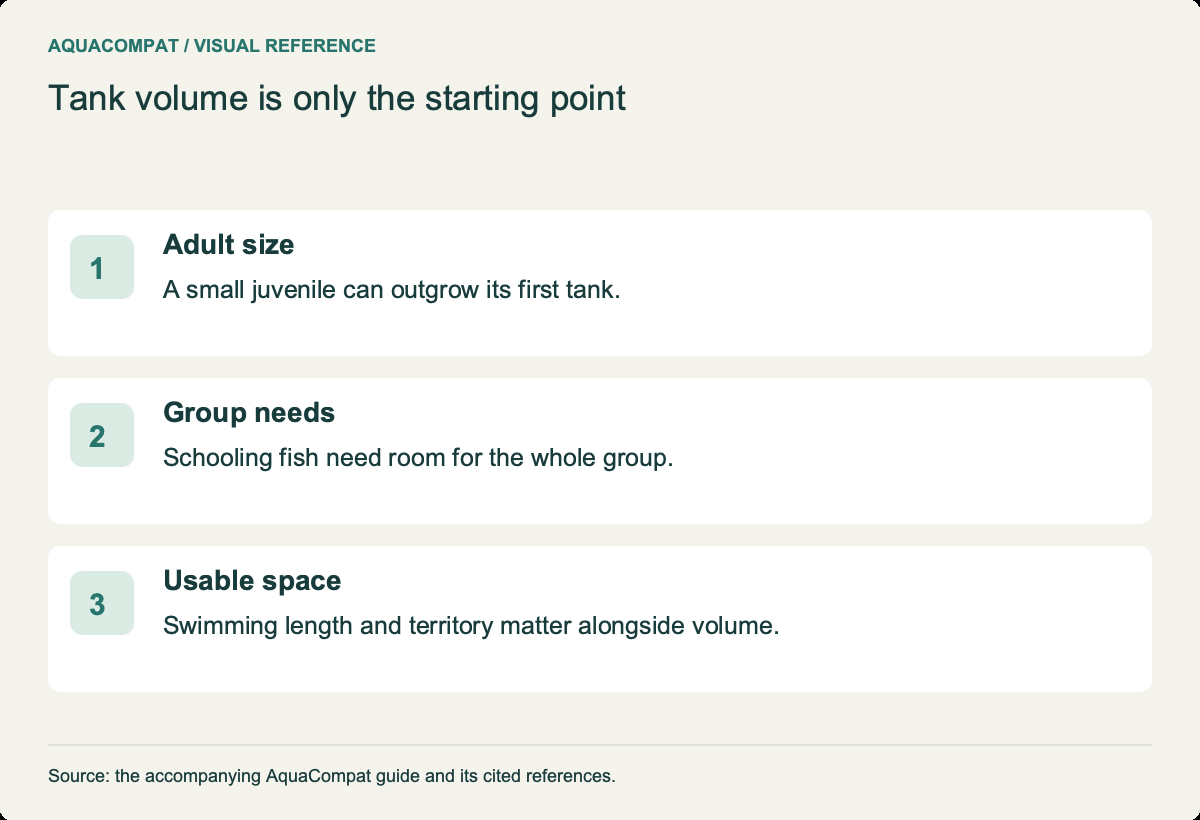
The other half of the myth is that a small fish suits a small tank. The neon tetra grows to only 1.2 in (3 cm), smaller than a guppy at 2.4 in (6.1 cm), yet it needs 15 US gal (57 L) against the guppy's 10 US gal (38 L), because it lives in a school that needs swimming length. The aquarium maintenance schedule sets out water changes for each tank size.
When does a tank-size setup not fit your fish?
A tank-size setup does not fit when one species in the plan needs far more room than the rest, or when a pairing needs more space than either species alone. In both cases the tank, not the species list, is what has to change.
- Large or coldwater species. The goldfish needs 48 US gal (182 L) and grows to 10 in (25.4 cm), so no 10 or 20-gallon setup suits it; the goldfish tank mates page covers tanks built around it. The oscar, at 75 US gal (284 L), is in the same position.
- A semi-aggressive species in a mixed tank. Betta with corydoras is rated caution, but the smallest tank listed for the pair is 40 US gal (151 L), double the corydoras' own minimum. The reasoning is set out under how pair tank sizes are worked out.
- Shrimp with schooling fish. Cherry shrimp with neon tetras is rated caution at 7/10. A 20-gallon planted tank gives the shrimp more cover, but Aquarium Co-Op notes that almost all fish eat baby shrimp, so the colony grows more slowly.
- Too many schools. Each schooling species brings its full minimum group. Two schools plus a group of corydoras can outgrow a 20-gallon tank even when every pair is rated well.
How do you plan a tank by size?
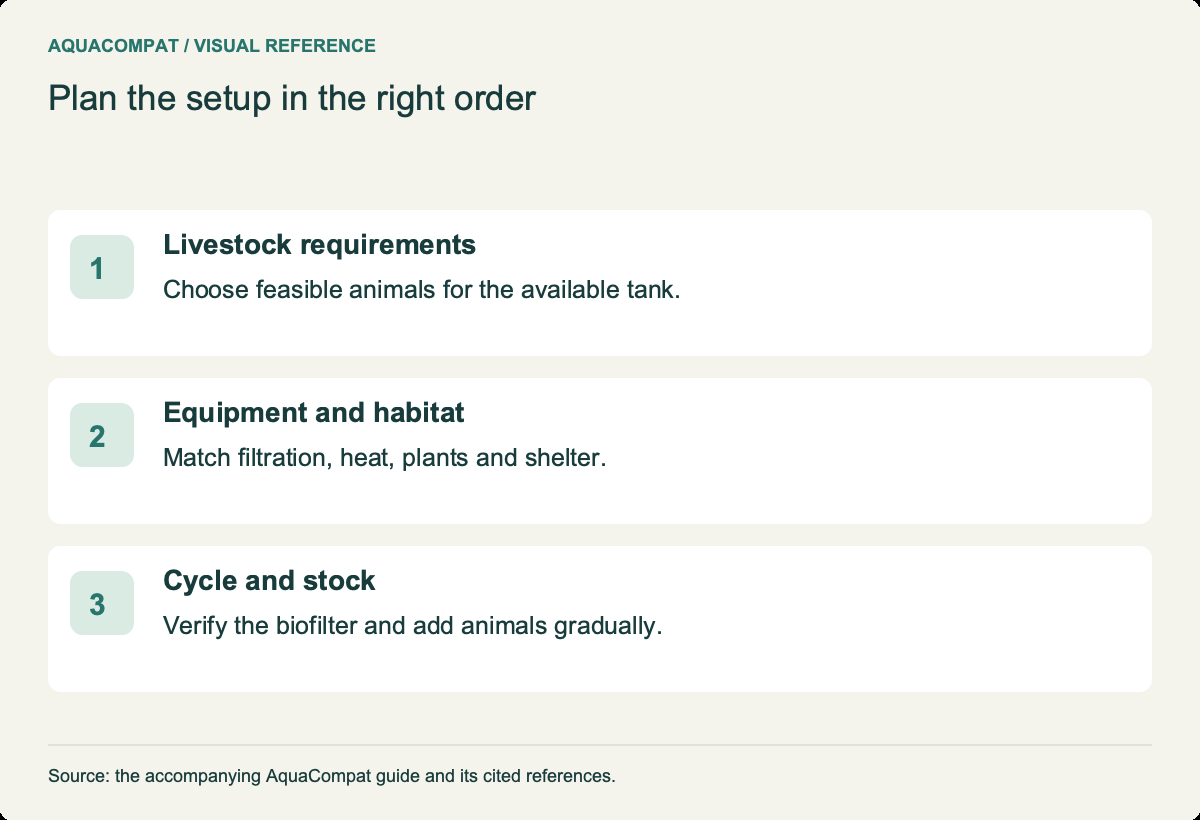
Plan a tank by size by fixing the tank first, then filtering species, then checking pairs and totals. The steps below follow the same order as the setup pages.
- Pick the tank you can house. Measure the stand and room; the footprint matters as much as the volume.
- List the species whose minimum fits. Use the table above; anything with a larger minimum is out.
- Check each pair. The fish compatibility checker guide scores any two species and shows the smallest tank for that pair.
- Check the whole list. The stocking calculator for a full tank adds up group sizes and flags any species whose minimum tank or group size is not met.
- Cycle before stocking. Run the filter until ammonia and nitrite read zero, as the nitrogen cycle explainer describes.
Which tank setups are available?
Questions people ask
What is the smallest tank for a community of fish?
Can I keep a betta in a 10-gallon community tank?
Is a 20-gallon tank enough for neon tetras and corydoras together?
Do I need a heater in a small tank?
Why are larger tank setups not listed yet?
Sources 85 documents from 17 publishers
- All Pond Solutions (allpondsolutions.co.uk): “Aquarium Heater Buying Guide”
- Applesnail.net (applesnail.net): “How to take care of apple snails”; “Quick guide”; “Pomacea diffusa”
- Aquarium Co-Op (aquariumcoop.com): “What Is Neon Tetra Disease and How Can It Be Prevented?”; “Neon and Cardinal Tetras: Beginner Schooling Fish”; “Top 5 Dither Fish to Help Shy or Aggressive Fish in Freshwater Tanks”; “Care Guide for Cherry Shrimp”; “Guppy Care Guide”; “Care Guide for Platy Fish: Feeding, Breeding, and Tank Mates”; “Care Guide for Cory Catfish”; “Care Guide for Nerite Snails”; “Care Guide for Mystery Snails”; “Betta Fish Care Guide”; “Care Guide for Harlequin Rasboras and Lambchop Rasboras”; “Care Guide for Kuhli Loaches”; “How to Set Up a Low Tech Planted Aquarium for Beginners”; “How to Balance Aquarium Lights to Grow Healthy Plants (& Avoid Algae)”; “CO2 in Planted Aquariums: What Does It Really Do and Is It Natural?”; “What is PAR? Lighting & Brightness Explained for Planted Tanks”; “Is Nitrate Good or Bad for Your Aquarium?”; “How to Use Root Tabs to Fertilize Your Live Aquarium Plants”; “Which Planted Tank Fertilizer Is Right for You?”; “Beginner's Guide to Fertilizing Your Planted Tank the EASY Way”; “Monte Carlo (plant care page)”; “How to Choose the Right Aquarium Heater”; “Guide to Aquarium Water Changes”; “Care Guide for Fancy Goldfish”; “Oscar Fish Care Guide”
- AquariumInfo.org (aquariuminfo.org): “Apple Snail”
- FishBase (fishbase.se): “Paracheirodon innesi summary page”; “Poecilia reticulata, Guppy: species summary”; “Xiphophorus maculatus, Southern platyfish: species summary”; “Length-weight relationships for Poecilia reticulata”; “Betta splendens, Siamese fighting fish: species summary”; “Osteogaster aenea, Bronze corydoras”; “Trigonostigma heteromorpha summary page”; “Carassius auratus, Goldfish: species summary”
- fishkeeping.co.uk (fishkeeping.co.uk): “Goldfish Size, Life Expectancy and Tank Recommendations”; “Keeping Goldfish - The Right Way”
- Maidenhead Aquatics (fishkeeper.co.uk species data sheet) (fishkeeper.co.uk): “Neon Tetra data sheet”; “Yellow Labidochromis data sheet”; “Guppy data sheet”; “Zebra Nerite Snail”; “Harlequin Rasbora data sheet”
- Merck Veterinary Manual (merckvetmanual.com): “Providing a Home for Fish (pet owner version)”; “Disorders and Diseases of Fish (pet owner version)”; “Special Considerations for Fish (pet owner version)”; “Routine Health Care of Fish (pet owner version)”
- Ornamental Aquatic Trade Association (OATA) (ornamentalfish.org): “How to look after goldfish in an aquarium / fish tank”; “How to look after fancy goldfish”
- PlanetCatfish (via Internet Archive snapshot, 2025) (web.archive.org): “Osteogaster aenea (Bronze Cory) Cat-eLog data sheet”
- Practical Fishkeeping (practicalfishkeeping.co.uk): “How long will my fish live?”; “Malawi's finest: The Yellow lab, Labidochromis caeruleus”; “What can I keep in my hard water aquarium?”; “A guide to the small rasboras from the genus Trigonostigma”; “How to Cycle a Fish Tank: The Complete Guide”; “How often should I change my water?”; “Frequently asked questions on Neocaridina shrimps”; “An introduction to Shrimp”
- Seriously Fish (seriouslyfish.com): “Paracheirodon innesi (Neon Tetra)”; “Poecilia reticulata”; “Xiphophorus maculatus”; “Osteogaster aenea (Bronze Cory)”; “Labidochromis caeruleus”; “Poecilia wingei”; “Betta splendens”; “Trigonostigma heteromorpha (Harlequin)”; “Pangio semicincta ('Kuhli' Loach)”; “Astronotus ocellatus”
- Shrimp and Snail Breeder (aquariumbreeder.com): “Cherry Shrimp in a Community Tank”; “Red Cherry Shrimp: detailed guide, care, diet and breeding”; “Nerite Snails: detailed guide, care, diet and breeding”; “How Copper Affects Dwarf Shrimp”
- Shrimp Science (shrimpscience.com): “Red Cherry Shrimp - Care Guide”; “General Hardness (GH) For Shrimp Tanks”; “Carbonate Hardness (KH) For Shrimp Tanks”; “TDS For Shrimp Tanks”
- Tropica Aquarium Plants (tropica.com): “Hardscape and bottom layer in the tank”; “Starting a new aquarium (growing-in guide)”; “Fertiliser and CO2 for your aquarium”; “Trimming”
- UF/IFAS EDIS (ask.ifas.ufl.edu): “Evolution, Culture, and Care for Betta splendens (FA212)”; “FA16: Ammonia in Aquatic Systems (Francis-Floyd, Watson, Petty, Pouder)”
- Wikipedia (en.wikipedia.org): “Vittina natalensis”
All sources accessed . Every number on this page comes from these documents.