What do you need before you start a fishless cycle?
You need a running tank, an ammonia source, a dechlorinator and a test kit that reads ammonia, nitrite, nitrate and pH. Fishless cycling is a way of starting the nitrogen cycle, the bacterial process that turns ammonia into nitrite and then nitrate, without putting fish through it; the nitrogen cycle guide explains each stage and why ammonia and nitrite are toxic. The list below sets out what each item does, in the order you will use it.
- Filter and heater, running. The bacteria colonise the filter, and SRAC Publication 4502 allows a modest temperature boost to speed them up.
- Water conditioner. Chlorine kills nitrifying bacteria, so the fill water must be treated first.
- Ammonia source. A measured ammonium chloride solution, or clear household ammonia dosed by calculation.
- Test kit. Ammonia, nitrite and nitrate readings tell you which stage the cycle has reached; pH and KH warn of a stall.
- Optional bacteria starter. A bottled culture that aims to shorten the cycle; see the section on bacteria starters below.
| Setting | Published figure | Source |
|---|---|---|
| Starting ammonia (hobby) | 2–3 mg/L ammonia-N | Dr Tim’s Aquatics; Practical Fishkeeping aims for 3 ppm |
| Starting ammonia (aquaculture) | 3–5 mg/L total ammonia | SRAC 4502 |
| Ammonia or nitrite ceiling | Below 5 mg/L (do not exceed) | Dr Tim’s Aquatics |
| Temperature boost | No more than 2–3 °C above operating temperature (max) | SRAC 4502 |
| Dissolved oxygen | Raise aeration below 5 mg/L dissolved oxygen (minimum) | UF/IFAS |
| Alkalinity | At least 100 mg/L as CaCO3 (minimum) | Merck Veterinary Manual |
| Completion test | Full dose cleared within 24 hours, no nitrite | Dr Tim’s Aquatics; Practical Fishkeeping |
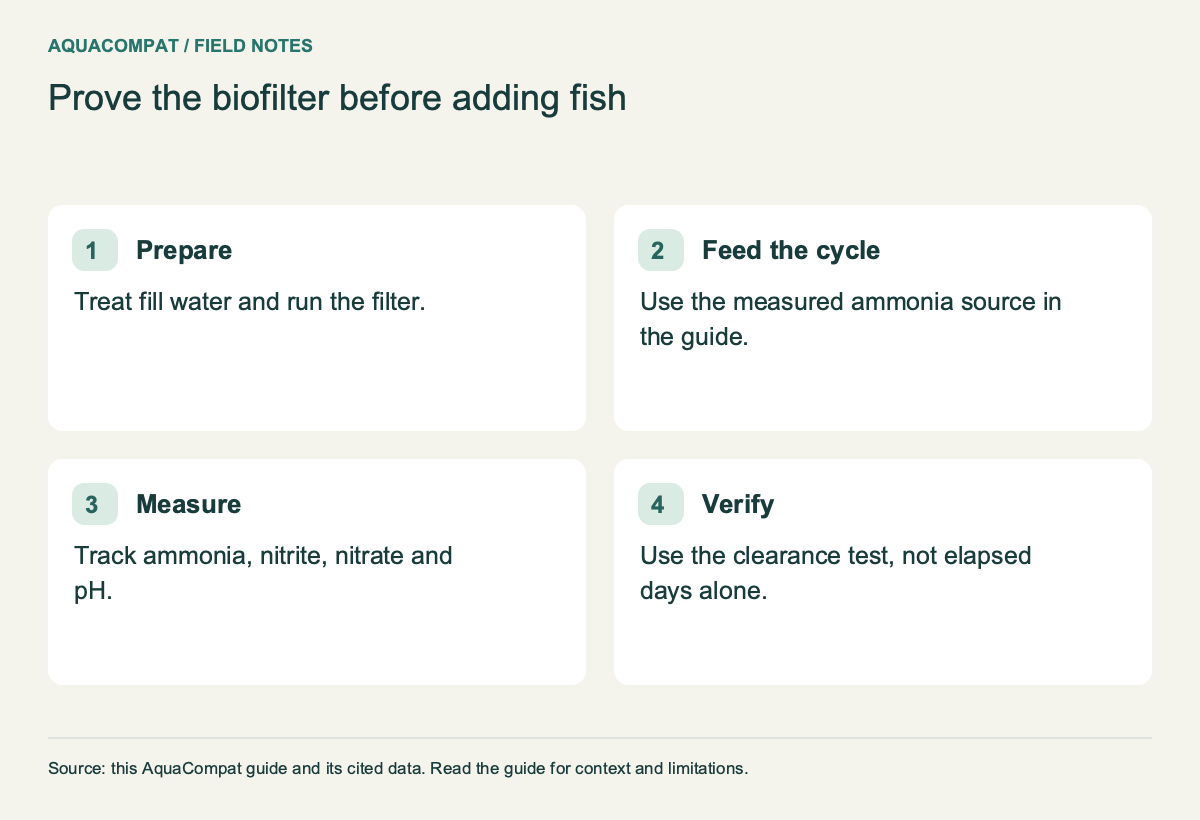
How do you cycle a tank without fish, step by step?
You cycle a tank without fish by dosing ammonia, testing as the bacteria convert it, and finishing with a 24-hour completion test. Each step below is drawn from the published sources in the table above.
- Fill and dechlorinate. Treat all fill water with a conditioner before anything else goes in; Practical Fishkeeping warns that tap water chlorine kills beneficial bacteria. The guide to treating tap water explains chloramine and why some conditioners also bind ammonia.
- Run the filter and set the temperature. Keep oxygen up: UF/IFAS advises more aeration if dissolved oxygen falls below 5 mg/L dissolved oxygen (minimum). A small temperature boost helps, but SRAC 4502 limits it to 2–3 °C above operating temperature (max) above the planned operating temperature.
- Check KH before dosing. Nitrifying bacteria consume alkalinity, and Merck recommends at least 100 mg/L as CaCO3 (minimum) for a healthy biofilter. In soft water, KH can run out during cycling and stall it.
- Dose ammonia to the target. Dr Tim’s Aquatics recommends 2–3 mg/L ammonia-N; its own solution is dosed at 4 drops per US gallon to reach about 2 ppm ammonia-nitrogen. SRAC 4502 gives 3–5 mg/L total ammonia for aquaculture biofilters, using clear 10% household ammonia at a rate of about 1.6 mg/L rise per 60 mL of 10% household ammonia in 3,785 L (1,000 gal).
- Test and watch the sequence. Ammonia falls first as the first group of bacteria establishes, then nitrite rises and falls, then nitrate appears. Keep both ammonia and nitrite below 5 mg/L (do not exceed), the level Dr Tim’s warns can inhibit nitrifiers.
- Run the completion test. Add a full dose and test 24 hours later. Dr Tim’s and Practical Fishkeeping both treat the cycle as complete when that dose is gone, converted to nitrate, with no detectable nitrite.
- Bring nitrate down, then stock gradually. A finished cycle leaves nitrate behind. Practical Fishkeeping and Aquarium Co-Op aim to keep it below about 40 ppm, so a water change before the first fish makes sense. Merck and UF/IFAS both recommend stocking gradually once the biofilter is established.
How do you know the cycle has worked?
The cycle has worked when a full ammonia dose disappears within 24 hours, nitrite reads zero and nitrate is rising. Reading zero ammonia on one day is not enough, because the nitrite stage can lag well behind. Practical Fishkeeping and Dr Tim’s use the same completion test, which makes it the clearest published standard.
Read the test results as a sequence across the weeks. Rising ammonia with no nitrite means the first group of bacteria has not yet established. Falling ammonia with rising nitrite means the first group is working and the second is lagging. Zero ammonia, zero nitrite and rising nitrate means both groups are working. Kits that cover all three readings are compared in the guide to the best aquarium test kits compared.
How long should it take?
Expect roughly a month to two months. Dr Tim’s gives 30–45 days without its bacterial product, Practical Fishkeeping says 4–6 weeks for most tanks, and UF/IFAS gives 6–8 weeks for a new biofilter to reach full capacity. The shorter figures describe passing the completion test; the longer ones describe a mature biofilter.
Do bacteria starters speed up a fishless cycle?
Bacteria starter makers say their products shorten the cycle, but no source in our fact base independently tests that claim or compares one starter with another. A bacteria starter is a bottled culture of nitrifying bacteria intended to seed a new filter. Fritz Aquatics describes FritzZyme 7 as containing live freshwater-specific nitrifying bacteria and claims it rapidly eliminates toxic ammonia and nitrite; seeds biofilters to shorten cycle time. Dr Tim’s Aquatics designs its ammonium chloride to be used with its own One & Only Nitrifying Bacteria, and its 30–45 days figure is specifically for cycling without that product.
Because those are manufacturer claims, this guide does not name a best bacteria starter. If you use one, the same completion test still applies: a full ammonia dose cleared within 24 hours with no nitrite. A starter that genuinely seeds the filter should reach that point sooner; one that does not will show it in the test results.
Which products are used in fishless cycling?
The three products below cover the ammonia source, the testing and an optional bacteria starter. They were chosen because their specifications match the steps above; none was tested by AquaCompat, and the notes rely on each maker’s published data.
As an Amazon Associate I earn from qualifying purchases. Prices change often, so they are not shown here; the button opens the current listing.

Dr. Tim’s Aquatics Ammonium Chloride
- Strength
- 40 mg/mL total ammonia-nitrogen (TAN)
- Dose
- 4 drops per US gallon to reach about 2 ppm ammonia-nitrogen
- Capacity
- 4 oz bottle cycles up to 200 US gal
- Bottle
- 4 fl oz
Fits: anyone who wants a known ammonia concentration instead of calculating a household ammonia dose; the drops-per-gallon dose lands at the low end of Dr Tim’s own 2–3 mg/L ammonia-N target.
Skip it if: you already have a measured, plain ammonia source and a reliable way to calculate the dose for your tank volume.
Check price on Amazon
API Freshwater Master Test Kit
- Tests
- pH, high range pH, ammonia, nitrite, nitrate
- Method
- liquid reagent
- Tests in kit
- 800 tests
Fits: tracking the whole cycle in one kit, since it reads ammonia, nitrite, nitrate and pH, the four readings the steps above depend on.
Skip it if: you need KH as well; the kit does not list a KH test, so soft-water tanks need a separate one.
Check price on Amazon
FritzZyme 7
- Contents
- live freshwater-specific nitrifying bacteria
- New-tank dose
- 4 fl oz per 10 US gal
- Storage
- buffered for stability without refrigeration
- Bottle
- 32 fl oz
Fits: owners who want to try seeding the filter and can store a bottle without refrigeration; the maker gives a separate new-system dose.
Skip it if: you expect it to replace testing; its cycle-shortening claim comes from the maker, and the completion test is still the only proof.
Check price on AmazonIs a tank cycled once ammonia reads zero?
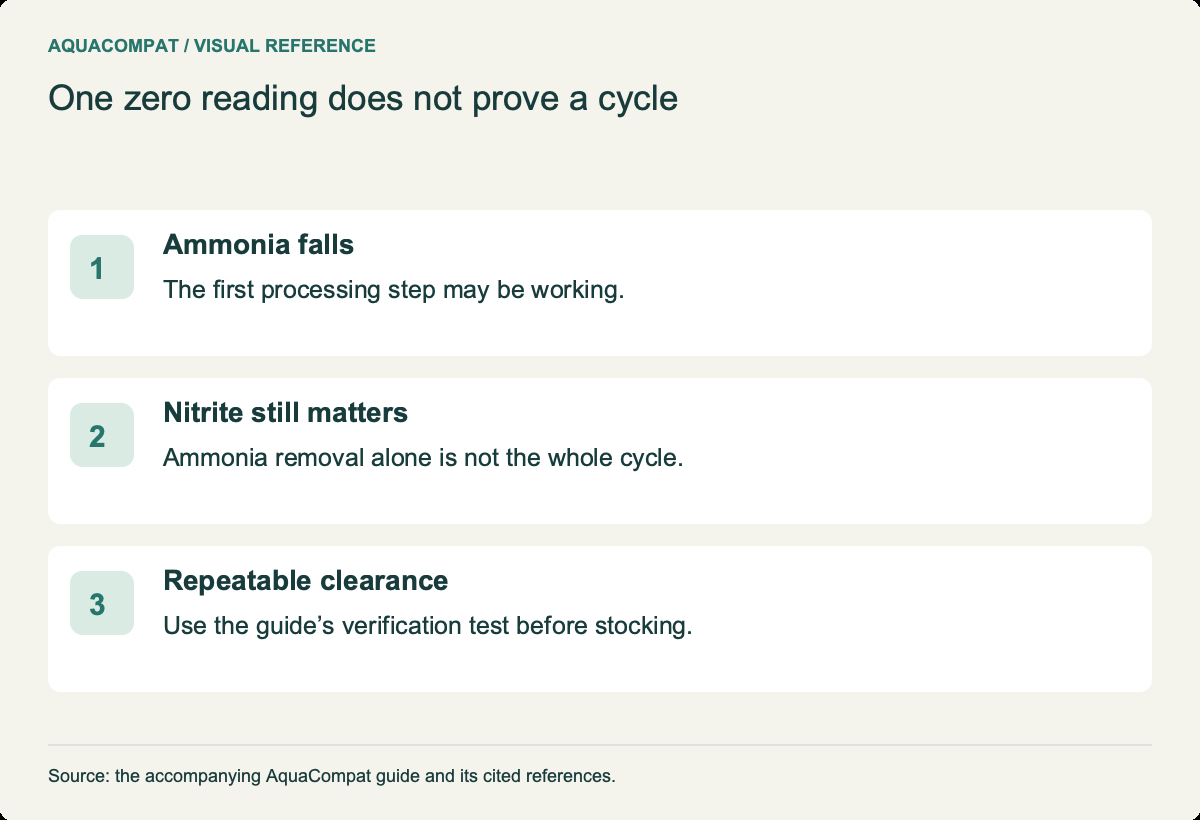
No. Zero ammonia shows only that the first group of bacteria is working. Nitrite-oxidizing bacteria establish later, and nitrite can be toxic from 0.1 mg/L nitrite, according to UF/IFAS and Merck. A tank is ready only when a full ammonia dose clears within 24 hours and nitrite also reads zero. Adding fish at the zero-ammonia stage risks the nitrite poisoning described under new tank syndrome.
A related mistake is reading cloudy water as a sign of failure. A white, milky haze in a cycling tank is usually a bacterial bloom, which Aquarium Co-Op and AquariumScience.org say normally clears in one to two weeks as the filter matures. Both advise against big water changes during the bloom; the guide to cloudy aquarium water explains how to tell a bloom from other causes.
Why does a fishless cycle stall?
A fishless cycle usually stalls because one of the bacteria’s needs is missing: buffer, a safe ammonia level, oxygen or chlorine-free water. Each cause below comes from the published sources.
pH crash from exhausted KH
Practical Fishkeeping links depleted KH during cycling to a pH crash below 6 pH (below), at which point bacterial activity stops. Testing KH and restoring it addresses the cause.
Too much ammonia
Overdosing can happen when ammonia is added by guesswork. Dr Tim’s warns that ammonia or nitrite above 5 mg/L (do not exceed) inhibits nitrifiers, so a partial water change to bring levels down restarts progress.
Chlorine or medication
Untreated top-up water or rinsing media under the tap kills bacteria. UF/IFAS also notes that disease treatments, especially antibiotics, can harm the biofilter.
Low oxygen
Nitrification needs oxygen, and UF/IFAS sets 5 mg/L dissolved oxygen (minimum) as the point to increase aeration.
What should you do after the cycle is complete?
After the cycle completes, lower nitrate with a water change, stock a few fish at a time and start a routine. Merck and UF/IFAS both recommend stocking gradually once the biofilter is established. From then on the fish supply the ammonia, excreted mainly through their gills, and the sources on cloudy water advise against overfeeding; the guide to the best fish food by species type helps match food to the species you add.
From here the job becomes keeping the cycle running: regular partial water changes to remove nitrate and replace KH, and filter cleaning in tank water rather than tap water. The aquarium maintenance schedule guide sets out that routine, and the other chemistry and setup topics are in the water chemistry and setup guides.
Questions people ask
How much household ammonia do I add for fishless cycling?
SRAC Publication 4502 gives a reference rate: clear 10% household ammonia at about 1.6 mg/L rise per 60 mL of 10% household ammonia in 3,785 L (1,000 gal). Scale that to your tank volume, dose less than you think you need, test, and top up toward the 2–3 mg/L ammonia-N hobby target. A measured ammonium chloride solution with a stated concentration avoids the calculation.
Can I speed up fishless cycling with heat?
A little. SRAC 4502 says raising temperature speeds nitrifier growth but limits the increase to 2–3 °C above operating temperature (max) above the planned operating temperature. Keep aeration up as well; UF/IFAS advises more aeration if dissolved oxygen falls below 5 mg/L dissolved oxygen (minimum).
Should I add plants during a fishless cycle?
The cycling sources in our fact base do not address plants directly. Planting guidance from Aquarium Co-Op notes that growing plants take up nitrate, and Tropica advises planting heavily from the start so fast growers use spare nutrients. Plants do not replace the completion test: the bacteria still need to clear a full ammonia dose within 24 hours.
What if nitrite stays high for weeks?
A long nitrite stage is common because the second group of bacteria establishes after the first. Check that nitrite is below the 5 mg/L (do not exceed) ceiling Dr Tim’s gives, that KH has not run out and that oxygen is high. If nitrite is above the ceiling, a partial water change brings it down so the bacteria can work.
Is fishless cycling safer than cycling with fish?
Yes, for the fish. A tank cycled with fish exposes them to ammonia and nitrite while the bacteria catch up, which is the cause of new tank syndrome. Ammonia damages gills above 0.05 mg/L un-ionized ammonia and nitrite can be toxic from 0.1 mg/L nitrite, so a fishless cycle keeps those levels away from livestock entirely.
Sources 45 documents from 15 publishers
- Amazon (amazon.com): “Dr. Tim's Aquatics Ammonium Chloride, 4 Oz”; “API Freshwater Master Test Kit 800-Test”; “Fritz Aquatics FritzZyme 7 Live Nitrifying Bacteria (32-Ounce)”
- API Fishcare (apifishcare.com): “API Freshwater Master Test Kit”
- Aquarium Co-Op (aquariumcoop.com): “Does dechlorinator remove ammonia?”; “Guide to Aquarium Water Changes”; “How to Clear Up Cloudy Fish Tank Water with 5 Easy Methods”; “Is Nitrate Good or Bad for Your Aquarium?”; “How to Balance Aquarium Lights to Grow Healthy Plants (& Avoid Algae)”; “CO2 in Planted Aquariums: What Does It Really Do and Is It Natural?”; “What is PAR? Lighting & Brightness Explained for Planted Tanks”; “How to Use Root Tabs to Fertilize Your Live Aquarium Plants”; “Which Planted Tank Fertilizer Is Right for You?”; “Beginner's Guide to Fertilizing Your Planted Tank the EASY Way”; “How to Set Up a Low Tech Planted Aquarium for Beginners”; “Monte Carlo (plant care page)”
- Aquarium Depot (aquariumdepot.ca): “DrTim's Ammonium Chloride Solution for Fishless Cycling - 4oz”; “FritzZyme 7 Freshwater Nitrifying Bacteria - 32 oz”
- AquariumScience.org (aquariumscience.org): “6.2.3 Cloudy Water”
- Dr Tim's Aquatics (manufacturer) (drtimsaquatics.com): “Fishless Cycling”
- Dr. Tim's Aquatics (drtimsaquatics.com): “Ammonium Chloride”
- Merck Veterinary Manual (merckvetmanual.com): “Environmental Diseases of Aquatic Animals in Aquatic Systems, Francis-Floyd, Yanong and Petty”; “Management of Aquarium Fish, Petty, Francis-Floyd and Yanong”; “Disorders and Diseases of Fish (pet owner version)”; “Special Considerations for Fish (pet owner version)”; “Routine Health Care of Fish (pet owner version)”; “Providing a Home for Fish (pet owner version)”
- Practical Fishkeeping (practicalfishkeeping.co.uk): “Problem solver: New Tank Syndrome”; “How to Cycle a Fish Tank: The Complete Guide”; “How often should I change my water?”; “Why is my aquarium water cloudy?”
- Seachem Laboratories (manufacturer) (seachem.com): “Prime”
- Southern Regional Aquaculture Center (srac.msstate.edu): “How to Start a Biofilter, SRAC Publication No. 4502, DeLong and Losordo”; “Nitrite in Fish Ponds, SRAC Publication No. 462, Durborow, Crosby and Brunson”; “Recirculating Aquaculture Tank Production Systems: Management of Recirculating Systems, SRAC Publication No. 452”; “SRAC Publication No. 466: Algae Blooms in Commercial Fish Production Ponds”; “Interactions of pH, Carbon Dioxide, Alkalinity and Hardness in Fish Ponds, SRAC Publication No. 464, Wurts and Durborow”
- That Pet Place (thatpetplace.com): “FritzZyme 7 Freshwater - 16oz”
- Tropica Aquarium Plants (tropica.com): “Starting a new aquarium (growing-in guide)”; “Fertiliser and CO2 for your aquarium”; “Hardscape and bottom layer in the tank”; “Trimming”
- University of Florida IFAS Extension (EDIS) (ask.ifas.ufl.edu): “Teach Aquaculture Curriculum: Chlorine, Friend or Foe? (FA171), Chapman et al.”; “Ammonia in Aquatic Systems (FA16/FA031), Francis-Floyd, Watson, Petty and Pouder”
- US Environmental Protection Agency (epa.gov): “Chloramines in Drinking Water”
All sources accessed . Every number on this page comes from these documents.