Check a stocking list
Enter your tank volume, then each species and how many you plan to keep. The check uses each species’ published minimum tank and group size, every pair verdict, and the water range all of them share.
How does the stocking calculator decide?
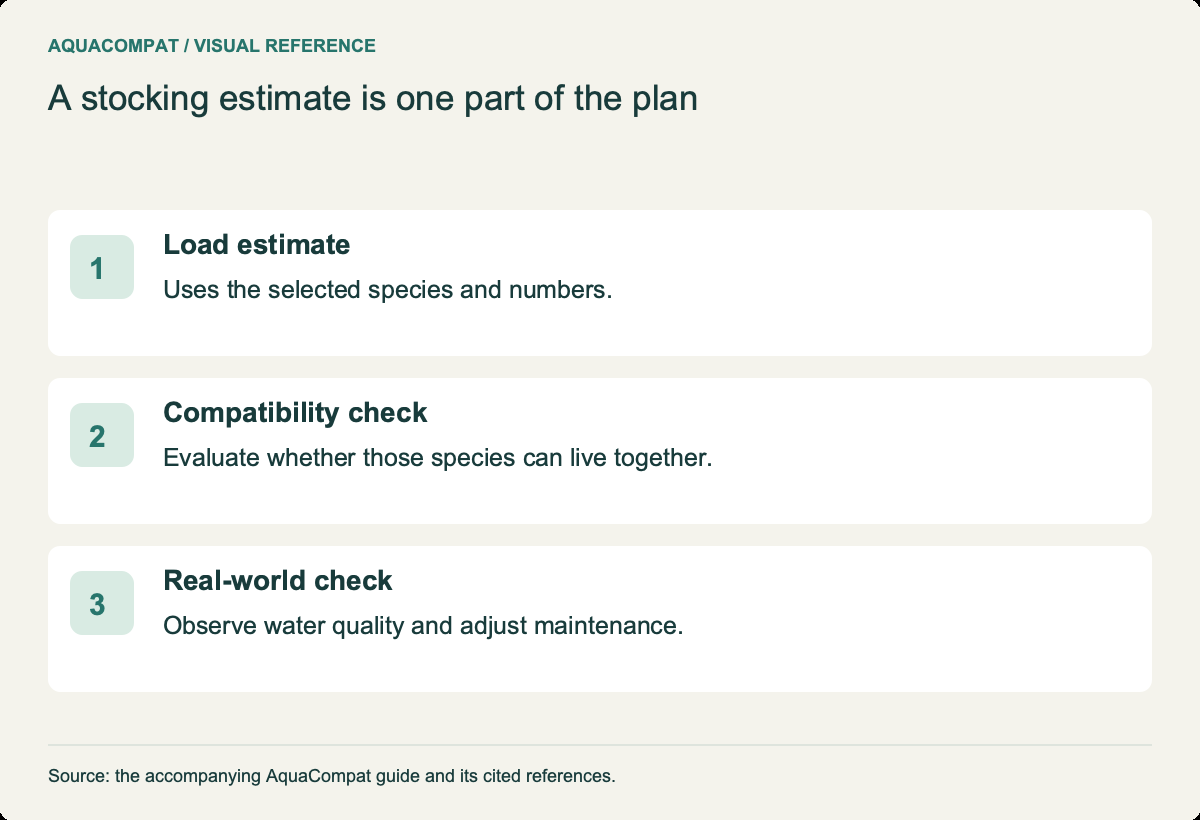
The calculator runs five separate checks from the same species data used everywhere on AquaCompat. Each check answers one question, and any one of them can be the reason a stocking list fails.
- Tank size per species. Each species has a published minimum tank, such as 15 US gal (57 L) for neon tetras or 75 US gal (284 L) for an oscar. If your tank is smaller than any species’ minimum, the list fails, however few fish you add.
- Group size. Schooling species need company. Aquarium Co-Op notes that some species prefer groups of 6–10 fish per schooling species, and each species page lists its own minimum, such as 8 for neon tetras.
- Every pair. Five species make ten pairs, and the calculator looks each one up in the same verdict table as the compatibility checker. One incompatible pair is enough to fail the list.
- Shared water. The calculator narrows each range to the band every species tolerates. If the temperature or pH bands do not meet, at least one species will always be outside its published limits.
- Load. It reports adult inches per gallon and, where FishBase publishes a length-weight equation, an estimate of total fish mass. Both are explained below, with their limits.
The exact scoring behind each pair verdict is on the methodology page.
Is the one-inch-per-gallon rule reliable?
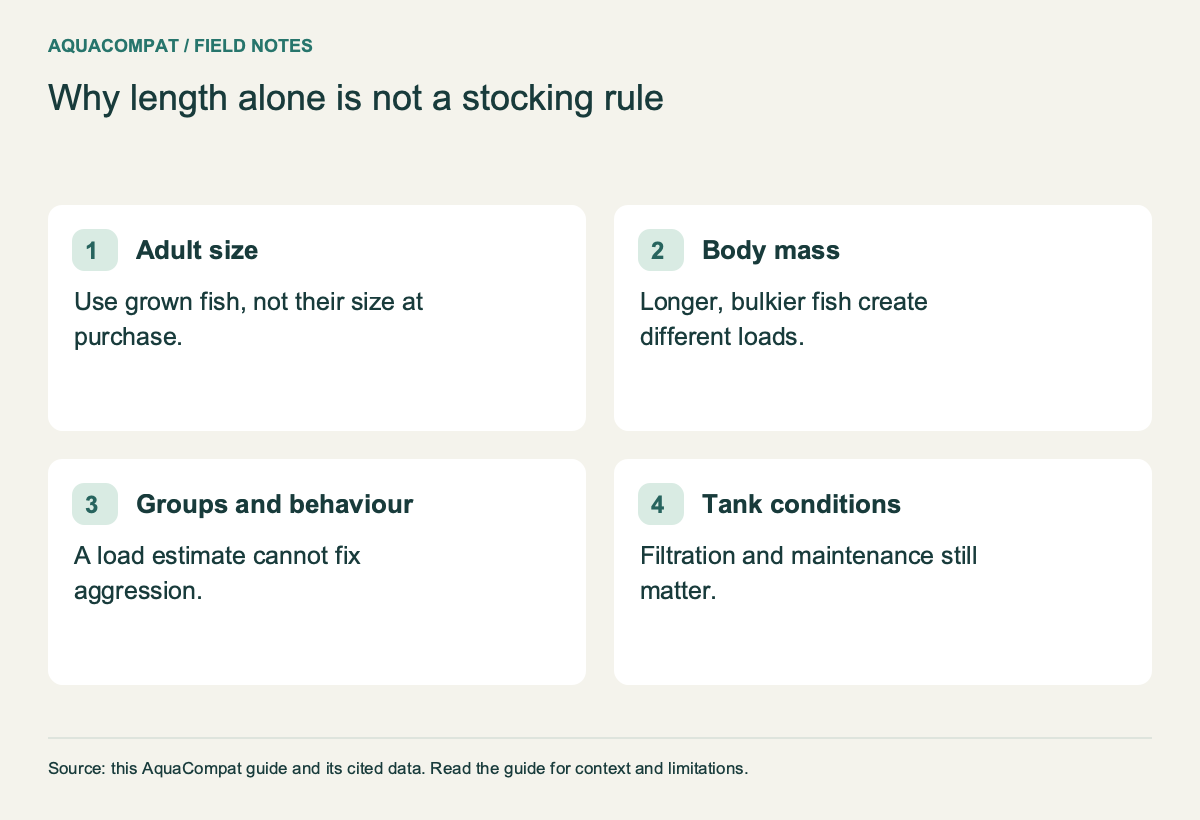
The one-inch-per-gallon rule is a rough guide that works only for small, slender fish. The rule allows 1 inch of fish per US gal, and LiveAquaria and Aquarium Co-Op both describe it as a common rule of thumb. Aquarium Co-Op limits it to small community fish of about 1–3 in (adult fish length). Both sources list its main weakness: it ignores body mass, adult size, behaviour and filtration.
The problem is easy to see with real numbers. An oscar grows to 14 in (35.6 cm), and a neon tetra to 1.2 in (3 cm). By length alone, one oscar counts the same as about a dozen neons. By weight it is far heavier, and it eats and excretes accordingly. That is why the calculator shows inches per gallon as a reference, not a verdict, and warns when the list includes large-bodied fish.
A second rule of thumb, the surface-area rule, allows 12 sq in of water surface per inch of fish. Only one retail source in our fact base states it, and it has the same blind spot for body shape, so the calculator does not use it.
Why does fish mass matter more than length?
Fish mass matters more because waste follows food, and food follows body weight. In recirculating fish culture, the Southern Regional Aquaculture Center describes feeding rates of about 2–4 % body weight per day, and estimates that 2.2 lb ammonia-N per 100 lb feed is produced. UF/IFAS and SRAC both note that ammonia excretion rises with feeding rate and feed protein. In other words, a tank’s ammonia load tracks the weight of fish being fed, not their total length.
The calculator estimates mass with the length-weight equations FishBase publishes for each species, in the form W = a × Lb, where W is grams and L is length in centimetres. Some species have a fitted relationship from measured fish; others have FishBase’s modelled (Bayesian) estimate for that body shape, noted in our data. The result is approximate for two reasons. FishBase’s equations use total length, while some published adult sizes are standard length, which excludes the tail. And captive fish can be heavier or lighter than wild samples. Use the mass figure to compare one stocking list with another, not as an exact weight.
How do filtration and water changes change what a tank can hold?
A tank can hold only as much fish as its filter and water changes can keep clean. SRAC expresses the practical limit of a recirculating system as highest feeding rate that keeps water quality acceptable. Aquarium Co-Op and AquariumScience.org make the same point for aquariums: biofilter capacity sets the safe load, and heavier stocking only works with large, well-established filters. That is why a new tank should be stocked slowly, after the fishless cycling process has built up the bacteria that process ammonia.
The most practical test is the one Aquarium Co-Op suggests: add fish in stages and check that nitrate stays under 40 ppm nitrate (keep below) over two to three weeks with your normal water-change schedule. If ammonia appears, UF/IFAS advises cutting back on feeding and doing a 25–50 % water change if your source water has no ammonia. The nitrogen cycle guide explains what each reading means.
Oxygen sets a ceiling of its own. USGS solubility tables (2020) show that fresh water at 25 °C (77 °F) and sea-level pressure holds at most 8.26 mg/L of dissolved oxygen when fully saturated, and every fish and the filter bacteria draw on that same supply.
How should you read the result?
Read the result from the top down, because the first problem listed is usually the one to fix first.
- Tank too small: a species needs a bigger tank. Remove it or plan a larger tank; adding fewer fish does not help, because the minimum reflects adult size and swimming space.
- Group too small: raise that species to its minimum, then recheck the load.
- An incompatible pair: remove one of the two species. The pair table links to the full guide where one exists.
- No shared water range: one species is from different water, such as a coldwater goldfish with a tropical fish, and cannot be kept in the same tank.
- Heavy by inches per gallon: treat this as a warning to check nitrate closely, or to stock fewer or smaller fish. Aquarium Co-Op recommends that you understock.
What does a worked example look like?
A 20-gallon tank with eight neon tetras, six corydoras and a betta shows how the checks interact. Neon tetras need at least 15 US gal (57 L) and a group of 8, so both pass. The betta and neon tetra pair is rated caution, the betta and corydoras pair caution, and corydoras with neon tetras compatible. The shared temperature narrows to the overlap of all three species, so the heater should sit inside it rather than at any one species’ preference. The betta and neon tetra guide explains why that one pair carries a caution.
A second example fails at once. An oscar in a 55-gallon tank is below the oscar’s 75 US gal (284 L) minimum before any tank mates are added. Adding neon tetras would also fail the pair check, because the pair is rated incompatible.
What can the calculator not tell you?
The calculator cannot see your filter, your feeding habits or your individual fish, so it is a planning check, not a guarantee. It does not model filter capacity, plant uptake or how often you change water. No source in our fact base gives a reliable per-gallon limit for these, and the calculator does not invent one. It also treats every species at adult size, so a tank that looks lightly stocked with juveniles will fill up as they grow.
It covers only the species in the AquaCompat data. A species missing from the list has not been researched to our standard yet, so check its published parameters before adding it. Where a species has no published range for a parameter, the result says so instead of guessing.
Both of AquaCompat’s planning tools are listed with short explanations on the aquarium tools page.
Questions people ask
How many fish can I put in a 10-gallon tank?
The answer depends on which fish, not on a single number. Several popular species need more than 10 gallons on their own, such as neon tetras at 15 US gal (57 L). Enter your planned fish above; the 10-gallon community guide lists the species whose published minimums fit.
Does the calculator account for plants?
No. Plants take up some nitrate, but no source in our data gives a figure that could be turned into extra stocking capacity. Treat plants as a margin of safety rather than permission to add more fish.
Why does it ask for the number of each fish?
Numbers matter for two checks: school size, because many species need a minimum group, and load, because inches and estimated mass add up per fish. A list that passes with six fish can fail with twelve.
Can I use litres?
Yes. Choose litres in the unit menu; the calculator converts to US gallons for the tank-size checks and shows both units in the result.
Sources 23 documents from 12 publishers
- Aquarium Co-Op (aquariumcoop.com): “Oscar Fish Care Guide”; “How Many Fish Can I Put in a Fish Tank?”; “Neon and Cardinal Tetras: Beginner Schooling Fish”; “Betta Fish Care Guide”; “Care Guide for Cory Catfish”
- AquariumScience.org (aquariumscience.org): “13 Stocking”
- FishBase (fishbase.se): “Paracheirodon innesi summary page”; “Astronotus ocellatus, Oscar: species summary”; “Betta splendens, Siamese fighting fish: species summary”; “Osteogaster aenea, Bronze corydoras”
- LiveAquaria (liveaquaria.com): “Is the One Inch of Fish per One Gallon of Water Rule the Gold Standard for Fish Stocking Levels?”
- Maidenhead Aquatics (fishkeeper.co.uk species data sheet) (fishkeeper.co.uk): “Neon Tetra data sheet”; “Oscar data sheet”
- PlanetCatfish (via Internet Archive snapshot, 2025) (web.archive.org): “Osteogaster aenea (Bronze Cory) Cat-eLog data sheet”
- Practical Fishkeeping (practicalfishkeeping.co.uk): “What can I keep in my hard water aquarium?”
- Seriously Fish (seriouslyfish.com): “Paracheirodon innesi (Neon Tetra)”; “Astronotus ocellatus”; “Betta splendens”; “Osteogaster aenea (Bronze Cory)”
- Southern Regional Aquaculture Center (srac.msstate.edu): “Recirculating Aquaculture Tank Production Systems: Management of Recirculating Systems, SRAC Publication No. 452, Masser, Rakocy and Losordo”
- UF/IFAS EDIS (ask.ifas.ufl.edu): “Evolution, Culture, and Care for Betta splendens (FA212)”
- University of Florida IFAS Extension (EDIS) (ask.ifas.ufl.edu): “Ammonia in Aquatic Systems (FA16/FA031), Francis-Floyd, Watson, Petty and Pouder”
- US Geological Survey (pubs.usgs.gov): “Chapter A6.2. Dissolved Oxygen, Techniques and Methods book 9, chapter A6.2 (revised October 2020)”
All sources accessed . Every number on this page comes from these documents.