What are the main aquarium fish diseases and tank problems?
The main aquarium fish diseases and tank problems are a short list of conditions that share causes, and grouping them by cause tells you where to look first. A fish disease is an infection or parasite on the fish itself; a tank problem is a fault in the water or the tank that can make fish ill or simply look wrong. Both are covered here because the two overlap so often.
Parasites and infections
Ich, also called white spot disease, is a single-celled parasite that needs a fish host, and UF/IFAS notes that it often shows within weeks of new fish arriving. The white spot disease guide covers its life cycle and treatment schedules. Fin rot is an opportunistic bacterial infection of the fins; UF/IFAS and SRAC sources describe it as usually secondary to stress such as poor water, crowding or aggressive tank mates, which the fin rot treatment guide explains.
Water-quality problems
New tank syndrome is ammonia or nitrite poisoning in a tank stocked before its filter bacteria are established, and the new tank syndrome page walks through the emergency steps. Cloudy water has several separate causes, from a bacterial bloom to substrate dust and tannins, each sorted on the cloudy aquarium water guide.
Signs that point to another cause
Two common complaints are signs rather than diseases. Loss of appetite is non-specific, with poor water, stress and infection as its usual causes, as the guide to fish not eating sets out. A buoyancy problem, where a fish floats, sinks or rolls, is likewise a sign with many possible causes, covered under swim bladder disorder.
Pests
Nuisance algae and the small invertebrate pests planaria and hydra do not infect fish, but they cause many of the questions keepers ask. The aquarium algae identification page sorts six common algae types by look and trigger, and the planaria and hydra guide covers the two pests that threaten baby shrimp and fry.
Which symptom points to which problem?
Each visible symptom points to one or two likely problems, and the table below lists the signs recorded in each condition's sources, grouped by condition. Use it to choose which guide to read, not as a diagnosis: UF/IFAS warns that white spots alone should not be used to diagnose ich, because other conditions look similar and confirmation needs a skin, fin or gill sample under a microscope.
| What you see | Likely problem | Detail from the sources |
|---|---|---|
| White spots like grains of salt on skin and fins | Ich | Mature parasites are visible to the eye; spots often appear one to three weeks after fish are shipped, according to UF/IFAS |
| Fish rubbing on decor (flashing), extra mucus | Ich | Can appear before any spots; gill-only infections may show no spots at all |
| Gasping at the surface, lethargy and deaths in a tank set up in the last few weeks | New tank syndrome | Merck places it in the first weeks after setup; ammonia and nitrite are colourless, so only a test kit confirms it |
| Red gills or bloody streaks in the fins in a new tank | New tank syndrome | Seen in severe cases; nitrite turns blood brown and fish can suffocate in oxygenated water |
| Whitish fin edges, then ragged, frayed fins | Fin rot | Advanced cases lose most of the fin and spread onto the body |
| Brown to yellow-brown patches or a pale saddle-shaped band | Fin rot (columnaris form) | Confirmed only by a microscope wet mount or culture |
| Fish ignores or spits out food | Fish not eating | A sign, not a disease; with ich, appetite loss can come before spots |
| Floating at the surface, lying on the bottom or swimming upside down | Swim bladder disorder | Often sudden; a swollen belly or pop-eye suggests a wider illness |
| Milky or white haze in the water | Cloudy water | Usually a bacterial bloom in a cycling tank, or dust from unwashed substrate |
| Green tint to the water | Algae (green water) | Free-floating single-celled algae; the green colour separates it from a white bacterial bloom |
| Brown or yellow tint to clear water | Cloudy water (tannins) | Tannins leaching from driftwood or leaves |
| Dusty brown film on glass that wipes off easily | Algae (diatoms) | Most common in newly set-up tanks |
| Slimy blue-green or dark sheet with a musty smell | Algae (cyanobacteria) | A photosynthetic bacterium rather than a true alga |
| Small flatworms with a triangular head gliding up the glass | Planaria | Can prey on shrimplets and eggs in breeding tanks |
| Tiny tentacled polyps that pull back when touched | Hydra | Stinging tentacles can catch fry and baby shrimp but rarely harm adult fish |
Should you buy aquarium fish medicine before testing the water?
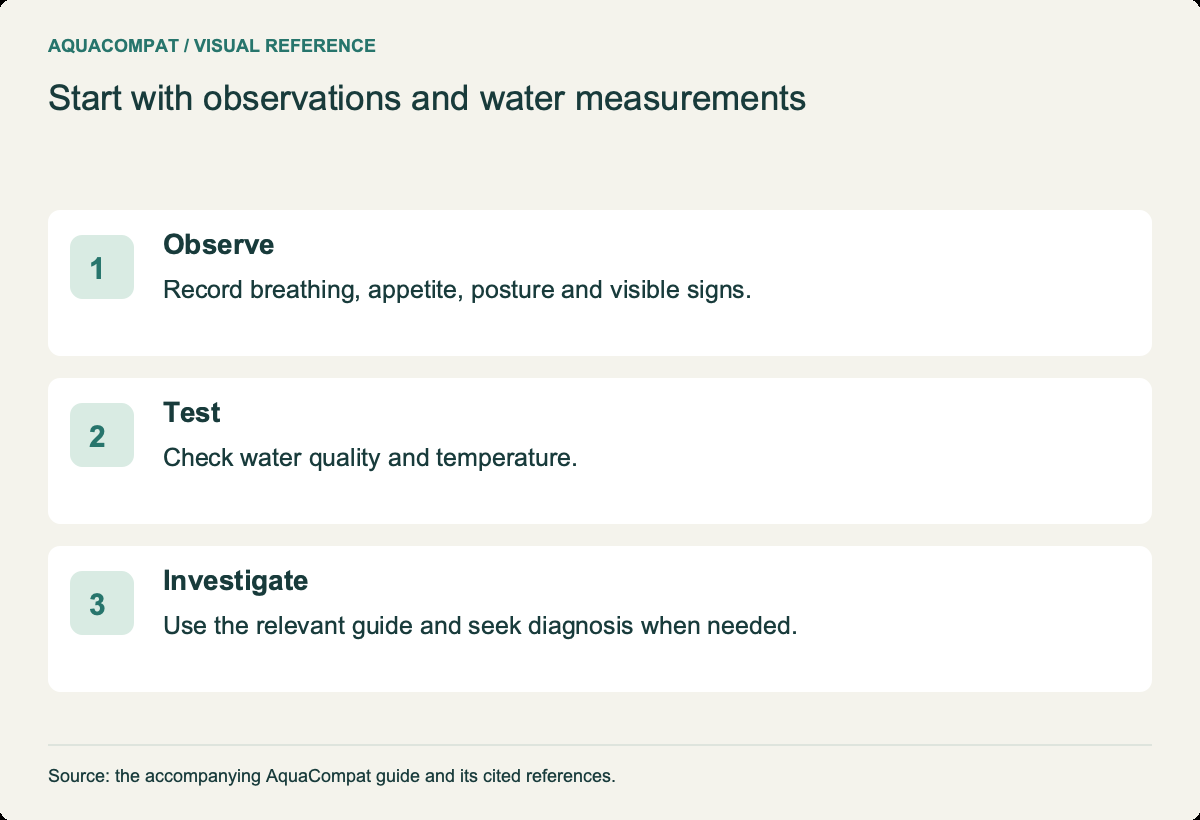
No. Testing the water comes before any aquarium fish medicine, because the sources behind every guide in this section name water quality as a cause or trigger far more often than they name a single pathogen. A common belief is that a sick fish needs a bottle of medicine first. The published guidance points the other way.
- Fin rot: the bacteria involved are opportunists that take hold after stress, so UF/IFAS and Aquarium Co-Op put finding and removing the stressor, such as high ammonia, low oxygen or a nipping tank mate, ahead of any remedy.
- Loss of appetite: UF/IFAS lists ammonia among the commonest causes and treats any ammonia reading as a fault to fix immediately.
- Buoyancy problems: the veterinary sources behind the swim bladder guide describe poor water quality as the most often overlooked contributor to swim bladder signs.
- New tank syndrome: the cause is the water itself, so medicine does nothing; daily tests, reduced feeding and water changes are the treatment.
A basic test covers ammonia, nitrite, nitrate and pH. Nitrite becomes a problem from about 0.1 mg/L nitrite, according to UF/IFAS and the Merck Veterinary Manual, and the nitrogen cycle explainer shows how ammonia and nitrite build up when a filter cannot keep pace. The kits that measure these readings are compared in the aquarium test kit guide. Medication still has its place: ich, for example, needs repeated treatment timed to the parasite's life cycle. But medicating without a test result can hide the real cause and, as the next section shows, can harm the rest of the tank.
How do treatments affect tank mates, shrimp and snails?
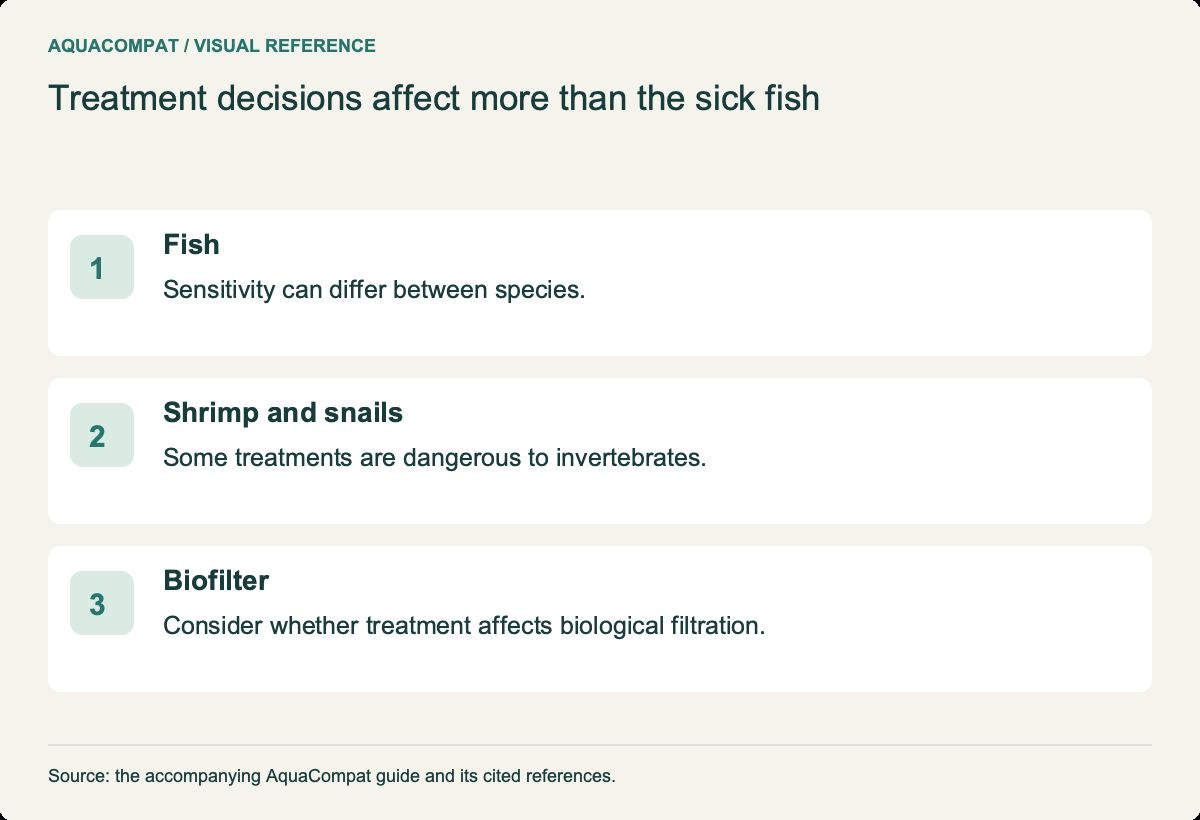
Treatments that are safe for one species can kill another in the same tank, so the stocking list matters as much as the diagnosis. This is where fish health meets compatibility: a community tank is treated as a whole, and the most sensitive animal sets the limit.
- Copper and invertebrates: UF/IFAS states that copper is lethal to most invertebrates, including snails and shrimp, which should be moved out before treatment and not returned until free copper is at or near zero. UF/IFAS also notes that goldfish need a reduced copper dose.
- Dewormers and snails: hobby reports collected on the planaria and hydra guide describe fenbendazole killing snails, and the maker of a betel-nut planaria product warns that it kills most snail species.
- Salt and plants: salt can help against ich only where every species and plant in the tank tolerates it, according to UF/IFAS.
- Antibiotics and the filter: UF/IFAS warns that antibiotic baths can damage nitrifying bacteria, so ammonia and nitrite should be tested more often during and after treatment.
Shrimp keepers face this most often, since dwarf shrimp share tanks with fish that may carry ich. The cherry shrimp tank mates page lists which fish and snails suit a shrimp tank, and moving invertebrates to a separate container before treatment avoids the problem entirely. Fish that injure each other also feed this cycle: fin damage from a nipping tank mate is one of the stressors behind fin rot, which the species compatibility checker flags before the fish are bought.
How can you prevent most aquarium fish illnesses?
Most aquarium fish illnesses are prevented by three habits: quarantining new arrivals, cycling the tank before stocking, and avoiding overfeeding. Each comes up repeatedly across the condition files.
- Quarantine new fish. UF/IFAS and the Merck Veterinary Manual recommend a quarantine of at least 30 days, which lets parasites such as ich show themselves away from the main tank. Plants and decor from other tanks can carry ich cysts, planaria and hydra too.
- Cycle before stocking. A new biofilter takes 6–8 weeks to build up, according to UF/IFAS, and stocking before then is the cause of new tank syndrome. The fishless cycling method builds the filter with no fish at risk.
- Protect the filter bacteria. Rinsing filter media in chlorinated tap water kills nitrifying bacteria, and replacing all media at once can set off a bacterial bloom, according to the sources behind the cloudy water and new tank syndrome guides. A dechlorinating water conditioner makes tap water safe for water changes.
- Feed less. Surplus food drives ammonia, bacterial blooms, algae and planaria outbreaks alike.
- Keep up routine maintenance. Practical Fishkeeping suggests a water change of about 25 % weekly to keep nitrate down, and the aquarium maintenance schedule sets out the rest of the routine.
Careful acclimation also limits transport stress, which the sources link to ich and appetite loss in newly bought fish; the guide to acclimating new fish covers the float and drip methods.
When does home treatment fail and a vet become necessary?
Home treatment fails when the cause is something a water change or an over-the-counter product cannot reach, and the condition files name the point at which an aquatic veterinarian should take over. Their advice is consistent: correct the water first, and if fish keep getting worse, get a professional diagnosis.
- Ich: if spots persist after a full course, fish keep dying, or copper or formalin dosing is being considered for valuable fish, the ich sources advise consulting an aquatic vet or fish health professional.
- Fin rot: fin loss reaching the body, ulcers, or deaths despite better water call for a vet. Culture and sensitivity testing picks an effective drug, and in the US medicated antibiotic feed needs a veterinary feed directive.
- New tank syndrome: fish damaged by ammonia or nitrite can fall ill weeks after the water is corrected, so continued deaths after readings return to zero need a vet.
- Loss of appetite: several days without eating while water tests are normal, or signs such as ulcers, bloating or laboured breathing, should be seen by a vet, and diagnosis should come before any antibiotic.
- Buoyancy problems: persistent cases need a vet, who can use radiographs to tell a swim bladder fault from gas in the gut.
Cloudy water, algae, planaria and hydra are not fish diseases, so their sources point to a vet only when fish show distress or before using antibiotics or livestock dewormers off-label.
How are the disease and tank problem guides written?
Each guide is built from a condition file that records its cause, signs, look-alikes, treatment steps, species cautions and prevention, with every statement tied to a published source. The preferred sources are university extension papers such as UF/IFAS EDIS and SRAC fact sheets and the Merck Veterinary Manual, followed by established hobby references such as Aquarium Co-Op and Practical Fishkeeping. Where sources disagree, for example on quarantine length or how often to repeat an ich treatment in cool water, the guide names both views. AquaCompat has not treated fish or trialled any product; the sourcing and verdict method explains how sources are ranked.
Fish disease and tank problem guides
- Ich (White Spot Disease)White spots, flashing and the temperature-timed treatment schedule, with copper and salt cautions for invertebrates.
- New Tank SyndromeAmmonia and nitrite poisoning in an uncycled tank: signs, daily testing, water changes and prevention.
- Fin RotFrayed and eroding fins, the stressors behind them, early treatment and when antibiotics need a vet.
- Cloudy Aquarium WaterWhite, green and brown water told apart, with the fix for bacterial blooms, dust and tannins.
- Fish Not EatingAppetite loss as a sign: water tests, stressors, disease checks and when to call a vet.
- Aquarium Algae Types and FixesSix common algae identified by look, with the trigger and removal method for each.
- Swim Bladder DisorderFloating, sinking and rolling fish: likely causes, feeding changes and when radiographs help.
- Planaria and Hydra in Shrimp TanksIdentifying flatworms and hydra, starving them out, and treatments that harm snails and shrimp.
Questions people ask
Why does ich so often appear after buying new fish?
Why do my aquarium fish keep dying in a new tank?
Can I treat the whole tank if I keep shrimp or snails?
Are aquarium fish antibiotics safe to use without a diagnosis?
Is cloudy water a sign that my fish are sick?
Sources 42 documents from 16 publishers
- Aquarium Co-Op (aquariumcoop.com): “Ich-X product guide”; “5 Quick and Easy Steps for Treating Fin Rot in Aquarium Fish”; “How to Clear Up Cloudy Fish Tank Water with 5 Easy Methods”; “How to Fight the 6 Most Common Types of Algae in Your Fish Tank”; “How to Get Rid of Blue-Green Algae in Freshwater Aquariums”; “How to Get Rid of Hydra in Your Aquarium”
- AquariumScience.org (aquariumscience.org): “6.2.3 Cloudy Water”; “10.13.1 Hydra”
- Environmental Science and Pollution Research (via PMC) (pmc.ncbi.nlm.nih.gov): “Wagil M. et al. Toxicity of anthelmintic drugs (fenbendazole and flubendazole) to aquatic organisms”
- FishTankAdvisor (fishtankadvisor.com): “Planaria in the Aquarium: Removal and Prevention”
- Greater Washington Aquatic Plant Association (GWAPA) (gwapa.org): “Algae in the Planted Aquarium (K. Weinhold)”
- Green Aqua (Biomax) (greenaqua.hu): “Biomax NO Planaria product instructions”
- Illinois State University Environmental Health and Safety (ehs.illinoisstate.edu): “Aeromonas (clinical signs in fish)”
- LiveAquaria (liveaquaria.com): “Algae Identification in Freshwater Tanks and Proper Removal”
- Merck Veterinary Manual (merckvetmanual.com): “Management of Aquarium Fish, Petty, Francis-Floyd and Yanong”; “Parasitic Diseases of Fish, Petty, Francis-Floyd and Yanong”; “Disorders and Diseases of Fish (pet owner version)”; “Environmental Diseases of Aquatic Animals in Aquatic Systems, Francis-Floyd, Yanong and Petty”
- PetMD (petmd.com): “Swim Bladder Disorders in Fish, Dr Jessie Sanders DVM (Fish Practice)”
- Practical Fishkeeping (practicalfishkeeping.co.uk): “The A-Z of Fish Health, Part 2: F-L, Dr Peter Burgess”; “Problem solver: New Tank Syndrome”; “Why is my aquarium water cloudy?”; “Tempting the difficult diner”; “The A-Z of Fish Health, Part 1: A-E, Dr Peter Burgess”; “When might my fish need veterinary help?, Willie Wildgoose”; “How often should I change my water?”
- Seachem Laboratories (seachem.com): “Flourish Excel product instructions”
- Southern Regional Aquaculture Center (srac.msstate.edu): “SRAC Publication No. 476: Ich (White Spot Disease)”; “Columnaris Disease: A Bacterial Infection Caused by Flavobacterium columnare, SRAC Publication No. 479”; “Motile Aeromonas Septicemia (MAS) in Fish, SRAC Publication No. 478 (2019)”; “Nitrite in Fish Ponds, SRAC Publication No. 462, Durborow, Crosby and Brunson”; “How to Start a Biofilter, SRAC Publication No. 4502, DeLong and Losordo”; “SRAC Publication No. 466: Algae Blooms in Commercial Fish Production Ponds”; “SRAC Publication No. 478: Motile Aeromonas Septicemia (MAS) in Fish (2019)”; “SRAC Publication No. 474: The Role of Stress in Fish Disease (Green and Haukenes)”; “SRAC Publication No. 4605: Algal Toxins in Pond Aquaculture (J.H. Rodgers Jr.)”
- University of Florida IFAS Extension (ask.ifas.ufl.edu): “FA006: Ichthyophthirius multifiliis (White Spot) Infections in Fish (Francis-Floyd, Yanong, Pouder)”; “FA084: Use of Antibiotics in Ornamental Fish Aquaculture (R.P.E. Yanong)”; “FA031: Ammonia in Aquatic Systems (Francis-Floyd, Watson, Petty, Pouder)”
- University of Florida IFAS Extension (EDIS) (ask.ifas.ufl.edu): “Use of Copper in Marine Aquaculture and Aquarium Systems (FA165), Yanong”; “Use of Copper in Freshwater Aquaculture and Farm Ponds (FA-13), Watson and Yanong”
- WikiVet (en.wikivet.net): “Buoyancy Disorders”
All sources accessed . Every number on this page comes from these documents.