How do you tell why a fish is not eating?
You tell why a fish is not eating by the signs that come with the refusal, because appetite loss on its own points to no single cause. UF/IFAS, SRAC and Practical Fishkeeping describe the patterns below, from the most to the least common.
- Ignoring or spitting out food, with reduced activity. Practical Fishkeeping and UF/IFAS describe this as the general picture of a fish that is stressed or unwell.
- Not eating, plus gasping or deaths in a new tank. UF/IFAS (FA031) notes that fish may not eat during ammonia stress, which points to water quality before anything else.
- Not eating, plus flashing and extra mucus. UF/IFAS (FA006) and SRAC Publication 476 list loss of appetite, weakness, flashing and heavy mucus as early ich signs that can appear before any white spots, and say badly infected fish usually refuse food.
- Not eating, plus ulcers, bloating or pale gills. Illinois State University’s Aeromonas sheet lists inappetence with swimming abnormalities, pale gills, bloating and skin ulcers.
- Not eating prepared food only. Practical Fishkeeping notes that a fish may simply not recognise prepared food as food, which is different from illness.
| Signs alongside the refusal | Most likely group | First check |
|---|---|---|
| Several fish affected, new or overstocked tank | Ammonia or nitrite | Test ammonia and nitrite |
| Recently bought, transported or moved fish | Transport and handling stress | Quarantine and watch |
| Chasing, hiding, torn fins | Aggressive tank mates or crowding | Watch the tank at feeding time |
| Flashing, mucus, then white spots | Ich | Look closely at skin, fins and gills |
| Ulcers, bloating, pale gills | Bacterial infection such as Aeromonas | Test water, then contact a vet |
| Takes live food but ignores flakes or pellets | Does not recognise prepared food | Try other formats |
What causes a fish to stop eating?
Poor water quality, stress and disease cause most appetite loss, and ammonia is the first of these to rule out. UF/IFAS says any ammonia reading means something is wrong, and that fish may not eat during ammonia stress. The nitrogen cycle guide explains why ammonia builds up and why warm, alkaline water makes the same reading more toxic. In a tank only a few weeks old, appetite loss across several fish fits the ammonia and nitrite poisoning described in the new tank syndrome guide, where the biofilter has not yet caught up with the fish.
Which kinds of stress put fish off their food?
SRAC Publication 474 (Green and Haukenes) and Practical Fishkeeping name aggressive tank mates, crowding, the wrong temperature or pH, and recent handling or transport as recognised stressors. Temperature is a common mismatch when species are mixed. Goldfish are listed at 59–70 °F (15–21 °C), while discus need 79–86 °F (26–30 °C), so a tank set for one is wrong for the other. Checking each species against the aquarium temperature guide catches that kind of conflict before it shows up as a fish refusing food.
Which diseases cause loss of appetite?
Ich and bacterial infections are the two named in the sources. UF/IFAS and SRAC 476 list appetite loss among the early signs of ich (white spot disease), and Illinois State University lists it among the signs of Aeromonas infection. Some species carry their own risks: Australian research summarised in the dwarf gourami data found about 22% of imported dwarf gouramis infected with dwarf gourami iridovirus, whose signs include lethargy, darkening and appetite loss, and which is nearly impossible to cure.
What should you do when a fish stops eating?
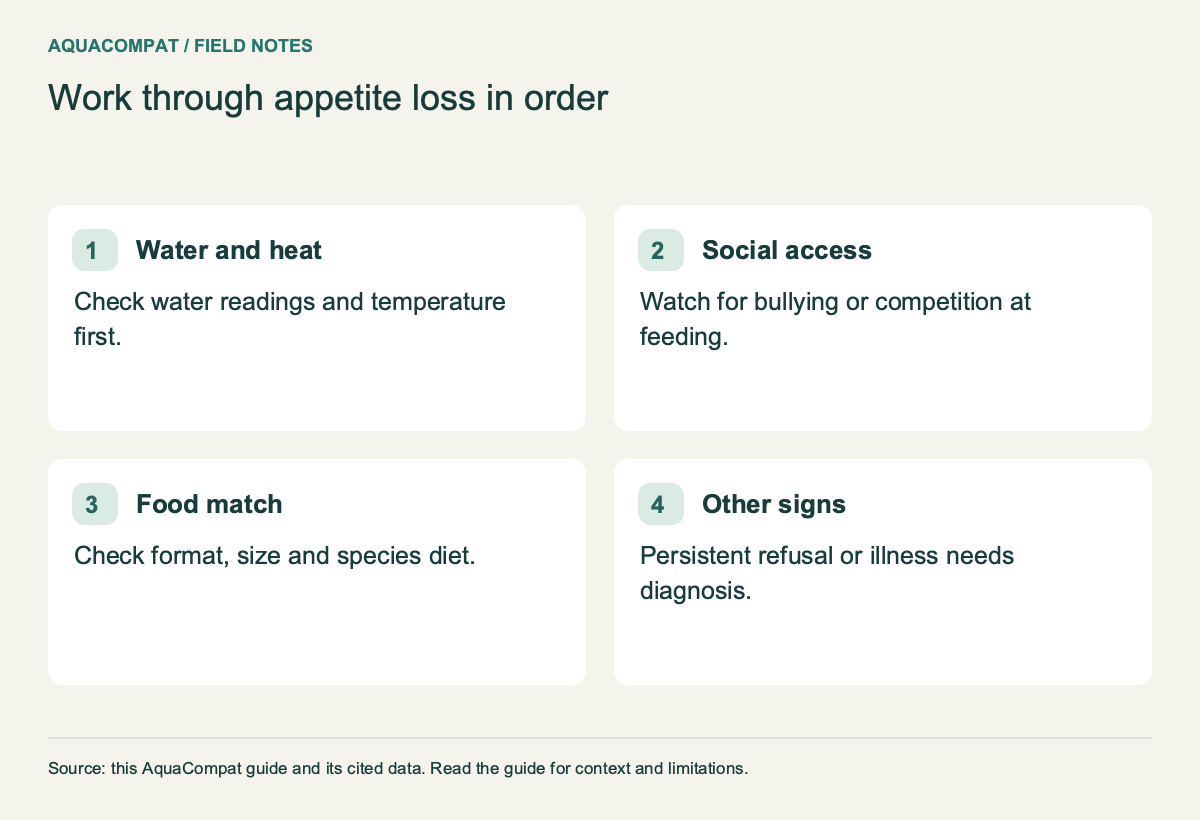
You should test the water first, fix what the test shows, and only then look for disease. The order below follows UF/IFAS FA031 and FA084, SRAC 474 and Practical Fishkeeping.
- Test the water. Test total ammonia with pH and temperature, which together decide how toxic it is, plus nitrite and nitrate. UF/IFAS treats any ammonia reading as a problem to fix right away. The guide to choosing aquarium test kits compares kits that read all three.
- Stop or reduce feeding if ammonia is present. Uneaten food makes ammonia worse. UF/IFAS says stopping feeding for one to three days does not usually harm fish, with fry the exception.
- Change water. In tanks, UF/IFAS advises a 25–50 % water change to remove ammonia, as long as the source water has none. Treat new water with a dechlorinator, since UF/IFAS and Merck require zero detectable chlorine.
- Remove stressors. Check for aggressive tank mates, crowding, the wrong temperature or pH, and recent handling or transport.
- Look for other disease signs. Check for white spots, flashing, ulcers, bloating or gill changes, and have a fish health professional diagnose the problem before you medicate.
- Tempt the fish once the water is right. Offer a food format the species recognises, soaked if needed, and remove anything uneaten.
The final step has a limit. SRAC 478 and UF/IFAS point out that medicated feeds only work if fish eat enough of them, so a fish that is not eating at all may need a treatment route a veterinarian chooses.
Products for tempting a fish that has stopped eating
The two products below suit the final step, once the water tests clean: one is a food soak and one is an alternative food format. Neither treats disease. AquaCompat did not use or test them; the notes compare what each maker or its retailer publishes.
As an Amazon Associate I earn from qualifying purchases. Prices change often, so they are not shown here; the button opens the current listing.

Seachem GarlicGuard
- Purpose
- appetite enhancer for finicky eaters
- Contains
- garlic odor/flavor enhancer with vitamin C
- How it is used
- soak food before feeding; not dosed to tank
- Tank safety
- safe for reef and planted aquaria
Fits: a fish that is healthy but finicky, once water tests are clean; Seachem describes it as an appetite enhancer for picky eaters such as discus, used as a soak on the food rather than dosed to the tank.
Skip it if: the fish is refusing food because of ammonia, ich or a bacterial infection; a flavour enhancer does nothing for the cause, and the fact base holds no verified allicin content.
Check price on Amazon
Fluval Bug Bites Tropical Formula
- Format
- granule
- Granule size
- 0.7–1 mm
- Buoyancy
- slow sinking
- First ingredients
- black soldier fly larvae, salmon, peas, potato, wheat
Fits: small tropical fish that ignore flakes; black soldier fly larvae are listed first, the granules sink slowly so fish can feed at their own depth, and the size suits small mouths.
Skip it if: herbivores such as kenyi cichlids, whose diet should be mainly vegetable, or oscars, whose species data lists cichlid pellets plus live or frozen foods. The guaranteed analysis is not in the fact base.
Check price on AmazonWhich fish need special care when they stop eating?
Fry, newly bought fish and species with particular diets need different handling from an established adult community fish. The notes below come from the appetite sources and the species data.
- Fry. UF/IFAS says fry should not be fasted like adult fish while ammonia is corrected.
- New arrivals. Practical Fishkeeping and UF/IFAS note that transport stresses fish, and that quarantine helps them settle and lets hidden disease show. The guide to acclimating new fish covers the move into the tank.
- Discus. Aquarium discus need small granules and frozen foods, and Seachem names discus as the example of a picky eater; the discus tank mates guide lists companions that share their warm water.
- Bettas. Bettas accept dried foods but benefit from live or frozen items such as daphnia, brine shrimp and bloodworm, which makes frozen food a reasonable test when a betta ignores pellets.
- Kenyi cichlids and other herbivores. The kenyi data says to feed mainly vegetable foods and avoid protein-rich foods, which are linked to Malawi bloat; a protein-rich bribe is the wrong fix.
- Goldfish. Goldfish need more carbohydrate than many fish, and vegetables are a good supplement.
Should you keep adding food until the fish eats?
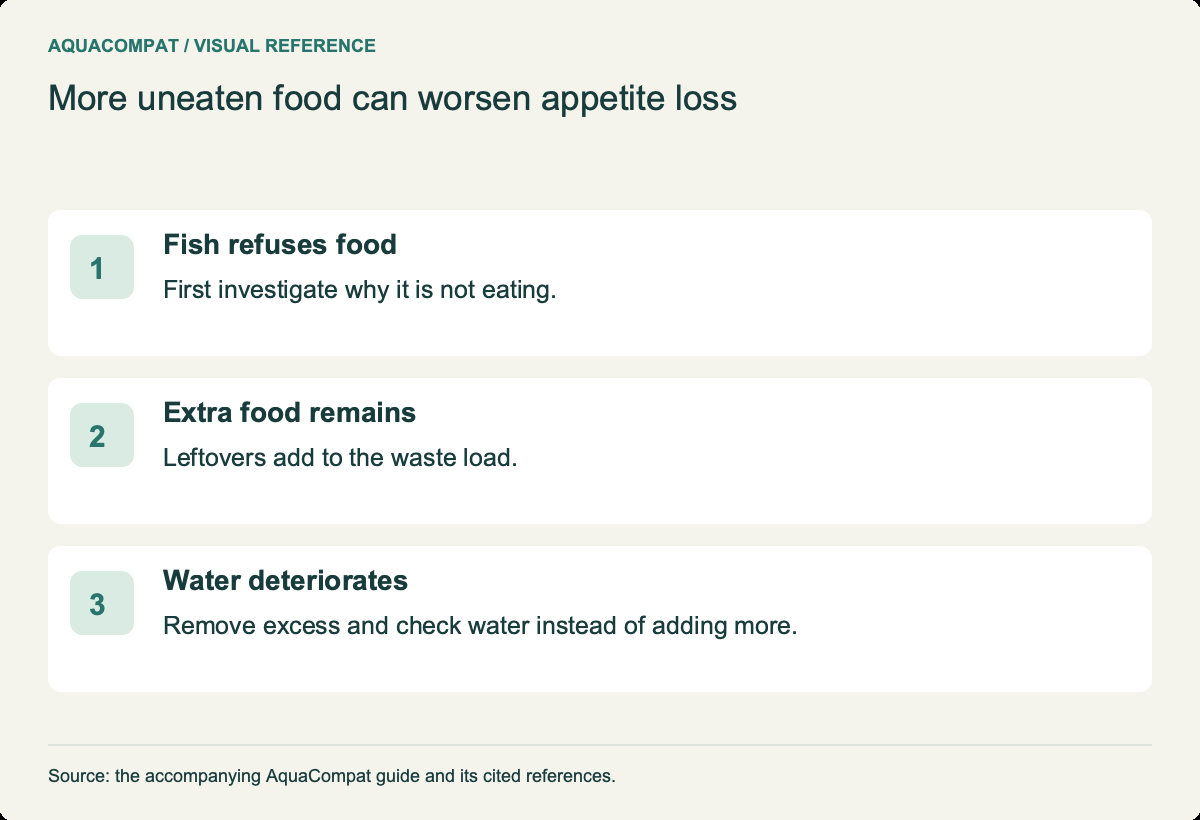
No: adding more food to tempt a fish that will not eat usually makes the cause worse. UF/IFAS identifies overfeeding as a major cause of ammonia build-up, and uneaten food breaks down into ammonia in the tank. A fish refusing food in water with ammonia is in a loop where every extra pinch raises the reading. The sources agree on the opposite approach: test first, stop or reduce feeding for one to three days if ammonia is present, and offer small portions again only once the water is right, removing anything left uneaten.
What looks like a fish not eating but is something else?
Food recognition, feeding competition and feeding depth can all look like appetite loss. Practical Fishkeeping notes that a fish may not recognise prepared foods as food at all, which is a feeding problem rather than illness, and the best fish food by species type comparison sorts foods by format and depth. Feeding depth matters too: corydoras take sinking dried foods, so floating flakes may never reach them. A fish that tries to eat but cannot stay level in the water has a buoyancy problem instead, covered under swim bladder disorder.
When is a fish not eating an emergency?
A fish not eating becomes an emergency when the water tests clean but the refusal continues for several days, or when other signs appear. A newly arrived fish that skips meals in a well-run quarantine tank and shows no other signs is a different case from an established fish that suddenly stops eating alongside ulcers, bloating or breathing trouble. The first fits the transport stress that Practical Fishkeeping and UF/IFAS describe; the second matches the signs of bacterial infection in the Illinois State University sheet.
Two limits make home treatment harder for a fish that will not eat. Medicated feed does not work if the fish does not eat it, which UF/IFAS and SRAC 478 both note. And diagnosis matters: UF/IFAS advises bacterial culture and sensitivity testing before any antibiotic, rather than guessing. The fact base holds no verified figure for how long an adult fish can safely go without food, so a fixed number of days is not a safe rule.
When should you consult an aquatic vet about a fish not eating?
You should contact an aquatic veterinarian if a fish has not eaten for several days with normal water tests, or shows other signs such as ulcers, bloating or breathing trouble. A vet can diagnose the cause, including bacterial culture and sensitivity testing, and choose a treatment route that does not rely on the fish eating. Ragged fins with appetite loss may be bacterial fin rot.
How can you keep fish eating well?
Regular testing, measured feeding, quarantine and low stress keep most fish eating. UF/IFAS advises regular water testing and warns that overfeeding is a major cause of ammonia build-up. UF/IFAS (FA006) recommends quarantining new fish for at least 30 days, which lets transport stress pass and hidden disease show before the fish joins the main tank. SRAC 474 adds limiting crowding, rough handling and sudden temperature changes. The tank mate compatibility checker flags temperament and water mismatches before a new fish goes in. More conditions are covered in the fish disease guides.
Questions people ask
How long can a fish go without eating?
The fact base has no verified maximum fasting time for adult fish, so this page does not give one. UF/IFAS says stopping feeding for one to three days does not usually harm fish, except fry, and uses that as a tool when ammonia is high. Beyond that, a fish that has not eaten for several days in clean water should be seen by an aquatic vet.
Why won’t my new fish eat?
Transport is stressful, and Practical Fishkeeping and UF/IFAS both note that newly arrived fish may need time to settle. A fish may also not recognise the food you offer. Test the water, keep the fish in quarantine if possible, and offer a food format the species recognises. The fact base has no verified figure for how many days new fish typically refuse food.
Why is my betta not eating?
The same order applies to a betta as to any fish: test ammonia and nitrite first, then check temperature against the betta’s listed range, then look for disease signs. Bettas are carnivores that accept dried food but benefit from frozen items such as daphnia, brine shrimp and bloodworm, so a frozen food can show whether the problem is the food or the fish.
Does garlic make fish eat?
Seachem sells GarlicGuard as an appetite enhancer for picky eaters such as discus, used as a soak on the food rather than added to the water. It is a flavour enhancer, not a treatment, so it only makes sense once water tests are clean and disease has been ruled out.
Sources 76 documents from 26 publishers
- Amazon (amazon.com): “Fluval Bug Bites Tropical Fish Food 1.6 oz A6577”
- Aqualog (aqualog.de): “Discus (lexicon profile)”
- Aquarium Co-Op (aquariumcoop.com): “Care Guide for Fancy Goldfish”; “Care Guide for Dwarf Gouramis”; “Does dechlorinator remove ammonia?”; “Oscar Fish Care Guide”; “Discus Fish Care Guide”; “Betta Fish Care Guide”; “10 Best Top-Dwelling Fish for Your Freshwater Community Aquarium”; “Goldfish Tank Mates”; “Amano Shrimp Care Guide”; “Care Guide for Cory Catfish”; “5 Quick and Easy Steps for Treating Fin Rot in Aquarium Fish”
- Complete Aquatics (retailer, Fluval label data) (completeaquatics.co.uk): “Fluval Bug Bites Tropical Small Micro Granule 45g”
- FishBase (fishbase.se): “Symphysodon aequifasciatus summary (Bayesian length-weight estimate)”; “Trichogaster lalius, Dwarf gourami: species summary”; “Length-weight relationships for Trichogaster lalius”; “Astronotus ocellatus, Oscar: species summary”; “Length-weight relationships for Astronotus ocellatus”; “Betta splendens summary (Bayesian length-weight estimate)”; “Maylandia lombardoi summary (Bayesian length-weight estimate)”; “Carassius auratus, Goldfish: species summary”; “Length-weight relationships for Carassius auratus”; “Osteogaster aenea, Bronze corydoras”; “Length-weight relationships for Osteogaster aenea”
- fishkeeping.co.uk (fishkeeping.co.uk): “Goldfish Size, Life Expectancy and Tank Recommendations”; “Keeping Goldfish - The Right Way”
- Illinois State University Environmental Health and Safety (ehs.illinoisstate.edu): “Aeromonas (clinical signs in fish)”
- Maidenhead Aquatics (fishkeeper.co.uk species data sheet) (fishkeeper.co.uk): “Oscar data sheet”; “Discus data sheet”; “Siamese Fighting Fish/Betta data sheet”; “Kenyi data sheet”
- Merck Veterinary Manual (merckvetmanual.com): “Disorders and Diseases of Fish (pet owner version)”; “Environmental Diseases of Aquatic Animals in Aquatic Systems, Francis-Floyd, Yanong and Petty”; “Management of Aquarium Fish, Petty, Francis-Floyd and Yanong”
- Neotropical Ichthyology (Crampton 2008) (scielo.br): “Ecology and life history of an Amazon floodplain cichlid: the discus fish Symphysodon”
- Ornamental Aquatic Trade Association (OATA) (ornamentalfish.org): “How to look after fancy goldfish”; “How to look after goldfish in an aquarium / fish tank”
- PetMD (petmd.com): “Swim Bladder Disorders in Fish, Dr Jessie Sanders DVM (Fish Practice)”
- PlanetCatfish (via Internet Archive snapshot, 2025) (web.archive.org): “Osteogaster aenea (Bronze Cory) Cat-eLog data sheet”
- Practical Fishkeeping (practicalfishkeeping.co.uk): “Tempting the difficult diner”; “Problem solver: New Tank Syndrome”; “Aquarium trade may have spread gourami virus”; “What water temperature do goldfish need?”; “How can I breed goldfish in my aquarium?”; “How long will my fish live?”; “What can I keep in my hard water aquarium?”; “The A-Z of Fish Health, Part 1: A-E, Dr Peter Burgess”; “When might my fish need veterinary help?, Willie Wildgoose”; “The A-Z of Fish Health, Part 2: F-L, Dr Peter Burgess”
- Practical Fishkeeping (Julian Dignall) (practicalfishkeeping.co.uk): “Focus on commonly kept Corydoras”
- Seachem (seachem.com): “GarlicGuard product page”
- Seachem Laboratories (manufacturer) (seachem.com): “Prime”
- Seriously Fish (seriouslyfish.com): “Symphysodon aequifasciatus”; “Trichogaster lalius”; “Astronotus ocellatus”; “Betta splendens”; “Maylandia lombardoi”; “Osteogaster aenea (Bronze Cory)”
- Shrimp and Snail Breeder (aquariumbreeder.com): “Cherry shrimp in a community tank: how to make it successful”
- Southern Regional Aquaculture Center (srac.msstate.edu): “SRAC Publication No. 476: Ich (White Spot Disease)”; “SRAC Publication No. 478: Motile Aeromonas Septicemia (MAS) in Fish (2019)”; “SRAC Publication No. 474: The Role of Stress in Fish Disease (Green and Haukenes)”; “Nitrite in Fish Ponds, SRAC Publication No. 462, Durborow, Crosby and Brunson”; “How to Start a Biofilter, SRAC Publication No. 4502, DeLong and Losordo”; “Columnaris Disease: A Bacterial Infection Caused by Flavobacterium columnare, SRAC Publication No. 479”; “Motile Aeromonas Septicemia (MAS) in Fish, SRAC Publication No. 478 (2019)”
- Tropical Fish Hobbyist Magazine (tfhmagazine.com): “Astronotus sp.”; “Betta splendens”
- UF/IFAS EDIS (ask.ifas.ufl.edu): “Evolution, Culture, and Care for Betta splendens (FA212)”
- University of Florida IFAS Extension (ask.ifas.ufl.edu): “FA006: Ichthyophthirius multifiliis (White Spot) Infections in Fish (Francis-Floyd, Yanong, Pouder)”
- University of Florida IFAS Extension (EDIS) (ask.ifas.ufl.edu): “Ammonia in Aquatic Systems (FA16/FA031), Francis-Floyd, Watson, Petty and Pouder”; “Use of Antibiotics in Ornamental Fish Aquaculture (Circular 84 / FA084), Yanong”; “Teach Aquaculture Curriculum: Chlorine, Friend or Foe? (FA171), Chapman et al.”
- US Environmental Protection Agency (epa.gov): “Chloramines in Drinking Water”
- WikiVet (en.wikivet.net): “Buoyancy Disorders”
All sources accessed . Every number on this page comes from these documents.