What should an aquarium test kit measure?
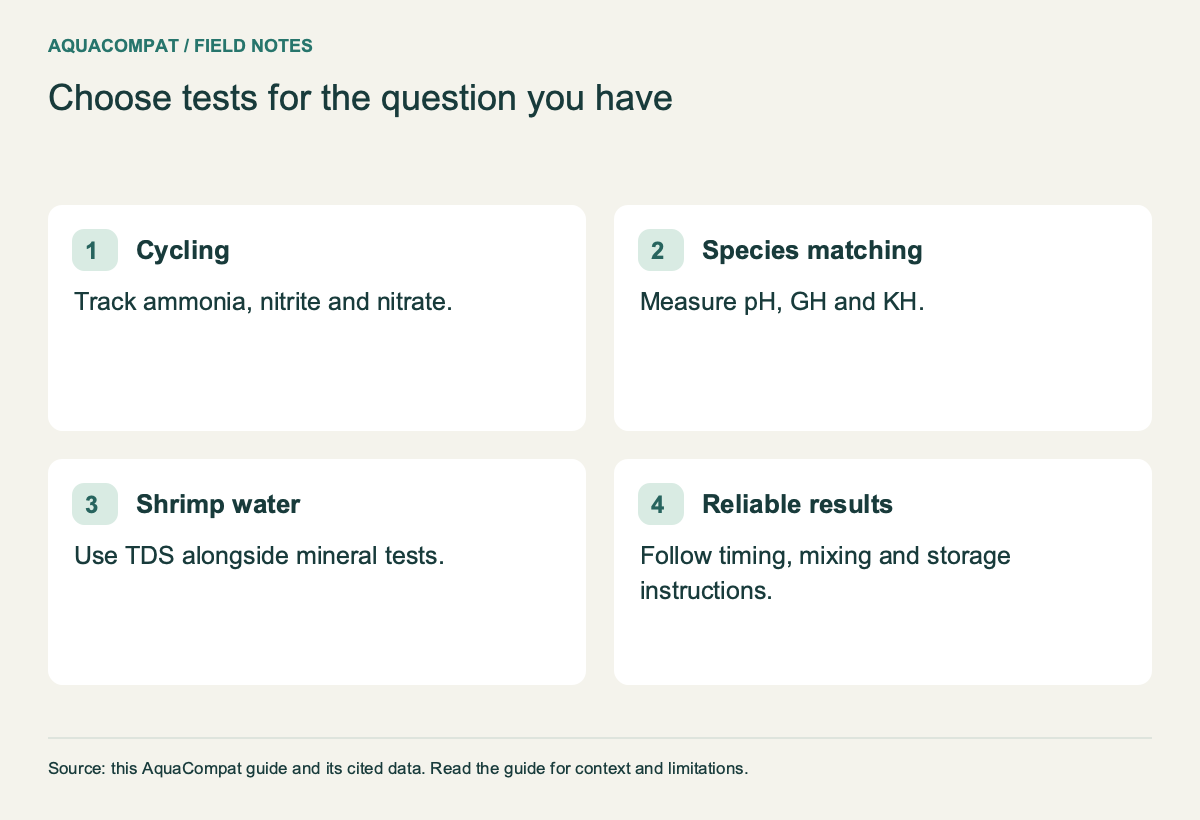
An aquarium test kit should measure the parameters that kill fish first: ammonia, nitrite and pH, then nitrate, and for many species GH and KH. A test kit is any product that turns a water sample into a reading for one or more of these values, whether by dipping a strip, counting drops of reagent or reading a cuvette with a light meter. Four specs decide whether a kit suits your tank.
Parameters covered
The API Freshwater Master Test Kit covers pH, high range pH, ammonia, nitrite, nitrate. The API 5-in-1 strips cover pH, nitrite, nitrate, KH, GH, so they add hardness but drop ammonia. That gap matters in a new tank, where ammonia is the reading that tells you the nitrogen cycle in your aquarium has not finished. Single-parameter tools such as the Salifert KH test, the Hanna HI700 and Seachem Ammonia Alert fill one gap each rather than replacing a full kit.
Method
The method is how the kit turns water into a number: test strip, liquid reagent, titration, photometer or a continuous sensor. Each method has different sources of error, which the next section compares.
Resolution and units
Resolution is the smallest step a kit can report. Only two of the six makers here publish one: Salifert gives 0.1 meq/L or 0.3 dKH for its KH test, and Hanna gives 0.01 ppm for the HI700. API publishes no resolution or measurement range for the Master Test Kit, the GH & KH kit or the strips. Units matter too: the Merck Veterinary Manual notes that most nitrate kits read nitrate-nitrogen (NO3-N), which must be multiplied by 4.4 to give nitrate (NO3) , and the HI700 reports ammonia as NH3-N.
Tests per pack
Test count decides running cost. The Master Test Kit listing describes 800 tests, Salifert states 100–200 tests, and the HI700 ships with reagents for 25 tests.
How do test strips, liquid reagents and photometers differ?
Strips, liquid reagents and photometers differ in how the colour is read: by eye against a printed chart, by eye against a card after a measured reaction, or by an LED and sensor that turns the colour into a number. The table sets out what each maker publishes about its own method.
| Kit | Method | How it is read | Published resolution or accuracy |
|---|---|---|---|
| API 5-in-1 Test Strips | test strip | Pads compared by eye with a colour chart; GH and KH immediately; pH, nitrite, nitrate after 30 seconds | Not published |
| API Freshwater Master Test Kit | liquid reagent | Tube colour compared by eye with a laminated card | Not published |
| API GH & KH Test Kit | liquid reagent (drop count) | Drops counted until the colour changes | Not published |
| Salifert KH/Alk Profi Test | liquid reagent titration | Reagent added until a sharp colour change | 0.1 meq/L or 0.3 dKH |
| Hanna HI700 | photometer (Nessler method adaptation) | LED @ 470 nm reads the cuvette | ±0.05 ppm ±5% of reading at 25 °C |
| Seachem Ammonia Alert | continuous colour-change sensor | Sensor disc compared by eye with a printed scale | Detects below 0.05 mg/L NH3 |
Which test method gives the most precise reading?
A photometer such as the Hanna HI700 is the only kit here with a published accuracy figure, ±0.05 ppm ±5% of reading at 25 °C, so it is the most precise on paper. That precision covers one parameter only, low-range ammonia from 0.00–3.00 ppm NH3-N, and Hanna states it is for freshwater only.
Liquid reagent kits such as the API Master Test Kit rely on your eye matching a tube to a card, so lighting and colour perception affect the result. A titration kit such as the Salifert KH test avoids colour matching: you count reagent until the sample changes colour, and the count gives the value in fixed steps. The API GH & KH kit works the same way by drop count, without a published step size.
Test strips are the fastest method but add a timing variable. API instructs that the GH and KH pads are read at once while the pH, nitrite and nitrate pads need a short wait, so reading a strip too early or too late changes the colour you compare. Strips suit frequent checks between full liquid tests rather than diagnosing a problem.
Seachem Ammonia Alert is different again. It sits in the tank and changes colour continuously, with a scale of safe <0.02; alert 0.05; alarm 0.2; toxic 0.5 mg/L NH3. It warns you between tests but does not replace them.
How do the six test kits compare on published specs?
The six kits compared below cover different parameters, so the table is a coverage map rather than a ranking. Blank or “not published” cells mean the maker gives no figure.
| Kit | Parameters | Tests or life | Water type |
|---|---|---|---|
| API Freshwater Master Test Kit | pH, high range pH, ammonia, nitrite, nitrate | 800 tests | Not published |
| API 5-in-1 Test Strips | pH, nitrite, nitrate, KH, GH | 100 strips (listing) | freshwater and saltwater |
| API GH & KH Test Kit | general hardness (GH), carbonate hardness (KH) | Not published | Not published |
| Salifert KH/Alk Profi Test | carbonate hardness / alkalinity | 100–200 tests | marketed with reef/seawater reference values |
| Hanna HI700 | ammonia (NH3-N), low range | 25 tests included | freshwater only |
| Seachem Ammonia Alert | free ammonia (NH3) | over 1 year | freshwater and marine; not recommended at acid pH |
Test kits matched to the job
Each kit below fills a different testing job, from a full nitrogen-cycle panel to a single precise ammonia number. AquaCompat did not test any of them; the notes describe what the published specifications mean for a freshwater tank.
As an Amazon Associate I earn from qualifying purchases. Prices change often, so they are not shown here; the button opens the current listing.

API Freshwater Master Test Kit
- Tests
- pH, high range pH, ammonia, nitrite, nitrate
- Method
- liquid reagent
- Reagents
- 7 bottles
- Tests per kit
- 800 tests
Fits: a new tank going through fishless cycling, or any community tank where you want ammonia, nitrite, nitrate and pH from one box.
Skip it if: you need GH or KH, which this kit does not cover, or you need a published resolution figure.
Check price on Amazon
API 5-in-1 Test Strips
- Tests
- pH, nitrite, nitrate, KH, GH
- Method
- test strip
- Read time
- GH and KH immediately; pH, nitrite, nitrate after 30 seconds
- Strips (listing)
- 100 strips
Fits: weekly spot checks of an established tank, including GH and KH, when a liquid kit feels slow.
Skip it if: the tank is cycling or fish show stress; the strips have no ammonia pad.
Check price on Amazon
API GH & KH Test Kit
- Tests
- general hardness (GH), carbonate hardness (KH)
- Method
- liquid reagent (drop count)
- Contents
- KH test bottle, GH test bottle, 2 capped test tubes, instructions
Fits: a cherry shrimp or soft-water tetra tank where GH and KH decide which species can share the water.
Skip it if: you only keep hardy community fish in stable tap water and already test hardness with strips.
Check price on Amazon
Salifert KH/Alk Profi Test
- Tests
- carbonate hardness / alkalinity
- Method
- liquid reagent titration
- Steps
- 0.1 meq/L or 0.3 dKH
- Tests per kit
- 100–200 tests
Fits: owners tracking small KH changes, for example in a low-KH planted or shrimp tank, who want fixed titration steps.
Skip it if: you want a published freshwater rating; Salifert frames the kit around seawater values and does not state freshwater suitability.
Check price on Amazon
Hanna HI700 Ammonia Checker
- Range
- 0.00–3.00 ppm NH3-N
- Resolution
- 0.01 ppm
- Accuracy
- ±0.05 ppm ±5% of reading at 25 °C
- Tests included
- 25 tests
Fits: anyone who struggles to judge reagent colours, or who wants a numeric ammonia reading during cycling or after a fish loss.
Skip it if: you need readings above its 0.00–3.00 ppm NH3-N range, such as the higher dosing targets some fishless-cycling methods use.
Check price on Amazon
Seachem Ammonia Alert
- Detects
- free ammonia (NH3)
- Threshold
- 0.05 mg/L NH3
- Lifespan
- over 1 year
- Use in
- freshwater and marine; not recommended at acid pH
Fits: a stocked tank where you want a passive warning between weekly tests, such as an established betta or goldfish tank.
Skip it if: your water is acidic, which Seachem does not recommend, or you need a total ammonia figure for cycling.
Check price on AmazonHow did we choose these test kits?
Every kit here was chosen by reading manufacturer specifications and instructions, not by testing kits against lab standards. No independent laboratory or hobby publication we found has published side-by-side accuracy testing of aquarium kits, so any page that ranks kits by accuracy is guessing. We selected kits that each cover a distinct job: a multi-parameter liquid kit, a strip alternative, a hardness kit, a fine-step KH titration, a photometer and a continuous sensor. Each one had to have a maker’s page we could read and a US listing that matches the exact product. Prices are left out because they change daily. The full process is described on the AquaCompat research method page.
Several kits we planned to cover were left out. Sera and JBL kits are common in Europe, and Salifert also sells nitrate and calcium tests, but we did not have verified manufacturer data or a matching listing for them, so they are not compared here.
Which test kit suits cycling, shrimp or a stocked community tank?
The right kit depends on what can go wrong in your tank. Three situations cover most freshwater owners.
Cycling a new tank
A new tank needs ammonia, nitrite and nitrate readings several times a week, which the liquid API Master Test Kit provides. The cycle is complete when a full ammonia dose is converted to nitrate within 24 hours with no nitrite, the end point set out in the fishless cycling method. Dr Tim’s Aquatics recommends dosing to 2–3 mg/L ammonia-N, which fits inside the HI700’s range; the SRAC target of 3–5 mg/L total ammonia may read above it.
Shrimp and soft-water tanks
Shrimp tanks need GH and KH as well. Cherry shrimp are listed at 6–10 dGH and 2–8 dKH, and any trace of ammonia or nitrite is dangerous to them. A drop-count GH & KH kit tells you whether your water suits cherry shrimp and their tank mates, and the guide to GH and KH explains what each reading means.
An established community tank
A stocked, cycled tank mainly needs nitrate and pH trends. Strips give a quick weekly view, with a liquid test when something looks wrong. A passive Ammonia Alert adds a warning between checks.
Does an ammonia test show how toxic the water is?
No, most ammonia tests read total ammonia, and the toxic share depends on pH and temperature. UF/IFAS explains that the un-ionized form (NH3) is 100 times more toxic (approx.) than ammonium, and that its share rises with pH and temperature. In the Emerson table that UF/IFAS uses, the un-ionized share is 0.006 fraction of TAN (pH 7.0, 26 °C / 78.8 °F), but it rises to 0.0574 fraction of TAN (pH 8.0, 26 °C). The same total ammonia reading is therefore far more dangerous in hard, alkaline water.
That is why a liquid kit that reads both pH and ammonia, or a pH reading taken alongside the HI700, gives a more useful answer than an ammonia number on its own. Seachem Ammonia Alert is the exception here: Seachem says it detects free NH3 only, not ionized ammonium . For the full chemistry, see how pH changes ammonia toxicity.
When do aquarium test kit readings go wrong?
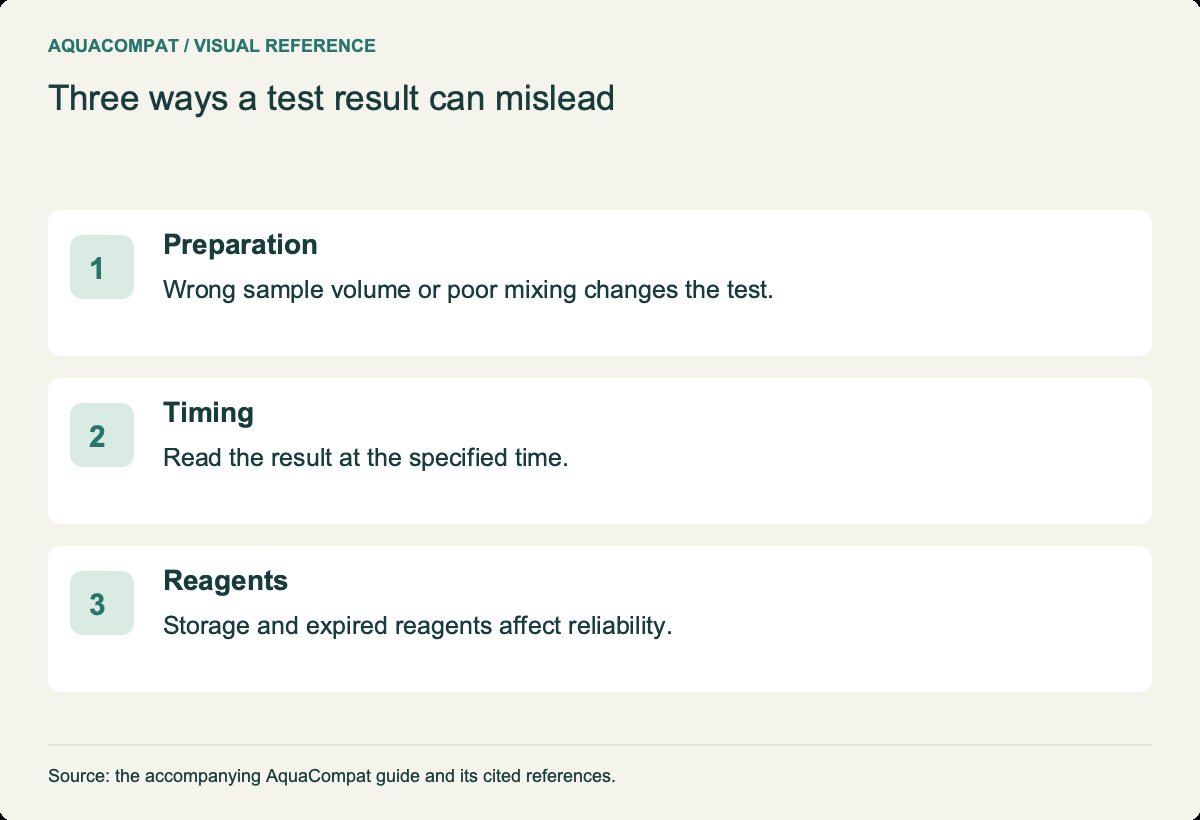
Most wrong readings come from timing, units or using a kit outside its stated range. The published instructions and sources point to five common traps.
- pH measured late: SRAC advises measuring pH promptly, with a limit of 30 minutes (max delay after sampling), because CO2 escaping from the sample shifts the result.
- Strips read at the wrong time: API specifies GH and KH immediately; pH, nitrite, nitrate after 30 seconds.
- Nitrate units mixed up: a kit reading NO3-N gives a smaller number than one reading NO3, as the Merck conversion above shows.
- Out of range: the HI700 tops out at the upper end of 0.00–3.00 ppm NH3-N, and Hanna’s accuracy figure applies only at its stated reference temperature.
- Wrong water: Seachem’s stated use for Ammonia Alert is freshwater and marine; not recommended at acid pH, and Hanna limits the HI700 to freshwater.
If a reading looks wrong, retest with a second method before treating the tank.
How often should you test aquarium water?
Test weekly in an established tank and every day or two while cycling or after a problem. The Merck Veterinary Manual’s maintenance schedule lists the water-change interval as 2 weeks (interval) and pairs it with tests for pH, alkalinity, ammonia, nitrite and nitrate. Merck also advises testing ammonia and nitrite more often after disease treatments, especially antibiotics, which can harm filter bacteria . Practical Fishkeeping and Aquarium Co-Op suggest keeping nitrate below about 40 ppm. The weekly aquarium maintenance schedule sets out when to test alongside other tasks.
Filtration affects how fast readings change. A large canister buffers swings better than a small internal filter; the canister filters by tank size and the sponge filters for shrimp and fry each list the published flow and rated volume to compare.
Are Sera or JBL test kits better for European tanks?
We cannot say, because we hold no verified manufacturer data for Sera or JBL kits. None of the six kits compared here has a published sales region in our fact files, so check that the API, Salifert, Hanna or Seachem product is sold in your country before relying on this page. If you choose a European kit, compare it on the same four points used above: parameters, method, published resolution and nitrate units.
Questions people ask
Are aquarium test strips accurate enough?
No maker here publishes strip accuracy, so nobody can give a figure. API’s own instructions show strips depend on reading time, and the 5-in-1 strips have no ammonia pad. They suit routine checks of a cycled tank; use a liquid kit or a photometer for cycling and for diagnosing sick fish.
Does the API Master Test Kit test GH and KH?
No. API lists pH, high range pH, ammonia, nitrite, nitrate only. Hardness needs the separate API GH & KH kit, the 5-in-1 strips, or a KH titration such as Salifert. Shrimp and soft-water species owners should add one of these.
Can I use the Salifert KH test in a freshwater tank?
Salifert does not state freshwater suitability; its page frames KH around seawater and coral growth. The titration chemistry measures carbonate hardness, which exists in freshwater too, but because the maker does not confirm freshwater use we list it as unverified rather than recommended for all tanks.
Why does my ammonia reading differ between two kits?
The kits may report different forms or units. Seachem Ammonia Alert detects free NH3 only, the HI700 reports NH3-N, and colour-card kits report total ammonia. Different methods also have different error sources, so compare trends from one kit rather than single readings across kits.
Which test kit do I need for a new tank?
A kit that covers ammonia, nitrite and nitrate, such as the API Freshwater Master Test Kit. You will test several times a week until a full ammonia dose clears to nitrate within 24 hours with no nitrite showing.
Sources 29 documents from 13 publishers
- Amazon (amazon.com): “API Freshwater Master Test Kit 800-Test”; “Salifert KH/Alk Test Kit, 100-200 Tests”; “API 5-IN-1 Test Strips 100-Count Box”; “Seachem Ammonia Alert 1 Year Monitor (3 Pack)”
- API Fishcare (apifishcare.com): “API Freshwater Master Test Kit”; “API 5-in-1 Test Strips”; “API General & Carbonate Hardness Test Kit”
- Aquarium Co-Op (aquariumcoop.com): “Care Guide for Cherry Shrimp”; “Guide to Aquarium Water Changes”
- Dr Tim's Aquatics (manufacturer) (drtimsaquatics.com): “Fishless Cycling”
- Hanna Instruments (hannainst.com): “Low Range Ammonia Colorimeter Checker HC HI700”
- Merck Veterinary Manual (merckvetmanual.com): “Environmental Diseases of Aquatic Animals in Aquatic Systems, Francis-Floyd, Yanong and Petty”; “Management of Aquarium Fish, Petty, Francis-Floyd and Yanong”; “Routine Health Care of Fish (pet owner version)”; “Disorders and Diseases of Fish (pet owner version)”; “Special Considerations for Fish (pet owner version)”; “Providing a Home for Fish (pet owner version)”
- Practical Fishkeeping (practicalfishkeeping.co.uk): “How to Cycle a Fish Tank: The Complete Guide”; “How often should I change my water?”
- Salifert (salifert.com): “KH/Alk Profi Test”
- Seachem (seachem.com): “Ammonia Alert”
- Shrimp and Snail Breeder (aquariumbreeder.com): “Red Cherry Shrimp: detailed guide, care, diet and breeding”
- Shrimp Science (shrimpscience.com): “Red Cherry Shrimp - Care Guide”; “Carbonate Hardness (KH) For Shrimp Tanks”
- Southern Regional Aquaculture Center (srac.msstate.edu): “How to Start a Biofilter, SRAC Publication No. 4502, DeLong and Losordo”; “Nitrite in Fish Ponds, SRAC Publication No. 462, Durborow, Crosby and Brunson”; “Recirculating Aquaculture Tank Production Systems: Management of Recirculating Systems, SRAC Publication No. 452”; “Interactions of pH, Carbon Dioxide, Alkalinity and Hardness in Fish Ponds, SRAC Publication No. 464, Wurts and Durborow”
- UF/IFAS EDIS (ask.ifas.ufl.edu): “FA16: Ammonia in Aquatic Systems (Francis-Floyd, Watson, Petty, Pouder)”
All sources accessed . Every number on this page comes from these documents.