What specs matter when you choose a canister filter for your tank?
Four published specs decide whether a canister filter suits a tank: the rated tank size, the flow rate, the media volume and the head height. A canister filter is a sealed external container, usually kept in the stand below the tank, that pumps water down through hoses, pushes it through stacked media and returns it to the tank.
Rated tank size
The rated tank size is the maker’s own statement of which aquariums the filter is built for, and it is the first number to compare. Fluval rates the 207 for 20–45 US gal / 60–220 L, while Eheim publishes the Classic 250 range only in litres, as 80–250 L. Treat the top of any range as a ceiling for a lightly stocked tank, not a target for a heavily stocked one.
Pump output versus filter circulation
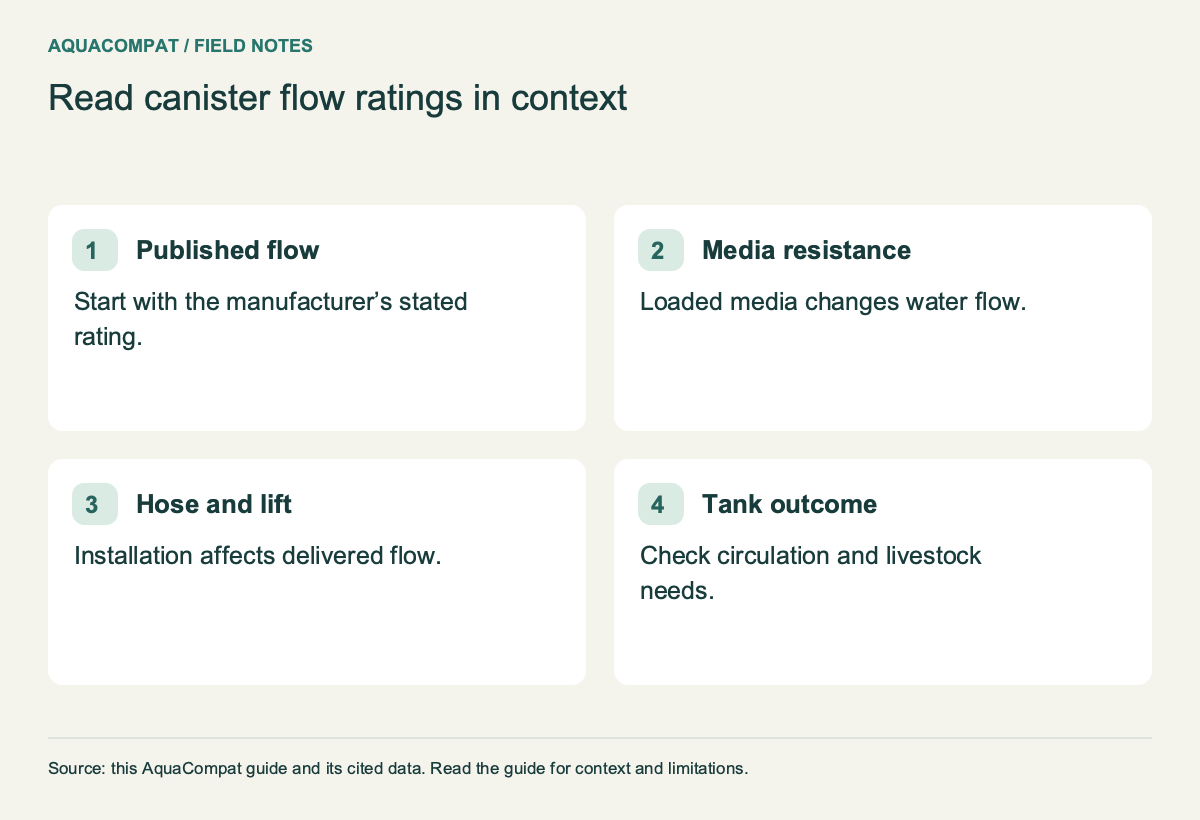
Pump output is the flow the motor can move with no media in the way. Fluval publishes a second, lower figure for the 107: pump output of 145 US gal/h but filter circulation of 95 US gal/h. The FX4 shows the same gap, 700 US gal/h against 450 US gal/h. The circulation figure is closer to what actually passes through the media.
Media volume
Media volume is how much sponge, ceramic and other filter material the canister holds, and more media gives filter bacteria more surface to live on. Fluval quotes a 3.1 L media basket for the 307, Eheim a 4 L filter volume for the Classic 350, and OASE 4.4 L for the BioMaster Thermo 250. Makers measure this differently, so compare within one brand where you can.
Head height
Head height is how far the pump can lift water from the canister back to the tank. The Fluval 107 and 207 list 4.75 ft / 1.45 m, the 407 lists 7 ft / 2.25 m, and Eheim gives the Classic 350 1.8 m. A tall stand uses up part of that figure before the water reaches the tank.
Which canister filter fits a 20, 29, 40, 55, 75 or 125-gallon tank?
Match the tank to every filter whose published range covers it, then choose on media volume and features. The table below applies each maker’s own rating; a filter appears only where the tank sits inside its stated range.
| Tank size | Volume | Filters rated for it |
|---|---|---|
| 20 gal | 76 L | Fluval 107, Fluval 207, OASE BioMaster Thermo 250 |
| 29 gal | 110 L | Fluval 107, Fluval 207, Eheim Classic 250, OASE BioMaster Thermo 250 |
| 40 gal | 151 L | Fluval 207, Fluval 307, Eheim Classic 250, Eheim Classic 350, OASE BioMaster Thermo 250 |
| 55 gal | 208 L | Fluval 307, Fluval 407, Eheim Classic 250, Eheim Classic 350, OASE BioMaster Thermo 250 |
| 75 gal | 284 L | Fluval 407, Eheim Classic 350, Fluval FX4 |
| 125 gal | 473 L | Fluval FX4 |
How do the eight canister filters compare on published specs?
The eight filters below are listed from smallest to largest rated tank. Fluval and OASE publish US gallons per hour; Eheim publishes litres per hour at 50 Hz only, so its US 60 Hz output is not given here.
| Filter | Rated tank | Pump output | Media | Power | Max head |
|---|---|---|---|---|---|
| Fluval 107 | 10–30 US gal / 40–130 L | 145 US gal/h | 1.2 L basket | 10 W | 4.75 ft / 1.45 m |
| Fluval 207 | 20–45 US gal / 60–220 L | 206 US gal/h | 1.8 L basket | 10 W | 4.75 ft / 1.45 m |
| Eheim Classic 250 | 80–250 L | 440 L/h | 3 L filter | 8 W | 1.5 m |
| OASE BioMaster Thermo 250 | up to 250 L / 70 US gal | 250 US gal/h | 4.4 L filter | 15 W plus 150 W heater | 1.7 m |
| Fluval 307 | 40–70 US gal / 90–330 L | 303 US gal/h | 3.1 L basket | 16 W | 5.75 ft / 1.75 m |
| Eheim Classic 350 | 120–350 L | 620 L/h | 4 L filter | 15 W | 1.8 m |
| Fluval 407 | 50–100 US gal / 150–500 L | 407 US gal/h | 4.2 L basket | 23 W | 7 ft / 2.25 m |
| Fluval FX4 | up to 250 US gal / 1000 L | 700 US gal/h | 1 US gal / 3.9 L media | 30 W | 6.9 ft / 2.1 m |
Canister filters matched to tank size
Each canister below was chosen for a tank-size band using the ratings and specifications above. AquaCompat did not run any of these filters; the notes explain what the published figures mean for a real tank and who should look elsewhere.
As an Amazon Associate I earn from qualifying purchases. Prices change often, so they are not shown here; the button opens the current listing.

Fluval 107
- Rated tank
- 10–30 US gal / 40–130 L
- Pump output
- 145 US gal/h
- Circulation
- 95 US gal/h
- Media basket
- 1.2 L
Fits: a 20-gallon planted or community tank where you want the filter out of sight; at 7.5 x 7 x 13.7 in (19 x 18 x 35 cm) it fits inside most cabinet stands.
Skip it if: your tank is 29 gallons and heavily stocked, which puts it at the top of the 107’s rated range; step up to the 207.
Check price on Amazon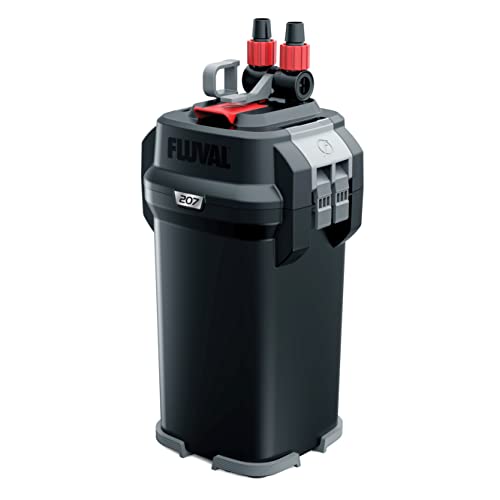
Fluval 207
- Rated tank
- 20–45 US gal / 60–220 L
- Pump output
- 206 US gal/h
- Media basket
- 1.8 L
- Pre-filter
- 803 cm2
Fits: a 29 or 40-gallon community tank, the size band where its range overlaps both the 107 and 307.
Skip it if: your stand puts the canister close to its published 4.75 ft / 1.45 m head limit below the tank rim.
Check price on Amazon
Eheim Classic 250
- Rated tank
- 80–250 L
- Pump output
- 440 L/h
- Filter volume
- 3 L
- Power
- 8 W
Fits: a 29 to 55-gallon tank where you want a simple single-chamber canister with a low published power draw.
Skip it if: you want a US-rated flow figure; Eheim publishes output at 50 Hz only, so flow on US 60 Hz power is not stated.
Check price on Amazon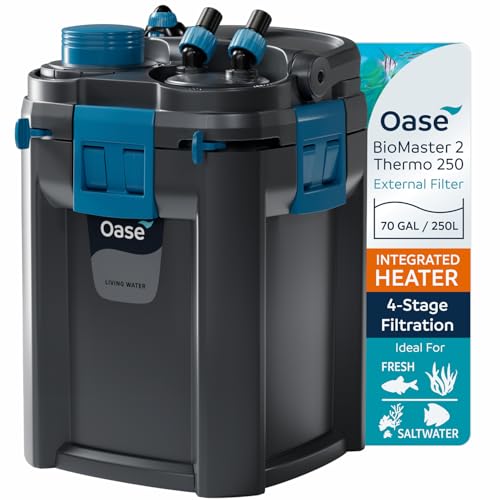
OASE BioMaster Thermo 250
- Rated tank
- up to 250 L / 70 US gal
- Max flow
- 250 US gal/h
- Heater
- 150 W
- Heater range
- 66–90 °F
Fits: a 40 to 55-gallon tropical tank where you want no heater tube in the display; the heater sits inside the canister.
Skip it if: you would rather replace a failed heater without replacing or servicing the filter, or your tank needs more than one heater.
Check price on Amazon
Fluval 307
- Rated tank
- 40–70 US gal / 90–330 L
- Pump output
- 303 US gal/h
- Media basket
- 3.1 L
- Max head
- 5.75 ft / 1.75 m
Fits: a 55-gallon community tank, near the middle of its rated range, with enough media basket for a well-stocked tank.
Skip it if: you keep a 75-gallon tank or larger; that is above Fluval’s stated range for the 307.
Check price on Amazon
Eheim Classic 350
- Rated tank
- 120–350 L
- Pump output
- 620 L/h
- Filter volume
- 4 L
- Max head
- 1.8 m
Fits: a 40 to 75-gallon tank, especially in the UK or EU where Eheim lists it, with a large single-chamber filter volume.
Skip it if: your tank is below Eheim’s stated 120–350 L range; the Classic 250 starts lower.
Check price on Amazon
Fluval 407
- Rated tank
- 50–100 US gal / 150–500 L
- Pump output
- 407 US gal/h
- Media basket
- 4.2 L
- Power
- 23 W
Fits: a 75-gallon tank or a heavily stocked 55, including large cichlids or goldfish that load the filter hard.
Skip it if: your tank is under 50 gallons; the 307 covers that range with a smaller canister.
Check price on Amazon
Fluval FX4
- Rated tank
- up to 250 US gal / 1000 L
- Pump output
- 700 US gal/h
- Media
- 1 US gal / 3.9 L
- Pump
- auto start; pauses every 12 hours to purge trapped air
Fits: a 90 to 125-gallon tank or an oscar tank, where the self-starting pump and drain valve make servicing a large canister easier.
Skip it if: you need exact dimensions to plan a stand; Fluval’s FX4 page does not list them in our sources.
Check price on AmazonHow did we choose these canister filters?
Every filter here was chosen by comparing manufacturer specifications against common tank sizes. We did not run these filters, measure their flow or test their noise, so the notes report only what Fluval, Eheim and OASE publish. The criteria, in order of weight, were a published tank rating that covers at least one common US tank size, a published flow and media figure, a maker’s page we could read, and a US listing that matches the exact model. Prices are left out because they change daily. The full process is on the methodology page.
Two filters on our plan were left off. The Fluval FX6 and Eheim Classic 600 had no verified spec file at the time of writing, so we could not size them with confidence.
Is the biggest flow rating always the best canister filter?
No, the headline flow on the box is pump output with an empty canister, and more flow is not better for every fish. Fluval’s own figures show the gap: the 207 moves 206 US gal/h at the pump but 121 US gal/h through the filter.
Strong flow also suits some species and harms others. Aquarium Co-Op notes that long-finned domestic bettas cannot swim well in strong currents and need gentle filtration , so a canister on a betta tank needs its spray bar aimed at the glass. The betta tank mates guide covers which fish share that calm water. Goldfish sit at the opposite end: Aquarium Co-Op and OATA describe them as heavy waste producers that need strong filtration , which is why a 75-gallon goldfish community suits the larger Fluval 407.
Should you size up the canister for large or messy fish?
Yes, size up one model when your fish are large or messy. Makers do not say what stocking level their tank ratings assume, so large fish leave less margin than the label suggests. Adult oscars reach 14 in (35.6 cm) and need at least 75 US gal (284 L). That tank sits inside the 407’s range, but because FishBase and Seriously Fish describe oscars as protein-preferring predators , the FX4 gives more headroom for oscar tank mates setups. Goldfish grow to 10 in (25.4 cm) with a 48 US gal (182 L) minimum, so a goldfish tank of that size suits the 307 or 407 rather than the 207.
Small, light-bodied fish need less. A 29-gallon tank of neon tetras at 1.2 in (3 cm) and bronze corydoras at 3 in (7.6 cm) sits comfortably inside the Fluval 107 or 207 range.
Does a canister filter with a built-in heater replace a separate heater?
It can, within its rating. The OASE BioMaster Thermo 250 includes a 150 W heater adjustable across 66–90 °F. Hobby sizing rules put the need at about 5 W/gal, so 150 watts suits roughly a 30-gallon tank in a cool room and more in a heated one. For tanks near the top of its rated range in a cold room, a second heater from the heaters sized for each tank is a sensible backup. Every other canister here needs a separate heater.
Which canister filters are sold in the US, UK and EU?
Fluval lists the 07 series and FX4 for the US, Canada and the UK, OASE lists the BioMaster Thermo 250 for the US, EU and UK, and Eheim lists the Classic 250 and 350 for the EU and UK. Eheim’s US availability is not confirmed by the maker in our sources, although a US Amazon listing exists for both. UK owners can choose from all three brands and EU owners from Eheim and OASE; US owners will find Fluval specifications published in gallons per hour at 60 Hz, which makes direct comparison easier.
When is a canister filter the wrong choice?
A canister is the wrong choice for very small tanks, shrimp and fry tanks, and stands that are too tall for the pump. The smallest canister here, the Fluval 107, is rated from 10 gallons, so nano tanks below that need a different filter type. Fluval does not publish intake strainer details for the 07 series or FX4, which matters for cherry shrimp and fry small enough to pass through an open intake; compare sponge filters for shrimp tanks instead. Eheim sets a maximum installation height of 180 cm for the Classic series, so check the stand height against both that figure and the head height.
A new canister also does not arrive cycled. A brand-new filter on a new tank still needs the full nitrogen cycle, tracked with one of the aquarium test kits we compare.
How do you clean a canister filter without losing the cycle?
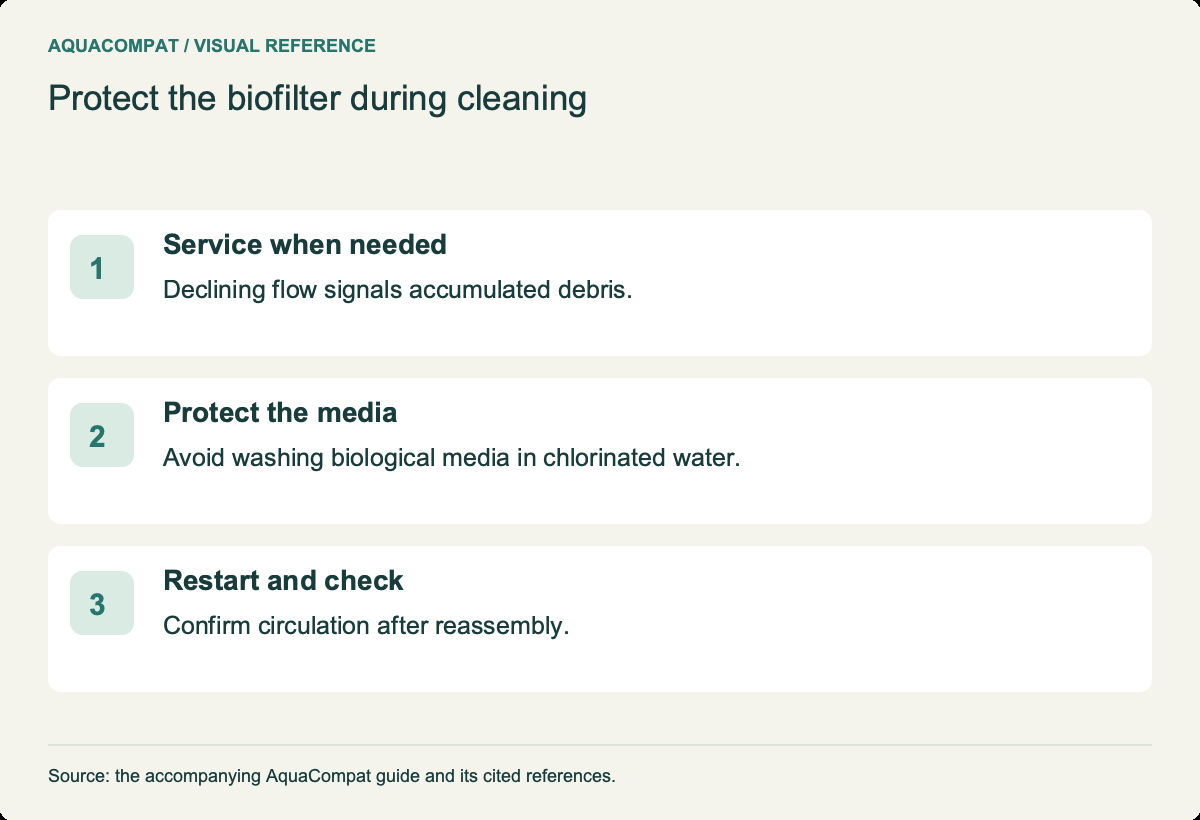
Rinse the media in old tank water, never in tap water. Practical Fishkeeping warns that chlorine in tap water kills the nitrifying bacteria living on filter media . Fluval fits the FX4 with a multi-functional utility valve for emptying canister and water changes, which shortens the job. Treat any top-up water first with one of the dechlorinators we compare. In planted tanks, keep the intake above fine soils such as those in the planted tank substrate guide, since disturbed soil clogs pre-filters quickly.
Questions people ask
What size canister filter do I need for a 55-gallon tank?
A filter whose rated range covers 55 gallons with headroom: the Fluval 307 (40–70 US gal / 90–330 L), the Eheim Classic 350 (120–350 L) or, for heavily stocked tanks, the Fluval 407 (50–100 US gal / 150–500 L).
Is a Fluval 07 series filter or an Eheim Classic better?
Neither is better on published data alone; they are built differently. Fluval publishes US flow at 60 Hz, a separate circulation figure and multi-basket media. Eheim publishes a single filter volume and metric output at 50 Hz. Choose by which maker rates its filter for your tank and region.
Can I use a canister filter on a 10-gallon tank?
Only the Fluval 107 is rated that low, at 10–30 US gal / 40–130 L, and 10 gallons is the bottom of its range. Most 10-gallon tanks are better matched to a filter rated for small tanks, such as the air-driven models in our sponge filter guide.
Do canister filters need priming?
Most do. Fluval says the FX4’s pump auto start; pauses every 12 hours to purge trapped air, which removes manual priming on that model. Check the manual for the 07 series, Eheim Classic and OASE units before the first start.
How many watts does a canister filter use?
Published power ranges from 8 W for the Eheim Classic 250 to 30 W for the Fluval FX4. The OASE Thermo adds up to 150 W when its heater is running.
Sources 55 documents from 20 publishers
- Amazon (amazon.com): “Fluval 207 Perfomance Canister Filter for Aquariums up to 45 Gallons”; “Fluval 107 Perfomance Canister Filter for Aquariums up to 30 Gallons”; “OASE BioMaster 2 Thermo 250 Canister Filter for Aquariums”; “Fluval 307 Perfomance Canister Filter for Aquariums up to 70 Gallons”; “Fluval 407 Performance Canister Filter - For Aquariums Up To 100 Gallons”; “Fluval FX4 High Performance Aquarium Filter, up to 250 Gal.”
- Aquarium Co-Op (aquariumcoop.com): “Betta Fish Care Guide”; “Care Guide for Dwarf Gouramis”; “10 Best Top-Dwelling Fish for Your Freshwater Community Aquarium”; “Care Guide for Fancy Goldfish”; “Goldfish Tank Mates”; “Amano Shrimp Care Guide”; “Oscar Fish Care Guide”; “How to Choose the Right Aquarium Heater”; “Does dechlorinator remove ammonia?”
- EHEIM (eheim.com): “EHEIM classic 250”; “EHEIM classic 350”
- FishBase (fishbase.se): “Betta splendens summary (Bayesian length-weight estimate)”; “Carassius auratus, Goldfish: species summary”; “Length-weight relationships for Carassius auratus”; “Astronotus ocellatus, Oscar: species summary”; “Length-weight relationships for Astronotus ocellatus”; “Paracheirodon innesi summary page”; “Osteogaster aenea, Bronze corydoras”
- fishkeeping.co.uk (fishkeeping.co.uk): “Goldfish Size, Life Expectancy and Tank Recommendations”; “Keeping Goldfish - The Right Way”
- Fluval (Hagen) (fluvalaquatics.com): “207 Canister Filter, 20-45 US Gal / 60-220 L - Fluval USA”; “07 Series Aquarium Filters - Fluval USA”; “107 Canister Filter, 10-30 US Gal / 40-130 L - Fluval USA”; “FX4 Canister Filter, up to 250 US Gal / 1000 L - Fluval USA”; “FX Series user manual”; “307 Canister Filter, 40-70 US Gal / 90-330 L - Fluval USA”; “407 Canister Filter, 50-100 US Gal / 150-500 L - Fluval USA”
- Maidenhead Aquatics (fishkeeper.co.uk species data sheet) (fishkeeper.co.uk): “Siamese Fighting Fish/Betta data sheet”; “Oscar data sheet”
- Merck Veterinary Manual (merckvetmanual.com): “Environmental Diseases of Aquatic Animals in Aquatic Systems, Francis-Floyd, Yanong and Petty”
- OASE (oase.com): “BioMaster 2 Thermo 250”
- OASE North America (us.oase.com): “BioMaster 2 Thermo 250 External Canister Filter”
- Ornamental Aquatic Trade Association (OATA) (ornamentalfish.org): “How to look after goldfish in an aquarium / fish tank”; “How to look after fancy goldfish”
- PlanetCatfish (via Internet Archive snapshot, 2025) (web.archive.org): “Osteogaster aenea (Bronze Cory) Cat-eLog data sheet”
- Practical Fishkeeping (practicalfishkeeping.co.uk): “What water temperature do goldfish need?”; “How can I breed goldfish in my aquarium?”; “Problem solver: New Tank Syndrome”
- Seachem Laboratories (manufacturer) (seachem.com): “Prime”
- Seriously Fish (seriouslyfish.com): “Betta splendens”; “Astronotus ocellatus”; “Paracheirodon innesi (Neon Tetra)”; “Osteogaster aenea (Bronze Cory)”
- Shrimp and Snail Breeder (aquariumbreeder.com): “Cherry shrimp in a community tank: how to make it successful”
- Tropical Fish Hobbyist Magazine (tfhmagazine.com): “Betta splendens”; “Astronotus sp.”
- UF/IFAS EDIS (ask.ifas.ufl.edu): “Evolution, Culture, and Care for Betta splendens (FA212)”
- University of Florida IFAS Extension (EDIS) (ask.ifas.ufl.edu): “Teach Aquaculture Curriculum: Chlorine, Friend or Foe? (FA171), Chapman et al.”
- US Environmental Protection Agency (epa.gov): “Chloramines in Drinking Water”
All sources accessed . Every number on this page comes from these documents.