What makes a good tank mate for an oscar?
A good oscar tank mate is too big to swallow, even after the oscar finishes growing, calm enough not to bully it, and comfortable in the same warm water. The oscar (Astronotus ocellatus) is a large cichlid from the Amazon and Orinoco basins that reaches 14 in (35.6 cm) by Seriously Fish’s measure. Four criteria follow from the sources in our oscar data.
- Too large to eat. Seriously Fish and Aquarium Co-Op both say the oscar will eat any fish small enough to swallow, and they advise against much smaller fish and nano species. This single rule removes most aquarium fish.
- Not a bully. Aquarium Co-Op notes that the oscar can itself be bullied by other large, aggressive fish. A tank mate big enough to be safe must not be so aggressive that the oscar becomes the victim.
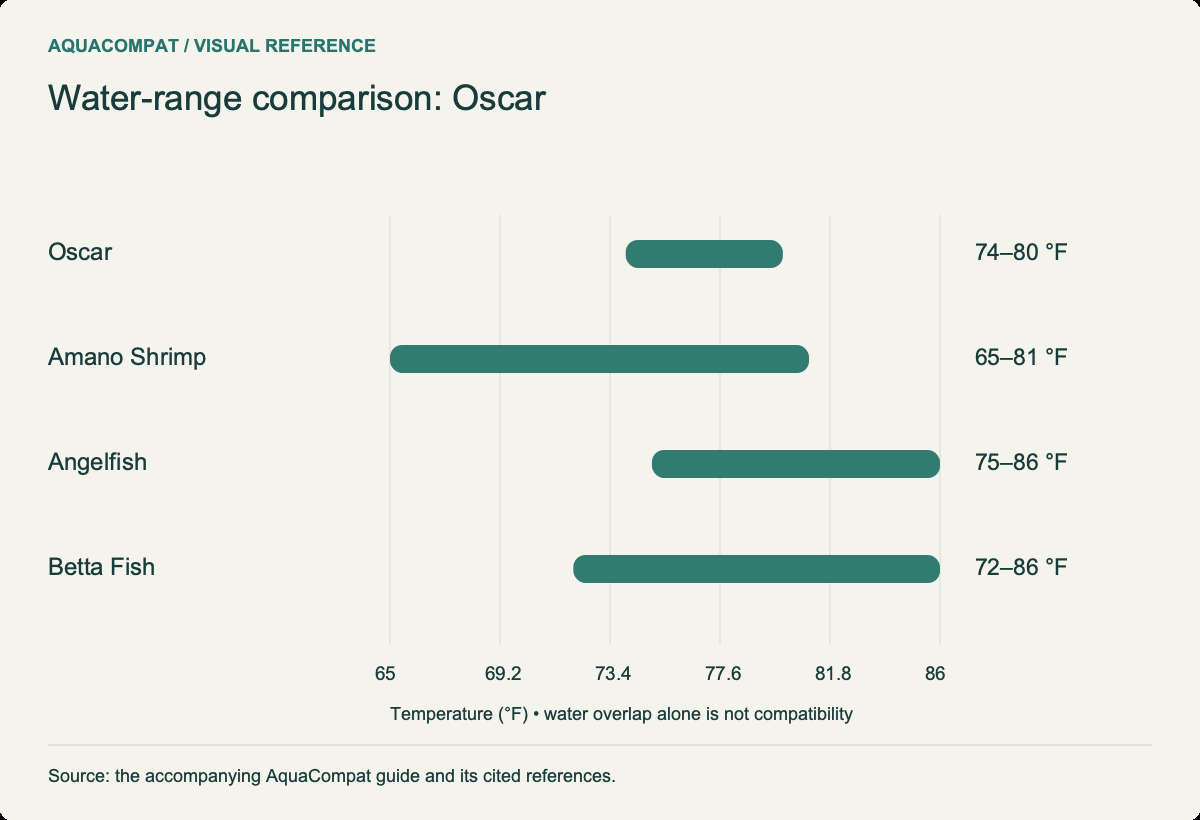
- Shared warm water. Oscars need 74–80 °F (23–27 °C), pH 6.0–8.0 and 5–20 dGH. The pH and hardness ranges are wide, so temperature and size decide most pairings.
- Tolerant of a bare, rearranged tank. Seriously Fish and Aquarium Co-Op both say oscars dig, uproot plants and rearrange decor, so tank mates that depend on dense planting lose their cover.
Temperament is the criterion people expect to matter most, yet it matters least here. Seriously Fish calls the oscar not especially aggressive for a cichlid of its size; the risk it poses is predation, not fighting. The other pages in our tank mates by species series apply the same criteria to smaller fish.
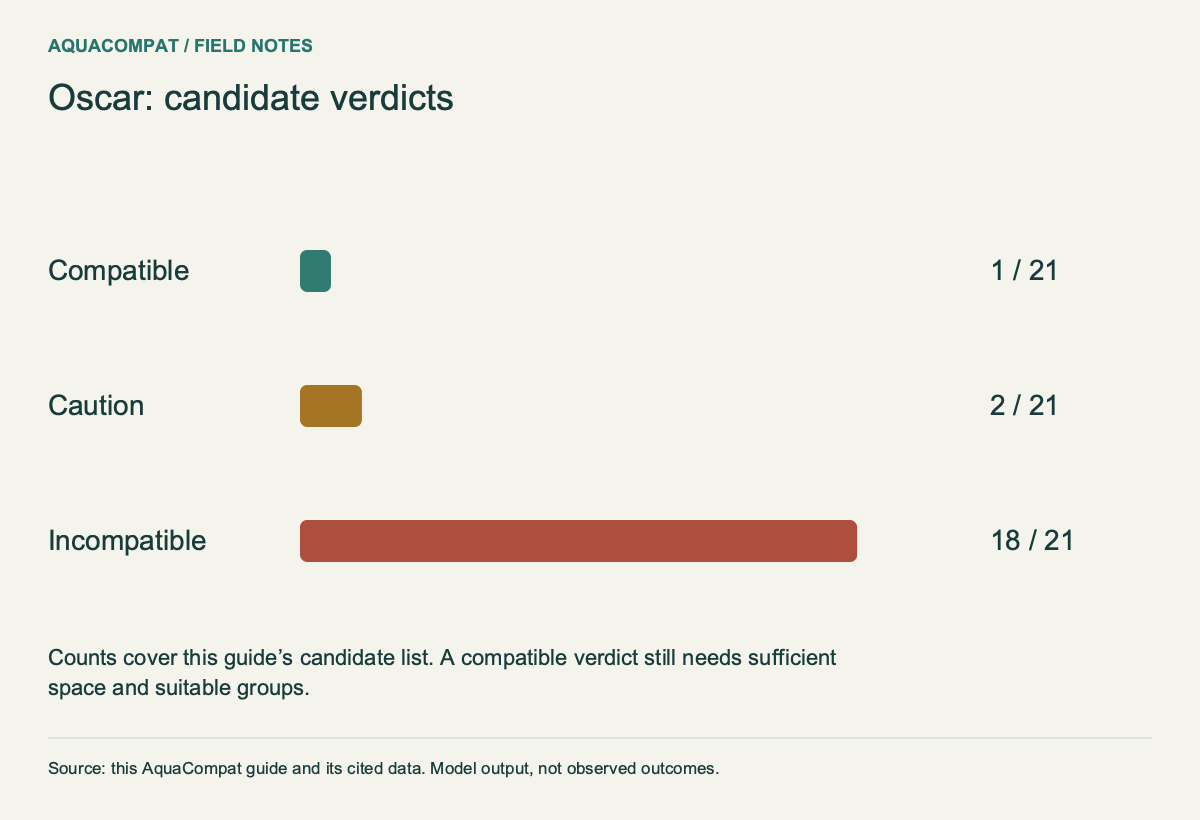
| Species | Verdict | Score | Shared temperature | Shared pH | Smallest tank |
|---|---|---|---|---|---|
| Nerite Snail | compatible | 8/10 | 74–79 °F (23–26 °C) | pH 7.2–8.0 | 125 US gal (473 L) |
| Angelfish | caution | 7/10 | 75–80 °F (24–27 °C) | pH 6.0–8.0 | 125 US gal (473 L) |
| Mystery Snail | caution | 7/10 | 74–78 °F (23–26 °C) | pH 7.2–8.0 | 125 US gal (473 L) |
| Amano Shrimp | incompatible | 3/10 | 74–80 °F (23–27 °C) | pH 6.0–7.5 | 125 US gal (473 L) |
| Betta Fish | incompatible | 3/10 | 74–80 °F (23–27 °C) | pH 6.0–8.0 | 125 US gal (473 L) |
| Cherry Shrimp | incompatible | 3/10 | 74–79 °F (23–26 °C) | pH 6.5–8.0 | 125 US gal (473 L) |
| Corydoras | incompatible | 3/10 | 74–80 °F (23–27 °C) | pH 6.5–7.5 | 125 US gal (473 L) |
| Dwarf Gourami | incompatible | 3/10 | 74–80 °F (23–27 °C) | pH 6.0–7.5 | 125 US gal (473 L) |
| GloFish Tetra | incompatible | 3/10 | 74–79 °F (23–26 °C) | pH 6.0–7.0 | 125 US gal (473 L) |
| Guppy | incompatible | 3/10 | 74–80 °F (23–27 °C) | pH 7.0–8.0 | 125 US gal (473 L) |
| Bristlenose Pleco | incompatible | 3/10 | 74–79 °F (23–26 °C) | pH 6.0–7.2 | 125 US gal (473 L) |
| Cardinal Tetra | incompatible | 3/10 | 74–80 °F (23–27 °C) | pH 6.0–7.5 | 125 US gal (473 L) |
| Endler's Livebearer | incompatible | 3/10 | 75–80 °F (24–27 °C) | pH 7.0–8.0 | 125 US gal (473 L) |
| Goldfish | incompatible | 3/10 | no overlap | pH 6.0–8.0 | 125 US gal (473 L) |
| Harlequin Rasbora | incompatible | 3/10 | 74–79 °F (23–26 °C) | pH 6.0–7.5 | 125 US gal (473 L) |
| Kuhli Loach | incompatible | 3/10 | 74–79 °F (23–26 °C) | pH 6.0–7.0 | 125 US gal (473 L) |
| Molly | incompatible | 3/10 | 74–80 °F (23–27 °C) | pH 7.5–8.0 | 125 US gal (473 L) |
| Neon Tetra | incompatible | 3/10 | 74–77 °F (23–25 °C) | pH 6.0–7.5 | 125 US gal (473 L) |
| Platy | incompatible | 3/10 | 74–77 °F (23–25 °C) | pH 7.0–8.0 | 125 US gal (473 L) |
| Zebra Danio | incompatible | 3/10 | 74–75 °F (23–24 °C) | pH 6.0–8.0 | 125 US gal (473 L) |
| Discus | incompatible | 3/10 | 79–80 °F (26–27 °C) | pH 6.0–7.6 | 125 US gal (473 L) |
Which species in our data can live with an oscar?
The angelfish is the only fish in our data that scores well with an oscar, and even that result rests on numbers rather than on any source that recommends the pairing. Two snails also score well, with caveats from their own care sheets.
Angelfish
The angelfish scores 7/10. The two share 75–80 °F (24–27 °C) and pH 6.0–8.0, and an adult angelfish reaches 6 in (15.2 cm), which keeps the size gap just inside the limit our method treats as a predation risk. That is the whole case for the pairing. No source in our oscar or angelfish data assesses the two together, and three facts argue for caution. Juvenile angelfish are smaller than adults, and Aquarium Co-Op says oscars grow to about two-thirds of adult size in their first 6–12 months. Angelfish have long fins and, according to Seriously Fish, squabble when they form territories. Both species are semi-aggressive, which is why the shared tank is 125 US gal (473 L). The angelfish tank mates ranking shows how angelfish fare with other companions.
Nerite and mystery snails
Nerite snails score 8/10 and mystery snails 7/10, because no source in our oscar data says whether oscars eat snails. The snails’ own care sheets point the other way. Aquarium Co-Op and Maidenhead Aquatics list large or aggressive cichlids among the nerite’s threats, and Aquarium Co-Op and Applesnail.net name larger strong-jawed fish such as cichlids as a threat to mystery snails. Treat both scores as unproven. The guide to aquarium snail tank mates lists safer settings for snails.
Why do so few fish in our data suit an oscar?
Few fish suit an oscar because our species data covers mainly small community fish and invertebrates, and almost all of them are small enough for an adult oscar to eat. The largest fish in the data besides the oscar are goldfish, angelfish and discus, and none of them is a proven oscar companion: goldfish fail on temperature, discus on temperature and size, and the angelfish passes only on the numbers.
The sources behind our oscar data describe which fish to avoid more clearly than which fish to choose. Seriously Fish and Aquarium Co-Op say to avoid much smaller fish and nano species; Aquarium Co-Op adds that other large, aggressive fish may bully an oscar. None of these sources names a list of recommended oscar tank mates that we could verify, so we do not name species we have no data for. A suitable companion would need to match the criteria above: an adult size well beyond what an oscar can swallow, a temperature range overlapping 74–80 °F (23–27 °C), and a temperament calm enough not to harass the oscar.
Other large-cichlid communities have their own pages, such as the guide to compatible tank mates for African cichlids. To test any species we do cover against the oscar, use the species compatibility checker.
Which fish should never live with an oscar?
Every small community fish in our data fails with an oscar, almost always because the oscar can eat it. Seriously Fish and Aquarium Co-Op describe the oscar as a generalised predator of smaller fish and crustaceans, and our method fails any pairing where a fish-eating species is several times longer than its companion.
Tetras, rasboras and danios
Neon tetras, cardinal tetras, GloFish tetras, harlequin rasboras and zebra danios all fail on size; the neon tetra, for example, scores 3/10. They are nano or small schooling fish, the group Seriously Fish and Aquarium Co-Op single out as unsafe. Zebra danios also share only 74–75 °F (23–24 °C) with the oscar.
Bottom dwellers, including the bristlenose pleco
Corydoras, kuhli loaches and bristlenose plecos score 3/10, 3/10 and 3/10. The bristlenose is the largest, at 5 in (12.7 cm), but the size gap still crosses the method’s predation threshold. Our data covers only the bristlenose, so this result says nothing about larger pleco species.
Livebearers, bettas and gouramis
Guppies, platies, mollies, Endler’s livebearers, bettas and dwarf gouramis all fail on size; the molly is the largest of them at 5 in (12.7 cm). The fish that live with bettas page explains that oscars are among the betta’s worst possible companions.
Goldfish and discus
Goldfish score 3/10 for a different reason: they are coldwater fish kept at 59–70 °F (15–21 °C) and share no temperature range with the oscar. Discus score 3/10: the shared temperature is only 79–80 °F (26–27 °C), and at 5.5 in (14 cm) a discus is still within the size gap our method treats as a predation risk.
How big a tank do an oscar and its tank mates need?
An oscar with any tank mate needs 125 US gal (473 L) in our data, and one oscar alone needs at least 75 US gal (284 L). Aquarium Co-Op recommends 75 gallons for one oscar and 90 to 100 gallons for two. Seriously Fish gives a 150 × 60 cm base as just enough for one adult but does not give a height, so no volume can be derived from it.
The shared figure is larger than either fish’s own minimum because the method takes the bigger of the two minimums, adds a margin when a semi-aggressive species is involved, and rounds up to the next common tank size. Every oscar pairing in our data reaches the same figure, whatever the companion. Plan the full stock with the stocking calculator.
Small tanks belong to a different kind of fishkeeping. The fish in the guide to choosing fish for a 10-gallon community tank are the nano and small species that Seriously Fish and Aquarium Co-Op say an oscar will eat, so none of them should be added to an oscar tank of any size.
An oscar that outgrows its tank needs rehoming, not release. The USGS Nonindigenous Aquatic Species profile (revised 2013) lists the oscar as established in south Florida, Hawaii and Puerto Rico and records introductions that failed in 21 states, noting that oscars grow large in aquaria and are likely to be released.
Can oscars live with other oscars?
Oscars are best kept singly or as a pair. Seriously Fish suggests a single fish or a pair, and our oscar data notes that groups work only if raised together from juveniles in a large tank. Aquarium Co-Op warns that several oscars often develop territorial fights that force the removal of some fish. Aquarium Co-Op notes that oscar aggression rises mainly in spawning seasons, and the breeding sources in our oscar data describe both parents guarding eggs laid on a flat rock or cleared pit. A pair needs the larger tank Aquarium Co-Op describes, rather than the single-oscar minimum.
Can a young oscar grow up safely with small fish?
No. A common belief is that small fish raised with a juvenile oscar will be accepted as tank mates, but no source in our data supports it. Aquarium Co-Op says oscars grow fast, reaching about two-thirds of adult size in their first 6–12 months, and both Seriously Fish and Aquarium Co-Op describe a predator that eats any fish that fits in its mouth. A fish that is safe beside a young oscar becomes food as the oscar grows.
The opposite misconception is that oscars are simply aggressive. Seriously Fish calls the oscar not especially aggressive for a cichlid of its size, and Aquarium Co-Op notes it can be bullied by larger aggressive fish. The problem with small tank mates is appetite, not temper, which is why a peaceful score elsewhere on this site does not carry over to an oscar tank.
Can oscars live with shrimp?
No. Our oscar data records that oscars eat dwarf shrimp, and Aquarium Co-Op says they eat any invertebrate small enough to fit in their mouths. Cherry shrimp score 3/10 and amano shrimp 3/10, because a fish recorded as eating both small fish and shrimp, and many times their size, is a deal-breaker in our method; the cherry shrimp tank mates guide covers the safer options. Aquarium Co-Op also lists medium to large cichlids among the fish that eat amano shrimp, and the oscar’s habit of uprooting plants removes the cover shrimp need.
Questions people ask
Can oscars live with plecos?
Not with the bristlenose pleco, the only pleco in our data. The pair scores 3/10 because the bristlenose reaches only 5 in (12.7 cm), small enough for our method to flag predation by a 14 in (35.6 cm) oscar. Larger pleco species are not covered by our data, so we cannot score them.
Can oscars live with angelfish?
On paper, sometimes. The pair scores 7/10 because the two share warm water and an adult angelfish is large enough to fall outside our predation rule. No source in our data assesses the pairing directly, juvenile angelfish are smaller, and the pair needs 125 US gal (473 L).
Can an oscar live alone?
Yes. Seriously Fish suggests keeping a single oscar or a pair, and Aquarium Co-Op bases its 75-gallon recommendation on one fish. Given how few species in our data suit an oscar, a single oscar in a tank of at least 75 US gal (284 L) is the option our sources support most clearly.
Can oscars live with goldfish?
No. The pair scores 3/10 because they share no temperature range: goldfish are coldwater fish kept at 59–70 °F (15–21 °C), while oscars need 74–80 °F (23–27 °C).
How long do oscars live with tank mates?
Seriously Fish and Aquarium Co-Op both give a typical oscar lifespan of 10–20 years, so any tank mate has to suit a tank that will exist for a decade or more. The oscar reaches about two-thirds of adult size in its first year, so plan the companions for the adult fish.
Sources 79 documents from 19 publishers
- Applesnail.net (applesnail.net): “How to take care of apple snails”; “Quick guide”; “Pomacea diffusa”; “Apple snail FAQ”
- Aqualog (aqualog.de): “Discus (lexicon profile)”
- Aquarium Co-Op (aquariumcoop.com): “Oscar Fish Care Guide”; “Freshwater Angelfish Care Guide”; “Care Guide for Nerite Snails”; “Care Guide for Mystery Snails”; “Betta fish tank mates”; “Care Guide for Zebra and Leopard Danios”; “Care Guide for Cory Catfish”; “Care Guide for Kuhli Loaches”; “Care Guide for Plecostomus”; “Care Guide for Mollies: Feeding, Breeding, and Tank Mates”; “Care Guide for Fancy Goldfish”; “Goldfish Tank Mates”; “Discus Fish Care Guide”; “Care Guide for Amano Shrimp”; “Care Guide for Cherry Shrimp”
- AquariumInfo.org (aquariuminfo.org): “Apple Snail”
- Crustacean Research 49 (Hamasaki et al. 2020) (jstage.jst.go.jp): “Dietary effects of phytoplankton and zooplankton on larval survival, duration and growth of four Caridina species”
- Crustacean Research 50 (Kondo, Hamasaki, Dan 2021) (jstage.jst.go.jp): “Larval performance of three amphidromous shrimp species in the genus Caridina under different temperature and salinity conditions”
- FishBase (fishbase.se): “Astronotus ocellatus, Oscar: species summary”; “Length-weight relationships for Astronotus ocellatus”; “Pterophyllum scalare, Freshwater angelfish: species summary”; “Length-weight relationships for Pterophyllum scalare”; “Paracheirodon innesi summary page”; “Danio rerio summary page”; “Osteogaster aenea, Bronze corydoras”; “Ancistrus cirrhosus summary (Bayesian length-weight estimate)”; “Carassius auratus, Goldfish: species summary”; “Symphysodon aequifasciatus summary (Bayesian length-weight estimate)”; “Length-weight relationships for Carassius auratus”
- fishkeeping.co.uk (fishkeeping.co.uk): “Goldfish Size, Life Expectancy and Tank Recommendations”; “Keeping Goldfish - The Right Way”
- Maidenhead Aquatics (fishkeeper.co.uk species data sheet) (fishkeeper.co.uk): “Oscar data sheet”; “Angelfish data sheet”; “Zebra Nerite Snail”; “Neon Tetra data sheet”; “Discus data sheet”; “Amano Shrimp”
- Neotropical Ichthyology (Crampton 2008) (scielo.br): “Ecology and life history of an Amazon floodplain cichlid: the discus fish Symphysodon”
- Ornamental Aquatic Trade Association (OATA) (ornamentalfish.org): “How to look after fancy goldfish”; “How to look after goldfish in an aquarium / fish tank”
- PlanetCatfish (via Internet Archive snapshot, 2025) (web.archive.org): “Osteogaster aenea (Bronze Cory) Cat-eLog data sheet”; “Ancistrus sp. (3) Common Bristlenose Catfish Cat-eLog data sheet”
- Practical Fishkeeping (practicalfishkeeping.co.uk): “Will these snails starve without algae?”; “What can I add for algae control?”; “What can I keep in my hard water aquarium?”; “Bristlenose catfish: the hardworking Ancistrus”; “How long will my fish live?”; “What water temperature do goldfish need?”; “How can I breed goldfish in my aquarium?”; “Frequently asked questions on Neocaridina shrimps”; “Amano shrimp: Spineless heroes (Nathan Hill)”; “An introduction to Shrimp”
- Seriously Fish (seriouslyfish.com): “Astronotus ocellatus”; “Pterophyllum scalare”; “Paracheirodon innesi (Neon Tetra)”; “Danio rerio (Zebra Danio)”; “Osteogaster aenea (Bronze Cory)”; “Pangio semicincta ('Kuhli' Loach)”; “Ancistrus sp. '3' (Common Bristlenose Catfish)”; “Poecilia latipinna”; “Symphysodon aequifasciatus”
- Shrimp and Snail Breeder (aquariumbreeder.com): “Cherry Shrimp in a Community Tank”; “Nerite Snails: detailed guide, care, diet and breeding”; “Red Cherry Shrimp: detailed guide, care, diet and breeding”; “Amano Shrimp: detailed guide, care, diet and breeding”; “How Copper Affects Dwarf Shrimp”
- Shrimp Science (shrimpscience.com): “Red Cherry Shrimp - Care Guide”; “General Hardness (GH) For Shrimp Tanks”; “Amano Shrimp”; “Carbonate Hardness (KH) For Shrimp Tanks”; “TDS For Shrimp Tanks”
- Tropical Fish Hobbyist Magazine (tfhmagazine.com): “Astronotus sp.”
- U.S. Geological Survey (nas.er.usgs.gov): “Astronotus ocellatus (Oscar) species profile, Nonindigenous Aquatic Species Database”
- Wikipedia (en.wikipedia.org): “Vittina natalensis”
All sources accessed . Every number on this page comes from these documents.