What makes a good tank mate for cherry shrimp?
A good cherry shrimp tank mate is an animal that does not hunt small invertebrates, shares the shrimp’s moderately hard water and does not need medication that harms crustaceans. The cherry shrimp (Neocaridina davidi) is a dwarf freshwater shrimp from Taiwan; females reach about 1.5 in (3.8 cm) and males stay smaller. Shrimp and Snail Breeder describes shrimp as inoffensive and unable to defend themselves from fish, so the whole question of compatibility runs one way. Four criteria follow from the sources.
- Not an invertebrate hunter. The tank mate’s mouth and habits matter more than its temperament. A peaceful fish can still eat shrimp, as the sections below show.
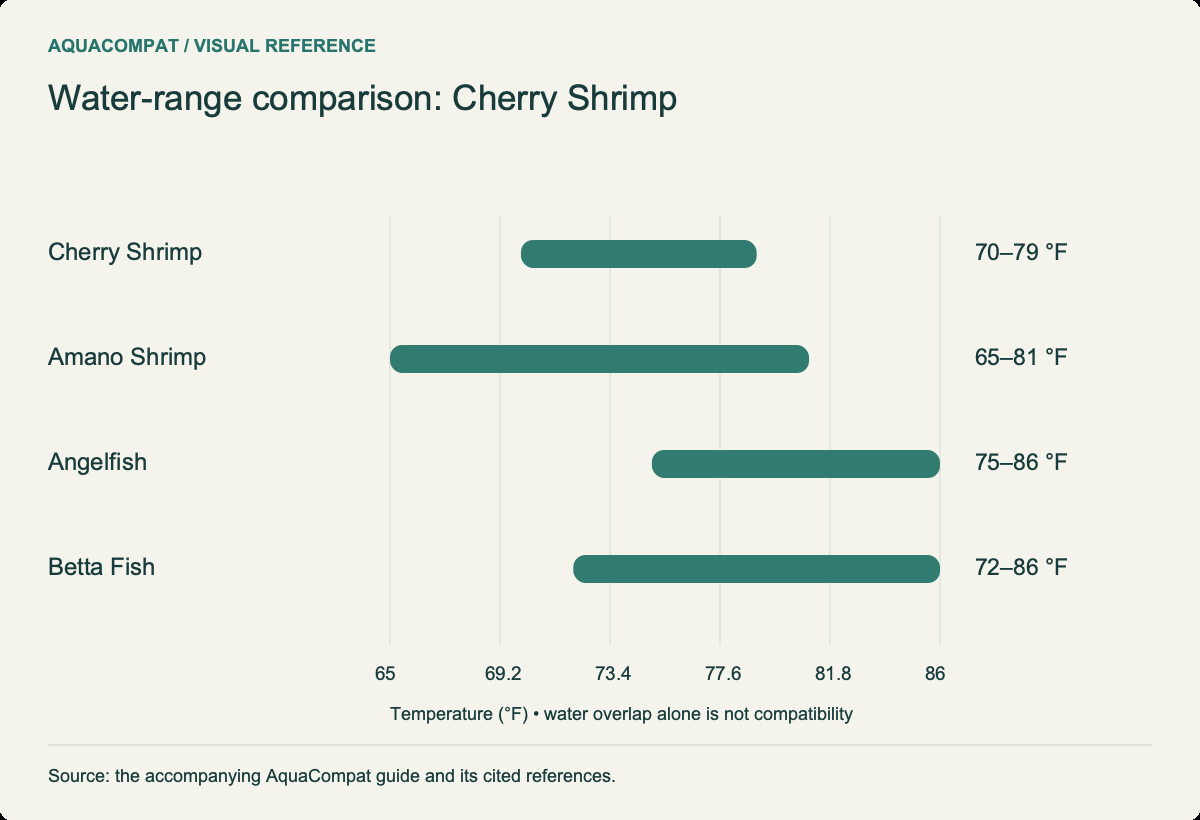
- The same water. Cherry shrimp need 70–79 °F (21–26 °C), pH 6.5–8.0, 6–10 dGH and 2–8 dKH, with 100–250 ppm of dissolved solids according to Shrimp Science. Very soft-water fish and very hard-water livebearers both fall outside part of that band.
- No copper. Shrimp and Snail Breeder puts the danger level for copper near 0.03 mg/l, far below the doses used to treat fish, so a tank mate that may need copper-based medication is a liability.
- Room to hide. Aquarium Co-Op and Shrimp and Snail Breeder both say cherry shrimp need dense plants or moss in any community tank.
Shrimp keepers also track dissolved solids; the guide to TDS in shrimp tanks explains why Shrimp Science treats it as secondary to GH and KH. The full list of tank mates by species covers the fish side of each pairing.
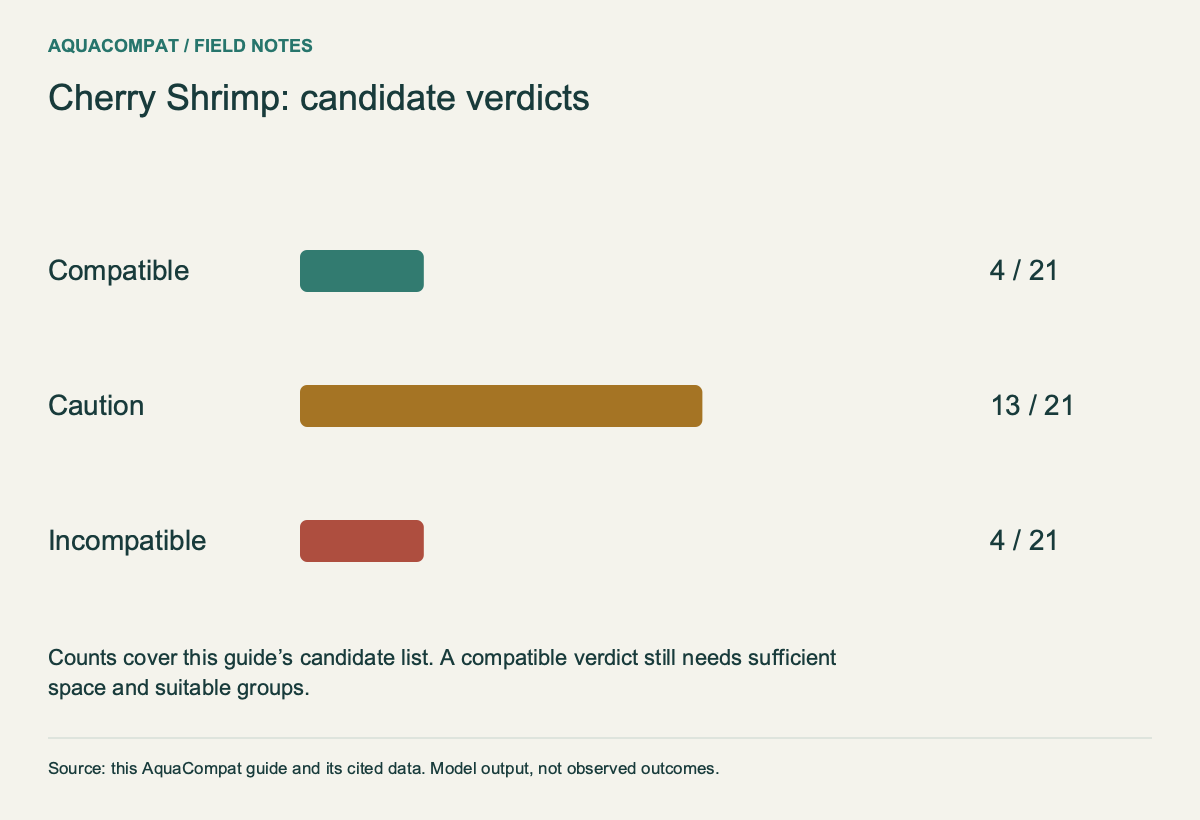
| Species | Verdict | Score | Shared temperature | Shared pH | Smallest tank |
|---|---|---|---|---|---|
| Mystery Snail | compatible | 10/10 | 70–78 °F (21–26 °C) | pH 7.2–8.0 | 5 US gal (19 L) |
| Amano Shrimp | compatible | 9/10 | 70–79 °F (21–26 °C) | pH 6.5–7.5 | 10 US gal (38 L) |
| Bristlenose Pleco | compatible | 9/10 | 72–79 °F (22–26 °C) | pH 6.5–7.2 | 20 US gal (76 L) |
| Nerite Snail | compatible | 9/10 | 72–79 °F (22–26 °C) | pH 7.2–8.0 | 5 US gal (19 L) |
| Corydoras | caution | 7/10 | 70–79 °F (21–26 °C) | pH 6.5–7.5 | 20 US gal (76 L) |
| Guppy | caution | 7/10 | 70–79 °F (21–26 °C) | pH 7.0–8.0 | 10 US gal (38 L) |
| Harlequin Rasbora | caution | 7/10 | 72–79 °F (22–26 °C) | pH 6.5–7.5 | 20 US gal (76 L) |
| Neon Tetra | caution | 7/10 | 70–77 °F (21–25 °C) | pH 6.5–7.5 | 20 US gal (76 L) |
| Cardinal Tetra | caution | 7/10 | 73–79 °F (23–26 °C) | pH 6.5–7.5 | 20 US gal (76 L) |
| GloFish Tetra | caution | 7/10 | 70–79 °F (21–26 °C) | pH 6.5–7.0 | 20 US gal (76 L) |
| Kuhli Loach | caution | 7/10 | 74–79 °F (23–26 °C) | pH 6.5–7.0 | 20 US gal (76 L) |
| Molly | caution | 7/10 | 70–79 °F (21–26 °C) | pH 7.5–8.0 | 20 US gal (76 L) |
| Platy | caution | 7/10 | 70–77 °F (21–25 °C) | pH 7.0–8.0 | 20 US gal (76 L) |
| Zebra Danio | caution | 7/10 | 70–75 °F (21–24 °C) | pH 6.5–8.0 | 20 US gal (76 L) |
| Betta Fish | caution | 7/10 | 72–79 °F (22–26 °C) | pH 6.5–8.0 | 20 US gal (76 L) |
| Dwarf Gourami | caution | 7/10 | 72–79 °F (22–26 °C) | pH 6.5–7.5 | 29 US gal (110 L) |
| Endler's Livebearer | caution | 7/10 | 75–79 °F (24–26 °C) | pH 7.0–8.0 | 10 US gal (38 L) |
| Oscar | incompatible | 3/10 | 74–79 °F (23–26 °C) | pH 6.5–8.0 | 125 US gal (473 L) |
| Angelfish | incompatible | 3/10 | 75–79 °F (24–26 °C) | pH 6.5–8.0 | 90 US gal (341 L) |
| Goldfish | incompatible | 3/10 | 70–70 °F (21–21 °C) | pH 6.5–8.0 | 55 US gal (208 L) |
| Discus | incompatible | 3/10 | 79–79 °F (26–26 °C) | pH 6.5–7.6 | 75 US gal (284 L) |
How does our data score fish that eat shrimp?
Each fish in our data carries a published answer to one question, whether it eats dwarf shrimp, and that answer caps the size part of its score with cherry shrimp. The answer is yes, no or unknown, and the yes answers are split by whether the fish also eats small fish. Adult size and predation risk count for 20% of the total score in the method behind our compatibility verdicts, alongside temperature, pH, hardness, temperament and swim level.
The table below sorts every species by that evidence. The unknown group scores slightly below the shrimplet-eaters on purpose: the methodology treats missing evidence as missing, not as safety. Two limits follow from this design, and both matter for shrimp.
- Shrimp predation never fails a pair on its own. The method only fails a pair outright for fish-on-fish predation, missing water overlap or open aggression. That is why the oscar, which Aquarium Co-Op says eats any invertebrate small enough to fit in its mouth, shows 3/10 and a verdict of incompatible. Treat every species in the first row as a shrimp predator whatever its score.
- The middle row is broad. It includes fish that sources say ignore adult shrimp and fish that sources say eat them. Aquarium Co-Op says larger mollies will most likely eat cherry shrimp and that the dwarf gourami snacks on them, yet both sit in the shrimplet row because neither is recorded as eating small fish.
| Published evidence | Size-factor cap | Species in our data |
|---|---|---|
| Eats dwarf shrimp and also eats small fish | 0.35 | Betta, angelfish, oscar, goldfish, discus |
| Eats dwarf shrimp but not small fish (mainly shrimplets) | 0.65 | Guppy, Endler’s livebearer, molly, neon tetra, cardinal tetra, harlequin rasbora, zebra danio, kuhli loach, dwarf gourami |
| No published data either way | 0.6 | Corydoras, platy, GloFish tetra |
| Sources say it does not eat shrimp | No cap | Bristlenose pleco, amano shrimp, nerite snail, mystery snail |
Which tank mates are safest for cherry shrimp?
Snails, amano shrimp and the bristlenose pleco are the safest cherry shrimp tank mates in our data, because the sources say none of them eats live shrimp.
Mystery and nerite snails
The mystery snail scores 10/10, and Aquarium Co-Op says mystery snails can live with dwarf shrimp. The nerite snail scores 9/10; Shrimp and Snail Breeder calls it a peaceful herbivore that competes with other snails only for food. Its slightly lower score comes from water: nerites prefer harder water, so the shared hardness is a single point at 10–10 dGH. Both snails, like the shrimp, are harmed by copper. The tank mates for aquarium snails page covers them in more depth.
Amano shrimp
The amano shrimp scores 9/10. Shrimp and Snail Breeder says amanos are scavengers, not hunters, and that attacks on cherry shrimp are unlikely unless the amanos are starving. The risk is competition: Aquarium Co-Op and Shrimp Science say amanos are possessive at feeding time and steal food from smaller shrimp, so spread food across the tank. Amanos grow to 2 in (5.1 cm), larger than cherry shrimp.
Bristlenose pleco
The bristlenose pleco scores 9/10, the highest of any fish. Aquarium Co-Op says it eats only animals already dead, and Shrimp and Snail Breeder notes it is co-bred with shrimp commercially, though small shrimp fry may occasionally be taken. It needs 20 US gal (76 L), so the pair calculates at 20 US gal (76 L). The bristlenose pleco tank mates guide covers its other companions.
Which fish can live with cherry shrimp?
Small, peaceful fish that eat only shrimplets can live with an adult cherry shrimp colony if the tank has dense moss, but the colony will grow more slowly. The fish below are ordered from the lowest to the highest documented risk to adult shrimp.
Harlequin rasbora and cardinal tetra
Shrimp and Snail Breeder says harlequin rasboras ignore shrimp too large for their mouths but take baby shrimp; the pair scores 7/10. Aquarium Co-Op says cardinal tetras usually leave adult dwarf shrimp alone where cover exists but eat baby shrimp; that pair scores 7/10 and shares 73–79 °F (23–26 °C).
Guppies and Endler’s livebearers
Guppies score 7/10. Shrimp and Snail Breeder says they are a problem for small shrimp and make shrimp breeding almost impossible. Endler’s livebearers score 7/10; the same source says adult cherry shrimp are safe with them but that Endler’s flush shrimp fry out of moss and eat them. Endler’s also prefer harder water and share no hardness range with cherry shrimp in our data. The what fish can live with guppies page has the guppy side of this pairing.
Neon tetra, zebra danio and kuhli loach
These three score 7/10, 7/10 and 7/10, but the sources describe more than shrimplet-eating. Shrimp and Snail Breeder says neons may pick at juvenile or adult shrimp, that zebra danios actively hunt shrimplets and can harm moulting shrimp, and that large adult kuhli loaches can eat adult dwarf shrimp, even though Aquarium Co-Op says kuhlis are not known for eating shrimp.
Corydoras, platies and GloFish tetras
No source in our data says whether these three eat dwarf shrimp, so each scores 7/10 on missing evidence. Shrimp and Snail Breeder adds one warning for platies: they may harass shrimp to death even when they cannot eat adults. The corydoras tank mates page explains the cory side of this gap.
Mollies and dwarf gouramis
These two score 7/10 and 7/10, but the source text is the stronger signal. Aquarium Co-Op says larger mollies will most likely eat cherry shrimp and that dwarf gouramis snack on anything that fits in their mouths, cherry shrimp included; Shrimp and Snail Breeder advises against keeping dwarf gouramis with shrimp. Mollies also share no hardness range with cherry shrimp. Neither should be chosen for a shrimp tank.
Which fish should never live with cherry shrimp?
Goldfish and discus fail outright with cherry shrimp in our data, and bettas, angelfish and oscars should be avoided as well because the sources say they eat adult shrimp.
Goldfish and discus
Goldfish score 3/10 and discus 3/10. Both fail on temperature first: goldfish share only 70–70 °F (21–21 °C) with the shrimp and discus only 79–79 °F (26–26 °C). Both also eat shrimp: Shrimp and Snail Breeder says all dwarf shrimp are on the goldfish’s menu and that shrimp become discus food.
Betta, angelfish and oscar
These three score 7/10, 3/10 and 3/10 in the table. Angelfish and oscars are recorded as eating both small fish and dwarf shrimp and are at least three times the shrimp’s length, which the method treats as a deal-breaker. The betta is smaller, so its score is lowered rather than failed, but the sources still advise against the pairing. The source evidence is clear. Shrimp and Snail Breeder calls bettas hunters and does not recommend them with cherry shrimp; the betta fish tank mates page explains which companions suit a betta instead. Aquarium Co-Op and Shrimp and Snail Breeder rule out dwarf shrimp with angelfish. Aquarium Co-Op says the oscar eats any invertebrate small enough to fit in its mouth, and an oscar grows to 14 in (35.6 cm).
Are baby cherry shrimp safe with any fish?
No fish in our data is documented as safe for baby cherry shrimp. Aquarium Co-Op says almost all fish will eat baby shrimp, and even the bristlenose pleco, the safest fish here, may occasionally take shrimp fry according to Shrimp and Snail Breeder. According to Aquarium Co-Op and Practical Fishkeeping, cherry shrimp hatch as miniature adults after the female carries 20–30 eggs for about a month, so the young are tiny, mobile and easy to swallow from day one.
The common misconception is that a peaceful fish is a shrimp-safe fish. Neon tetras, harlequin rasboras and guppies are among the most peaceful fish in our data, and every one of them eats shrimplets. Temperament describes how a fish treats other fish, not whether it eats invertebrates. A keeper who wants the colony to grow has two choices: a shrimp-only tank with snails, or a community tank with dense moss and plant cover where shrimplets have somewhere to hide. Shrimp and Snail Breeder recommends that dense cover in any community setting.
Which cherry shrimp tank mates fit a 5, 10 or 20-gallon tank?
A 5-gallon tank suits cherry shrimp with snails only; fish need 10 gallons or more. Our cherry shrimp minimum is 5 US gal (19 L), the smallest tank Shrimp Science and Shrimp and Snail Breeder give for a colony, and both recommend 10 gallons or more for breeding. Start with at least 10 shrimp so both sexes are present, as Aquarium Co-Op and Shrimp and Snail Breeder advise.
5-gallon tank
Mystery and nerite snails both calculate at 5 US gal (19 L) with cherry shrimp, so a 5-gallon shrimp tank can hold snails and nothing else in our data.
10-gallon tank
Amano shrimp, guppies and Endler’s livebearers calculate at 10 US gal (38 L). Of these, the amano shrimp is the only one not recorded as eating shrimplets. For fish choices at this size, see the fish for a 10-gallon community tank we recommend.
20-gallon tank and larger
Most small fish calculate at 20 US gal (76 L), including harlequin rasboras, tetras, corydoras, kuhli loaches and the bristlenose pleco. Dwarf gouramis calculate at 29 US gal (110 L), though the section above explains why they are a poor choice. Use the stocking calculator to check a full plan and the species compatibility checker for any single pairing.
Can cherry shrimp live with other dwarf shrimp?
Cherry shrimp can live with other Neocaridina, but colour varieties crossbreed, and they are usually not kept with Caridina shrimp because the two need different water. Practical Fishkeeping notes that Neocaridina colour varieties crossbreed with one another. Shrimp Science gives GH 4–10 and KH 1–8 for Neocaridina against GH 4–6 and KH 0–1 for Caridina, and Practical Fishkeeping adds that Caridina prefer cooler, softer and more acidic water. The neocaridina vs caridina shrimp guide sets the two groups side by side.
Whatever the mix, surplus shrimp should go to another keeper rather than into a pond or stream. USGS (profile revised 2026) reports cherry shrimp established on O’ahu, Hawaii, since the 1990s, names aquarium releases as the main route in, and cites a 2025 USFWS screening that rated the species high risk.
Questions people ask
Can cherry shrimp live with bettas?
It is not recommended. Shrimp and Snail Breeder calls bettas hunters and advises against keeping them with cherry shrimp, and our betta data records that bettas eat dwarf shrimp. The pair scores 7/10: the betta is not large enough relative to the shrimp for the method’s deal-breaker rule, so the predation risk lowers the score instead of failing it.
Can cherry shrimp live with neon tetras?
Adults often can, but the colony will lose young. The pair scores 7/10 and shares 70–77 °F (21–25 °C). Shrimp and Snail Breeder says neon tetras likely eat baby shrimp and may pick at juveniles or adults, so dense moss is essential.
Will a pleco eat cherry shrimp?
A bristlenose pleco is unlikely to. Aquarium Co-Op says bristlenose plecos eat only animals already dead, and Shrimp and Snail Breeder notes the two are co-bred commercially, though shrimp fry may occasionally be taken. The pair scores 9/10. Our data covers only the bristlenose, not larger pleco species.
Do amano shrimp eat cherry shrimp?
Rarely. Shrimp and Snail Breeder says amano attacks on cherry shrimp are unlikely unless the amanos are starving. The real issue is food: amanos grow to 2 in (5.1 cm) and, according to Aquarium Co-Op, steal food from smaller shrimp. The pair scores 9/10.
Which medications are unsafe for cherry shrimp tank mates?
Copper-based medications. Shrimp and Snail Breeder puts the danger level for shrimp near 0.03 mg/l, far below the roughly 0.6 mg/l used to treat fish, and Practical Fishkeeping warns that new plants may carry copper snail treatments.
Sources 126 documents from 21 publishers
- Applesnail.net (applesnail.net): “How to take care of apple snails”; “Quick guide”; “Pomacea diffusa”; “Apple snail FAQ”
- Aqualog (aqualog.de): “Discus (lexicon profile)”
- Aquarium Co-Op (aquariumcoop.com): “Care Guide for Cherry Shrimp”; “Oscar Fish Care Guide”; “Care Guide for Mystery Snails”; “Care Guide for Nerite Snails”; “Top 10 Betta Fish Tank Mates”; “Care Guide for Amano Shrimp”; “Care Guide for Plecostomus”; “Care Guide for Harlequin Rasboras and Lambchop Rasboras”; “Care Guide for Cardinal Tetras”; “Neon and Cardinal Tetras: Beginner Schooling Fish”; “Guppy Care Guide”; “Endler's Livebearer Care Guide”; “Top 5 Dither Fish to Help Shy or Aggressive Fish in Freshwater Tanks”; “Care Guide for Zebra and Leopard Danios”; “Care Guide for Kuhli Loaches”; “What Is Neon Tetra Disease and How Can It Be Prevented?”; “10 Best Top-Dwelling Fish for Your Freshwater Community Aquarium”; “Care Guide for Cory Catfish”; “Care Guide for Platy Fish: Feeding, Breeding, and Tank Mates”; “Care Guide for Mollies: Feeding, Breeding, and Tank Mates”; “Care Guide for Dwarf Gouramis”; “Care Guide for Fancy Goldfish”; “Goldfish Tank Mates”; “Discus Fish Care Guide”; “Betta Fish Care Guide”; “Freshwater Angelfish Care Guide”
- AquariumInfo.org (aquariuminfo.org): “Apple Snail”
- Crustacean Research 49 (Hamasaki et al. 2020) (jstage.jst.go.jp): “Dietary effects of phytoplankton and zooplankton on larval survival, duration and growth of four Caridina species”
- Crustacean Research 50 (Kondo, Hamasaki, Dan 2021) (jstage.jst.go.jp): “Larval performance of three amphidromous shrimp species in the genus Caridina under different temperature and salinity conditions”
- FishBase (fishbase.se): “Astronotus ocellatus, Oscar: species summary”; “Length-weight relationships for Astronotus ocellatus”; “Ancistrus cirrhosus summary (Bayesian length-weight estimate)”; “Trigonostigma heteromorpha summary page”; “Paracheirodon axelrodi summary (Bayesian length-weight estimate)”; “Poecilia reticulata, Guppy: species summary”; “Poecilia wingei summary (Bayesian length-weight estimate)”; “Length-weight relationships for Poecilia reticulata”; “Paracheirodon innesi summary page”; “Danio rerio summary (Bayesian length-weight estimate)”; “Pangio kuhlii summary (Bayesian length-weight estimate)”; “Osteogaster aenea, Bronze corydoras”; “Xiphophorus maculatus summary (Bayesian length-weight estimate)”; “Length-weight relationships for Osteogaster aenea”; “Trichogaster lalius, Dwarf gourami: species summary”; “Poecilia sphenops, Molly: species summary”; “Poecilia latipinna, Sailfin molly: species summary”; “Length-weight relationships for Poecilia sphenops”; “Length-weight relationships for Trichogaster lalius”; “Carassius auratus, Goldfish: species summary”; “Symphysodon aequifasciatus summary (Bayesian length-weight estimate)”; “Length-weight relationships for Carassius auratus”; “Betta splendens, Siamese fighting fish: species summary”; “Pterophyllum scalare, Freshwater angelfish: species summary”; “Length-weight relationships for Pterophyllum scalare”
- fishkeeping.co.uk (fishkeeping.co.uk): “Goldfish Size, Life Expectancy and Tank Recommendations”; “Keeping Goldfish - The Right Way”
- Maidenhead Aquatics (fishkeeper.co.uk species data sheet) (fishkeeper.co.uk): “Oscar data sheet”; “Zebra Nerite Snail”; “Amano Shrimp”; “Harlequin Rasbora data sheet”; “Guppy data sheet”; “Neon Tetra data sheet”; “Platy data sheet”; “Molly data sheet”; “Discus data sheet”; “Angelfish data sheet”; “Siamese Fighting Fish/Betta data sheet”
- Neotropical Ichthyology (Crampton 2008) (scielo.br): “Ecology and life history of an Amazon floodplain cichlid: the discus fish Symphysodon”
- Ornamental Aquatic Trade Association (OATA) (ornamentalfish.org): “How to look after fancy goldfish”; “How to look after goldfish in an aquarium / fish tank”
- PlanetCatfish (via Internet Archive snapshot, 2025) (web.archive.org): “Ancistrus sp. (3) Common Bristlenose Catfish Cat-eLog data sheet”; “Osteogaster aenea (Bronze Cory) Cat-eLog data sheet”
- Practical Fishkeeping (practicalfishkeeping.co.uk): “Frequently asked questions on Neocaridina shrimps”; “An introduction to Shrimp”; “Will these snails starve without algae?”; “What can I add for algae control?”; “Amano shrimp: Spineless heroes (Nathan Hill)”; “Bristlenose catfish: the hardworking Ancistrus”; “How long will my fish live?”; “A guide to the small rasboras from the genus Trigonostigma”; “Cardinal tetra, Paracheirodon axelrodi”; “Quick guide to livebearers”; “Endler's livebearers are nearly all hybrids!”; “What can I keep in my hard water aquarium?”; “Aquarium trade may have spread gourami virus”; “What water temperature do goldfish need?”; “How can I breed goldfish in my aquarium?”
- Practical Fishkeeping (Julian Dignall) (practicalfishkeeping.co.uk): “Focus on commonly kept Corydoras”
- Seriously Fish (seriouslyfish.com): “Astronotus ocellatus”; “Ancistrus sp. '3' (Common Bristlenose Catfish)”; “Trigonostigma heteromorpha (Harlequin)”; “Paracheirodon axelrodi (Cardinal Tetra)”; “Poecilia reticulata”; “Poecilia wingei”; “Paracheirodon innesi (Neon Tetra)”; “Danio rerio (Zebra Danio)”; “Pangio semicincta ('Kuhli' Loach)”; “Osteogaster aenea (Bronze Cory)”; “Xiphophorus maculatus”; “Poecilia sphenops”; “Poecilia latipinna”; “Trichogaster lalius”; “Symphysodon aequifasciatus”; “Betta splendens”; “Pterophyllum scalare”
- Shrimp and Snail Breeder (aquariumbreeder.com): “Red Cherry Shrimp: detailed guide, care, diet and breeding”; “Cherry Shrimp in a Community Tank”; “How Copper Affects Dwarf Shrimp”; “Nerite Snails: detailed guide, care, diet and breeding”; “Amano Shrimp: detailed guide, care, diet and breeding”
- Shrimp Science (shrimpscience.com): “Red Cherry Shrimp - Care Guide”; “General Hardness (GH) For Shrimp Tanks”; “Carbonate Hardness (KH) For Shrimp Tanks”; “TDS For Shrimp Tanks”; “Amano Shrimp”
- Tropical Fish Hobbyist Magazine (tfhmagazine.com): “Astronotus sp.”; “Betta splendens”
- U.S. Geological Survey (nas.er.usgs.gov): “Neocaridina davidi (cherry shrimp) species profile, Nonindigenous Aquatic Species Database”
- UF/IFAS EDIS (ask.ifas.ufl.edu): “Evolution, Culture, and Care for Betta splendens (FA212)”
- Wikipedia (en.wikipedia.org): “Vittina natalensis”
All sources accessed . Every number on this page comes from these documents.