What TDS range do Neocaridina, Caridina and Amano shrimp need?
Cherry shrimp tolerate the widest and highest TDS band, crystal reds need the lowest and narrowest, and Amano shrimp sit across both. The three species represent the three shrimp types most keepers meet: Neocaridina (Neocaridina davidi is the cherry shrimp), Caridina bee shrimp, and the larger Amano. The table puts TDS beside the hardness readings that produce it, because dissolved minerals are most of what a shrimp-tank TDS reading measures.
| Parameter | Cherry Shrimp | Crystal Red Shrimp | Amano Shrimp |
|---|---|---|---|
| TDS | 100–250 ppm | 100–180 ppm | 100–300 ppm |
| General hardness | 6–10 dGH | 4–6 dGH | 6–15 dGH |
| Carbonate hardness | 2–8 dKH | 0–2 dKH | 0–10 dKH |
| pH | pH 6.5–8.0 | pH 6.2–7.0 | pH 6.0–7.5 |
| Temperature | 70–79 °F (21–26 °C) | 70–74 °F (21–23 °C) | 65–81 °F (18–27 °C) |
How do you read the shrimp TDS table?
Read each column as one shrimp’s comfort zone, and treat TDS as the summary line under the hardness rows. Crystal reds combine the lowest TDS with a KH of 0–2 dKH, almost no carbonate buffer. Cherry shrimp take more of both: 6–10 dGH and 2–8 dKH. Shrimp Science sets out the same split for the two genera in general, which is why Neocaridina are described as the harder-water shrimp.
Amano shrimp overlap both groups on TDS, but their hardness range starts at 6–15 dGH, and Practical Fishkeeping says GH should not fall below its lower end for good moulting. The Amano KH and TDS figures come from Shrimp Science alone, so treat them as less settled than the cherry and crystal red ranges. Tank-mate choices for the hardier of the three are covered in the guide to cherry shrimp tank mates.
What is TDS and how is it measured?
TDS is the total amount of dissolved material in water, and it is usually estimated from electrical conductivity rather than measured directly. SRAC Publication 4606 (Stone, Shelton, Haggard and Thomforde) explains that TDS in mg/L is typically about half the conductivity in µS/cm, a conversion factor of 0.5 mg/L TDS per µS/cm.
Because a meter reads conductivity, it counts every dissolved ion without saying which ones. Calcium and magnesium from a remineraliser, carbonate buffer and nitrate can all add to the same number. For fish culture, SRAC 4606 gives a desirable conductivity of 60–2000 µS/cm, a very wide band; shrimp keepers work to much tighter targets set by their remineraliser and their species.
Why do sources give different TDS targets for the same shrimp?
Sources differ because some describe a remineraliser’s target, some an optimum and some the full tolerance. SaltyShrimp’s product information gives targets its mineral salts are designed to hit, Green Aqua gives broader tolerance ranges, and the species care sources give their own bands. None of these is a peer-reviewed range; our fact base found no peer-reviewed TDS figure for aquarium shrimp. The table lists each figure so the spread is visible.
| Shrimp group | SaltyShrimp remineraliser target | Green Aqua | Species care data used on this site |
|---|---|---|---|
| Caridina bee shrimp (crystal red) | 100–150 ppm | 100–200 ppm | 100–180 ppm |
| Neocaridina (cherry) | 200–250 ppm | 100–400 ppm | 100–250 ppm |
| Sulawesi shrimp | 200+ ppm | Not covered | Not covered |
Which shrimp TDS figure should you follow?
Follow the range for your species from the care data, and use the remineraliser’s target only as a mixing aim inside it. For crystal reds the sources cluster closely: SaltyShrimp’s 100–150 ppm sits inside Green Aqua’s 100–200 ppm and the species range on this site. Shrimp and Snail Breeder narrows the optimum further, to 140–160 ppm within an acceptable 100–250 ppm.
For cherry shrimp the spread is wider. SaltyShrimp targets 200–250 ppm, Green Aqua allows 100–400 ppm, and Shrimp and Snail Breeder gives an optimum of 150–200 ppm within an acceptable 80–400 ppm. That breadth is the practical difference between the two genera: a cherry shrimp tank tolerates a range of tap waters, while a crystal red tank usually starts from RO water and is built up to a narrow target. The care differences between the genera are compared in the Neocaridina vs Caridina shrimp guide.
How do you raise or lower TDS in a shrimp tank?
You lower TDS by replacing some tank water with purer water, and raise it by adding a measured remineraliser. Both should happen through water changes, not by dosing the tank directly, because Green Aqua stresses that shrimp tolerate changes in temperature, pH or softness poorly and that stability matters most.
Lowering TDS
Reverse osmosis water starts near 5–10 ppm, according to Green Aqua, so mixing it into change water pulls TDS down in proportion. How much RO you need depends on your source: in USGS sampling of about 2,100 private domestic wells between 1991 and 2004, 15 percent held more than 500 mg/L of dissolved solids, the EPA’s secondary drinking-water level, mostly in the West, Southwest and south-central states. The RO/DI water for aquariums guide explains what the membrane removes and why the water must be remineralised before use.
Raising TDS
Shrimp remineralisers restore general hardness and, for Neocaridina, some carbonate hardness. SaltyShrimp’s Bee Shrimp Mineral GH+ adds GH without KH for Caridina; its GH/KH+ product for Neocaridina adds both. Mix the change water, measure TDS, GH and KH, and only then add it to the tank. GH and KH are the readings that tell you which minerals are behind the TDS number, as set out in the GH and KH explained guide, and kits for them are compared among the aquarium test kits we recommend.
Is TDS the most important number in a shrimp tank?
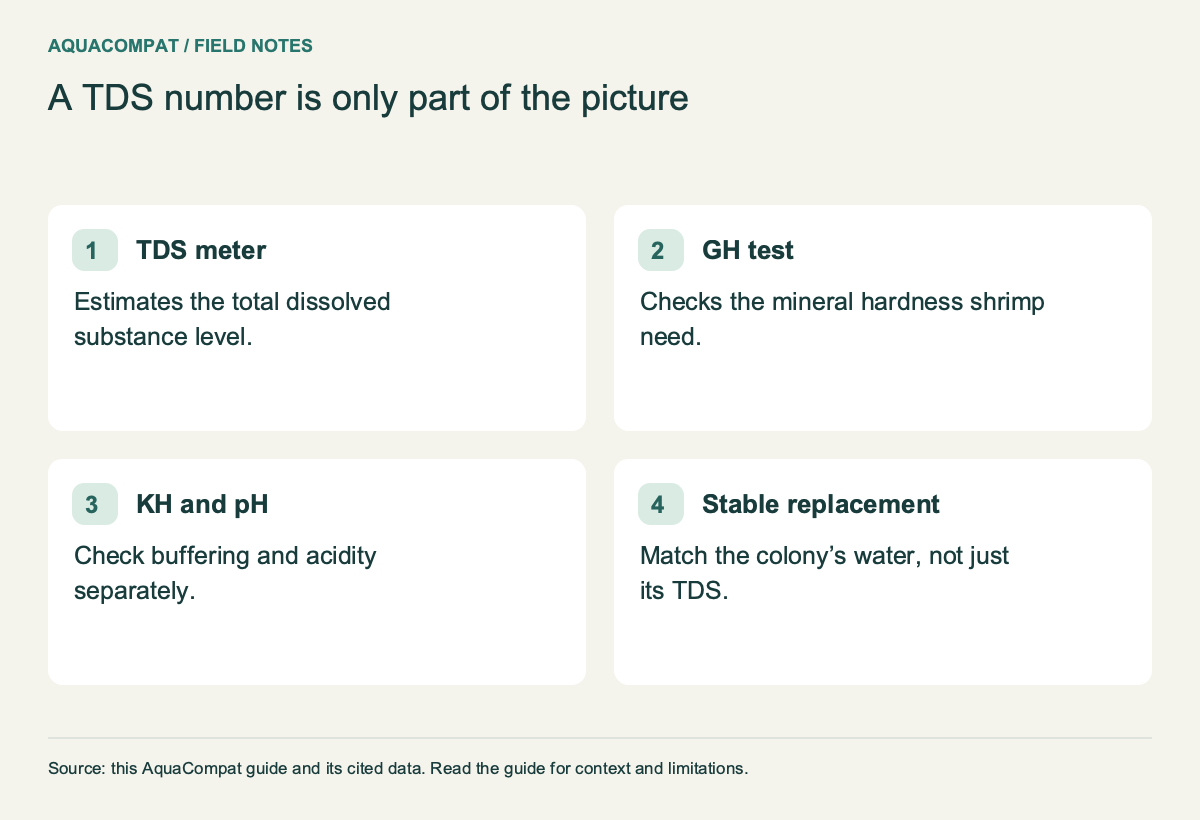
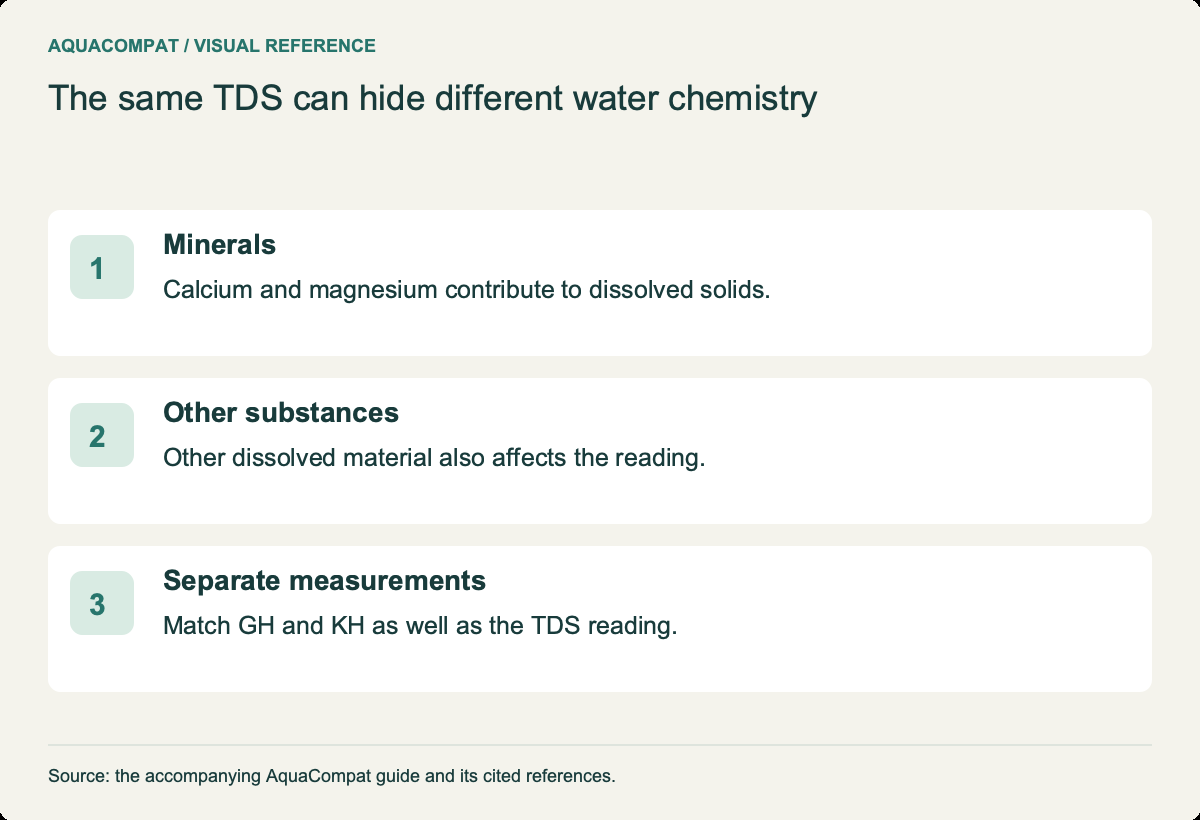
No. Shrimp Science states plainly that TDS is not a useful measurement on its own, and that GH, KH and nitrogen readings matter more. A TDS reading of 200 ppm could come from the right balance of calcium and magnesium, or from carbonate buffer a crystal red does not want, or from accumulated nitrate. The number is the same; the water is not.
TDS earns its place as a quick consistency check. Once you have mixed water that tests correctly for GH and KH, its TDS becomes a fingerprint: if the next batch reads the same, it was probably mixed the same way. Used that way, a TDS pen helps keep the stability that Green Aqua stresses.
Can cherry shrimp and crystal red shrimp share the same water?
They can only share a compromise. Cherry shrimp are listed at 6–10 dGH and crystal reds at 4–6 dGH, so the two ranges meet only at their edges, and their pH ranges overlap at pH 6.5–7.0. The care data on this site records the shared tank as a compromise for that reason. The sources also disagree on breeding risk: Shrimp and Snail Breeder says there is no hybridisation risk between Neocaridina and Caridina, while Shrimp Science claims they can interbreed near pH 7. How the pairing scores overall is explained in how scores are calculated.
Amano shrimp fit more easily with cherry shrimp than with crystal reds, because their GH ranges overlap widely. The Amano care data also notes that they are bold feeders that can outcompete slower dwarf shrimp if kept in large numbers, which is a feeding issue rather than a water one.
When does a TDS reading mislead shrimp keepers?
A TDS reading misleads when the danger is something dissolved in tiny amounts, because a meter cannot single it out. Two of the biggest threats to shrimp fall into that category.
Ammonia and nitrite
Shrimp Science advises that any trace of ammonia or nitrite is dangerous to cherry shrimp and that they belong only in fully cycled, established tanks. Traces that small may barely move a TDS reading, so a tank can read inside the target band while still being unsafe. Only an ammonia and nitrite test answers that question.
Copper
Shrimp and Snail Breeder puts the danger level for copper near 0.03 mg/L, far below the doses used in fish medications. A TDS pen cannot see that amount. Avoiding copper-based treatments, and rinsing new plants that may carry copper snail treatments, protects shrimp where a meter cannot. New plants can also carry pests such as planaria, which prey on shrimplets; the guide to planaria and hydra in shrimp tanks covers what to look for. For equipment that suits small shrimp, the comparison of sponge filters we recommend covers filter choices, and the other chemistry topics are in the water chemistry and setup guides.
Questions people ask
What TDS is best for cherry shrimp?
The care data on this site lists cherry shrimp at 100–250 ppm. SaltyShrimp’s Neocaridina remineraliser targets 200–250 ppm, and Shrimp and Snail Breeder gives an optimum of 150–200 ppm. Any steady reading in that band, with GH and KH inside the cherry shrimp range, matches the published guidance.
Can I keep crystal red shrimp in tap water?
Only if your tap already sits inside their range: 4–6 dGH, 0–2 dKH and 100–180 ppm. Most keepers start from RO water at 5–10 ppm and remineralise with a GH-only product, because the care data notes that remineralised RO water gives full control of the parameters.
Why is my shrimp tank TDS rising over time?
A TDS meter counts everything dissolved, so a rise means something is being added faster than water changes remove it. Nitrate left by the nitrogen cycle and remineraliser added with change water both count. Test GH, KH and nitrate to find which one is climbing; Shrimp Science notes those readings tell you more than TDS alone.
How do I convert conductivity to TDS?
SRAC Publication 4606 says TDS in mg/L is typically about half the conductivity in µS/cm, a factor of 0.5 mg/L TDS per µS/cm. SRAC gives that as a typical relationship, not an exact one, so compare readings taken with the same meter over time rather than across different instruments.
Sources 25 documents from 13 publishers
- Aquarium Co-Op (aquariumcoop.com): “Care Guide for Cherry Shrimp”; “Care Guide for Amano Shrimp”
- Crustacean Research 49 (Hamasaki et al. 2020) (jstage.jst.go.jp): “Dietary effects of phytoplankton and zooplankton on larval survival, duration and growth of four Caridina species”
- Crustacean Research 50 (Kondo, Hamasaki, Dan 2021) (jstage.jst.go.jp): “Larval performance of three amphidromous shrimp species in the genus Caridina under different temperature and salinity conditions”
- Green Aqua (greenaqua.hu): “Shrimp in the aquarium”
- Maidenhead Aquatics (fishkeeper.co.uk species data sheet) (fishkeeper.co.uk): “Amano Shrimp”
- Michigan State University Extension (archive) (sanweb.lib.msu.edu): “Reverse Osmosis for Home Treatment of Drinking Water (WQ24, 1990)”
- Practical Fishkeeping (practicalfishkeeping.co.uk): “Amano shrimp: Spineless heroes (Nathan Hill)”; “Frequently asked questions on Neocaridina shrimps”; “An introduction to Shrimp”
- SaltyShrimp (product information via Furry Critter Network) (furrycritter.com): “SaltyShrimp Remineralizers for Invertebrates”
- Seriously Fish (seriouslyfish.com): “New shrimp from Hong Kong and southern China”
- Shrimp and Snail Breeder (aquariumbreeder.com): “Red Cherry Shrimp: detailed guide, care, diet and breeding”; “Crystal Red Shrimp: detailed guide, care, diet and breeding”; “Cherry Shrimp in a Community Tank”; “How Copper Affects Dwarf Shrimp”; “Amano Shrimp: detailed guide, care, diet and breeding”
- Shrimp Science (shrimpscience.com): “Red Cherry Shrimp - Care Guide”; “Crystal Red Shrimp - Care Guide”; “Amano Shrimp”; “Carbonate Hardness (KH) For Shrimp Tanks”; “General Hardness (GH) For Shrimp Tanks”; “TDS For Shrimp Tanks”
- Southern Regional Aquaculture Center (srac.msstate.edu): “SRAC 4606: Interpretation of Water Analysis Reports for Fish Culture (Stone, Shelton, Haggard, Thomforde)”
- US Geological Survey (pubs.usgs.gov): “The Quality of Our Nation's Waters: Quality of Water from Domestic Wells in Principal Aquifers of the United States, 1991-2004, Overview of Major Findings (Circular 1332)”
All sources accessed . Every number on this page comes from these documents.