Which aquarium species need RO water?
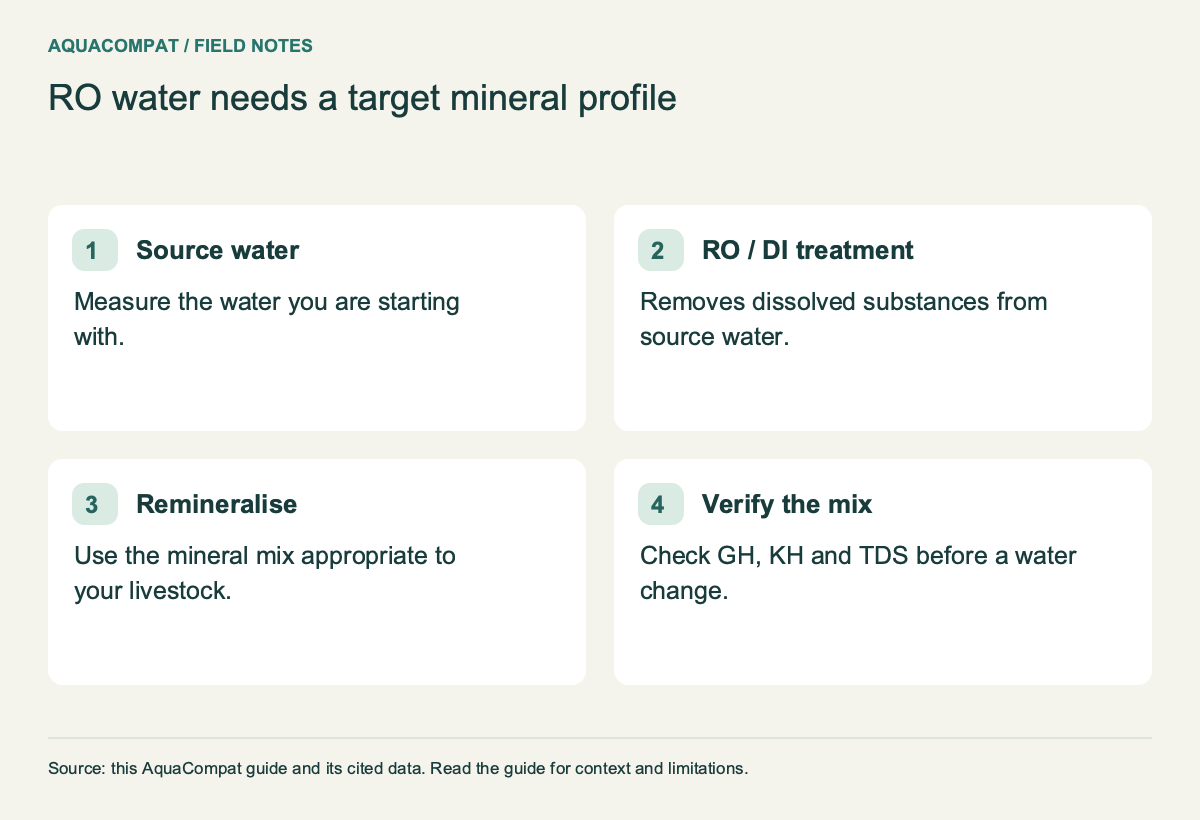
RO water helps the species whose published hardness range sits below what most tap water delivers, and it does little for species that want hard water. Reverse osmosis (RO) is a purification method that forces water through a membrane under pressure, so most dissolved compounds and suspended matter stay behind; Michigan State University Extension describes it this way in its home-treatment bulletin WQ24. RO/DI adds a deionisation stage after the membrane.
The table compares species at both ends of the hardness scale. Where a species’ range is low, RO water mixed with tap or remineralised to a set level gives you control over GH and KH that tap water alone cannot.
| Species | pH | General hardness (GH) | RO likely useful? |
|---|---|---|---|
| Crystal Red Shrimp | pH 6.2–7.0 | 4–6 dGH | Usually |
| Cardinal Tetra | pH 4.0–7.5 | 1–12 dGH | If tap is hard |
| Discus | pH 5.0–7.6 | 0–8 dGH | If tap is hard |
| Neon Tetra | pH 5.0–7.5 | 1–12 dGH | If tap is hard |
| Cherry Shrimp | pH 6.5–8.0 | 6–10 dGH | Rarely |
| Molly | pH 7.5–8.5 | 15–25 dGH | No |
| Yellow Lab | pH 7.7–8.5 | 10–25 dGH | No |
Why do Caridina shrimp keepers rely on RO water?
Caridina keepers rely on RO water because bee shrimp need soft water with almost no carbonate hardness, which few taps supply. Crystal red shrimp are listed at 0–2 dKH, and the care data notes that remineralised RO water gives full control of the parameters. Green Aqua describes RO output for shrimp keeping as 5–10 ppm before minerals go back in, a near-blank starting point.
Neocaridina such as cherry shrimp are different. They are listed at 6–10 dGH and 2–8 dKH, the harder-water side of dwarf shrimp keeping, so many taps already suit them. The differences between the two groups are set out in the Neocaridina vs Caridina shrimp comparison, and the dissolved-solids targets for each are covered in the TDS in shrimp tanks guide.
What does reverse osmosis remove from tap water?
Reverse osmosis removes most dissolved compounds, organics, inorganics, bacteria and particulates, but not all of them equally. Michigan State University Extension notes that removal efficiency varies with the contaminant, the membrane and the operating conditions. It gives nitrate as an example: rejection can reach about 90 % in some systems, which is high but not complete.
The same bulletin notes that RO membranes are chlorine-sensitive, so systems commonly include an activated carbon prefilter to protect them. That matters for aquarium use too, because municipal supplies are disinfected with chlorine and, in many areas, chloramine, as explained in the guide to tap water for aquariums.
What does the DI stage add?
Deionisation (DI) resin is offered as a polishing stage after the RO membrane. None of the sources in our fact base describes how DI resin performs, so this guide makes no claim about how much it removes or when it is worth adding. If your RO output already sits in the 5–10 ppm range Green Aqua describes, the remineralising step below matters more than further purification.
How do you remineralise RO water for fish and shrimp?
You remineralise RO water by adding a measured mineral product that restores general hardness (calcium and magnesium) and, where the species needs it, carbonate hardness. SRAC Publication 4606 explains why: fish need some minimum salt content to keep their osmotic balance, so mineral-free water is not a safe environment on its own. Green Aqua makes the same point for shrimp.
Remineralisers are formulated for a target species group, so the product follows the animal. SaltyShrimp’s product information gives two examples that bracket the dwarf shrimp range.
- Caridina bee shrimp: SaltyShrimp Bee Shrimp Mineral GH+ adds GH without KH, at about 2–3 g per 10 L RO water to reach 100–150 ppm TDS.
- Neocaridina: SaltyShrimp Shrimp Mineral GH/KH+ uses about 3 g per 10 L RO water and targets roughly 6 dGH, 2 dKH and 200–250 ppm TDS.
These are one manufacturer’s label figures, not independent measurements. Weigh the dose, mix it fully, and confirm GH, KH and TDS with a test before the water goes in. Kits that read GH and KH separately are compared in the guide to best aquarium test kits compared, and the meaning of each reading is set out in GH and KH explained.
Can you mix RO water with tap water instead?
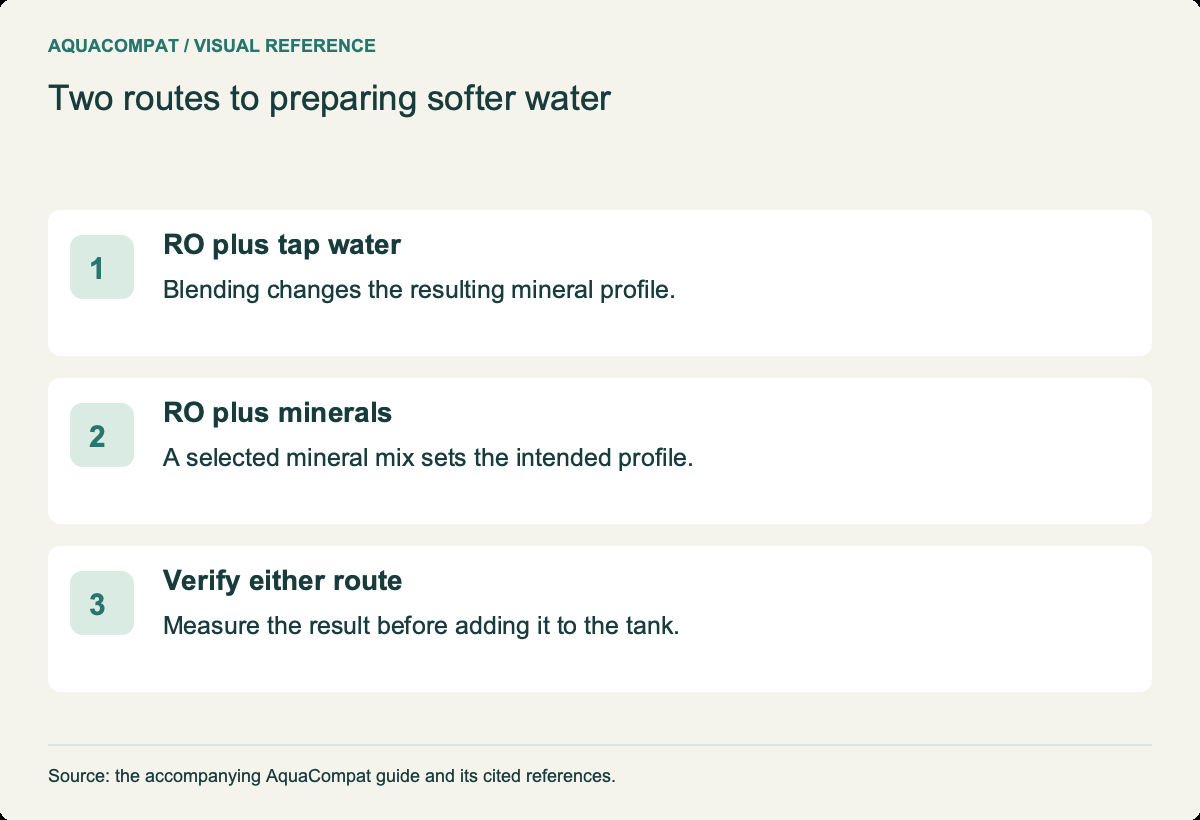
Yes. Blending RO water with dechlorinated tap water lowers hardness, carbonate buffer and dissolved solids together, which suits soft-water fish whose ranges sit just below your tap readings. The aquarium pH guide explains how a lower KH lets pH fall toward the acidic range that species such as Cardinal Tetra, listed at pH 4.0–7.5, are kept in.
Mixing has a limit: it can only reduce what your tap supplies, in proportion. It cannot add a mineral your tap lacks, and it cannot reach the near-zero KH that Caridina need if your tap is very hard without using mostly RO. Whatever ratio you choose, make every change with water mixed the same way, because Green Aqua stresses that shrimp tolerate changes in softness poorly and stability matters most.
What should you look for in an RO system for an aquarium?
Look first at how a unit protects its membrane and how much water it wastes, because those are the two attributes our sources document. Michigan State University Extension notes that activated carbon prefilters are commonly used to protect chlorine-sensitive membranes, which matters on chlorinated or chloraminated supplies. The same bulletin warns that RO units send a large share of incoming water to drain, between 50–90 % of incoming water. The US EPA’s WaterSense programme puts a typical point-of-use unit at 5 gallons or more of reject water for every gallon of purified water, while units carrying the WaterSense label under its November 2024 specification must waste 2.3 gallons or less per gallon. Those figures describe drinking-water units, but the label is one documented way to compare efficiency.
Our fact base holds no specifications for individual RO or RO/DI units, so this guide does not name a best model. Measuring TDS on the output gives you a number to compare: Green Aqua’s figure of 5–10 ppm for shrimp-grade RO is a useful benchmark to compare against.
Is pure RO water better for fish than tap water?
No. Pure RO water is too empty to keep fish or shrimp in on its own. SRAC 4606 states that fish need some minimum salt content to maintain osmotic balance, and the RO fact sheet records that purified water must be remineralised before use with fish or shrimp. Purity is the starting point for building the water you want, not the goal.
A second version of the same idea is that RO water keeps a tank free of problems. RO removes dissolved compounds from the source water, but pests such as planaria and hydra arrive on plants, decor and livestock rather than through the tap, as described in the guide to planaria and hydra in shrimp tanks. Quarantining new plants addresses that risk; RO water does not.
When is RO water the wrong choice?
RO water is the wrong choice when your tap already falls inside the range of every species you keep, and especially for hard-water fish. Mollies are listed at 15–25 dGH and Yellow Labs at 10–25 dGH; softening the water for them would move it away from their published ranges, not toward them.
It is also the wrong tool when the cost of waste water outweighs the benefit. With 50–90 % of incoming water going to drain, a large community tank of hardy species gains little from RO that matching species to your tap would not give for free. Stocking to suit the water you have is the simpler route, and the compatibility checker shows which species share a hardness band.
The equipment around the water still matters in a shrimp tank built on RO. Filters suited to shrimp tanks are compared among the best sponge filters, and the other chemistry topics are collected in the water chemistry and setup guides.
Questions people ask
What TDS should RO water read before remineralising?
Green Aqua describes RO water for shrimp keeping at about 5–10 ppm before minerals are added. A reading well above that suggests the membrane or prefilter is not performing. Remineralisation then brings TDS up to the target for the species, such as 100–150 ppm for Caridina bee shrimp with SaltyShrimp’s GH+ product.
Do I need RO water for cherry shrimp?
Usually not. Cherry shrimp are listed at 6–10 dGH and 2–8 dKH, harder water than Caridina need, so dechlorinated tap water often suits them. RO becomes useful only if your tap sits above that range or carries something you cannot otherwise reduce, such as high nitrate.
Does RO water remove nitrate?
It reduces it. Michigan State University Extension reports nitrate rejection as high as about 90 % in some systems, so RO can help where tap water starts high in nitrate. Removal varies with the membrane and operating conditions, so test the output rather than assume it is nitrate-free.
How much water does an RO unit waste?
Michigan State University Extension reports that RO units send 50–90 % of incoming water to drain. The share depends on the system and operating conditions, and our fact base holds no figures for individual aquarium units. For a large tank of hard-water species that already suit your tap, that waste is a strong reason to skip RO altogether.
Is distilled water the same as RO water?
The sources behind this guide describe reverse osmosis only and give no data on distilled water, so we cannot compare the two. The principle that applies to any mineral-free water comes from SRAC 4606: fish need some minimum salt content for osmotic balance, so water stripped of minerals must be remineralised before use.
Sources 28 documents from 12 publishers
- Aquarium Co-Op (aquariumcoop.com): “Care Guide for Cardinal Tetras”; “Discus Fish Care Guide”; “Care Guide for Cherry Shrimp”
- FishBase (fishbase.se): “Symphysodon aequifasciatus, Blue discus: species summary”
- Green Aqua (greenaqua.hu): “Shrimp in the aquarium”
- Maidenhead Aquatics (fishkeeper.co.uk species data sheet) (fishkeeper.co.uk): “Discus data sheet”; “Neon Tetra data sheet”; “Molly data sheet”; “Yellow Labidochromis data sheet”
- Michigan State University Extension (archive) (sanweb.lib.msu.edu): “Reverse Osmosis for Home Treatment of Drinking Water (WQ24, 1990)”
- Practical Fishkeeping (practicalfishkeeping.co.uk): “Frequently asked questions on Neocaridina shrimps”; “Malawi's finest: The Yellow lab, Labidochromis caeruleus”
- SaltyShrimp (product information via Furry Critter Network) (furrycritter.com): “SaltyShrimp Remineralizers for Invertebrates”
- Seriously Fish (seriouslyfish.com): “Paracheirodon axelrodi (Cardinal Tetra)”; “Symphysodon aequifasciatus”; “Paracheirodon innesi (Neon Tetra)”; “Poecilia sphenops”; “Labidochromis caeruleus”; “New shrimp from Hong Kong and southern China”
- Shrimp and Snail Breeder (aquariumbreeder.com): “Crystal Red Shrimp: detailed guide, care, diet and breeding”; “Red Cherry Shrimp: detailed guide, care, diet and breeding”
- Shrimp Science (shrimpscience.com): “Crystal Red Shrimp - Care Guide”; “Red Cherry Shrimp - Care Guide”; “General Hardness (GH) For Shrimp Tanks”; “Carbonate Hardness (KH) For Shrimp Tanks”
- Southern Regional Aquaculture Center (srac.msstate.edu): “SRAC 4606: Interpretation of Water Analysis Reports for Fish Culture (Stone, Shelton, Haggard, Thomforde)”
- US Environmental Protection Agency, WaterSense (epa.gov): “Point-of-Use Reverse Osmosis Systems”; “Water Efficient Point-of-Use Reverse Osmosis Systems (fact sheet EPA-832-F-22-021)”
All sources accessed . Every number on this page comes from these documents.