What specs matter when you choose a sponge filter for shrimp, fry or bettas?
Three specs decide whether a sponge filter suits a tank: the rated tank size, what it needs to run, and the foam it uses. A sponge filter is a block or cylinder of foam on a lift tube; an air pump pushes bubbles up the tube, which draws tank water through the foam, where debris is trapped and filter bacteria grow. Unlike a canister or hang-on-back filter, it has no motor in the water.
Rated tank size
Sponge filter sizes are named loosely, so check the rated tank figure rather than the label. AQUANEAT’s Middle size is rated up to 20 US gal, hygger’s Small is 10–40 US gal, and the Bacto-Surge Small is up to 40 US gal. All three ratings come from the seller or brand listing; none is backed by a published flow figure.
What it needs to run
A sponge filter does nothing without an air pump and airline tubing. AQUANEAT says an air pump is required, and its listing sums up the box contents as “no (only 1 sponge filter included)”. hygger’s answer to whether a pump is needed reads “yes, not included; 4 mm airline”. The Bacto-Surge listing we read does not state the air pump requirement, so check the box before ordering.
Foam density
Foam density is usually given in pores per inch (ppi): more pores means a finer sponge that traps smaller particles. hygger is the only maker here to publish it, at 60 ppi. Aquarium Solutions describes the Bacto-Surge as high density foam without a ppi figure, and AQUANEAT gives none.
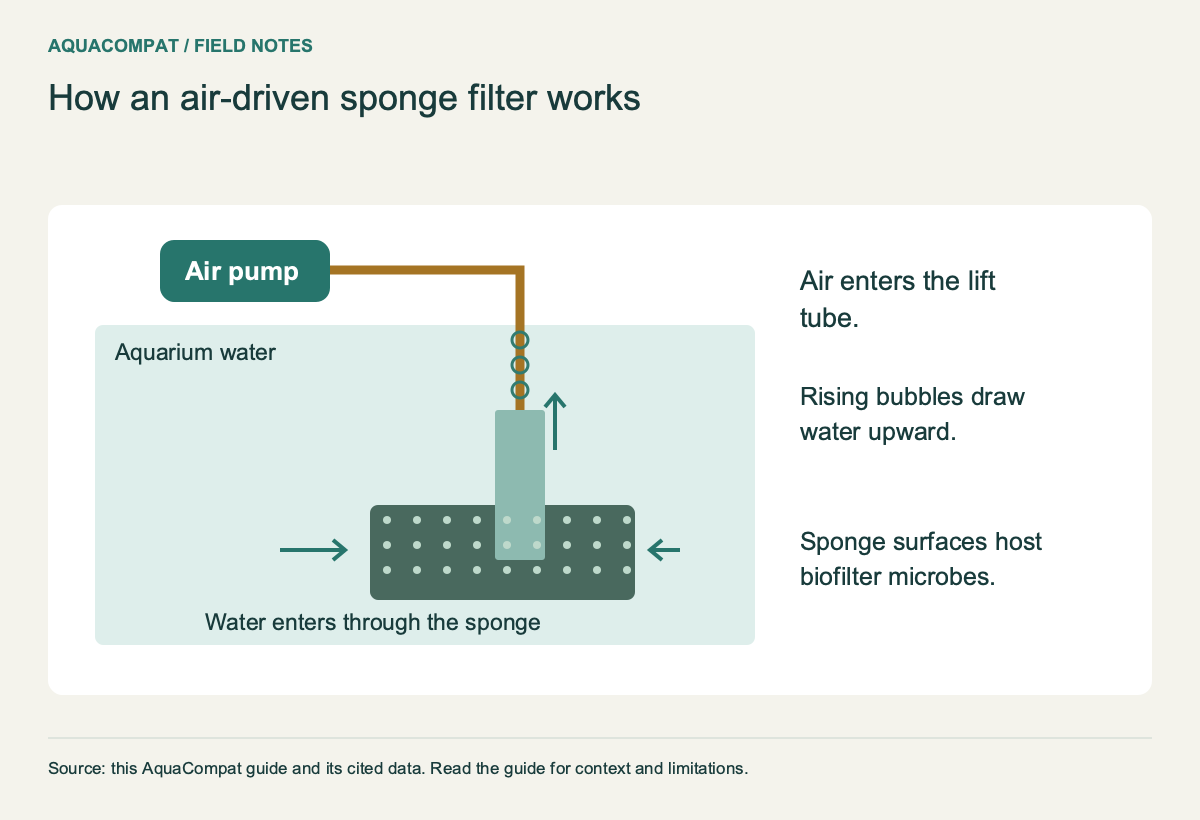
How do the three sponge filters compare?
The three sponge filters below differ most in size and in what comes in the box. Cells marked “not published” mean the seller gives no figure.
| Filter | Rated tank | Size | Foam | Air pump |
|---|---|---|---|---|
| AQUANEAT Bio Sponge Filter, Middle | up to 20 US gal | 3.0 D x 6.5 H in | Not published | Required, not included |
| Aquarium Solutions Bacto-Surge, Small | up to 40 US gal | 2 H x 4.75 D in | high density foam | Not stated |
| hygger Double Sponge Filter, Small | 10–40 US gal | 6 x 9 x 14 in, height 9–13 in | 60 ppi | yes, not included; 4 mm airline |
Sponge filters matched to tank and livestock
Each sponge filter below was chosen for a tank size and a type of livestock, using the listing specifications above. AquaCompat did not run any of them; the notes say what the published figures mean in practice.
As an Amazon Associate I earn from qualifying purchases. Prices change often, so they are not shown here; the button opens the current listing.

AQUANEAT Bio Sponge Filter (Middle)
- Rated tank
- up to 20 US gal
- Size
- 3.0 D x 6.5 H in
- Filtration
- mechanical and biological
- In the box
- no (only 1 sponge filter included)
Fits: a 5 to 20-gallon cherry shrimp, betta or fry tank where one compact sponge is enough.
Skip it if: you want a published foam density or a maker’s product page; AQUANEAT sells only through its listing, and the listing gives two different sizes.
Check price on Amazon
Aquarium Solutions Bacto-Surge (Small)
- Rated tank
- up to 40 US gal
- Size
- 2 H x 4.75 D in
- Foam
- high density foam
Fits: a 20 to 40-gallon breeding or grow-out tank where a short, wide filter sits low and out of the way.
Skip it if: you need to know before buying what else is in the box; the listing does not state the air pump requirement or included parts.
Check price on Amazon
hygger Double Sponge Filter (Small)
- Rated tank
- 10–40 US gal
- Foam
- 60 ppi
- Height
- 9–13 in
- In the box
- double sponge filter with 2 media containers, ceramic media balls, 2 spare sponges, suction cups, air valve
Fits: a 20 to 40-gallon shrimp or community tank where two sponges, spare foam and ceramic media give room to clean one side at a time.
Skip it if: your tank is under 10 gallons or shallow; the Small size stands at least 9 inches tall.
Check price on AmazonHow did we choose these sponge filters?
Every sponge filter here was chosen by comparing the published tank ratings, sizes and contents, not by running them in our tanks. Sponge filters are thinly documented: AQUANEAT has no product site, and the Aquarium Solutions (Hikari) pages were unreachable when we checked, so two of the three ratings come only from retail listings. We say where that is the case. The criteria were a stated tank rating, a listing that matches the exact size we name, and coverage of the 5 to 40-gallon range where sponge filters are most used. Prices are left out because they change daily. Our process is on the methodology page.
The Aquarium Co-Op sponge filter and the Powkoo double sponge filter were on our plan but had no verified specification file at the time of writing, so they are not compared.
Which sponge filter suits a cherry shrimp tank?
Any of the three suits a cherry shrimp tank sized to its rating; the deciding factor is tank size, not brand. Cherry shrimp need at least 5 US gal (19 L), so the AQUANEAT Middle covers most shrimp tanks and the hygger Small suits a larger colony. Practical Fishkeeping warns that any trace of ammonia or nitrite is dangerous to shrimp and that they should go only into fully cycled, established tanks , so the sponge must be fully cycled before shrimp go in.
Water chemistry matters as much as filtration. Cherry shrimp are listed at 6–10 dGH and 2–8 dKH, and SaltyShrimp targets 200–250 ppm TDS for Neocaridina. Caridina such as crystal red shrimp are kept at lower TDS, around 100–150 ppm, which usually means starting from RO water at 5–10 ppm. The Neocaridina versus Caridina comparison sets the two side by side, the guide to TDS for shrimp explains the meter readings, and the RO and DI water guide covers remineralising. For compatible fish, see the cherry shrimp tank mates list.
Is a sponge filter gentle enough for a betta?
Yes, a sponge filter suits most betta tanks because its flow comes only from rising air bubbles. Aquarium Co-Op notes that long-finned domestic bettas cannot swim well in strong currents and need gentle filtration . Bettas need at least 10 US gal (38 L) and grow to 2.8 in (7.1 cm), so a 10-gallon betta tank sits inside both the AQUANEAT and hygger ratings. FishBase and UF/IFAS describe bettas as labyrinth fish that breathe air at the surface. The betta fish tank mates page lists species that share that calm water; cherry shrimp are not among the recommended ones, because Shrimp and Snail Breeder notes that bettas hunt small invertebrates .
Why do fry and breeding tanks use sponge filters?
Breeding tanks use sponge filters because the foam is the only intake, so newborn fry and shrimplets meet a sponge surface rather than an open pipe. Fry are small and vulnerable: Seriously Fish and FishBase record that neon tetra fry become free-swimming only a few days after hatching , and Aquarium Co-Op notes that platy fry get no parental care and need hiding places . Guppy adults eat their own fry unless dense cover is provided, Aquarium Co-Op adds , so a separate fry tank needs a filter that small fish can live beside.
Fry tanks carry one specific risk. FishTankAdvisor and AquariumScience report that planaria and hydra multiply when there is surplus food, such as fine live foods like baby brine shrimp, and that hydra can catch fry and shrimplets . AquariumScience lists mature filtration and careful feeding among the preventions. The planaria and hydra guide covers removal if they appear.
Is an aquarium filter sponge the same as a sponge filter?
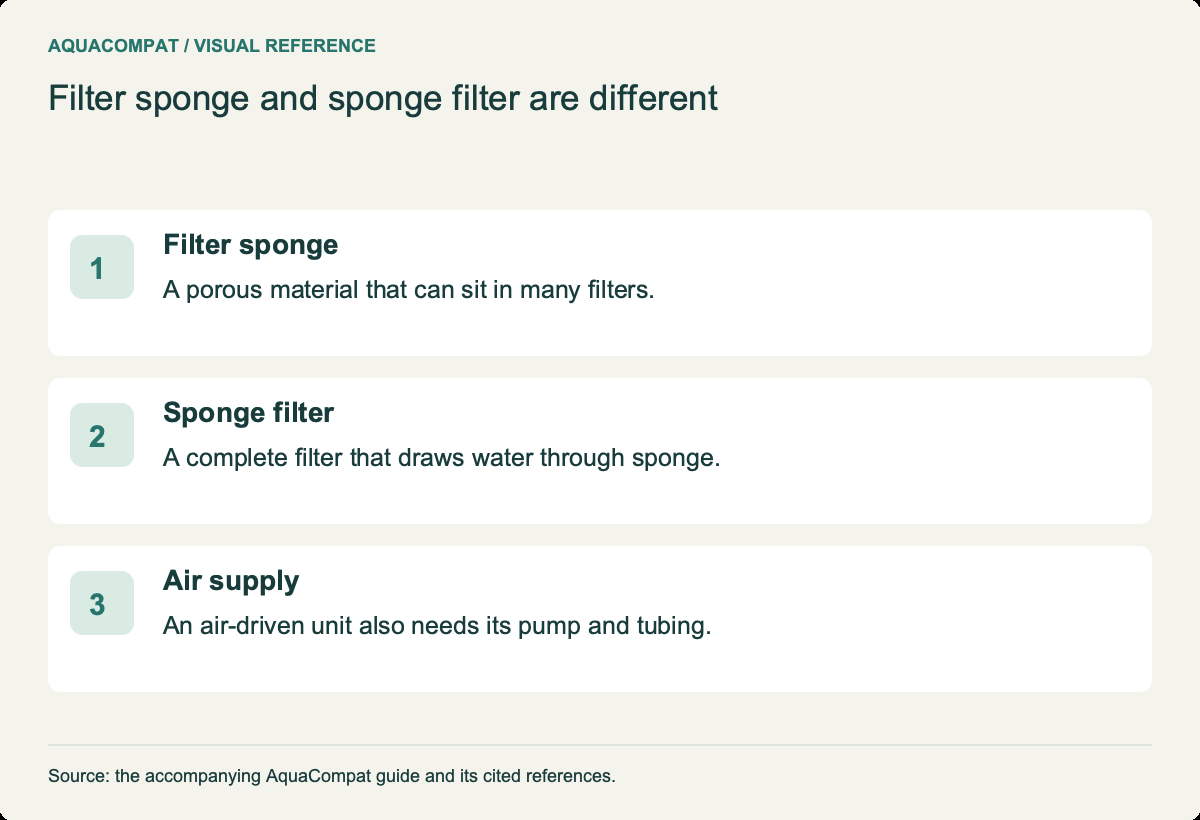
Not quite. A sponge filter is the complete air-driven unit; an aquarium filter sponge, or filter foam, is the block of foam inside it, and the same term covers replacement foam for other filter types. When you buy replacement foam, match the size and the pore density. hygger includes double sponge filter with 2 media containers, ceramic media balls, 2 spare sponges, suction cups, air valve, so its owners can swap a worn sponge without buying a new filter.
A common mistake is to rinse a filter sponge under the tap. Practical Fishkeeping warns that chlorine in tap water kills the nitrifying bacteria living on filter media , and those bacteria are the reason the sponge works. Rinse it instead in chlorine-free water, such as water just removed from the tank during a water change.
When is a sponge filter not enough?
A sponge filter is not enough for tanks above its rating or for fish that produce heavy waste. The largest ratings here are the hygger Small at 10–40 US gal and the Bacto-Surge Small at up to 40 US gal. Goldfish are the clearest mismatch: Aquarium Co-Op and OATA describe them as heavy waste producers that need strong filtration , and they grow to 10 in (25.4 cm). Large cichlids such as Oscar, which need at least 75 US gal (284 L), are well beyond any sponge filter here. For those tanks, compare canister filters by tank size, which publish flow and media volume.
Are these sponge filters sold outside the US?
All three are US listings, and none has a verified EU or UK sales region in our sources. AQUANEAT sells through Amazon only, the Bacto-Surge listing is a US Amazon product, and hygger’s store advertises shipping from the US only. Owners in Europe should compare a local sponge filter on the same three specs used above: rated tank size, air pump needs and foam density.
Questions people ask
Do sponge filters need an air pump?
Yes. AQUANEAT and hygger both state an air pump is required and not included; hygger’s listing reads “yes, not included; 4 mm airline”. The Bacto-Surge listing does not state it, but the design works the same way, so plan for a pump and tubing with any of the three.
What size sponge filter do I need for a 10-gallon tank?
A sponge filter rated above 10 gallons. The AQUANEAT Middle is rated up to 20 US gal and is the most compact of the three. The hygger Small starts at 10 gallons but stands 9–13 in tall, which may crowd a short tank.
Can a sponge filter cycle a new tank on its own?
Yes, a sponge filter hosts the same nitrifying bacteria as any other filter, but it still has to go through the full cycle first. The fishless cycling steps take several weeks; UF/IFAS gives 6–8 weeks for a new biofilter.
What does ppi mean on filter foam?
Ppi means pores per inch. Higher numbers mean finer foam that traps smaller particles. hygger lists its sponges at 60 ppi; AQUANEAT and Aquarium Solutions do not publish a ppi figure for the sizes compared here.
Sources 68 documents from 25 publishers
- Amazon (amazon.com): “Hygger Aquarium Double Sponge Filter (S) B07RFL4JMM”; “Aquarium Solutions Bacto-Surge High Density Foam Filter Kit, Small (B00GOFRZIU)”
- Amazon (AQUANEAT brand listing) (amazon.com): “AQUANEAT Aquarium Bio Sponge Filter (Middle up to 20Gal) B078Q29JT4”
- Aquarium Co-Op (aquariumcoop.com): “Care Guide for Cherry Shrimp”; “Betta Fish Care Guide”; “Care Guide for Dwarf Gouramis”; “10 Best Top-Dwelling Fish for Your Freshwater Community Aquarium”; “What Is Neon Tetra Disease and How Can It Be Prevented?”; “Neon and Cardinal Tetras: Beginner Schooling Fish”; “Top 5 Dither Fish to Help Shy or Aggressive Fish in Freshwater Tanks”; “Care Guide for Platy Fish: Feeding, Breeding, and Tank Mates”; “Guppy Care Guide”; “How to Get Rid of Hydra in Your Aquarium”; “Does dechlorinator remove ammonia?”; “Care Guide for Fancy Goldfish”; “Goldfish Tank Mates”; “Amano Shrimp Care Guide”; “Oscar Fish Care Guide”
- AquariumScience.org (aquariumscience.org): “10.13.1 Hydra”
- Environmental Science and Pollution Research (via PMC) (pmc.ncbi.nlm.nih.gov): “Wagil M. et al. Toxicity of anthelmintic drugs (fenbendazole and flubendazole) to aquatic organisms”
- FishBase (fishbase.se): “Betta splendens, Siamese fighting fish: species summary”; “Paracheirodon innesi summary (Bayesian length-weight estimate)”; “Xiphophorus maculatus summary (Bayesian length-weight estimate)”; “Poecilia reticulata, Guppy: species summary”; “Length-weight relationships for Poecilia reticulata”; “Carassius auratus, Goldfish: species summary”; “Length-weight relationships for Carassius auratus”
- fishkeeping.co.uk (fishkeeping.co.uk): “Goldfish Size, Life Expectancy and Tank Recommendations”; “Keeping Goldfish - The Right Way”
- FishTankAdvisor (fishtankadvisor.com): “Planaria in the Aquarium: Removal and Prevention”
- Green Aqua (greenaqua.hu): “Shrimp in the aquarium”
- Green Aqua (Biomax) (greenaqua.hu): “Biomax NO Planaria product instructions”
- hygger (hygger-online.com): “hygger Double Biochemical Sponge Filter”
- Maidenhead Aquatics (fishkeeper.co.uk species data sheet) (fishkeeper.co.uk): “Siamese Fighting Fish/Betta data sheet”; “Neon Tetra data sheet”; “Platy data sheet”; “Guppy data sheet”
- Merck Veterinary Manual (merckvetmanual.com): “Environmental Diseases of Aquatic Animals in Aquatic Systems, Francis-Floyd, Yanong and Petty”
- Ornamental Aquatic Trade Association (OATA) (ornamentalfish.org): “How to look after goldfish in an aquarium / fish tank”; “How to look after fancy goldfish”
- Practical Fishkeeping (practicalfishkeeping.co.uk): “Frequently asked questions on Neocaridina shrimps”; “An introduction to Shrimp”; “How long will my fish live?”; “Quick guide to livebearers”; “Problem solver: New Tank Syndrome”; “What water temperature do goldfish need?”; “How can I breed goldfish in my aquarium?”
- SaltyShrimp (product information via Furry Critter Network) (furrycritter.com): “SaltyShrimp Remineralizers for Invertebrates”
- Seachem Laboratories (manufacturer) (seachem.com): “Prime”
- Seriously Fish (seriouslyfish.com): “Betta splendens”; “Paracheirodon innesi (Neon Tetra)”; “Xiphophorus maculatus”; “Poecilia reticulata”; “Poecilia wingei”; “Astronotus ocellatus”
- Shrimp and Snail Breeder (aquariumbreeder.com): “Red Cherry Shrimp: detailed guide, care, diet and breeding”; “Cherry shrimp in a community tank: how to make it successful”; “How Copper Affects Dwarf Shrimp”
- Shrimp Science (shrimpscience.com): “Red Cherry Shrimp - Care Guide”; “General Hardness (GH) For Shrimp Tanks”; “Carbonate Hardness (KH) For Shrimp Tanks”; “TDS For Shrimp Tanks”
- Tropical Fish Hobbyist Magazine (tfhmagazine.com): “Betta splendens”
- UF/IFAS EDIS (ask.ifas.ufl.edu): “Evolution, Culture, and Care for Betta splendens (FA212)”
- University of Florida IFAS Extension (ask.ifas.ufl.edu): “FA165: Use of Copper in Marine Aquaculture and Aquarium Systems (R.P.E. Yanong)”
- University of Florida IFAS Extension (EDIS) (ask.ifas.ufl.edu): “Teach Aquaculture Curriculum: Chlorine, Friend or Foe? (FA171), Chapman et al.”; “Ammonia in Aquatic Systems (FA16/FA031), Francis-Floyd, Watson, Petty and Pouder”
- US Environmental Protection Agency (epa.gov): “Chloramines in Drinking Water”
All sources accessed . Every number on this page comes from these documents.