What does the editorial team do?
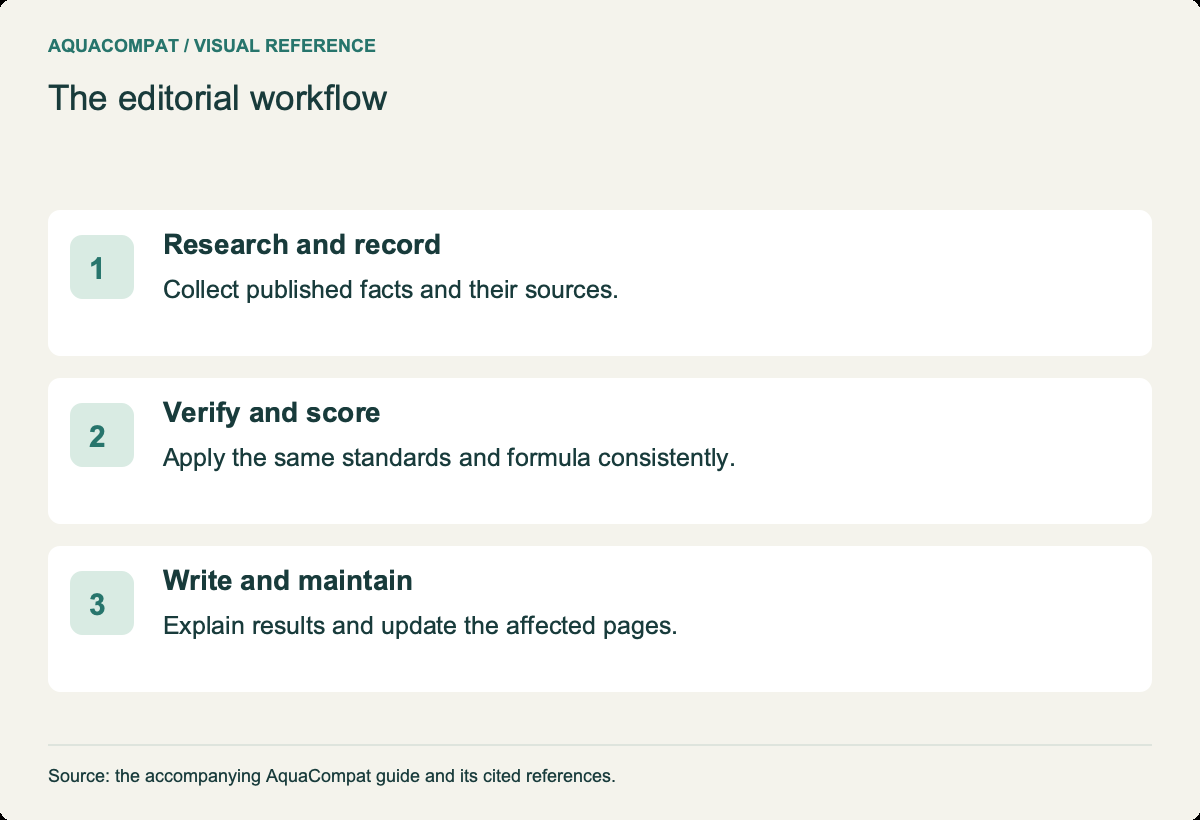
The editorial team turns published aquarium references into consistent, checkable pages. Its work falls into four tasks, listed in the order they happen.
- Research. The team reads species, water-chemistry, disease and equipment sources and records each value in a fact file with the publisher, title, address and date it was read.
- Verification. Temperature, pH and general hardness need two independent sources before they count as verified. Values with one source are kept but marked single-source, and disagreements between sources are recorded rather than averaged away.
- Scoring. Every pair of species is scored by the same formula from those fact files, so the species compatibility guides and the fish compatibility checker always agree.
- Writing and upkeep. The team writes the guides, inserts every number from the fact base rather than typing it by hand, and rebuilds the site when a value or the method changes.
Because numbers are inserted from the fact files, one correction reaches every page that uses that value. A species' pH range reads the same on its tank mates hub, its pair pages and inside both tools.
How does the team research a guide?
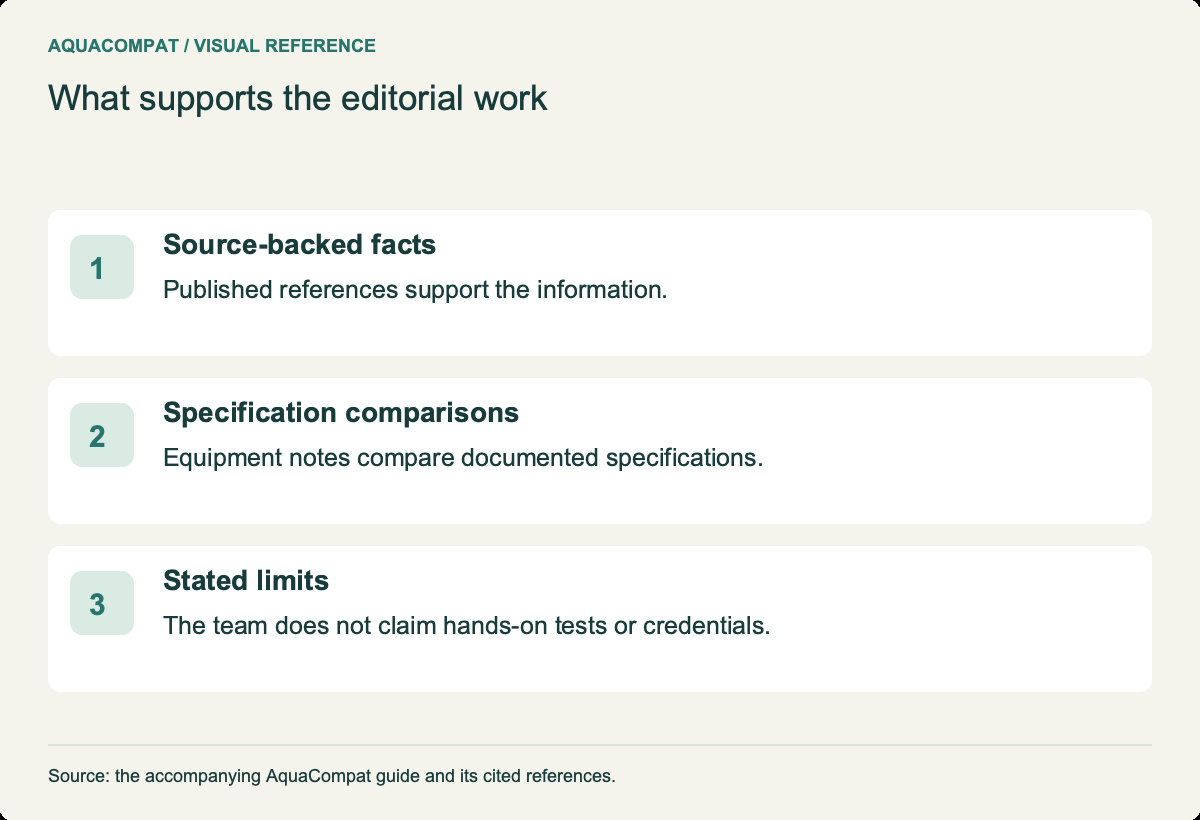
The team researches a guide by starting from the fact base and adding only what a named source supports. Sources are used in a fixed order of preference: FishBase and Seriously Fish for species data, group-specific references such as PlanetCatfish where they exist, university extension papers such as UF/IFAS EDIS and the Southern Regional Aquaculture Center, the Merck Veterinary Manual and peer-reviewed papers, then established hobby references such as Aquarium Co-Op and Practical Fishkeeping. Retail product pages are never used as a source for species data.
Each kind of page follows the same approach.
- Compatibility and tank mates pages explain the sourced reasons behind a verdict: shared temperature and pH, temperament records, adult size and predation notes.
- Water guides, collected under aquarium water chemistry guides, cite extension and veterinary references for thresholds such as safe ammonia and nitrite levels.
- Health pages under fish health and tank problems paraphrase extension and veterinary sources on signs, causes and treatment, and each one says when to consult an aquatic veterinarian.
- Buyer guides under equipment buyer guides compare manufacturers' published specifications against a tank size or species need.
The weights, deal-breakers and version history behind every verdict are documented once, on the scoring methodology page, and are not restated in individual guides.
What does the editorial team not claim?
The editorial team does not claim hands-on experience or professional credentials, and no page implies otherwise. Specifically, the team makes none of these claims.
- No keeping or breeding. No verdict rests on fish the team has kept together, and no breeding or care advice comes from the team's own tanks.
- No testing. No equipment has been tested, measured or used by the team. Product notes compare published specifications only.
- No veterinary or scientific credentials. The team includes no claimed veterinarian, biologist or aquaculture professional. Disease pages summarise published sources and point to an aquatic veterinarian for diagnosis and medication.
- No invented ratings. There are no star ratings, review scores, percentages or "best overall" badges anywhere on the site.
This is why the team writes as an organisation rather than under a personal byline. The authority of a page comes from the sources it cites, which any reader can open, not from a person's résumé.
Is the editorial team independent of advertisers?
Yes. The team chooses topics, sources and products without input from manufacturers or retailers, and no brand pays for coverage. The site earns Amazon Associates commissions on some product links, but those links appear only on equipment pages and never feed into a compatibility score. The affiliate disclosure sets out how links are marked and why prices are not shown, and the About AquaCompat page explains how the site is run.
How does the team handle corrections?
The team handles corrections by fixing the fact file first, then rebuilding every page that uses it. A report through the AquaCompat contact page is most useful when it names the page, the value in question and a published source that disagrees. If the source checks out, the value is corrected or the disagreement is added to the species' conflicts list, and the page's updated date changes to show when. Pages are never re-dated without a real content change.
Which guides does the editorial team maintain?
- Freshwater aquarium speciesCare data for every species in the database
- Fish compatibility guidesPair-by-pair answers on which species can share a tank
- Tank mates by speciesRanked companion lists for each centrepiece species
- Water chemistry and setup guidespH, hardness, temperature, cycling and planted tanks
- Fish diseases and tank problemsSymptoms, causes and sourced treatment steps
- Aquarium equipment buyer guidesEquipment matched to tank size from published specs
- Free aquarium toolsThe compatibility checker and stocking calculator
- Tank setups by sizeStocking plans for specific tank sizes
- Species comparisonsClose species set side by side
- Betta fish and guppiesShared water, fin-nipping risk and tank size
- Betta fish and neon tetrasA narrow shared temperature band and school size
- Betta fish and goldfishWhy tropical and coldwater fish do not mix
- Betta fish tank matesPeaceful companions for a semi-aggressive centrepiece
- Corydoras tank matesSchooling fish that share a cory's water
- Guppy tank matesHard-water companions and fry pressure
- Cherry shrimp tank matesWhich fish leave shrimp and shrimplets alone
- Oscar tank matesThe few species large enough to live with an oscar
- Angelfish tank matesCompanions too large to be eaten
- Kuhli loach tank matesSoft-water companions for a bottom dweller
- African cichlids tank matesCompanions for hard, alkaline cichlid tanks
- Bristlenose pleco tank matesCommunity fish that suit a pleco
- Goldfish tank matesColdwater companions and why other goldfish come first
- Aquarium snails tank matesFish and shrimp that leave snails alone
- Discus tank matesWarm, soft-water companions for discus
- Fish compatibility checkerA scored verdict for any two species
- Aquarium stocking calculatorChecks a full species list against one tank
- 10-gallon community tankSpecies that fit 10 US gallons (38 L)
- 20-gallon planted tankFish and plants for 20 US gallons (76 L)
- Canister filtersRated tank size, flow and media volume
- Sponge filtersGentle filtration for shrimp, fry and bettas
- Aquarium heatersWattage by tank size and safety features
- Aquarium test kitsWhat each kit measures and how
- Water conditionersChlorine, chloramine and label doses
- Planted tank substratesAqua soils and other planted substrates compared
- Planted tank lightsLights matched to plant demand
- CO2 systemsPressurised CO2 kits and drop checkers
- Fish foodFoods matched to diet and swim level
- Aquascaping toolsScissors, tweezers and spatulas for planting
- The nitrogen cycleAmmonia, nitrite and nitrate explained
- Aquarium pHRanges by species and how to change pH
- Aquarium temperatureTemperature ranges by species
- Fishless cyclingHow to cycle a new tank without fish
- GH and KHGeneral and carbonate hardness
- CO2 in planted tanksTarget levels and fish safety
- Tap waterChlorine, chloramine and conditioning
- RO/DI waterWhen to use purified water and remineralise
- TDS in shrimp tanksDissolved solids targets for shrimp
- Planted tank setupStarting a planted aquarium step by step
- Low-tech planted tanksPlants without injected CO2
- Acclimating new fishFloat and drip methods
- Maintenance scheduleWater changes and routine checks
- Ich (white spot)Spots, life cycle and treatment by temperature
- New tank syndromeAmmonia and nitrite in an uncycled tank
- Fin rotFrayed fins and the water problems behind them
- Cloudy waterCauses by colour of the haze
- Fish not eatingWhat loss of appetite can signal
- Aquarium algaeAlgae types and their triggers
- Swim bladder disorderFloating, sinking and buoyancy problems
- Planaria and hydraPests that threaten shrimplets and fry
- Caridina vs Neocaridina shrimpWater and difficulty compared
- Harlequin vs chili vs galaxy rasboraThree small schooling fish compared
Questions people ask
Why is there no named author on AquaCompat pages?
Every page is built from the same fact base and the same method, so the team publishes as one organisation author. A named byline would suggest personal expertise or first-hand experience that the site does not claim. Instead, each page lists the published sources behind its figures, which is the evidence a reader can actually check.
Does the editorial team answer fishkeeping questions?
The team does not offer individual advice on a reader's tank or sick fish. It does read error reports and source suggestions sent through the contact page, and a well-sourced correction will change the affected pages. For a sick fish or a medication decision, an aquatic veterinarian is the right person to ask.
How can the team write about fish it has never kept?
The team reports what published references document, the same way a reference librarian summarises sources without running the experiments. Each claim names its source, conflicting figures are shown side by side, and values with only one source are flagged. That makes the pages a summary of published knowledge, with the gaps marked, rather than one keeper's opinion.