What does an aquarium species comparison compare?
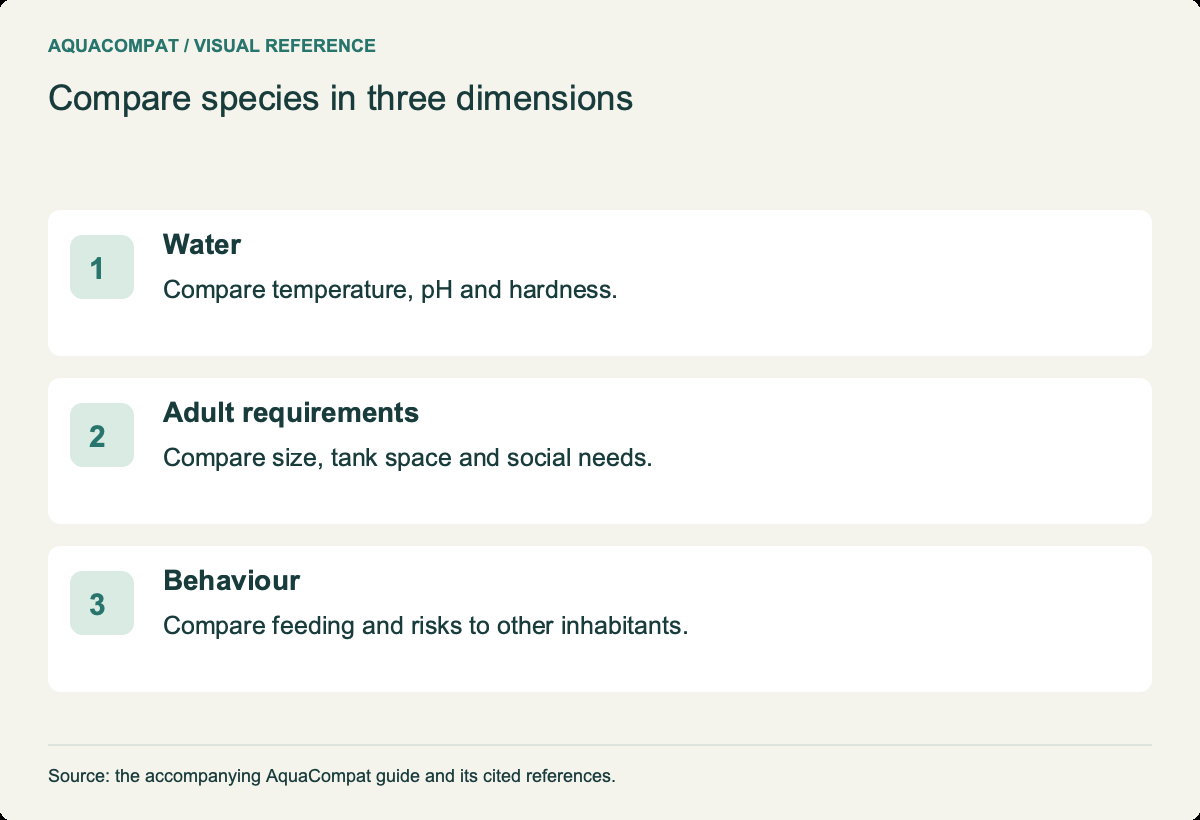
An aquarium species comparison compares the care attributes that decide which of two similar species will do better in your tank: temperature, pH, general hardness (GH), carbonate hardness (KH) where it matters, adult size, minimum tank, group size, temperament, care level and breeding. Hardness here means minerals dissolved in the water, not anything physical. Each comparison takes those values from the same species fact files used across AquaCompat, so a number on a comparison page matches the number on every pair page and tool.
Comparisons exist for species that are sold side by side and look interchangeable on a shop label, but differ in one or two attributes that change the whole setup. The cherry shrimp and crystal red shrimp are both small, peaceful, bottom-grazing shrimp, yet they want different water. The harlequin, chili and galaxy rasboras are all small, peaceful, mid-water schooling fish, yet one is more than twice the length of the other two. The freshwater species index lists the care data for each species on its own; a comparison page adds the reasoning about which one to choose.
The table below lists the five species covered by the two live comparisons, in the order they appear on those pages.
| Species | Temperature | pH | General hardness | Adult size | Minimum tank | Care level |
|---|---|---|---|---|---|---|
| Cherry Shrimp (Neocaridina) | 70–79 °F (21–26 °C) | pH 6.5–8.0 | 6–10 dGH | 1.5 in (3.8 cm) | 5 US gal (19 L) | beginner |
| Crystal Red Shrimp (Caridina) | 70–74 °F (21–23 °C) | pH 6.2–7.0 | 4–6 dGH | 1.2 in (3 cm) | 10 US gal (38 L) | intermediate |
| Harlequin Rasbora | 72–79 °F (22–26 °C) | pH 5.0–7.5 | 1–12 dGH | 2 in (5.1 cm) | 15 US gal (57 L) | beginner |
| Chili Rasbora | 72–82 °F (22–28 °C) | pH 6.0–7.0 | 1–10 dGH | 0.8 in (2 cm) | 10 US gal (38 L) | intermediate |
| Galaxy Rasbora | 72–78 °F (22–26 °C) | pH 6.6–7.5 | 5–15 dGH | 0.8 in (2 cm) | 10 US gal (38 L) | beginner |
How do Neocaridina and Caridina shrimp differ?
Neocaridina and Caridina shrimp differ mainly in the water they need: Neocaridina, such as the cherry shrimp, live in harder, more alkaline water, while Caridina, such as the crystal red shrimp, need soft, slightly acidic water with almost no carbonate hardness. Everything else about the two, from size to temperament, is close enough that the water decides the choice.
Hardness, KH and TDS
The cherry shrimp's care range is 6–10 dGH and 2–8 dKH, against 4–6 dGH and 0–2 dKH for the crystal red. Shrimp Science gives the same split at genus level, GH 4–10 for Neocaridina and GH 4–6 for Caridina, which is why the two are usually not kept in the same water. Total dissolved solids (TDS), the overall mineral load read by a TDS meter, follow the same pattern: 100–250 ppm for the cherry shrimp and 100–180 ppm for the crystal red. The guide to TDS in shrimp tanks explains how those readings are taken and held steady.
Temperature and pH
The crystal red shrimp has the narrower band on both counts: 70–74 °F (21–23 °C) and pH 6.2–7.0, against 70–79 °F (21–26 °C) and pH 6.5–8.0 for the cherry shrimp. A tank that runs warm for tropical fish suits the cherry shrimp far more easily.
Care level and breeding
The cherry shrimp is rated beginner and the crystal red intermediate. Shrimp and Snail Breeder describes the crystal red as harder than the cherry shrimp and not one for novice breeders, and it links crystal red losses to swings in water parameters. Both species hatch young as miniature adults with no larval stage, so either can build a colony in a home tank once the water is right. The Neocaridina vs Caridina comparison goes through each attribute in turn.
How do harlequin, chili and galaxy rasboras differ?
Harlequin, chili and galaxy rasboras differ most in size, minimum tank and feeding. The Harlequin Rasbora grows to 2 in (5.1 cm), while the Chili Rasbora and the galaxy rasbora both reach only about 0.8 in (2 cm). That size gap sets the rest of the comparison.
Tank size and group size
The harlequin needs 15 US gal (57 L) and a group of at least 8. The chili rasbora needs 10 US gal (38 L) and a group of 8, and the galaxy rasbora 10 US gal (38 L) and a group of 10. Aquarium Co-Op recommends 10 to 15 galaxy rasboras because they are timid, and Seriously Fish goes further, advising as many as possible.
Water
All three share soft to moderately hard water, but their pH ranges sit in different places: pH 5.0–7.5 for the harlequin, pH 6.0–7.0 for the chili and pH 6.6–7.5 for the galaxy rasbora. The harlequin's wide range is one reason it is rated beginner; the chili, rated intermediate, wants a well-established tank according to Seriously Fish.
Feeding and behaviour
The chili and galaxy rasboras are micropredators: Seriously Fish and Aquarium Co-Op both advise small live or frozen foods such as Daphnia, cyclops and microworms alongside fine dry food. The harlequin is an omnivore that accepts flake. Behaviour differs too. Seriously Fish describes the chili as easily outcompeted by larger, boisterous fish, and Aquarium Co-Op notes that galaxy rasboras hide and stress in sparse tanks, while galaxy males spar among themselves. The harlequin, chili and galaxy rasbora comparison lays these differences out in one table.
Can the compared species live in the same tank?
The three rasboras can share a tank, but the two shrimp groups are better kept apart even though their ranges touch. The pair matrix shows how close each combination comes.
Among the rasboras, the harlequin and chili pairing is rated compatible at 10/10, harlequin with galaxy compatible at 9/10, and chili with galaxy compatible at 9/10. All three are peaceful mid-water fish with overlapping water. The size gap is the part to watch: a mixed group needs the harlequin's larger tank, 20 US gal (76 L) for that pair, and the tiny species need enough cover to feed without competition.
The cherry shrimp and crystal red shrimp are rated compatible at 9/10, because neither harms the other and their temperature ranges overlap. Their hardness ranges, though, share only 6–6 dGH, the top of the crystal red's range and the bottom of the cherry shrimp's. Holding a tank at that single value leaves no margin for either species, which is why shrimp keepers usually pick one genus per tank. The scoring method behind each verdict explains what a pair score does and does not measure.
Are all rasboras close relatives?
No. The three fish sold as rasboras belong to three different genera, so the shared name says little about their care. The harlequin is Trigonostigma heteromorpha, the chili rasbora is Boraras brigittae and the galaxy rasbora is Danio margaritatus, a danio. All three sit in the family Danionidae, but the galaxy rasbora was first traded as Microrasbora sp. 'Galaxy' after its discovery in 2006 and is also sold as the celestial pearl danio, according to Seriously Fish and FishBase. The chili rasbora is sometimes sold as the mosquito rasbora.
Shrimp names mislead in a similar way. Shrimp Science notes that crystal black shrimp are the same species as crystal reds with identical care, and that the black gene is dominant, so red parents can produce black young. Treat the common name as a label, and compare the species by its care data rather than by what it is called in the shop.
How do you choose between two similar species?
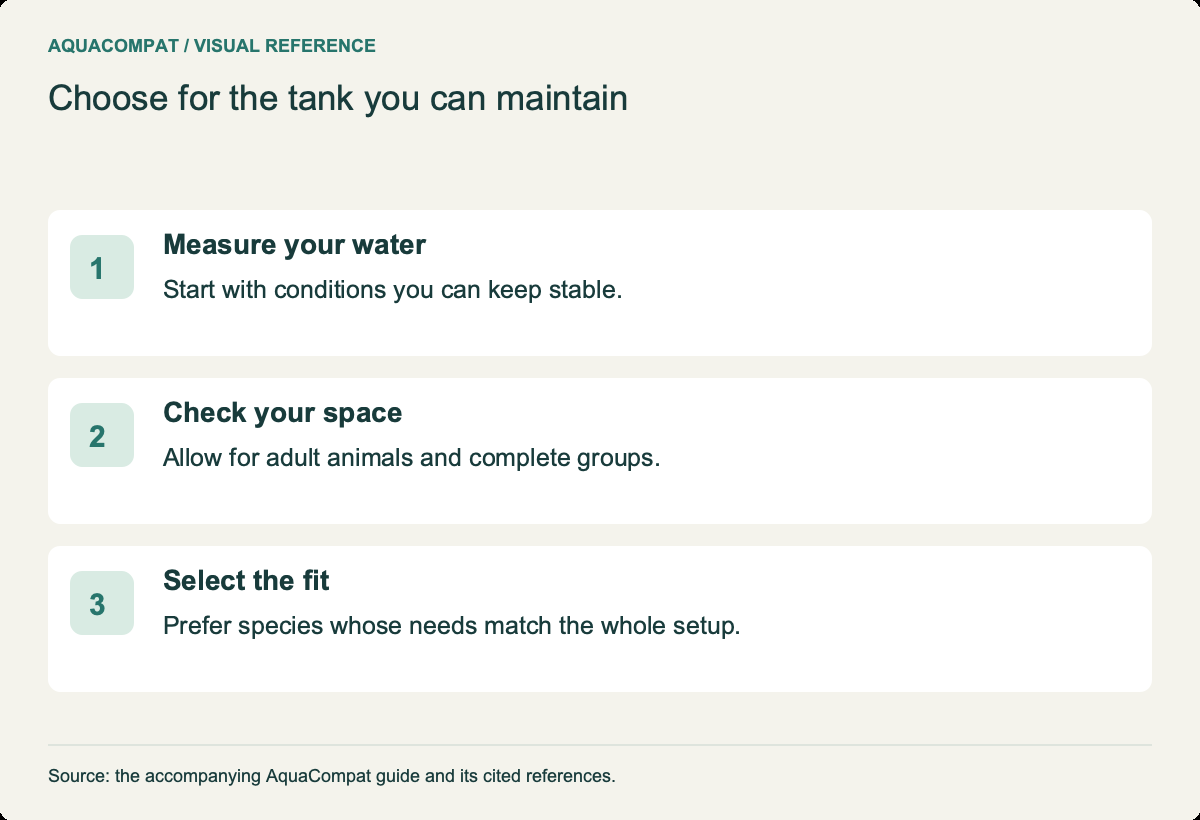
Choose between two similar species by testing your tap water first, then matching the species to the tank you have and the tank mates you want. The order below avoids buying a species that will need its water changed to suit it.
- Test GH, KH and pH. Tap water that already sits inside a species' range is the easiest path. Hard, alkaline tap water points to Neocaridina shrimp; soft water opens up Caridina and the soft-water rasboras. The explanation of general and carbonate hardness covers the test kits and units.
- Check the tank size. A 10-gallon tank fits the chili and galaxy rasboras by their published minimums, but not the harlequin at 15 US gal (57 L).
- Check the tank mates. Every fish here will take baby shrimp, so the cherry shrimp tank mates list is the place to see which companions leave a colony room to grow.
- Decide how much control you want. Caridina shrimp often need remineralised reverse osmosis water; Shrimp Science notes that remineralised RO water gives full control of parameters. The RO/DI water guide explains what that involves.
When does a comparison not settle the choice?
A comparison does not settle the choice when the rest of the tank rules out both species, or when you want to keep more than one line together. These are the cases where the side-by-side data is not enough on its own.
- The tank already holds a predator. A betta with chili rasboras is rated incompatible at 3/10, and with galaxy rasboras incompatible, because a betta can swallow fish that small. Choosing the better of the two rasboras does not fix that.
- The tank runs warm. The crystal red shrimp shares only 72–74 °F (22–23 °C) with the chili rasbora, and the pair is rated incompatible. A nano tank combining the most delicate fish and the most delicate shrimp leaves almost no working temperature.
- You want several colour lines. Shrimp Science and Shrimp and Snail Breeder both warn that crystal reds crossbreed with other Caridina bee and tiger shrimp, so one Caridina line per tank is the rule. Seriously Fish records that the galaxy rasbora can hybridise with Danio erythromicron, so the two should not share a tank.
- The fish will eat the shrimp young. Cherry shrimp with harlequins is rated caution: Shrimp and Snail Breeder says harlequins ignore larger shrimp but take shrimplets, and Aquarium Co-Op says galaxy rasboras give mixed results with cherry shrimp.
Pests are a separate risk in shrimp tanks. Flatworms and hydra can take shrimplets, and the page on planaria and hydra in shrimp tanks covers how they arrive and how to remove them safely.
Which species comparisons are available?
Where should you go after a comparison?
After a comparison, check the chosen species against the rest of your stocking list. The fish and shrimp compatibility checker scores any two species in the fact base, and the aquarium stocking calculator checks a whole list against tank volume and group sizes. For a planted nano or small community build, the 20-gallon planted tank stocking guide shows how small schooling fish and shrimp fit together.
Questions people ask
Is the cherry shrimp or the crystal red shrimp better for a first shrimp tank?
Which rasbora suits a 10-gallon tank?
Why do the comparison pages show different ranges from some shop labels?
Can galaxy rasboras live with cherry shrimp?
Sources 31 documents from 9 publishers
- Aquarium Co-Op (aquariumcoop.com): “Care Guide for Cherry Shrimp”; “Care Guide for Harlequin Rasboras and Lambchop Rasboras”; “Chili Rasbora care guide”; “Celestial Pearl Danio care guide”; “Top 10 Betta Fish Tank Mates”; “Betta Fish Care Guide”
- FishBase (fishbase.se): “Trigonostigma heteromorpha summary page”; “Danio margaritatus summary page”; “Boraras brigittae summary (Bayesian length-weight estimate)”; “Betta splendens, Siamese fighting fish: species summary”
- Maidenhead Aquatics (fishkeeper.co.uk species data sheet) (fishkeeper.co.uk): “Harlequin Rasbora data sheet”
- Practical Fishkeeping (practicalfishkeeping.co.uk): “Frequently asked questions on Neocaridina shrimps”; “A guide to the small rasboras from the genus Trigonostigma”; “An introduction to Shrimp”; “How long will my fish live?”
- Seriously Fish (seriouslyfish.com): “Trigonostigma heteromorpha (Harlequin)”; “Boraras brigittae”; “Danio margaritatus (Celestial Pearl Danio)”; “New shrimp from Hong Kong and southern China”; “Betta splendens”
- Shrimp and Snail Breeder (aquariumbreeder.com): “Red Cherry Shrimp: detailed guide, care, diet and breeding”; “Crystal Red Shrimp: detailed guide, care, diet and breeding”; “Cherry Shrimp in a Community Tank”; “How Copper Affects Dwarf Shrimp”
- Shrimp Science (shrimpscience.com): “Red Cherry Shrimp - Care Guide”; “General Hardness (GH) For Shrimp Tanks”; “Crystal Red Shrimp - Care Guide”; “Carbonate Hardness (KH) For Shrimp Tanks”; “TDS For Shrimp Tanks”
- UF/IFAS EDIS (ask.ifas.ufl.edu): “Evolution, Culture, and Care for Betta splendens (FA212)”
- Wikipedia (en.wikipedia.org): “Celestial pearl danio”
All sources accessed . Every number on this page comes from these documents.