Which species are small enough for a 20-gallon planted tank?
A species qualifies for a 20-gallon tank only if its published minimum tank is 20 US gal (76 L) or smaller. Each minimum comes from the species’ care sources, usually the base footprint Seriously Fish recommends, converted to US gallons. That rule admits every small community fish we cover and removes seven larger species: goldfish, angelfish, discus, oscars and the three African cichlids.
A planted tank adds a second filter: the water the substrate makes. Active soils lower pH and hardness, so the soft-water species in the table sit comfortably over soil, while livebearers and snails that need hard water belong over inert gravel. The table lists each species’ minimum, group size and pH range so you can see both filters at once. Species rated by tank size alone are not a stocking; the three stockings further down check every pair.
| Species | Minimum tank | Group minimum | pH range | 20-gallon resident? |
|---|---|---|---|---|
| Assassin Snail | 5 US gal (19 L) | 1 | pH 7.2–8.0 | Yes, hard water |
| Cherry Shrimp | 5 US gal (19 L) | 10 | pH 6.5–8.0 | Yes |
| Nerite Snail | 5 US gal (19 L) | 1 | pH 7.2–8.0 | Yes, hard water |
| Mystery Snail | 5 US gal (19 L) | 1 | pH 7.2–8.0 | Yes, hard water |
| Amano Shrimp | 10 US gal (38 L) | 1 | pH 6.0–7.5 | Yes |
| Chili Rasbora | 10 US gal (38 L) | 8 | pH 6.0–7.0 | Yes |
| Galaxy Rasbora | 10 US gal (38 L) | 10 | pH 6.6–7.5 | Yes |
| Crystal Red Shrimp | 10 US gal (38 L) | not reliably documented | pH 6.2–7.0 | Yes, species tank only |
| Guppy | 10 US gal (38 L) | 5 | pH 7.0–8.0 | Yes, hard water |
| Endler's Livebearer | 10 US gal (38 L) | 3 | pH 7.0–8.5 | Yes, hard water |
| Betta Fish | 10 US gal (38 L) | 1 | pH 6.0–8.0 | Yes, with care (see below) |
| Platy | 14 US gal (53 L) | 3 | pH 7.0–8.2 | Yes, hard water |
| Harlequin Rasbora | 15 US gal (57 L) | 8 | pH 5.0–7.5 | Yes |
| Neon Tetra | 15 US gal (57 L) | 8 | pH 5.0–7.5 | Yes |
| Cardinal Tetra | 15 US gal (57 L) | 8 | pH 4.0–7.5 | Yes |
| Kuhli Loach | 15 US gal (57 L) | 5 | pH 3.5–7.0 | Yes |
| Dwarf Gourami | 15 US gal (57 L) | 1 | pH 6.0–7.5 | Alone only (see below) |
| Corydoras | 20 US gal (76 L) | 6 | pH 6.5–7.5 | Yes |
| Bristlenose Pleco | 20 US gal (76 L) | 1 | pH 6.0–7.2 | Yes |
| Zebra Danio | 20 US gal (76 L) | 8 | pH 6.0–8.0 | Yes |
| GloFish Tetra | 20 US gal (76 L) | 6 | pH 6.0–7.0 | Yes |
| Molly | 20 US gal (76 L) | 3 | pH 7.5–8.5 | Yes, hard water |
| Angelfish | 53 US gal (201 L) | 1 | pH 6.0–8.0 | No |
| Goldfish | 48 US gal (182 L) | 1 | pH 6.0–8.0 | No |
| Discus | 67 US gal (254 L) | 6 | pH 5.0–7.6 | No |
| Oscar | 75 US gal (284 L) | 1 | pH 6.0–8.0 | No |
Can harlequin rasboras, kuhli loaches and a bristlenose pleco share 20 gallons?
Yes: harlequin rasboras, kuhli loaches and one bristlenose pleco form the strongest 20-gallon planted stocking, because all three pairs are rated compatible. Harlequin with kuhli is compatible at 10/10, harlequin with bristlenose is compatible at 10/10, and bristlenose with kuhli is compatible at 9/10. Each pair is sized at 20 US gal (76 L).
- Harlequin rasboras: a group of 8; Seriously Fish recommends at least 8 to 10. Harlequins attach their eggs to the underside of broad plant leaves, so anubias and cryptocoryne suit them .
- Kuhli loaches: a group of 5. Seriously Fish says they like to dig and recommends a soft sandy substrate, and that they are known to jump, so the tank needs a tight lid .
- Bristlenose pleco: 1. Aquarium Co-Op notes it may snack on sword plants, so this stocking leaves Amazon swords out .
All three share soft water, which suits an active soil. The overlap for harlequin and kuhli is pH 5.0–7.0 and 1–8 dGH, and the figure below shows the shared temperature, pH and hardness. The kuhli loach tank mates ranking lists other species that fit the same water.
Do chili rasboras work with a cherry shrimp colony?
Chili rasboras and cherry shrimp can work, but this is a caution stocking because the fish will take baby shrimp. Chili rasbora with cherry shrimp is caution at 7/10, chili with amano shrimp is caution, and cherry with amano is compatible at 9/10. Aquarium Co-Op says adult chilis leave adult shrimp alone, and Seriously Fish lists Caridina and Neocaridina shrimp as suitable companions; the risk is limited to shrimplets.
- Chili rasboras: a group of 8; Aquarium Co-Op suggests 8 to 12. Seriously Fish warns they are easily outcompeted by larger, boisterous fish, which is why this stocking keeps them with invertebrates only .
- Cherry shrimp: start with at least 10 so both sexes are present, as Aquarium Co-Op and Shrimp and Snail Breeder advise .
- Amano shrimp: optional, 1 or a few. Aquarium Co-Op warns that amanos can outcompete slower dwarf shrimp at mealtimes in large numbers.
Plants are what make this stocking work. Aquarium Co-Op says almost all fish eat baby shrimp, so colonies need dense cover, and java moss gives shrimplets somewhere to hide. Chili and cherry share pH 6.5–7.0, which a soil that supports neutral to slightly acidic pH, such as Fluval Stratum, can hold. The cherry shrimp companions ranked page compares other fish for a shrimp tank.
Can neon tetras, corydoras and a nerite snail share a planted tank?
Yes, but only over an inert substrate: neon tetras, corydoras and a nerite snail are all rated compatible, yet the snail needs harder, more alkaline water than an active soil allows. Neon with corydoras is compatible at 10/10, neon with nerite is compatible at 8/10, and corydoras with nerite is compatible.
- Neon tetras: a group of 8; Seriously Fish recommends 8 to 10 or more.
- Corydoras: a group of 6 of one species. Seriously Fish and PlanetCatfish say rough or chipped gravel can damage the barbels, so use sand or smooth rounded gravel .
- Nerite snail: 1. Its eggs do not hatch in freshwater, so it will not overrun the tank .
The shared pH is the narrow point. Neon with nerite overlaps only at pH 7.2–7.5, and Aquarium Co-Op says cracked or eroded nerite shells in soft water signal a need for more minerals. An active soil that steers pH below 7 would push the snail out of its range, so this stocking needs a pH-neutral gravel such as Seachem Flourite, which Seachem says does not alter pH. Without the snail, neons and corydoras share pH 6.5–7.5 and suit a soil tank too. The corydoras community options page lists more partners.
Which plants suit these 20-gallon stockings?
Easy, low-light plants suit all three stockings, because each grows without CO2 and gives fish and shrimp cover. The table lists the plants that match the stockings above, with their published light need, placement and height. Anubias nana and cryptocoryne wendtii give harlequins broad leaves to spawn on; java moss gives shrimplets cover; vallisneria and water sprite fill the back and use spare nutrients fast. Amazon swords are left out of the bristlenose stocking because Aquarium Co-Op says bristlenoses may snack on sword plants.
| Plant | Light | CO2 | Placement | Max height | Best for |
|---|---|---|---|---|---|
| Anubias nana | low | not required | attach to hardscape | 4 in | Harlequin spawning leaves |
| Cryptocoryne wendtii | low | not required | midground | 12 in | Midground cover in all three |
| Java moss | low | not required | attach to hardscape | Not published | Shrimplet cover |
| Java fern | low | not required | attach to hardscape | 16 in | Shade for kuhlis and corydoras |
| Vallisneria | low to medium | not required | background | 31 in | Background in all three |
| Water sprite | medium | not required | background or floating | Not published | Fast nutrient uptake |
| Dwarf sagittaria | low to medium | beneficial | foreground | 24 in | Foreground lawn |
How should the plants be arranged around the fish?
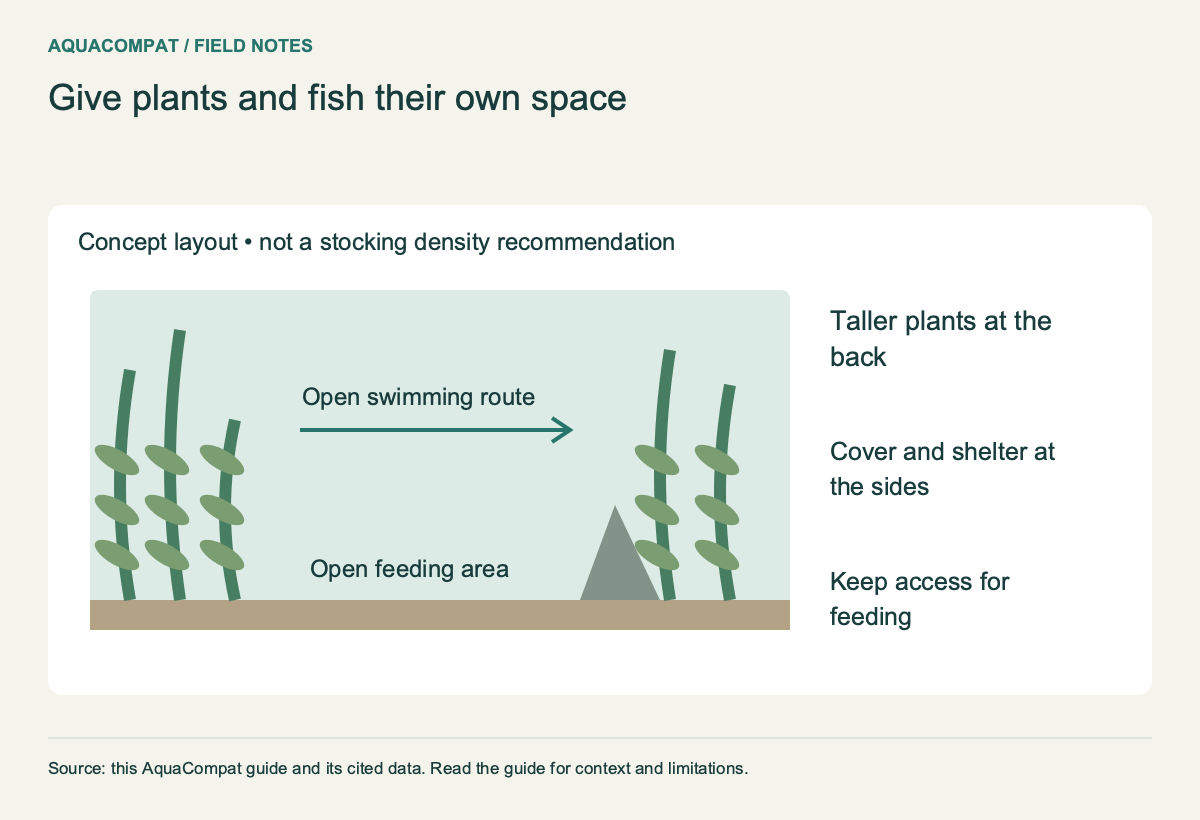
Arrange the plants so each stocking gets what its fish need: open sand for bottom dwellers, dense cover for shrimp, and broad leaves for spawning. Kuhli loaches and corydoras both want a soft or smooth substrate patch to dig and forage, so keep the front of those tanks open with dwarf sagittaria at most. Anubias and java fern should go on wood or stone with the rhizome uncovered, as Tropica advises.
Root feeders need feeding. Aquarium Co-Op names cryptocorynes as root feeders that do best with root tabs in inert gravel, placed about every 5–6 in. That matters most in the neon, corydoras and nerite stocking, where the substrate is inert. Every plant listed here also appears in the low-tech planted tank guide, which gives their temperature tolerance and feeding needs.
Can a betta or dwarf gourami anchor a 20-gallon planted tank?
A betta can, with careful partners; a dwarf gourami qualifies on its own but not in a community by our calculation. The betta’s own minimum is 10 US gal (38 L), and most betta pairs with the small species here are sized at 20 US gal (76 L), so 20 gallons is the starting point. Small fish are the problem: betta with chili rasbora is incompatible and betta with galaxy rasbora is incompatible, because the betta eats fish small enough to swallow. A nerite snail is the safer partner at caution; the betta tank mates ranked by verdict page covers the rest.
The dwarf gourami lists a minimum of 15 US gal (57 L) alone, but its pairs are sized larger: with neon tetras the pair reaches 29 US gal (110 L), and with harlequins 29 US gal (110 L). In a 20-gallon planted tank, keep it as the only fish or choose a larger tank. See how scores are calculated for the sizing method.
Which combinations fail in a 20-gallon planted tank?
Combinations fail in a 20-gallon planted tank when two species share no water range or when one eats the other. Each of the pairs below lists species that qualify for 20 gallons on their own.
- No shared pH: chili rasbora with nerite snail is incompatible, and kuhli loach with nerite is incompatible; the soft-water fish and the hard-water snail have no shared pH range.
- No shared temperature: cardinal tetra with zebra danio is incompatible, because their published temperature ranges barely meet. Crystal red shrimp, at 70–74 °F (21–23 °C), fail with harlequins for the same reason: incompatible.
- Predation: betta with chili rasbora is incompatible.
Substrate can cause a failure the matrix does not show. Mollies need 15–25 dGH, so an active soil that lowers hardness works against them even where a pair scores well. Check the substrate’s published effect against every species before buying.
Do plants let you stock more fish?
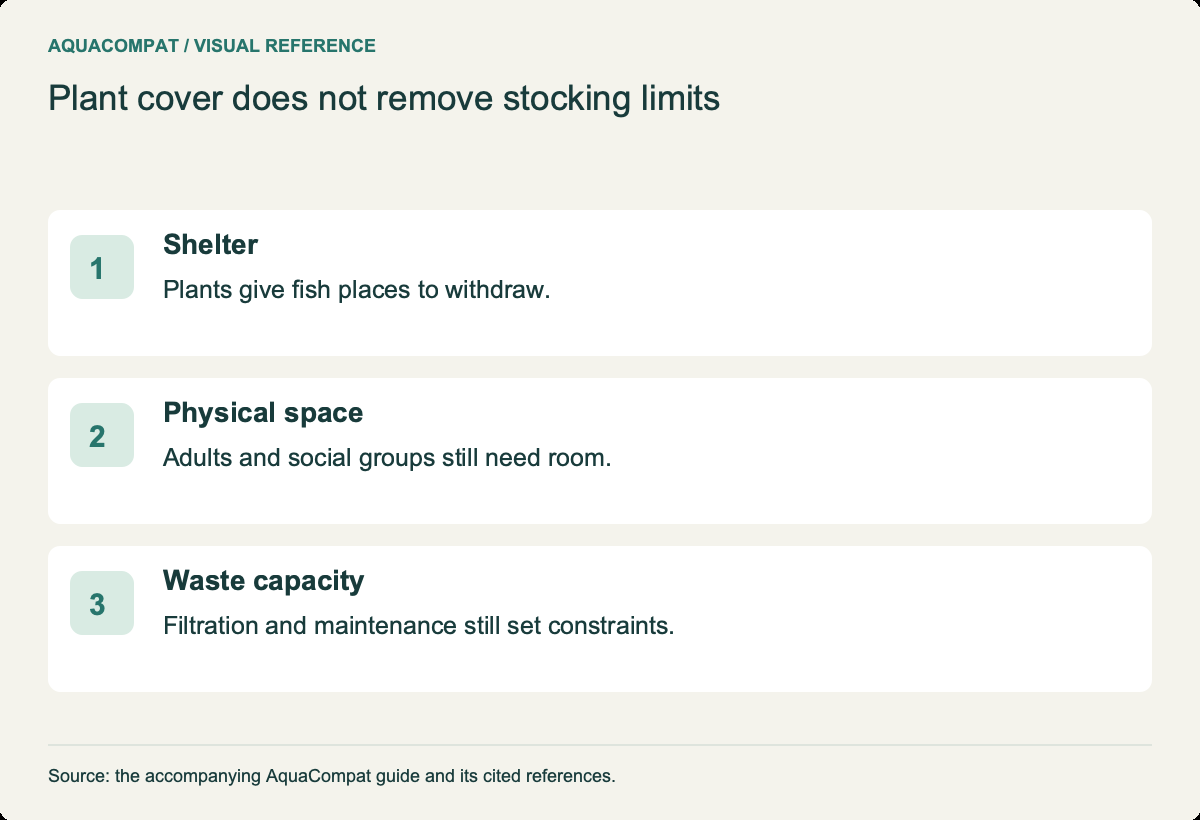
No. Plants take up nitrate, but they do not raise how many fish a 20-gallon tank can hold. Aquarium Co-Op says growing plants use nitrate as a nutrient and fast growers such as water sprite remove it faster than slow growers like anubias, yet water changes remain the fastest way to lower nitrate. Bioload depends on filtration, feeding and maintenance, so check a full list with the bioload calculator before buying, and keep the routine of about 25 % weekly that Practical Fishkeeping gives.
What equipment does a 20-gallon planted tank need?
A 20-gallon planted tank needs a filter and heater rated for the volume, a substrate chosen for the stocking, a light sized to the tank’s length, and a fertiliser. The AquaClear 30 is rated for 10–30 US gal with 150 US gal/h of flow and adjustable output, so it covers 20 gallons with room to spare. Aquarium Co-Op’s rule of about 5 W/gal points to a 100-watt heater, and Fluval rates its E100 for tanks up to 30 US gal / 120 L; the guide to choosing aquarium heaters by tank size works through the figures.
For substrate, Fluval Stratum suits the harlequin and shrimp stockings; the neon, corydoras and nerite stocking needs an inert gravel instead, as the best substrate for planted tanks comparison explains. The Fluval Plant 3.0 fits 15–24 in tanks, which the Chihiros specification file places alongside the 24-inch 20-gallon high ; a 30-inch 20-gallon long needs a longer fixture from the best aquarium lights for plant growth. Seachem Flourish supplies trace elements at 5 mL per 250 L (60 US gal) once or twice weekly, so a 20-gallon tank takes about a third of a capful, with each cap thread holding each cap thread is about 1 mL.
Which products fit a 20-gallon planted tank?
Each item was chosen for a 20-gallon planted tank from its published specifications. None was tested by AquaCompat; the notes explain what the specifications suggest for these stockings.
As an Amazon Associate I earn from qualifying purchases. Prices change often, so they are not shown here; the button opens the current listing.

Fluval AquaClear 30
- Rated tank
- 10–30 US gal
- Max flow
- 150 US gal/h
- Stages
- 4 (2 x mechanical, chemical, biological)
- Adjustable flow
- yes
Fits: a 20-gallon planted tank, sitting in the middle of its rated range, with flow you can turn down for chili rasboras and shrimp.
Skip it if: you keep a cherry shrimp colony and do not plan to cover the intake; the published specs include no intake guard.
Check price on Amazon
Fluval E100
- Power
- 100 W
- Rated tank
- up to 30 US gal / 120 L
- Setting steps
- 0.5 °
- Display
- LCD with VueTech colour alert
Fits: a 20-gallon tank where you want to read the temperature at a glance and set it in half-degree steps inside the stocking’s shared range.
Skip it if: you need a published run-dry shutoff; Fluval does not list one.
Check price on Amazon
Fluval Plant and Shrimp Stratum
- Type
- volcanic soil substrate
- pH effect
- supports neutral to slightly acidic pH
- Claims
- porous for bacteria; shelter for newborn shrimp; will not discolour water
- Bag
- 8.8 lb
Fits: the harlequin and kuhli stocking or the chili and cherry shrimp stocking, which both sit in neutral to slightly acidic water.
Skip it if: you keep the nerite snail stocking or any livebearers; they need harder, more alkaline water than this soil supports.
Check price on Amazon
Fluval Plant 3.0 (22 W)
- Fits
- 15–24 in
- Power
- 22 W
- Output
- 1450 lm
- Control
- Bluetooth, FluvalSmart app; 24-hour programmable cycle
Fits: a 24-inch 20-gallon high running low-tech plants, with app scheduling for the 6 hours/day start and the later 8–10 hours/day photoperiod.
Skip it if: your tank is a 30-inch 20-gallon long; this size stops at 24 inches.
Check price on Amazon
Seachem Flourish
- Contents
- micro and trace elements incl. calcium, magnesium, iron, boron, cobalt, copper, manganese, molybdenum, zinc; minimal N and P
- Dose
- 5 mL per 250 L (60 US gal) once or twice weekly
- Small doses
- each cap thread is about 1 mL
- Label caution
- contains 1,5-pentanedial; may cause allergic reaction
Fits: anubias, java fern and java moss, which feed from the water, and any tank where you want trace elements without much added nitrogen or phosphorus.
Skip it if: you expect it to feed root plants on its own; cryptocorynes in inert gravel still need root tabs.
Check price on AmazonDoes a 20-gallon planted tank need CO2?
No. Every plant in the table above is listed as needing no added CO2, so a 20-gallon tank with these stockings runs as a low-tech planted tank. Aquarium Co-Op puts the CO2 available without injection at roughly 2–3 ppm, enough for easy plants. CO2 becomes worth adding only for carpeting plants such as Monte Carlo, which Tropica says needs it; the best CO2 systems for planted aquariums compares kits sized for this volume. Trimming and replanting go faster with long tweezers and curved scissors from the best aquascaping tools page. Other sizes are on the tank setups by size hub.
Setups for other tank sizes are gathered on the tank setups by size page.
Questions people ask
How many harlequin rasboras fit in a 20-gallon planted tank?
Start with the group minimum of 8, which matches Seriously Fish’s advice of at least 8 to 10. The species’ own minimum tank is 15 US gal (57 L), so 20 gallons leaves room for kuhli loaches or corydoras below them. Check the full total with the stocking calculator.
Can cherry shrimp breed with chili rasboras in the tank?
They can, but expect losses. Aquarium Co-Op says adult chilis leave adult shrimp alone, yet all fish take baby shrimp, and the pair is rated caution for that reason. Dense java moss gives shrimplets cover, which is what lets a colony keep growing alongside the fish.
Will Fluval Stratum work for neon tetras?
Yes. Neon tetras take pH 5.0–7.5, and Fluval says Stratum supports neutral to slightly acidic pH. The limit is any nerite snail in the same tank: its range starts at pH 7.2, so with Stratum the snail should be left out, or the tank should use an inert gravel instead.
Do I need a 20-gallon long or a 20-gallon high for a planted tank?
Either works for these stockings; the difference is the light. The Chihiros specification file places the 20-gallon high among 24-inch tanks and the 20-gallon long among 30-inch tanks. The Fluval Plant 3.0 in this size fits up to 15–24 in, so it suits the high but needs a longer fixture on the long.
Sources 157 documents from 29 publishers
- Amazon (amazon.com): “Fluval Plant 3.0 LED Planted Aquarium Lighting, 22 Watts, 15-24 Inches (B083QP62MP)”; “Chihiros WRGB II PRO LED Aquarium Light 60cm (B09YQXLX2T)”; “Fluval E 100 Watt Electronic Heater (B001VMWT4Q)”
- Amazon.com (amazon.com): “Fluval Plant and Shrimp Stratum Aquarium Substrate - 8.8 lb Bag | Freshwater Planted Tank Substrate for Strong Plant Growth and Shrimp Habitats - Supports Neutral to Slightly Acidic pH”
- Applesnail.net (applesnail.net): “How to take care of apple snails”; “Quick guide”
- Aquarium Co-Op (aquariumcoop.com): “Care Guide for Cory Catfish”; “Care Guide for Assassin Snails”; “Care Guide for Cherry Shrimp”; “Care Guide for Nerite Snails”; “Care Guide for Mystery Snails”; “Care Guide for Amano Shrimp”; “Chili Rasbora care guide”; “Celestial Pearl Danio care guide”; “Guppy Care Guide”; “Endler's Livebearer Care Guide”; “Betta Fish Care Guide”; “Care Guide for Platy Fish: Feeding, Breeding, and Tank Mates”; “Care Guide for Harlequin Rasboras and Lambchop Rasboras”; “Neon and Cardinal Tetras: Beginner Schooling Fish”; “Care Guide for Cardinal Tetras”; “Care Guide for Kuhli Loaches”; “Care Guide for Dwarf Gouramis”; “Care Guide for Plecostomus”; “Care Guide for Zebra and Leopard Danios”; “Care Guide for GloFish”; “Care Guide for Mollies: Feeding, Breeding, and Tank Mates”; “Freshwater Angelfish Care Guide”; “Care Guide for Fancy Goldfish”; “Discus Fish Care Guide”; “Oscar Fish Care Guide”; “Top 10 Betta Fish Tank Mates”; “Anubias Nana (care page)”; “Cryptocoryne Wendtii 'Green' (care page)”; “Java Moss (care page)”; “Care Guide for Java Moss”; “Java Fern (care page)”; “Vallisneria (care page)”; “Water Sprite (care page)”; “Dwarf Sagittaria (care page)”; “How to Use Root Tabs to Fertilize Your Live Aquarium Plants”; “How to Choose the Right Aquarium Heater”; “How to Balance Aquarium Lights to Grow Healthy Plants (& Avoid Algae)”; “CO2 in Planted Aquariums: What Does It Really Do and Is It Natural?”
- AquariumInfo.org (aquariuminfo.org): “Apple Snail”
- Aquasabi (aquasabi.de): “Anubias barteri var. nana”; “Cryptocoryne wendtii 'Green'”; “Taxiphyllum barbieri 'Java moss'”; “Microsorum pteropus”; “Vallisneria spiralis”; “Ceratopteris thalictroides”; “Sagittaria subulata”; “Fluval E-Serie Aquarium Heater E100”; “Chihiros LED System Serie WRGB II PRO 60”
- Bulk Reef Supply (bulkreefsupply.com): “Fluval Plant 3.0 Bluetooth LED Light”
- Chihiros (chihiros.com): “Chihiros WRGB II Pro LED Light”
- FishBase (fishbase.se): “Poecilia reticulata, Guppy: species summary”; “Betta splendens, Siamese fighting fish: species summary”; “Xiphophorus maculatus, Southern platyfish: species summary”; “Trigonostigma heteromorpha summary page”; “Paracheirodon innesi summary page”; “Trichogaster lalius, Dwarf gourami: species summary”; “Osteogaster aenea, Bronze corydoras”; “Danio rerio summary page”; “Carassius auratus, Goldfish: species summary”; “Symphysodon aequifasciatus, Blue discus: species summary”; “Pangio kuhlii summary (Bayesian length-weight estimate)”; “Ancistrus cirrhosus summary (Bayesian length-weight estimate)”; “Boraras brigittae summary (Bayesian length-weight estimate)”; “Length-weight relationships for Osteogaster aenea”; “Danio margaritatus summary page”
- fishkeeping.co.uk (fishkeeping.co.uk): “Goldfish Size, Life Expectancy and Tank Recommendations”; “Keeping Goldfish - The Right Way”
- Flowgrow Aquatic Plant Database (flowgrow.de): “Anubias barteri var. nana”; “Cryptocoryne wendtii 'grün'”; “Taxiphyllum barbieri (Java moss)”; “Microsorum pteropus”; “Vallisneria spiralis”; “Ceratopteris thalictroides”; “Sagittaria subulata”
- Fluval (Hagen) (fluvalaquatics.com): “Plant 3.0 product page”; “Plant and Shrimp Stratum”
- Fluval (Rolf C. Hagen) (fluvalaquatics.com): “AC30 Power Filter, 10-30 US Gal / 38-114 L”; “E100 Electronic Heater, 100W, up to 30 US Gal / 120 L”
- GloFish (Spectrum Brands) (glofish.com): “GloFish FAQs”
- GreenAqua (greenaqua.hu): “Chihiros WRGB II Pro 60 cm LED light”
- Maidenhead Aquatics (fishkeeper.co.uk species data sheet) (fishkeeper.co.uk): “Zebra Nerite Snail”; “Guppy data sheet”; “Neon Tetra data sheet”; “Black Widow Tetra (Black Skirt Tetra) data sheet”; “Molly data sheet”; “Angelfish data sheet”; “Oscar data sheet”; “Harlequin Rasbora data sheet”
- Neotropical Ichthyology (Crampton 2008) (scielo.br): “Ecology and life history of an Amazon floodplain cichlid: the discus fish Symphysodon”
- Ornamental Aquatic Trade Association (OATA) (ornamentalfish.org): “How to look after goldfish in an aquarium / fish tank”; “How to look after fancy goldfish”
- PetSmart (retailer, maker copy) (petsmart.com): “Fluval Plant & Shrimp Stratum”
- PlanetCatfish (via Internet Archive snapshot, 2025) (web.archive.org): “Osteogaster aenea (Bronze Cory) Cat-eLog data sheet”; “Ancistrus sp. (3) Common Bristlenose Catfish Cat-eLog data sheet”
- Practical Fishkeeping (practicalfishkeeping.co.uk): “Frequently asked questions on Neocaridina shrimps”; “Amano shrimp: Spineless heroes (Nathan Hill)”; “Quick guide to livebearers”; “A guide to the small rasboras from the genus Trigonostigma”; “Bristlenose catfish: the hardworking Ancistrus”; “How long will my fish live?”; “An introduction to Shrimp”; “What can I keep in my hard water aquarium?”; “Will these snails starve without algae?”; “What can I add for algae control?”; “How often should I change my water?”
- Practical Fishkeeping (Julian Dignall) (practicalfishkeeping.co.uk): “Focus on commonly kept Corydoras”
- Seachem (seachem.com): “Flourish”
- Seriously Fish (seriouslyfish.com): “Osteogaster aenea (Bronze Cory)”; “Boraras brigittae”; “Danio margaritatus (Celestial Pearl Danio)”; “Poecilia reticulata”; “Poecilia wingei”; “Betta splendens”; “Xiphophorus maculatus”; “Trigonostigma heteromorpha (Harlequin)”; “Paracheirodon innesi (Neon Tetra)”; “Paracheirodon axelrodi (Cardinal Tetra)”; “Pangio semicincta ('Kuhli' Loach)”; “Trichogaster lalius”; “Ancistrus sp. '3' (Common Bristlenose Catfish)”; “Danio rerio (Zebra Danio)”; “Gymnocorymbus ternetzi (Black Widow Tetra)”; “Poecilia sphenops”; “Poecilia latipinna”; “Pterophyllum scalare”; “Symphysodon aequifasciatus”; “Astronotus ocellatus”
- Shrimp and Snail Breeder (aquariumbreeder.com): “Assassin Snail: detailed guide, care, diet and breeding”; “Red Cherry Shrimp: detailed guide, care, diet and breeding”; “Nerite Snails: detailed guide, care, diet and breeding”; “Amano Shrimp: detailed guide, care, diet and breeding”; “Crystal Red Shrimp: detailed guide, care, diet and breeding”; “Cherry Shrimp in a Community Tank”; “How Copper Affects Dwarf Shrimp”
- Shrimp Science (shrimpscience.com): “Red Cherry Shrimp - Care Guide”; “General Hardness (GH) For Shrimp Tanks”; “Amano Shrimp”; “Crystal Red Shrimp - Care Guide”; “Carbonate Hardness (KH) For Shrimp Tanks”; “TDS For Shrimp Tanks”
- Tropica Aquarium Plants (tropica.com): “Anubias barteri var. nana (101)”; “Cryptocoryne wendtii 'Green' (109)”; “Taxiphyllum barbieri 'Bogor Moss' (003 TC)”; “Microsorum pteropus (008)”; “Vallisneria spiralis 'Tiger' (055A)”; “Ceratopteris thalictroides (005A)”; “Sagittaria subulata (079)”; “Starting a new aquarium (growing-in guide)”
- UF/IFAS EDIS (ask.ifas.ufl.edu): “Evolution, Culture, and Care for Betta splendens (FA212)”
- Wikipedia (en.wikipedia.org): “Vittina natalensis”
All sources accessed . Every number on this page comes from these documents.