What specs matter when choosing aquascaping tools for a planted tank?
Four things decide whether an aquascaping tool suits a tank: what the tool is for, its length, the shape of its tips and what it is made of. Brand matters less than matching the tool to the job.
Purpose
Aquascaping tools are long-handled scissors, tweezers and spatulas used to plant, trim and arrange a planted aquarium without putting your hands in the water. A planted aquarium grows live plants whose growth depends on the balance of light, CO2 and nutrients, so most tool work is routine: planting at the start, then trimming as plants grow.
Length
A longer tool reaches the substrate of a deeper tank. The three products here run from 10 in for the Liveek tweezers to 12.5 in for its spatula. Measure the water depth of your tank before buying, since none of the makers states a tank size.
Tip shape
Straight tweezers push stems straight down into the substrate. Curved scissors let the blades lie flat over a carpet or along the substrate line; Fluval describes its S scissors as designed for pruning small foreground plants, with curved tips for control and a long neck for reach.
Material
Both Fluval tools are stainless steel with a carbonised coating. Liveek lists stainless steel with a spray-painted finish, sold as anti-rust; that claim rests on the Amazon listing alone.
| Tool | What’s included | Length | Material | Stated use |
|---|---|---|---|---|
| Fluval S Curved Scissors | single curved scissors (not a multi-piece kit) | 25 cm | stainless steel with carbonized coating | pruning smaller foreground plants |
| Fluval Straight Tweezers | single straight tweezers | 27 cm | stainless steel with carbonized coating | planting small or thin plants |
| Liveek 4-piece kit | curved scissors, straight tweezers, curved tweezers, sand spatula, storage bag | Scissors 10.5 in; tweezers 10 in; spatula 12.5 in | stainless steel, spray-painted finish | trimming and planting plants, placing stones and sand, removing debris |
Which aquascaping tool does each planted-tank task need?
Each routine planted-tank job maps to one tool. The tasks below come from Tropica and Aquarium Co-Op planting guidance, in the order a new tank meets them.
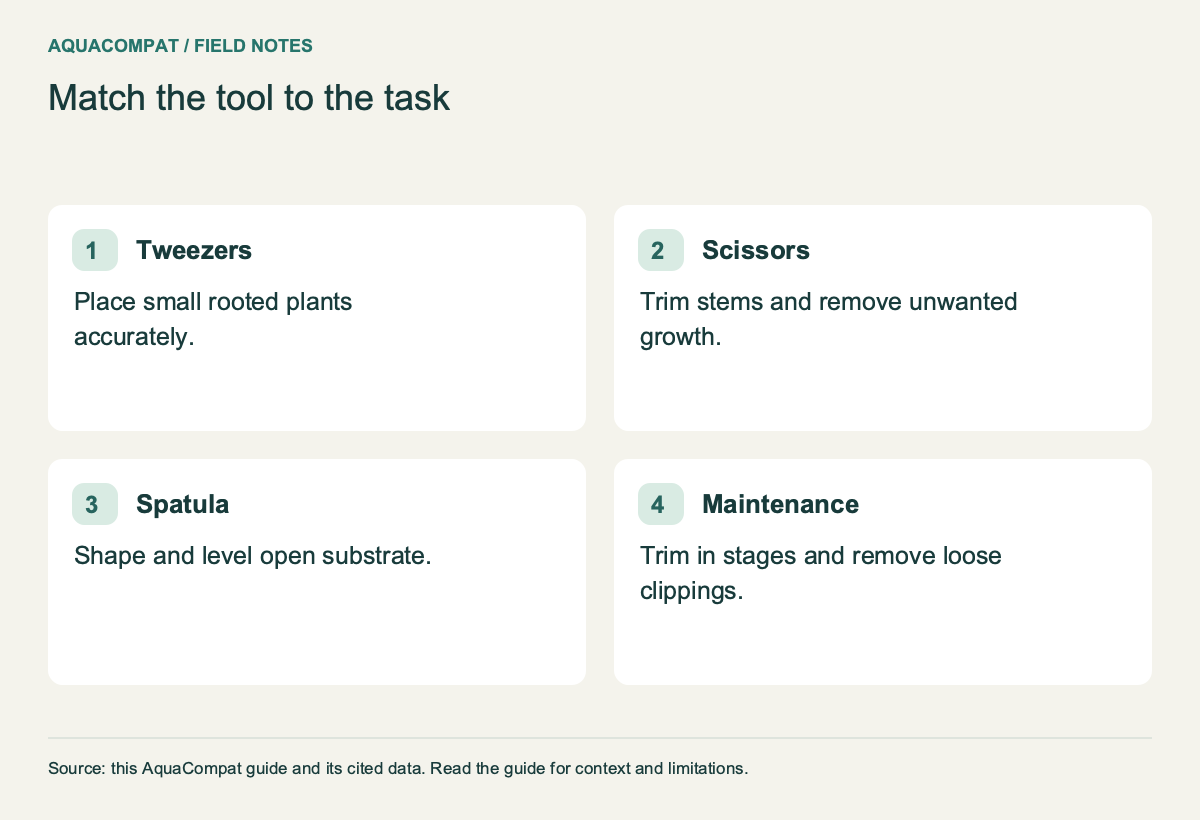
Shaping the substrate: spatula
Planted tanks usually need at least 2–3 in of substrate, according to Aquarium Co-Op, and Tropica slopes it from shallow at the front to deeper at the back over a thin nutrient layer. A sand spatula smooths and slopes that layer; of the three products, only the Liveek kit includes one. The best substrate for planted tanks guide compares the soils and gravels you would be shaping.
Planting stems and small plants: straight tweezers
Aquarium Co-Op and Tropica both advise planting heavily from the start, including fast growers, so plants use up spare nutrients and limit algae while a new tank settles. That means pushing many small stems and plantlets into the substrate, which is the job Fluval names for its straight tweezers. The guide to setting up a planted tank covers the order of work.
Trimming stem plants: scissors
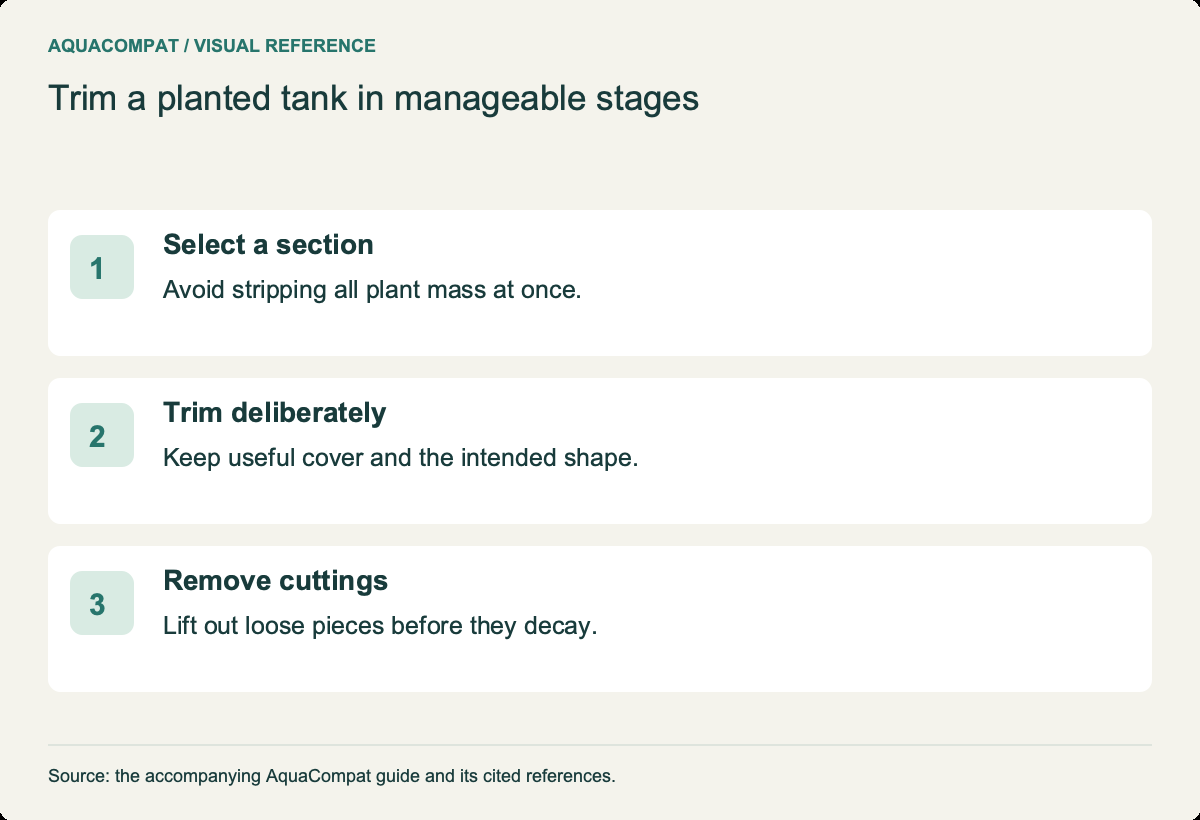
Tropica recommends trimming small and frequent rather than all at once, cutting stem plants above a lower leaf and replanting the cuttings. Scissors make the cut and tweezers replant the tops, so the two tools work as a pair.
Trimming carpets: curved scissors
Carpeting plants are trimmed like a lawn, according to Tropica and Aquarium Co-Op. Monte Carlo grows as a low carpet of about 2 in, so blades that lie flat just above the substrate do the work; Fluval designed its S curved scissors for pruning small foreground plants.
Attaching moss and epiphytes: tweezers
Anubias, java fern and java moss are attached to wood or stone rather than buried. Aquarium Co-Op and Tropica say to tie or wedge them in place and keep the rhizome uncovered. Tweezers help position a plant in a gap between stones; Liveek also lists arranging stones among its kit’s uses.
Aquascaping tools matched to planted-tank tasks
Each tool below was chosen for one task or set of tasks, using the published specifications above. AquaCompat has not used or tested these tools; the notes explain what the specifications suggest and who should look elsewhere.
As an Amazon Associate I earn from qualifying purchases. Prices change often, so they are not shown here; the button opens the current listing.

Fluval S Curved Scissors 25 cm
- In the box
- single curved scissors (not a multi-piece kit)
- Length
- 25 cm
- Design
- curved tips, ergonomic long-neck design
- Maker’s stated use
- pruning smaller foreground plants
Fits: a planted tank with a foreground carpet or low plants that need regular lawn-style trims; the curved tips and long neck are aimed at that job.
Skip it if: you expected a kit; despite its catalogue id, this listing is a single pair of scissors, so you still need tweezers for planting.
Check price on Amazon
Fluval Straight Tweezers 27 cm
- In the box
- single straight tweezers
- Length
- 27 cm
- Tips
- straight, rubber-coated tips
- Maker’s stated use
- planting small or thin plants
Fits: planting stems, plantlets and replanted cuttings in a new or freshly trimmed tank; the rubber-coated tips are described as giving a firm grip.
Skip it if: you need to cut or trim, or want curved tweezers for reaching behind hardscape; this is one straight tool.
Check price on Amazon
Liveek 4-piece Aquascape Tools Kit
- In the box
- curved scissors, straight tweezers, curved tweezers, sand spatula, storage bag
- Scissors
- 10.5 in
- Straight tweezers
- 10 in
- Spatula
- 12.5 in
Fits: a first planted tank where you want scissors, straight and curved tweezers and a spatula for sloping substrate in one purchase.
Skip it if: you want specifications confirmed beyond a retail listing; Liveek has no manufacturer page we could find, and the listing’s colour details disagree with each other.
Check price on AmazonHow did we choose these aquascaping tools?
We compared the published specifications of widely sold aquascaping tools against the planted-tank tasks above. We did not use any of them, so the notes report what each listing or retailer page states and what that means in practice. The criteria, in order, were a clearly stated use that matches a planted-tank task, a published length, a stated material and a current US listing matched to the exact product. Prices are left out because they change daily. Our wider research method is on the methodology page.
The evidence behind each tool differs, and you should weigh it. Fluval’s own page for the tweezers could not be retrieved and none is recorded for the scissors, so the Fluval specs come from the Amazon listing cross-checked against retailer pages (Petstop for the scissors; Northern Gecko and PetSmart for the tweezers). Every Liveek spec comes from its Amazon listing alone. One naming note: our catalogue entry for the scissors is called an aquascaping tool kit, but the matched listing is the single Fluval S Curved Scissors, and we describe it as such.
Is a 4-piece kit better than two single tools?
A kit is better if you need a spatula or curved tweezers; two single tools are better if you only plant and trim. The Liveek kit adds a curved pair of tweezers and a 12.5 in spatula to its scissors and straight tweezers. The Fluval pair, the 25 cm curved scissors and 27 cm straight tweezers, covers the two jobs most planted tanks repeat every few weeks, with specifications cross-checked against more than one retailer. Choose by which tasks your layout needs, not by piece count.
When are aquascaping tools not worth buying?
A simple low-tech tank of epiphytes and floating plants can manage without them. A low-tech planted tank uses low light, no injected CO2 and light weekly fertilising, and many of its plants need no planting at all: Tropica and Aquarium Co-Op say hornwort is best left floating, and water sprite can float at the surface. Anubias and java fern are tied to wood or stone by hand. The low-tech planted tank guide lists plants that suit that approach.
Tools earn their place in high-tech tanks, where bright light, pressurised CO2 and heavier fertilising drive fast growth that needs frequent trimming. Tropica says its medium and advanced plants need added CO2; the CO2 levels in planted tanks guide explains the targets, and choosing CO2 systems for planted aquariums compares the equipment. Strong lighting is the other driver, covered in the best aquarium lights for plant growth.
Should you trim an overgrown planted tank all at once?
No. Tropica advises small, frequent trims over extensive cuts, because heavy trimming can upset the tank’s balance. Plants and algae compete for the same light, nutrients and CO2, according to Aquarium Co-Op and Tropica, so removing a large share of plant mass in one session leaves spare nutrients for algae to take. Trim a section at a time and replant the healthy cuttings. If algae does spread, the guide to aquarium algae types and fixes covers each kind. For a worked layout that uses these tools, see the fish for a 20-gallon planted tank we recommend, and the equipment buyer guides index lists the rest of the planted-tank kit.
Questions people ask
What aquascaping tools does a beginner need?
Straight tweezers for planting and scissors for trimming cover most planted-tank work. Aquarium Co-Op and Tropica advise planting heavily at the start and trimming a little and often, which are the two jobs those tools do. Add a spatula only if you slope or smooth the substrate.
Are curved or straight scissors better for aquascaping?
Curved scissors suit carpets and low foreground plants, because the blades can lie flat near the substrate; Fluval designed its S curved scissors for pruning small foreground plants. Straight blades are not part of the three products here, so we make no comparison of their specifications.
How long should aquascaping tweezers be?
Long enough to reach the substrate with your hand above the water. The Fluval straight tweezers are 27 cm and the Liveek straight tweezers 10 in. Neither maker states a maximum tank depth, so measure your tank first.
Do I need a spatula for aquarium substrate?
Only if you shape it. Aquarium Co-Op suggests at least 2–3 in of substrate in planted tanks, and Tropica slopes it deeper at the back. A spatula smooths that slope. Among the tools here, only the Liveek kit includes one.
Sources 67 documents from 12 publishers
- Amazon (amazon.com): “Liveek Aquarium Aquascape Tools Kit, 4 Pcs Stainless Steel Aquascaping Set (B0B6TZ769M)”; “Fluval Aquascaping S Curved Scissors”; “Fluval Straight Tweezers, Aquascaping Tool for Aquariums, 27 cm (B074P4PFRC)”
- Aquarium Co-Op (aquariumcoop.com): “Is Nitrate Good or Bad for Your Aquarium?”; “How to Balance Aquarium Lights to Grow Healthy Plants (& Avoid Algae)”; “CO2 in Planted Aquariums: What Does It Really Do and Is It Natural?”; “What is PAR? Lighting & Brightness Explained for Planted Tanks”; “How to Use Root Tabs to Fertilize Your Live Aquarium Plants”; “Which Planted Tank Fertilizer Is Right for You?”; “Beginner's Guide to Fertilizing Your Planted Tank the EASY Way”; “How to Set Up a Low Tech Planted Aquarium for Beginners”; “Monte Carlo (care page)”; “Anubias Nana (care page)”; “Java Fern (care page)”; “Cryptocoryne Wendtii 'Green' (care page)”; “Java Moss (care page)”; “Care Guide for Java Moss”; “Amazon Sword Plant (care page)”; “Vallisneria (care page)”; “How to Care for Hornwort (Ceratophyllum demersum) in Aquariums & Ponds”; “Water Sprite (care page)”; “Marimo Moss Ball Care Guide”; “Dwarf Sagittaria (care page)”; “CO2 for planted tanks”
- Aquarium Science (aquariumscience.org) (aquariumscience.org): “Measuring CO2”
- Aquasabi (aquasabi.de): “Anubias barteri var. nana”; “Microsorum pteropus”; “Cryptocoryne wendtii 'Green'”; “Taxiphyllum barbieri 'Java moss'”; “Echinodorus grisebachii 'Bleherae'”; “Vallisneria spiralis”; “Ceratopteris thalictroides”; “Sagittaria subulata”
- Dennerle (dennerle.com): “CO2 Langzeittest (long-term test) instructions 2985/2986”
- Flowgrow Aquatic Plant Database (flowgrow.de): “Micranthemum tweediei”; “Anubias barteri var. nana”; “Microsorum pteropus”; “Cryptocoryne wendtii 'grün'”; “Taxiphyllum barbieri (Java moss)”; “Echinodorus grisebachii 'Bleherae'”; “Vallisneria spiralis”; “Ceratophyllum demersum”; “Ceratopteris thalictroides”; “Aegagropila linnaei”; “Sagittaria subulata”
- Merck Veterinary Manual (merckvetmanual.com): “Environmental Diseases of Aquatic Animals in Aquatic Systems (Francis-Floyd, Yanong, Petty)”
- Northern Gecko (us.northerngecko.net): “Fluval Straight Forceps, 27cm”
- PetSmart (petsmart.com): “Fluval Straight Forceps for Aquascaping and Plant Care, 10.6 inches”
- Petstop (petstop.ie): “Fluval "S" Curved Scissors 25cm”
- Southern Regional Aquaculture Center (srac.msstate.edu): “SRAC 464: Interactions of pH, Carbon Dioxide, Alkalinity and Hardness in Fish Ponds (Wurts and Durborow)”; “SRAC 468: Carbon Dioxide in Fish Ponds (Hargreaves and Brunson)”
- Tropica Aquarium Plants (tropica.com): “Starting a new aquarium (growing-in guide)”; “Fertiliser and CO2 for your aquarium”; “Hardscape and bottom layer in the tank”; “Trimming”; “Micranthemum tweediei 'Monte Carlo' (025)”; “Anubias barteri var. nana (101)”; “Microsorum pteropus (008)”; “Cryptocoryne wendtii 'Green' (109)”; “Taxiphyllum barbieri 'Bogor Moss' (003 TC)”; “Echinodorus grisebachii 'Bleherae' (071)”; “Vallisneria 'Gigantea' (054)”; “Vallisneria spiralis 'Tiger' (055A)”; “Ceratophyllum demersum (021A POR)”; “Ceratopteris thalictroides (005A)”; “Aegagropila linnaei (000 CST)”; “Sagittaria subulata (079)”
All sources accessed . Every number on this page comes from these documents.