What do you need before you start a planted tank?
A planted tank needs six things before the first plant goes in: a tank with a filter and heater, a substrate, a light, plants, fertiliser, and a test kit. CO2 injection is a seventh item, needed only for a high-tech tank.
- Substrate: enough for 2–3 in, the depth Aquarium Co-Op gives. An active soil lowers pH; an inert gravel leaves water chemistry alone.
- Light: a fixture sized to the tank’s length, with a timer. A planted aquarium grows live plants whose growth depends on the balance of light, CO2 and nutrients, so the light is the input you control most often.
- Plants: more than you think you need. Aquarium Co-Op advises buying lots of plants up front to use spare nutrients and limit algae.
- Fertiliser: a liquid all-in-one for plants that feed from the water, and root tabs for root feeders in inert substrate.
- Test kit: one that reads ammonia, nitrite and nitrate, to confirm the tank is cycled before fish arrive. Our guide to choosing aquarium test kits compares the options.
- Hardscape: wood or stone to tie epiphytes onto, since anubias and java fern grow best attached rather than buried.
This guide sits with the other water chemistry and setup guides, which cover the cycle, pH and hardness in more depth.
Should a first planted tank be low-tech or high-tech?
A first planted tank should usually be low-tech, because it needs less equipment and forgives mistakes. Aquarium Co-Op defines a low-tech tank as one with low light, no injected CO2 and light fertilising about once a week, and Tropica says easy plants cope without added CO2. A high-tech tank uses bright light, pressurised CO2 and heavier fertilising, and needs more maintenance; Tropica says its Medium and Advanced plants need added CO2. The table below sets the two side by side.
| Input | Low-tech | High-tech |
|---|---|---|
| Light (PAR) | 10–20 PAR | 40–50+ PAR |
| CO2 | About 2–3 ppm from gas exchange | Injected; Tropica gives 10–15 mg/L for Medium plants and 15–30 mg/L for Advanced |
| Fertiliser | Light, about weekly | Heavier, more frequent |
| Typical plants | Anubias, java fern, cryptocoryne, java moss | Carpeting plants such as Monte Carlo |
| Maintenance | Lower | Higher |
Which path suits which keeper?
The low-tech path suits a keeper who wants plants as part of a community tank, with weekly care. Every plant in the low-tech planted tank guide grows without injected gas, and a moderate light keeps algae in check. The high-tech path suits a keeper who wants a carpet or fast, dense growth and will check a drop checker daily. Monte Carlo is the typical reason to go high-tech: Tropica says it needs added CO2 to form a compact carpet, and its light need is listed as medium to high. The targets and fish-safety limits for injection are in the guide to CO2 levels in planted tanks.
How do you set up a planted tank, step by step?
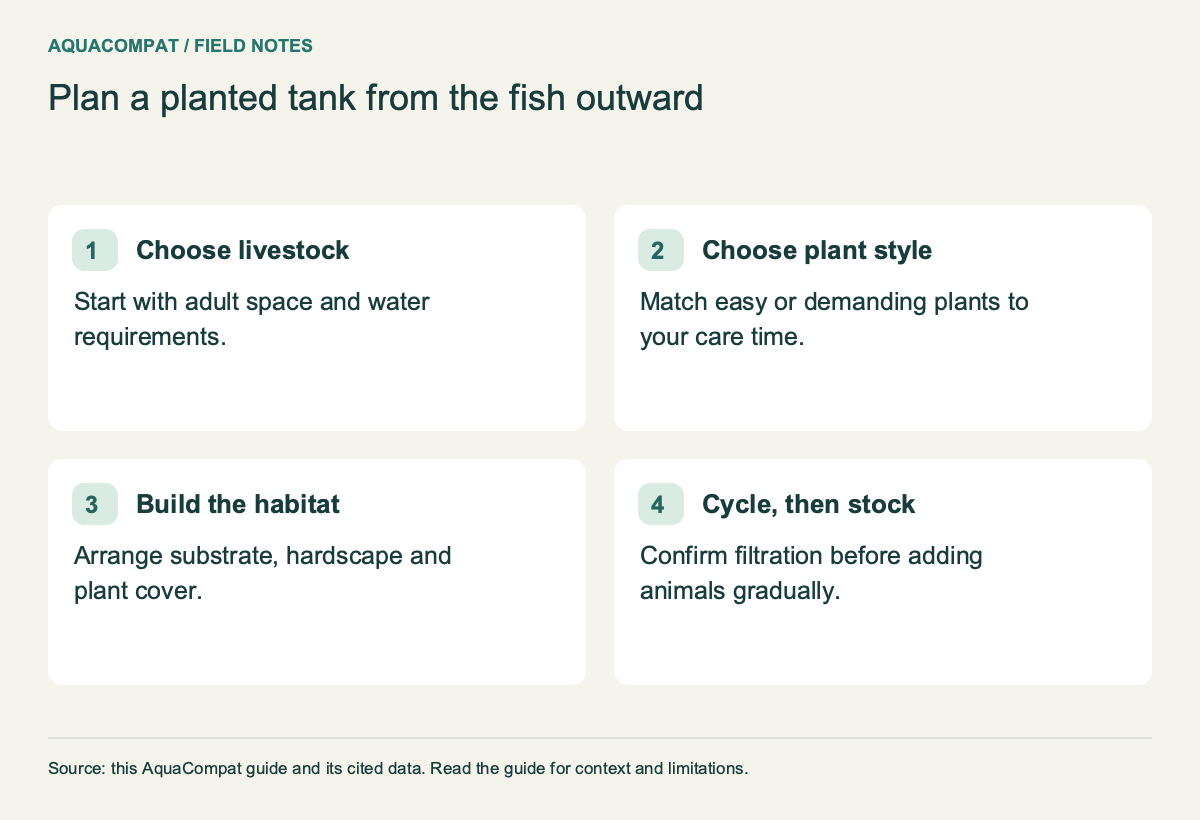
Set up a planted tank in the order below, so each layer is in place before the next goes on top.
- Lay the substrate. Spread it to at least 2–3 in. Tropica slopes it from 3 to 4 cm at the front to 6 to 8 cm at the back, over a thin nutrient layer where strong-rooted plants will go. A complete soil needs no extra layer.
- Place the hardscape. Set wood and stone before planting so you do not uproot plants later.
- Plant. Plant heavily, with fast growers among the slow ones. Tie anubias and java fern onto hardscape and leave the rhizome uncovered.
- Set the light timer. Run it for about 6 hours/day for the first two to three weeks, as Tropica advises.
- Hold back fertiliser. Use little or none for the first 3–4 weeks, because Tropica says nursery plants arrive with stored nutrients.
- Cycle the filter. Build up nitrifying bacteria before fish arrive, and test for ammonia and nitrite.
- Raise the light and start feeding. After the start-up weeks, lift the photoperiod to 8–10 hours/day and begin liquid fertiliser and root tabs.
- Add CO2 if high-tech. Start injection low and raise it slowly while watching a drop checker and the fish.
- Trim little and often. Tropica says small, frequent trims beat heavy cuts that upset the tank’s balance.
Which plants should go in first?
Fast growers should go in first, alongside the slow plants you want long term. Tropica says fast growers absorb excess nutrients early, and Aquarium Co-Op says a large plant mass limits algae while a new tank settles. Water sprite is rated fast and hornwort fast; both are easy to remove once slower plants fill in. The table groups common plants by where they go in the tank.
| Plant | Placement | Growth | CO2 |
|---|---|---|---|
| Dwarf sagittaria | foreground | fast | beneficial |
| Monte Carlo | foreground | medium | required |
| Cryptocoryne wendtii | midground | medium | not required |
| Anubias nana | attach to hardscape | slow | not required |
| Java fern | attach to hardscape | slow | not required |
| Vallisneria | background | fast | not required |
| Amazon sword | background | fast | not required |
| Water sprite | background or floating | fast | not required |
| Hornwort | floating | fast | not required |
How do you fertilise a new planted tank?
Fertilise a new planted tank by matching the feed to how each plant takes up nutrients: liquid fertiliser for plants that feed from the water, root tabs for plants that feed from the substrate. Tropica and Aquarium Co-Op both say most aquarium plants absorb nutrients through roots and leaves, so either route works for many species.
Which nutrients do plants need?
Plants use N, P, K in large amounts and Fe, B, Mn and other trace elements in small amounts. The sources disagree on classification: Aquarium Co-Op lists potassium as a macronutrient and iron as a micronutrient, while Tropica lists iron and manganese among its macronutrients and does not list potassium. Aquarium Co-Op says iron shortage shows as pale or yellow new leaves with dark veins.
Root feeders and water-column feeders
Aquarium Co-Op names swords, cryptocorynes, bulb plants as root feeders that do best with root tabs, especially in inert gravel or sand, placed about every 5–6 in and re-dosed about monthly. Mosses, floating plants and epiphytes such as anubias and java fern feed mainly from the water. Aquarium Co-Op aims for about 25–50 ppm nitrate when dosing all-in-one fertiliser in planted tanks, a band that runs above the general 40 ppm guide that Practical Fishkeeping and Aquarium Co-Op give for aquariums, so test nitrate rather than dosing by habit.
When can fish go into a new planted tank?
Fish should go in only after the filter has cycled, which takes several weeks in a planted tank just as in any other. Practical Fishkeeping puts most cycles at 4–6 weeks, and UF/IFAS gives 6–8 weeks for a biofilter to build up. The tank is ready when a full ammonia dose is converted to nitrate within 24 hours with no detectable nitrite. The aquarium nitrogen cycle explains the stages.
The start-up weeks of a planted tank overlap usefully with cycling: the light runs short and fertiliser is held back while the bacteria establish. Once the tank is cycled, the stockings on the choosing fish for a 20-gallon planted tank page show how to match fish to the water a soil or gravel produces.
How do you know the planted tank is working?
A planted tank is working when the plants put out new leaves and algae does not spread over them. Test readings confirm it: ammonia and nitrite should read zero once cycled, and nitrate should hold steady between water changes. Aquarium Co-Op says growing plants take up nitrate as a nutrient, and that fast growers such as water sprite remove it much faster than slow growers such as anubias and java fern.
Trim as growth picks up. Tropica advises cutting stem plants above a lower leaf and replanting the cuttings, and Aquarium Co-Op says carpets can be trimmed like a lawn. Keep trims small and frequent, so the plant mass that holds nutrients and algae in check never drops sharply at once.
What goes wrong in a new planted tank?
Most new planted tanks fail for one of four reasons: too much light, too much fertiliser, buried rhizomes, or too few plants. Aquarium Co-Op and Tropica describe the first two the same way: plants and algae compete for the same light, nutrients and CO2, and any surplus goes to algae. Over-fertilising the water can cause algae when the plants cannot take up the feed. Algae on new growth is the cue to cut the photoperiod back, and the aquarium algae types and fixes guide explains each type.
- Buried rhizomes: Tropica says an anubias rhizome must not be covered or it may rot.
- Crypt melt: Aquarium Co-Op notes cryptocoryne leaves often melt after a move and then regrow, so this is not a failure.
- Bare substrate: sparse planting leaves nutrients unused, which is why both sources advise planting heavily from the start.
Do plants replace water changes?
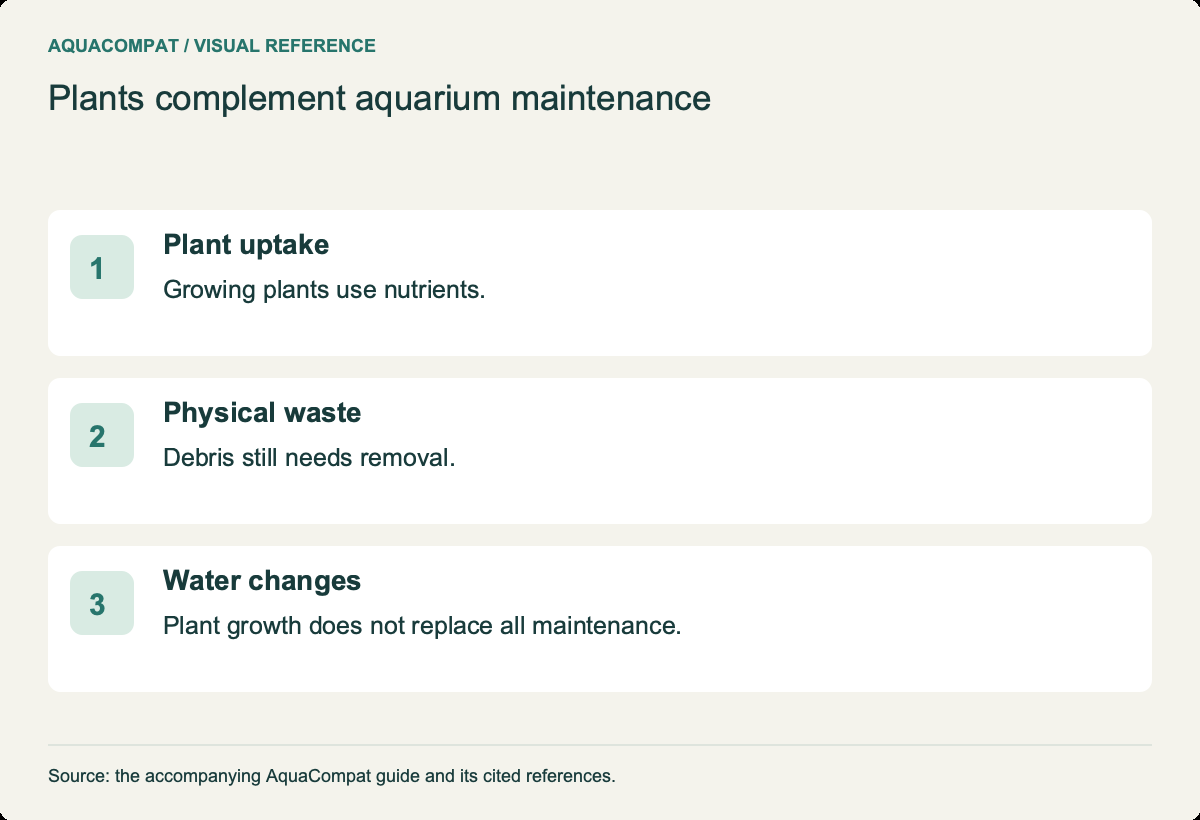
No. Plants lower nitrate, but they do not replace water changes. Aquarium Co-Op says water changes remain the fastest way to lower nitrate, even though growing plants use it as a nutrient . Practical Fishkeeping’s routine of about 25 % weekly still applies to a planted tank, and Aquarium Co-Op warns that very large changes can stress fish and plants. Keep the routine and use plants as a buffer, not a substitute.
Questions people ask
How long should the lights be on in a new planted tank?
About 6 hours/day for the first two to three weeks, as Tropica advises; Aquarium Co-Op gives 6 to 8 hours. After that, raise it to about 8–10 hours/day. Aquarium Co-Op allows up to 12 hours as plants grow but says to cut back if algae spreads.
Can I add fish and plants on the same day?
Plants can go in on day one, but fish should wait until the filter has cycled, which Practical Fishkeeping puts at 4–6 weeks. Planting heavily from the start helps, because the plant mass uses spare nutrients while bacteria establish. The fishless cycling routine explains how to cycle without livestock.
Do I need CO2 to start a planted tank?
No. A low-tech tank relies on the roughly 2–3 ppm of CO2 from gas exchange and fish respiration, which Aquarium Co-Op says easy plants manage on. Add CO2 only if you choose demanding or carpeting plants, or a light bright enough that plants run short of it.
How deep should the substrate be at the back?
Tropica slopes gravel to 6 to 8 cm at the back, from 3 to 4 cm at the front, so tall root feeders get depth while the foreground stays low. Aquarium Co-Op gives an overall minimum of 2–3 in. The planted tank substrates compared page sets out how much each product covers.
Sources 51 documents from 7 publishers
- Aquarium Co-Op (aquariumcoop.com): “How to Set Up a Low Tech Planted Aquarium for Beginners”; “CO2 in Planted Aquariums: What Does It Really Do and Is It Natural?”; “What is PAR? Lighting & Brightness Explained for Planted Tanks”; “Monte Carlo (plant care page)”; “How to Balance Aquarium Lights to Grow Healthy Plants (& Avoid Algae)”; “Water Sprite (care page)”; “How to Care for Hornwort (Ceratophyllum demersum) in Aquariums & Ponds”; “Dwarf Sagittaria (care page)”; “Cryptocoryne Wendtii 'Green' (care page)”; “Anubias Nana (care page)”; “Java Fern (care page)”; “Vallisneria (care page)”; “Amazon Sword Plant (care page)”; “Which Planted Tank Fertilizer Is Right for You?”; “How to Use Root Tabs to Fertilize Your Live Aquarium Plants”; “Is Nitrate Good or Bad for Your Aquarium?”; “Beginner's Guide to Fertilizing Your Planted Tank the EASY Way”; “Guide to Aquarium Water Changes”
- Aquasabi (aquasabi.de): “Sagittaria subulata”; “Cryptocoryne wendtii 'Green'”; “Anubias barteri var. nana”; “Microsorum pteropus”; “Vallisneria spiralis”; “Echinodorus grisebachii 'Bleherae'”; “Ceratopteris thalictroides”
- Dr Tim's Aquatics (manufacturer) (drtimsaquatics.com): “Fishless Cycling”
- Flowgrow Aquatic Plant Database (flowgrow.de): “Micranthemum tweediei”; “Ceratopteris thalictroides”; “Ceratophyllum demersum”; “Sagittaria subulata”; “Cryptocoryne wendtii 'grün'”; “Anubias barteri var. nana”; “Microsorum pteropus”; “Vallisneria spiralis”; “Echinodorus grisebachii 'Bleherae'”
- Practical Fishkeeping (practicalfishkeeping.co.uk): “How often should I change my water?”; “How to Cycle a Fish Tank: The Complete Guide”
- Tropica Aquarium Plants (tropica.com): “Hardscape and bottom layer in the tank”; “Fertiliser and CO2 for your aquarium”; “Micranthemum tweediei 'Monte Carlo' (025)”; “Starting a new aquarium (growing-in guide)”; “Ceratopteris thalictroides (005A)”; “Ceratophyllum demersum (021A POR)”; “Sagittaria subulata (079)”; “Cryptocoryne wendtii 'Green' (109)”; “Anubias barteri var. nana (101)”; “Microsorum pteropus (008)”; “Vallisneria spiralis 'Tiger' (055A)”; “Echinodorus grisebachii 'Bleherae' (071)”; “Trimming”
- University of Florida IFAS Extension (EDIS) (ask.ifas.ufl.edu): “Ammonia in Aquatic Systems (FA16/FA031), Francis-Floyd, Watson, Petty and Pouder”
All sources accessed . Every number on this page comes from these documents.