How do you identify aquarium algae?
You identify algae by colour, texture and where it grows; six types cover almost every case in the hobby references. The list below runs from the green algae most aquariums meet first to the rarer problems.
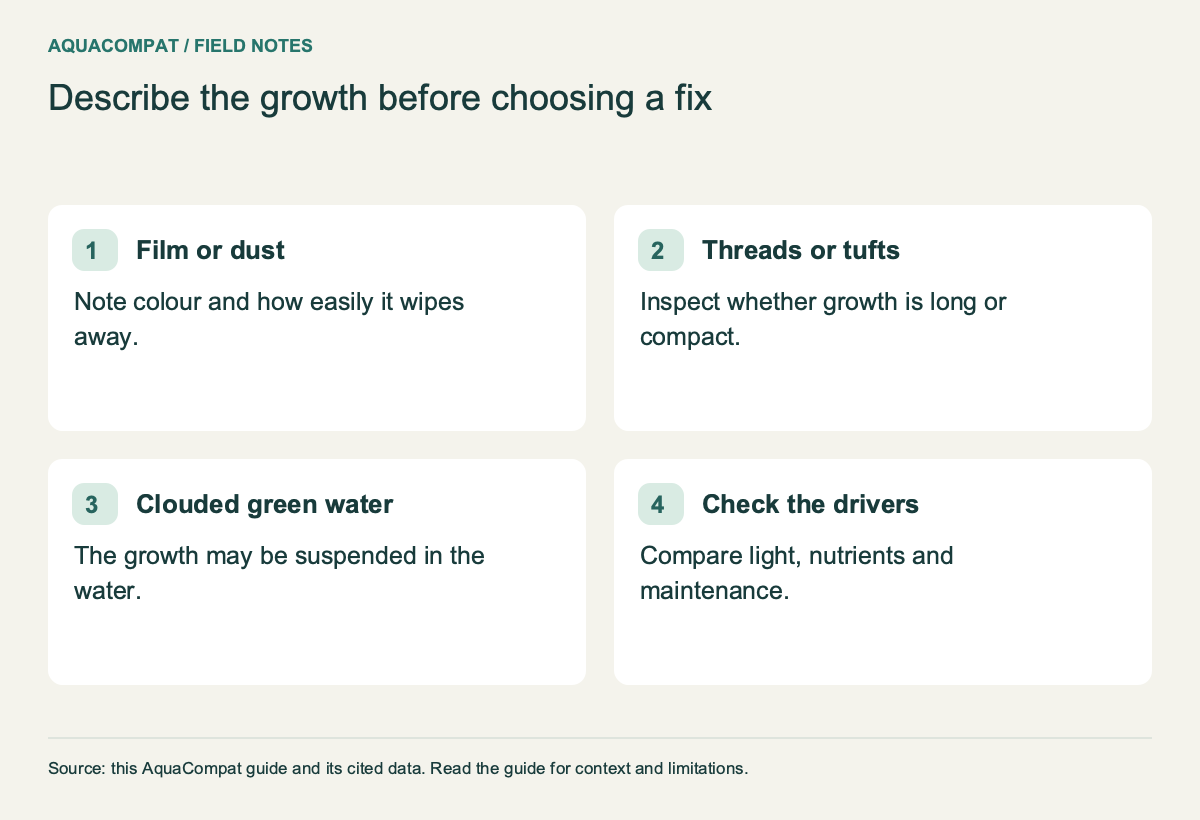
- Green spot algae (GSA): small, hard green spots on the glass and on the leaves of slow-growing plants that are difficult to wipe off.
- Hair or thread algae: green filaments, including staghorn and string algae, that look like wet hair when lifted out of the water. It grows on plant edges and rocks or forms matted clumps.
- Green water: the whole water column turns pea-soup green from free-floating single-celled algae.
- Diatoms (brown algae): a dusty, flour-like brown coating on glass, substrate and plants that wipes off easily. It is most common in newly set-up tanks.
- Black beard or brush algae (BBA): thick, bushy, dark tufts firmly attached to plants, decor and equipment. LiveAquaria compares it to coarse horsehair, and despite its colour it belongs to the red algae.
- Blue-green algae (cyanobacteria): a slimy sheet over substrate, plants and decor, usually blue-green but also brown, black or red, with an earthy or foul smell that may be noticed before it is visible.
| Algae type | Looks like | Typical trigger named by sources | First-line fix |
|---|---|---|---|
| Green spot algae | Hard green dots on glass and slow leaves | Phosphate imbalance or excess light | Scrape the glass; nerite snails graze it |
| Hair or thread algae | Wet-hair strands on plants and rocks | Excess nutrients or iron, too much light | Remove by hand; shorten the photoperiod |
| Green water | Pea-soup green water column | Excess light and nutrients | UV sterilizer or a blackout |
| Diatoms | Brown dust that wipes off | New tank, silicate and phosphate | Wipe off and wait for the tank to mature |
| Black beard algae | Dark, firmly attached tufts | Unstable CO2 in planted tanks | Spot-treat with hydrogen peroxide out of the water |
| Cyanobacteria | Smelly blue-green slime sheet | Low nitrate, poor circulation, overfeeding | Siphon it out, clean and increase flow |
What causes algae in an aquarium?
Algae grows when light, nutrients and CO2 are out of balance, so that plants cannot use everything on offer. Aquarium Co-Op and Tropica both describe plants and algae competing for the same light, nutrients and CO2: with too much light for the nutrients available, or too many nutrients for the light, algae takes the surplus. Over-fertilising the water is one route, because plants cannot take up fertiliser faster than their light allows.
Light
Light is the trigger most within your control. Tropica advises about 6 hours/day of light for the first two to three weeks of a new planted tank, then 8–10 hours/day once plants settle. Aquarium Co-Op allows longer days for established tanks but says to cut back if algae spreads. Direct sunlight and inconsistent hours both feed algae, which is why Co-Op recommends a timer.
CO2 and bright light
The brighter the light, the more CO2 and fertiliser plants need. Aquarium Co-Op says high light of 40–50+ PAR usually needs added CO2, or algae can take over, while low-tech tanks run on low light of about 10–20 PAR. GWAPA links black beard algae to unstable CO2. Our guide to CO2 levels in planted tanks explains how to measure and hold CO2 steady.
Nutrients and waste
Nitrate and phosphate come from fish waste and food as well as fertiliser. The nitrogen cycle turns ammonia from waste into nitrate, which plants use and algae can use too. Aquarium Co-Op calls nitrate below about 40 ppm safe, and Practical Fishkeeping says a reading that far above tap water calls for more water changes, the main way to remove it.
Where the sources disagree
The per-type causes are not settled. For green spot algae, GWAPA blames depleted phosphate and suggests raising it in planted tanks, while LiveAquaria lists high phosphate, excess light or low CO2. For hair algae, GWAPA points to excess iron, LiveAquaria to excess nitrate and phosphate, and Aquarium Co-Op to excess nutrients, too much light or too few nutrients. Treat the trigger column above as a starting point and test before you change dosing; the best aquarium test kits compared cover nitrate and phosphate tests.
How do you get rid of each type of algae?
Remove what you can by hand first, then fix the trigger so it does not come back. The steps below follow Aquarium Co-Op, GWAPA and LiveAquaria for each type.
- Green spot algae: scrape the glass with a razor blade, or a plastic card on acrylic. Nerite snails eat GSA. In planted tanks GWAPA suggests raising phosphate to a moderate level, while LiveAquaria suggests reducing light.
- Hair or thread algae: pull it out by hand or with a toothbrush, shorten the photoperiod and rebalance fertiliser. GWAPA links it to iron above about 0.15 ppm.
- Green water: a UV sterilizer clears it in about two to three days, according to Aquarium Co-Op. The alternative is a blackout: Co-Op recommends at least a week of darkness and GWAPA describes five days. Co-Op notes that large water changes alone do not work, and that light and feeding should be reduced at the same time.
- Diatoms: wipe them off with a sponge. They usually fade as a new tank matures and silicate and phosphate are used up.
- Black beard algae: spray affected decor or plants out of the water with 3% hydrogen peroxide, leave about five minutes, rinse and return, and trim affected leaves. GWAPA recommends stable CO2 in planted tanks. Aquarium Co-Op warns that full eradication can take six to eight months.
- Cyanobacteria: siphon off the slime, vacuum the substrate, clean the filter, improve circulation and stop overfeeding. GWAPA links it to low nitrate in planted tanks. If it returns, Aquarium Co-Op describes erythromycin products such as Maracyn and Fritz Slime Out, each with its own label dose.
Liquid carbon (glutaraldehyde) products are a further option in planted tanks. Seachem’s Flourish Excel label gives a dosing schedule and warns against spot-treating plants, because overdosing can damage them.
Which algae eaters help with each type?
Algae eaters help with soft films and some filament algae, but none of them fixes the imbalance that caused it. The animals below appear in our species data with algae in their recorded diets.
- Nerite snail: grazes algal film on glass and hardscape, and the algae sources name it for green spot algae and diatoms. It needs pH 7.2–8.0 water. The aquarium snail tank mates guide covers which fish leave it alone.
- Amano shrimp: grazes most soft algae and biofilm; Practical Fishkeeping says almost all forms. The algae sources name it for hair algae and black beard algae. It grows to 2 in (5.1 cm) and needs at least 10 US gal (38 L).
- Cherry shrimp: grazes algae, biofilm and detritus, according to Aquarium Co-Op, and the sources list shrimp among diatom eaters. The fish that live safely with cherry shrimp are ranked on their own hub.
- Bristlenose pleco: Practical Fishkeeping notes it rasps algae and biofilm, though PlanetCatfish says it still needs mainly vegetable foods such as algae wafers.
- Molly: the algae sources list mollies among hair algae grazers, and FishBase says the sailfin molly feeds mainly on algae in the wild.
The sources also name Siamese algae eaters, otocinclus and Florida flagfish, which are not yet in our species data. No grazer clears green water, which is suspended in the water column, or cyanobacteria.
Which fish and plants are sensitive to algae treatments?
Plants and the biological filter are more at risk from algae treatments than fish are. The cautions in the sources are listed below.
- Plants and liquid carbon: Seachem says anacharis is sensitive to Flourish Excel and should be dosed every other day, and that high doses can melt Vallisneria leaves.
- Plants and blackouts: Aquarium Co-Op notes that blackouts and antibiotic treatments are hard on live plants.
- The biofilter and antibiotics: UF/IFAS Extension warns that antibiotic baths may harm the biological filter, while Aquarium Co-Op says its erythromycin product does not. Test ammonia and nitrite during and after any erythromycin treatment.
No source in our data addresses the safety of hydrogen peroxide or liquid carbon for shrimp or snails, so remove treated decor and rinse it before it goes back into a tank with invertebrates.
What looks like algae but is something else?
Blue-green algae is the main look-alike: it is not a true alga but a photosynthetic bacterium (cyanobacteria), which is why antibiotic products affect it. Green water is the other common confusion. Its green tint separates an algal bloom from a white bacterial bloom, which is a different problem covered in the guide to cloudy aquarium water. Black beard algae can also mislead, since it belongs to the red algae despite its dark colour. Finally, the marimo ball sold as a plant is itself a green alga, according to Tropica, so it is not a sign of an algae problem.
Will an algae eater solve an algae problem?
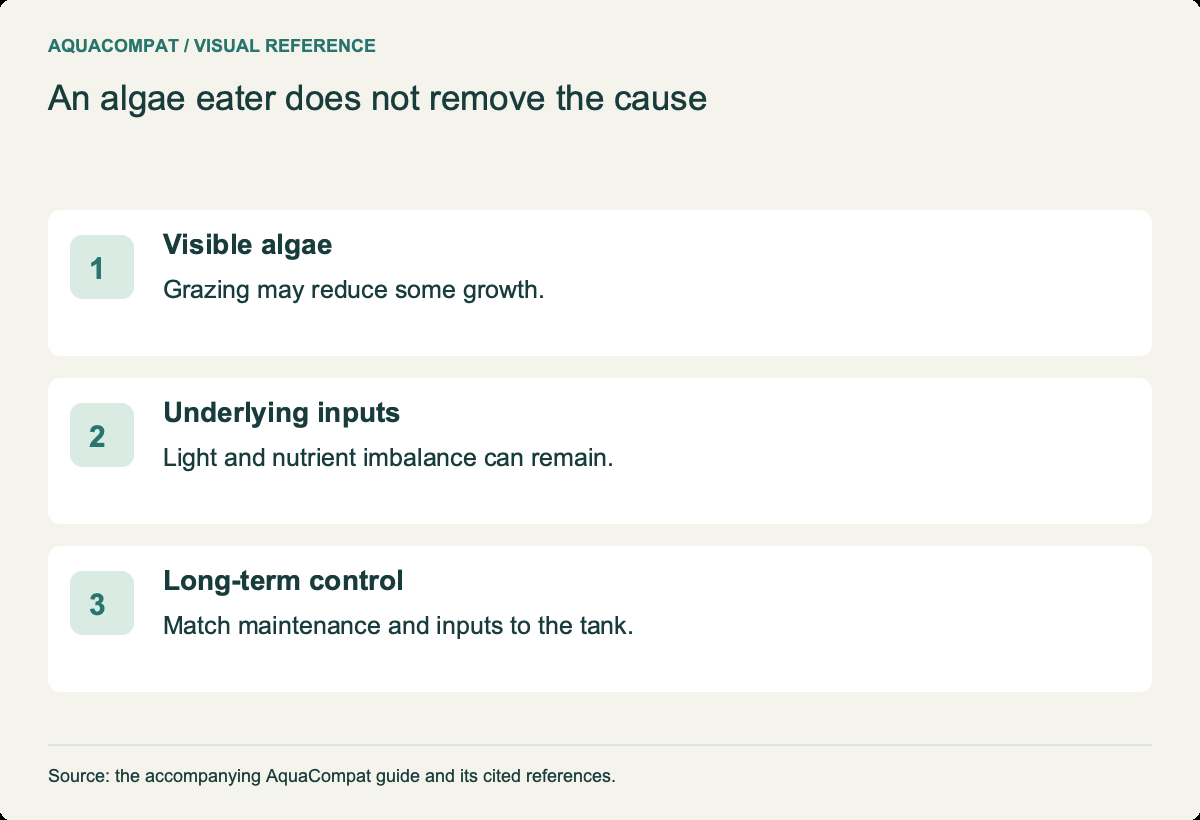
No. An algae eater removes some algae, but the light and nutrient imbalance that grew it remains, and some popular bottom fish are not algae eaters at all. Aquarium Co-Op notes that corydoras are not primarily algae eaters, and PlanetCatfish says bristlenose plecos need vegetable foods beyond the algae they find. Practical Fishkeeping notes that algal film is mostly what nerites eat in the wild, so a spotless tank can leave a nerite short of food. Use grazers as maintenance, and fix the photoperiod, CO2 and nutrients as the cure.
Algae scraper for glass tanks
A magnetic cleaner covers the routine part of algae control: wiping green spot algae and diatoms off the front glass between water changes. AquaCompat has not used or tested this cleaner; the note compares what the maker publishes.
As an Amazon Associate I earn from qualifying purchases. Prices change often, so they are not shown here; the button opens the current listing.

Mag-Float Glass Large
- Rated up to
- 350 US gal
- Glass thickness
- 5/8 in
- For
- glass
- Size
- 3 x 2.25 x 1 in
Fits: glass tanks with glass up to 5/8 in thick that need regular wiping of diatoms or soft green film; the maker describes a floating inner cleaner and lists a scraper with this size.
Skip it if: your tank is acrylic, which needs the separate acrylic model, or the problem is hard green spot algae, which Aquarium Co-Op removes with a razor blade on glass.
Check price on AmazonWhen does an algae bloom become dangerous to fish?
A bloom becomes dangerous when it consumes the oxygen fish need. Algae and cyanobacteria consume oxygen at night, and Southern Regional Aquaculture Center pond data shows heavy blooms can stress or suffocate fish. SRAC also lists cyanobacteria among the most common toxin-producing algae in freshwater ponds, though how far that applies to aquariums is not quantified. Algae itself is not a fish disease. If fish gasp at the surface during a bloom or after a treatment, test ammonia, nitrite and oxygen, and ask an aquatic veterinarian before using antibiotics against cyanobacteria.
How do you prevent algae from coming back?
Prevention comes down to steady light, steady nutrients and plenty of plants. Aquarium Co-Op recommends a lighting timer, keeping the tank out of direct sunlight and changing nutrient dosing gradually, waiting two to three weeks between adjustments. LiveAquaria and Co-Op add the routine basics: avoid overfeeding, keep up water changes and gravel cleaning, and keep the water moving.
Planted tanks start with the advantage of plant mass. Aquarium Co-Op and Tropica both advise planting heavily from the start, including fast growers, so plants use up spare nutrients while a new tank settles, and Tropica suggests little or no fertiliser for the first 3–4 weeks. The guide to how to start a planted tank walks through that set-up, and the low-tech planted tank guide covers tanks run without added CO2. The fish disease guides index lists the other tank problems we cover.
Questions people ask
Why does my new tank have brown algae?
Brown dust in a new tank is usually diatoms. Aquarium Co-Op, GWAPA and LiveAquaria describe them as most common in newly set-up tanks, and they usually fade as the tank matures and silicate and phosphate are used up. Wipe them off with a sponge in the meantime; nerite snails, otocinclus and shrimp eat them.
How long should aquarium lights be on to avoid algae?
Tropica suggests about 6 hours/day for the first two to three weeks of a planted tank, then 8–10 hours/day. Aquarium Co-Op allows longer days for established tanks but says to cut back if algae spreads. Use a timer so the hours stay the same every day.
Do water changes get rid of green water?
Not on their own. Aquarium Co-Op notes that large water changes alone are ineffective against green water. A UV sterilizer clears it in about two to three days, according to Co-Op, or a blackout of five days to a week can work. Reduce light and feeding at the same time.
Is black beard algae harmful to fish?
No source in our data describes black beard algae harming fish directly; it is a red alga that clings to plants and decor. The problem is removal: Aquarium Co-Op warns that eradication can take six to eight months. Spot-treat decor with hydrogen peroxide out of the water and keep CO2 stable in planted tanks.
Can snails control algae on their own?
They help with soft films. Nerite snails eat green spot algae and diatoms, according to the algae sources, but no grazer clears green water or cyanobacteria. Snails also need food once the algae is gone, so keep only as many as the tank can feed.
Sources 123 documents from 26 publishers
- Amazon (amazon.com): “Gulfstream Tropical AGU350LG Mag-Float Glass Aquarium Cleaner, Large”
- Aquarium Co-Op (aquariumcoop.com): “How to Fight the 6 Most Common Types of Algae in Your Fish Tank”; “How to Get Rid of Blue-Green Algae in Freshwater Aquariums”; “Is Nitrate Good or Bad for Your Aquarium?”; “How to Balance Aquarium Lights to Grow Healthy Plants (& Avoid Algae)”; “CO2 in Planted Aquariums: What Does It Really Do and Is It Natural?”; “What is PAR? Lighting & Brightness Explained for Planted Tanks”; “How to Use Root Tabs to Fertilize Your Live Aquarium Plants”; “Which Planted Tank Fertilizer Is Right for You?”; “Beginner's Guide to Fertilizing Your Planted Tank the EASY Way”; “How to Set Up a Low Tech Planted Aquarium for Beginners”; “Monte Carlo (care page)”; “CO2 for planted tanks”; “Guide to Aquarium Water Changes”; “Care Guide for Nerite Snails”; “Care Guide for Amano Shrimp”; “Care Guide for Cherry Shrimp”; “Care Guide for Plecostomus”; “Care Guide for Mollies: Feeding, Breeding, and Tank Mates”; “Top 5 Dither Fish to Help Shy or Aggressive Fish in Freshwater Tanks”; “Anubias Nana (care page)”; “Java Fern (care page)”; “Cryptocoryne Wendtii 'Green' (care page)”; “Java Moss (care page)”; “Care Guide for Java Moss”; “Amazon Sword Plant (care page)”; “Vallisneria (care page)”; “How to Care for Hornwort (Ceratophyllum demersum) in Aquariums & Ponds”; “Water Sprite (care page)”; “Marimo Moss Ball Care Guide”; “Dwarf Sagittaria (care page)”; “Care Guide for Cory Catfish”
- Aquarium Science (aquariumscience.org) (aquariumscience.org): “Measuring CO2”
- Aquasabi (aquasabi.de): “Anubias barteri var. nana”; “Microsorum pteropus”; “Cryptocoryne wendtii 'Green'”; “Taxiphyllum barbieri 'Java moss'”; “Echinodorus grisebachii 'Bleherae'”; “Vallisneria spiralis”; “Ceratopteris thalictroides”; “Sagittaria subulata”
- Crustacean Research 49 (Hamasaki et al. 2020) (jstage.jst.go.jp): “Dietary effects of phytoplankton and zooplankton on larval survival, duration and growth of four Caridina species”
- Crustacean Research 50 (Kondo, Hamasaki, Dan 2021) (jstage.jst.go.jp): “Larval performance of three amphidromous shrimp species in the genus Caridina under different temperature and salinity conditions”
- Dennerle (dennerle.com): “CO2 Langzeittest (long-term test) instructions 2985/2986”
- FishBase (fishbase.se): “Ancistrus cirrhosus summary (Bayesian length-weight estimate)”; “Poecilia sphenops, Molly: species summary”; “Poecilia latipinna, Sailfin molly: species summary”; “Length-weight relationships for Poecilia sphenops”; “Osteogaster aenea, Bronze corydoras”; “Length-weight relationships for Osteogaster aenea”
- Flowgrow Aquatic Plant Database (flowgrow.de): “Anubias barteri var. nana”; “Microsorum pteropus”; “Cryptocoryne wendtii 'grün'”; “Taxiphyllum barbieri (Java moss)”; “Echinodorus grisebachii 'Bleherae'”; “Vallisneria spiralis”; “Ceratophyllum demersum”; “Ceratopteris thalictroides”; “Aegagropila linnaei”; “Sagittaria subulata”; “Micranthemum tweediei”
- Greater Washington Aquatic Plant Association (GWAPA) (gwapa.org): “Algae in the Planted Aquarium (K. Weinhold)”
- LiveAquaria (liveaquaria.com): “Algae Identification in Freshwater Tanks and Proper Removal”
- Mag-Float (Gulfstream Tropical) (magfloat.com): “MAGFLOAT GLASS - LARGE”
- Maidenhead Aquatics (fishkeeper.co.uk species data sheet) (fishkeeper.co.uk): “Zebra Nerite Snail”; “Amano Shrimp”; “Molly data sheet”
- Merck Veterinary Manual (merckvetmanual.com): “Environmental Diseases of Aquatic Animals in Aquatic Systems (Francis-Floyd, Yanong, Petty)”; “Disorders and Diseases of Fish (pet owner version)”; “Special Considerations for Fish (pet owner version)”; “Routine Health Care of Fish (pet owner version)”; “Providing a Home for Fish (pet owner version)”
- PlanetCatfish (via Internet Archive snapshot, 2025) (web.archive.org): “Ancistrus sp. (3) Common Bristlenose Catfish Cat-eLog data sheet”; “Osteogaster aenea (Bronze Cory) Cat-eLog data sheet”
- Practical Fishkeeping (practicalfishkeeping.co.uk): “How often should I change my water?”; “Will these snails starve without algae?”; “What can I add for algae control?”; “Amano shrimp: Spineless heroes (Nathan Hill)”; “Frequently asked questions on Neocaridina shrimps”; “An introduction to Shrimp”; “Bristlenose catfish: the hardworking Ancistrus”; “How long will my fish live?”; “Quick guide to livebearers”; “What can I keep in my hard water aquarium?”
- Practical Fishkeeping (Julian Dignall) (practicalfishkeeping.co.uk): “Focus on commonly kept Corydoras”
- Seachem Laboratories (seachem.com): “Flourish Excel product instructions”
- Seriously Fish (seriouslyfish.com): “Ancistrus sp. '3' (Common Bristlenose Catfish)”; “Poecilia sphenops”; “Poecilia latipinna”; “Osteogaster aenea (Bronze Cory)”
- Shrimp and Snail Breeder (aquariumbreeder.com): “Nerite Snails: detailed guide, care, diet and breeding”; “How Copper Affects Dwarf Shrimp”; “Amano Shrimp: detailed guide, care, diet and breeding”; “Red Cherry Shrimp: detailed guide, care, diet and breeding”; “Cherry Shrimp in a Community Tank”
- Shrimp Science (shrimpscience.com): “Amano Shrimp”; “Red Cherry Shrimp - Care Guide”; “General Hardness (GH) For Shrimp Tanks”; “Carbonate Hardness (KH) For Shrimp Tanks”; “TDS For Shrimp Tanks”
- Southern Regional Aquaculture Center (srac.msstate.edu): “SRAC Publication No. 466: Algae Blooms in Commercial Fish Production Ponds”; “SRAC Publication No. 4605: Algal Toxins in Pond Aquaculture (J.H. Rodgers Jr.)”; “SRAC 464: Interactions of pH, Carbon Dioxide, Alkalinity and Hardness in Fish Ponds (Wurts and Durborow)”; “SRAC 468: Carbon Dioxide in Fish Ponds (Hargreaves and Brunson)”
- Tropica Aquarium Plants (tropica.com): “Starting a new aquarium (growing-in guide)”; “Fertiliser and CO2 for your aquarium”; “Hardscape and bottom layer in the tank”; “Trimming”; “Anubias barteri var. nana (101)”; “Microsorum pteropus (008)”; “Cryptocoryne wendtii 'Green' (109)”; “Taxiphyllum barbieri 'Bogor Moss' (003 TC)”; “Echinodorus grisebachii 'Bleherae' (071)”; “Vallisneria 'Gigantea' (054)”; “Vallisneria spiralis 'Tiger' (055A)”; “Ceratophyllum demersum (021A POR)”; “Ceratopteris thalictroides (005A)”; “Aegagropila linnaei (000 CST)”; “Sagittaria subulata (079)”; “Micranthemum tweediei 'Monte Carlo' (025)”
- UF/IFAS EDIS (ask.ifas.ufl.edu): “FA16: Ammonia in Aquatic Systems (Francis-Floyd, Watson, Petty, Pouder)”
- University of Florida IFAS Extension (ask.ifas.ufl.edu): “FA084: Use of Antibiotics in Ornamental Fish Aquaculture (R.P.E. Yanong)”
- Wikipedia (en.wikipedia.org): “Vittina natalensis”
All sources accessed . Every number on this page comes from these documents.