What specs matter when you choose aquarium equipment?
The spec that matters most for any piece of aquarium equipment is the one that ties it to your tank's volume or your species' needs. Brand, styling and accessories come after that. Each buyer guide starts by naming its deciding spec, and the main ones are listed below in the order a new tank usually needs them.
- Rated tank size for filters. A filter's published rating says how large a tank it is designed to clean. The Fluval 307 canister, for example, is rated 40–70 US gal / 90–330 L, and the AQUANEAT Bio Sponge Filter up to 20 US gal. The canister filter sizes by tank and the sponge filters for shrimp, fry and bettas both sort their picks by that rating.
- Wattage and rated volume for heaters. Aquarium Co-Op's rule of thumb is 5 W/gal, or about 1 W/L. The Fluval E100 is rated up to 30 US gal / 120 L. The heater guide by tank size applies that sizing to every common tank.
- What a test kit measures, and how. The API Freshwater Master Test Kit covers pH, high range pH, ammonia, nitrite, nitrate by liquid reagent. The comparison of aquarium test kits sets strips, liquid reagents and a photometer side by side.
- Dose for water conditioners. Seachem lists Prime at 5 mL per 200 L (50 US gal) of new water, which decides how long a bottle lasts in a large tank. The water conditioner and dechlorinator guide compares label doses.
- Format and buoyancy for food. Hikari Micro Pellets are semi-floating, which suits fish that feed in mid-water rather than on the bottom. The fish food matched to species type pairs each format with a feeding zone.
Specs are read from the maker's own page or manual, and each guide lists those sources under the article so a figure can be checked against where it came from.
Which equipment does a new freshwater tank need first?
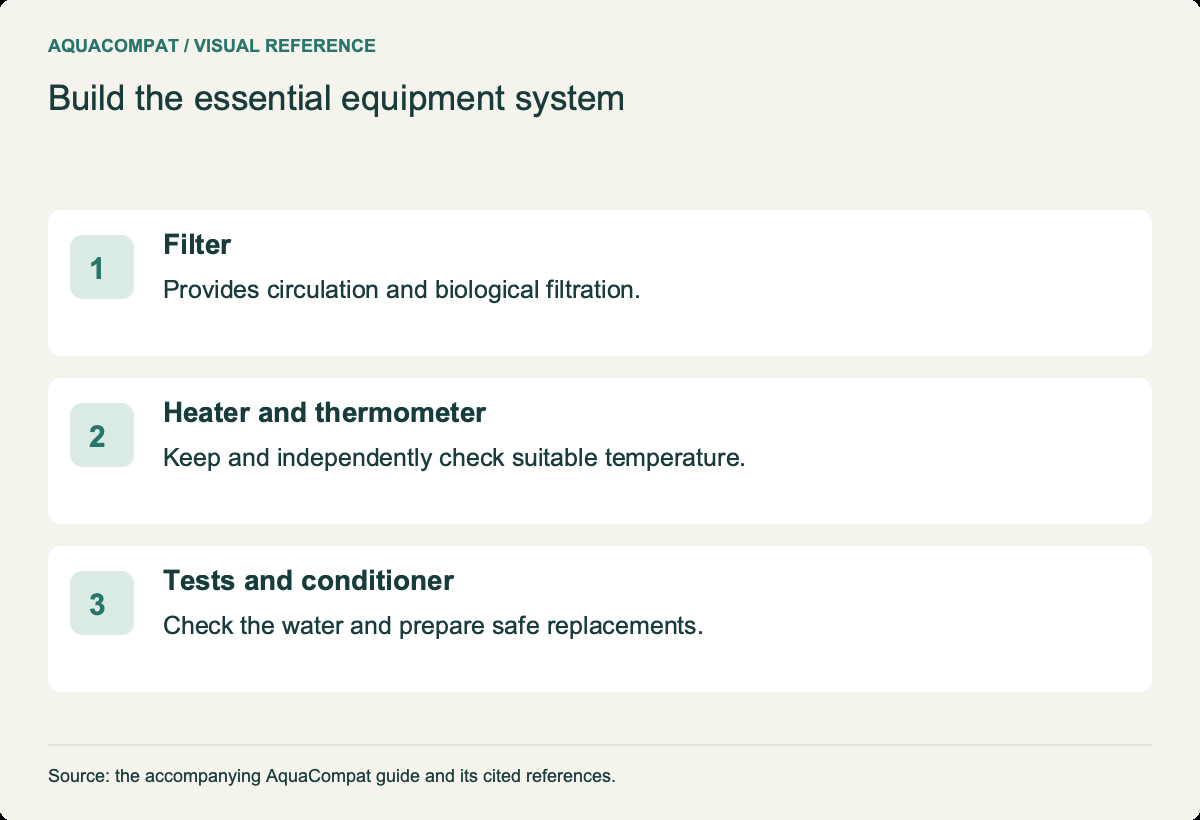
A new freshwater tank needs a filter, a water conditioner and a test kit before any fish go in, and a heater as well if it will hold tropical species. Food comes last, once the tank is cycled and stocked. Planted-tank gear is optional and can be added in a second stage.
The order matters because each item protects the fish from a different risk. The filter houses the bacteria that process ammonia, which the aquarium nitrogen cycle explains step by step. The conditioner removes chlorine and chloramine from every refill, and the test kit is the only way to see whether ammonia and nitrite have fallen to zero, because both are colourless. The heater holds the temperature band your species share, which for most community fish sits within the hobby range of 75–80 °F given by the fish temperature chart.
For a worked example, the 10-gallon community tank setup lists one filter, one heater and one test kit sized to that tank, with three stockings checked pair by pair. A coldwater goldfish tank is the main exception: goldfish are kept at 59–70 °F (15–21 °C), so many goldfish tanks in heated rooms need no heater at all.
Which buyer guide answers which question?
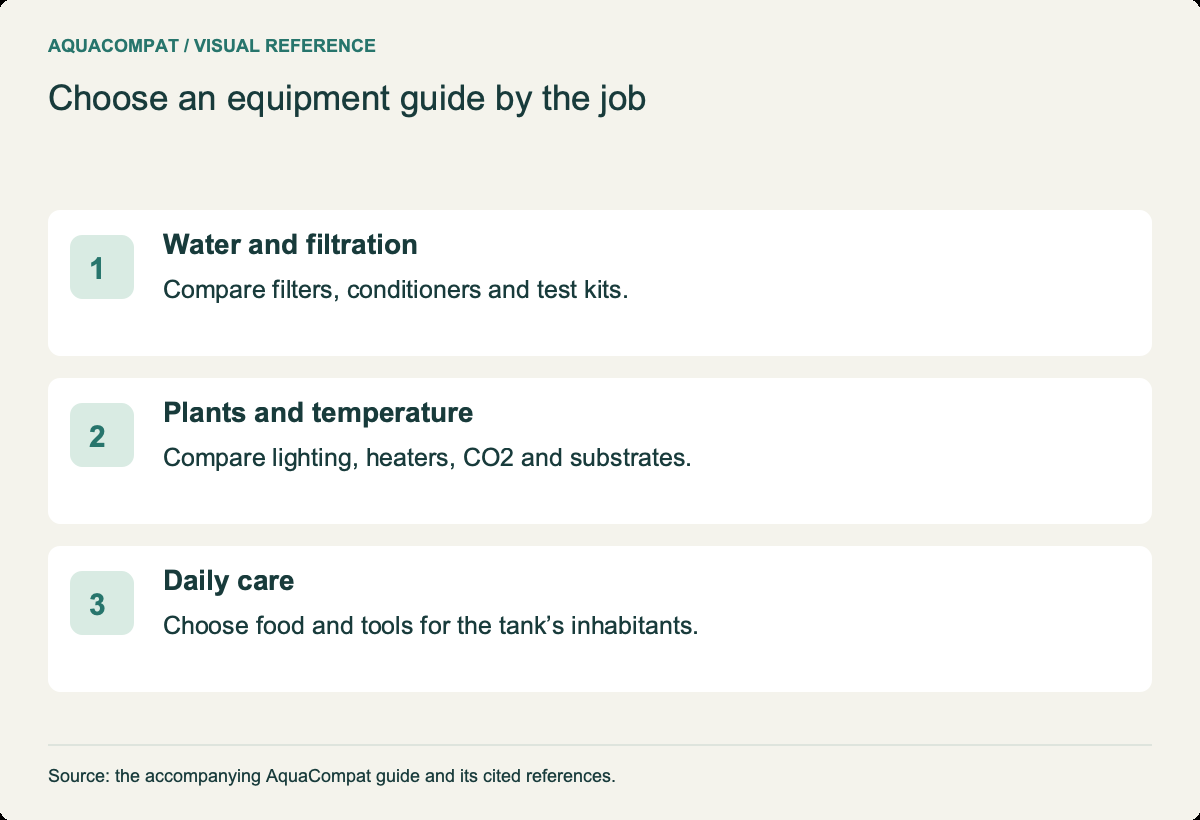
The ten buyer guides fall into four groups, each answering a different stage of keeping a tank. Pick the group that matches the problem, then the guide inside it.
Life support: filters and heaters
Filtration and heating keep fish alive from day one. Canister filters suit tanks from about 20 gallons up and hide the media outside the tank; sponge filters suit small, gentle-flow tanks for shrimp, fry and bettas. Heaters are sized by wattage against volume, and the guide also covers dry-run shutoff and other safety features published by the makers.
Water testing and treatment
Test kits and water conditioners work as a pair: one tells you what is in the water, the other neutralises what comes out of the tap. Shrimp keepers and owners of soft-water species usually add a GH and KH test to the basic kit, which the guide to general and carbonate hardness explains.
Feeding
Food is matched to where a species feeds and what it eats. A school of Neon Tetra feeds in mid-water, while a Bristlenose Pleco grazes on the bottom, so most community tanks need two formats.
Planted tanks
Four guides cover the planted tank: nutrient substrates for planted tanks, aquarium lights for plant growth, pressurised CO2 systems and aquascaping scissors and tools. Read them in that order, because the substrate goes in first and the light decides whether CO2 is needed at all.
How are products chosen for the buyer guides?
Products are chosen by comparing manufacturers' published specifications against the needs of a tank size or species group, then writing down who each one suits and who should skip it. AquaCompat does not test, run or measure equipment, and no guide claims that it did. The full rules sit on the page explaining how AquaCompat selects products and scores pairs.
Three rules shape every list:
- Only published specs count. A rated tank size, wattage, dose or parameter list must appear on the maker's own page or manual. Where a maker publishes nothing, the guide says so rather than estimating.
- No invented ratings. There are no stars, scores or best-overall badges. Each product note names the tank or species it fits and the case where another product fits better.
- Exact listings only. When a product links to Amazon, the listing must match the exact model and size the maker names. Bundles, renewed items and listings from unrelated third-party sellers are left out.
Prices are not shown, because Amazon requires a displayed price to carry the time it was checked and to be removed within 24 hours, which a static site cannot guarantee. Product boxes send you to the current listing instead.
As an Amazon Associate I earn from qualifying purchases. A purchase through a product link can pay AquaCompat a commission at no extra cost to you, and commissions never change which products are listed or any compatibility verdict. The affiliate disclosure page explains how links are marked.
How should you size equipment to your tank?
Size every piece of equipment to the tank's volume first and to its species second. Volume decides the filter rating and heater wattage; species decide flow, temperature and food.
Volume is the simple part. Multiply the tank's volume by 5 W/gal to get a heater size, then pick a model whose published rating includes that volume: the Fluval E100, rated up to 30 US gal / 120 L, covers a 20-gallon tank with room to spare. Filters work the same way: choose one whose rated range includes your tank rather than one that only just reaches it.
Species change the answer more than people expect. A Betta Fish has long fins and lives near the surface, so a gentle sponge filter suits it better than a strong outlet. Shrimp need foam over the intake, which is why sponge filters lead the shrimp-tank lists. A Discus is kept at 79–86 °F (26–30 °C), warmer than most community fish, so its heater has to hold the top of the range rather than the middle. The tank mates by species index shows which species share a tank, and the shared temperature of those species is the figure the heater should hold.
Bioload matters too. Large, messy fish such as the Oscar, which reaches 14 in (35.6 cm), produce far more waste than their tank volume suggests, and the canister guide discusses sizing up the filter for them.
Does tap water left out overnight still need a conditioner?
Yes, in many homes tap water left out overnight still needs a conditioner, because standing water loses chlorine but not chloramine. This is one of the most repeated pieces of aquarium advice, and it is only half true.
UF/IFAS Extension describes aerating water for 24 hours to drive off chlorine, but notes that aeration does not remove chloramine, and the US Environmental Protection Agency says chloramine persists longer in water. The EPA also reports that more than 20 % of Americans (more than) drink chloramine-treated water. The Merck Veterinary Manual reports fish deaths at chlorine levels as low as 0.04 mg/L chlorine, so the margin for error is small.
The practical answer is to treat every refill with a conditioner that lists both chlorine and chloramine, then check the dose against your tank volume. The tap water preparation guide explains how to find out which disinfectant your water supplier uses.
When can equipment not fix a tank problem?
Equipment cannot fix a stocking mistake or replace routine care. The most common case is buying gear to rescue two species that should not share a tank.
The betta and goldfish pairing shows the limit clearly. A betta is kept at 72–86 °F (22–30 °C) and a goldfish at 59–70 °F (15–21 °C), so no heater setting satisfies both, and the pair currently reads incompatible at 3 out of 10. The betta and goldfish compatibility page explains why a better heater or a bigger filter does not change that.
Products that bind toxins are a bridge, not a cure. Seachem says Prime binds ammonia for up to 48 hours, which buys time in an emergency, but only a working biofilter and water changes remove the waste for good. A test kit, likewise, only reports a problem; acting on the reading is still the keeper's job, and the aquarium maintenance schedule sets out how often to test and change water.
Finally, a filter rated for your tank does not make an overstocked tank safe. Check species and numbers first with the aquarium stocking calculator, then buy equipment for the stocking you end up with.
All aquarium equipment buyer guides
- Best Canister Filters by Tank SizeFluval, Eheim and OASE canisters matched to 20 to 125-gallon tanks by published rating.
- Best Sponge FiltersGentle air-driven filters for shrimp, fry and betta tanks, with foam and air pump needs.
- Best Aquarium Heaters by Tank SizeWatts per gallon, rated volumes and safety features for Fluval, Eheim and Hydor heaters.
- Best Aquarium Test Kits ComparedStrips, liquid reagents and a photometer compared by what they measure and how.
- Best Water Conditioners ComparedChlorine and chloramine removal, label doses and ammonia-binding claims.
- Best Substrate for Planted TanksAquasoils and mineral substrates compared by pH effect and preparation.
- Best Aquarium Lights for Plant GrowthLED fixtures compared by fit range, output and spectrum for planted tanks.
- Best CO2 Systems for Planted AquariumsPressurised CO2 kits, regulators and drop checkers compared on published specs.
- Best Fish Food by Species TypeFlakes, micro pellets, granules and wafers matched to diet and swim level.
- Best Aquascaping ToolsScissors and tools for trimming and planting, compared by length and intended use.
Questions people ask
Does AquaCompat test the equipment in its buyer guides?
Why are there no prices or star ratings on the buyer guides?
Which buyer guide should I read first for a brand-new tank?
Do affiliate commissions affect which products are listed?
Are the products in these guides sold outside the US?
Sources 33 documents from 19 publishers
- All Pond Solutions (allpondsolutions.co.uk): “Aquarium Heater Buying Guide”
- Amazon (amazon.com): “Fluval 307 Perfomance Canister Filter for Aquariums up to 70 Gallons”; “Hikari Micro Pellets Semi-Floating Fish Food 0.77 oz (22g)”
- Amazon (AQUANEAT brand listing) (amazon.com): “AQUANEAT Aquarium Bio Sponge Filter (Middle up to 20Gal) B078Q29JT4”
- API Fishcare (apifishcare.com): “API Freshwater Master Test Kit”
- Aquarium Co-Op (aquariumcoop.com): “How to Choose the Right Aquarium Heater”; “Care Guide for Fancy Goldfish”; “Oscar Fish Care Guide”; “Does dechlorinator remove ammonia?”; “Betta Fish Care Guide”; “Goldfish Tank Mates”
- Aquasabi (aquasabi.de): “Fluval E-Serie Aquarium Heater E100”
- FishBase (fishbase.se): “Symphysodon aequifasciatus, Blue discus: species summary”; “Astronotus ocellatus, Oscar: species summary”; “Betta splendens, Siamese fighting fish: species summary”; “Carassius auratus, Goldfish: species summary”
- fishkeeping.co.uk (fishkeeping.co.uk): “Goldfish Size, Life Expectancy and Tank Recommendations”; “Keeping Goldfish - The Right Way”
- Fluval (Hagen) (fluvalaquatics.com): “307 Canister Filter, 40-70 US Gal / 90-330 L - Fluval USA”; “07 Series Aquarium Filters - Fluval USA”
- Fluval (Rolf C. Hagen) (fluvalaquatics.com): “E100 Electronic Heater, 100W, up to 30 US Gal / 120 L”
- LiveAquaria (retailer, Hikari label data) (liveaquaria.com): “Hikari Micro Pellets”
- Merck Veterinary Manual (merckvetmanual.com): “Environmental Diseases of Aquatic Animals in Aquatic Systems, Francis-Floyd, Yanong and Petty”
- Ornamental Aquatic Trade Association (OATA) (ornamentalfish.org): “How to look after fancy goldfish”; “How to look after goldfish in an aquarium / fish tank”
- Practical Fishkeeping (practicalfishkeeping.co.uk): “Problem solver: New Tank Syndrome”
- Seachem (seachem.com): “Prime”
- Seriously Fish (seriouslyfish.com): “Symphysodon aequifasciatus”; “Astronotus ocellatus”; “Betta splendens”
- UF/IFAS EDIS (ask.ifas.ufl.edu): “Evolution, Culture, and Care for Betta splendens (FA212)”
- University of Florida IFAS Extension (EDIS) (ask.ifas.ufl.edu): “Teach Aquaculture Curriculum: Chlorine, Friend or Foe? (FA171), Chapman et al.”
- US Environmental Protection Agency (epa.gov): “Chloramines in Drinking Water”
All sources accessed . Every number on this page comes from these documents.