- Temperature overlap
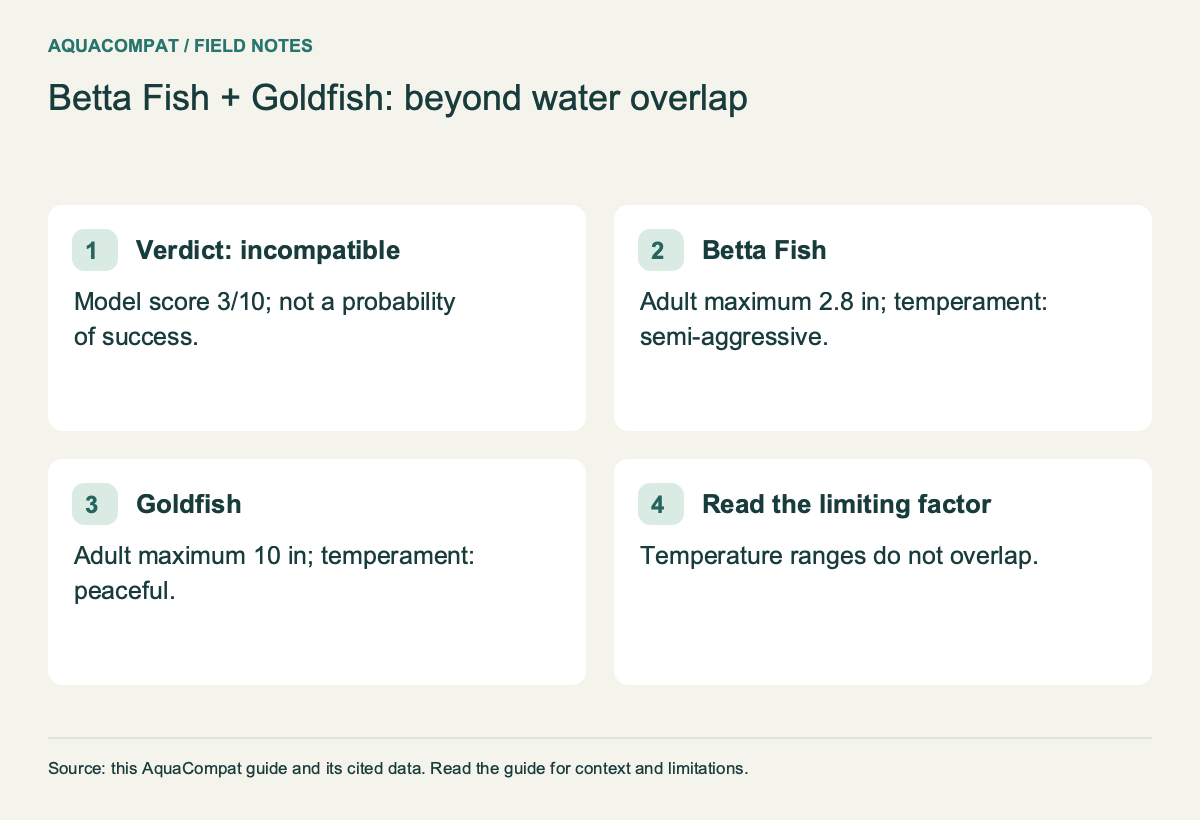
- 0/10
- pH overlap
- 10/10
- Hardness overlap
- 7/10
- Temperament
- 4/10
- Size and predation
- 4/10
- Swim level
- not scored (data missing)
- Smallest tank together
- 75 US gal (284 L)
Scores come from published water ranges, adult size, temperament and swim level. How the score works.
Where do bettas and goldfish overlap in water parameters?
Bettas and goldfish overlap on water chemistry but not on temperature. They share pH 6.0–8.0 and a general hardness of 5–15 dGH, and on temperature the shared band comes out as no overlap. Our compatibility method treats a missing temperature overlap as a hard fail, because a fish kept outside its range all the time is stressed whatever else goes right.
The bars below make the gap visible. The goldfish’s temperature bar ends a little before the betta’s begins, while the pH bars lie on top of each other and the hardness bars share a wide middle stretch. Many species in our data share pH and hardness bands, so a match there says little about whether two fish belong together; temperature is the parameter that separates tropical from coldwater fish.
Why can’t one heater setting suit a betta and a goldfish?
One heater setting cannot suit both fish because the betta needs heated water and the goldfish needs water that is not heated. The individual sources make the split clear. For bettas, Seriously Fish gives 72–86 °F (22–30 °C), Aquarium Co-Op suggests about 80 °F, and UF/IFAS EDIS (FA212) says an unheated container is only suitable where the room air stays at about 71.6 °F or above. For goldfish, Aquarium Co-Op gives 50–70 °F with no heater needed, and the Ornamental Aquatic Trade Association (OATA) puts the optimum for fancy goldfish at 15–23 °C.
The Southern Regional Aquaculture Center (SRAC 7201) describes goldfish and koi as temperate species with an optimum of 65–75 °F. Merck’s veterinary guidance, by contrast, puts tropical fish near 77 °F. Those two figures describe two different kinds of aquarium, which is why the guide to aquarium temperature ranges by species sorts species into tropical and coldwater groups before anything else.
Do any sources narrow the gap?
A few do, and they are worth stating plainly. Practical Fishkeeping suggests about 72–75 °F for good goldfish growth, and fishkeeping.co.uk says fancy goldfish do better near 72 °F. Those figures touch the cool edge of the betta’s range. Even there, the betta would be kept at its coolest listed temperature and the goldfish at its warmest, with neither fish in the middle of its comfort zone. The size, feeding and filtration differences below would remain whatever the thermostat says.
Can goldfish adapt to tropical water because they are so hardy?
Not in a way that makes the pairing safe. Goldfish are hardy: FishBase records a tolerated range of 0–41 °C, and SRAC 7201 says goldfish and koi can survive 32–95 °F if changes are gradual. Survival is not the same as thriving, though. SRAC adds that outside the optimum, immunity, feeding and growth can drop. Practical Fishkeeping also notes that fancy varieties are less hardy than single-tailed types, so the fish most often bought for indoor tanks are the ones with the least margin.
The same misconception runs the other way. Bettas can live unheated only in a warm room, according to UF/IFAS, which is not the same as thriving in the cool water a goldfish prefers. A tank that keeps both alive is still a tank where at least one fish is outside its comfortable range every day.
How big does a goldfish get next to a betta?
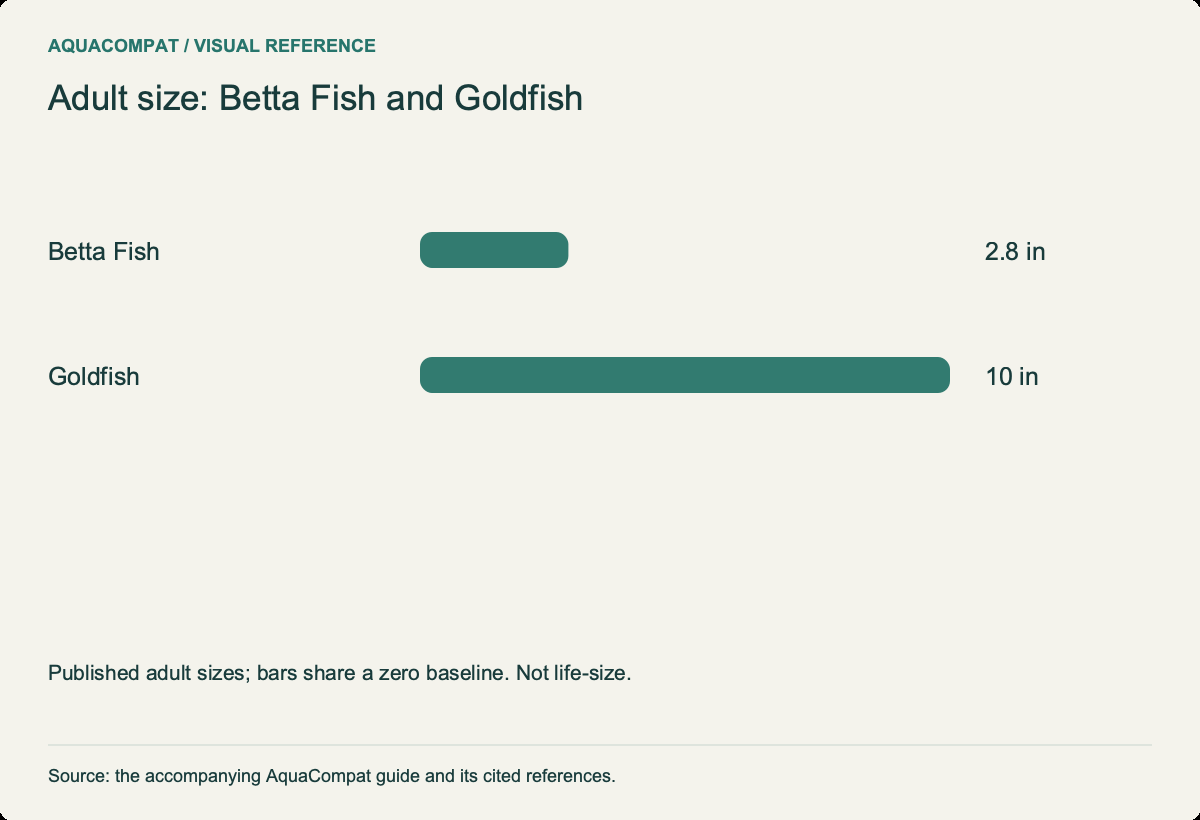
A goldfish grows far larger than a betta, and that size gap creates a predation risk on top of the temperature problem. Our data lists the goldfish at 10 in (25.4 cm) against the betta’s 2.8 in (7.1 cm). OATA says goldfish reach about 25 cm in aquaria, fishkeeping.co.uk puts single-tailed fish at 10–12 in, and FishBase records a maximum of 48 cm in the wild. Goldfish are often sold small, so the gap may not be obvious at first, but OATA and fishkeeping.co.uk both warn that small starter tanks are quickly outgrown.
The size factor in our scoring flags that a goldfish may eat fish small enough to swallow. fishkeeping.co.uk states that a goldfish will eat anything that fits in its mouth, and our goldfish data records that small fish kept with juvenile goldfish become food as the goldfish grow. A betta is not tiny, but it is slow, long-finned and a fraction of an adult goldfish’s length.
Do goldfish nip betta fins?
They may. Our pair data notes that goldfish may nip the fins of bettas. OATA reports fin-nipping among goldfish, especially boisterous single-tailed fish harassing slower fancy varieties. Long-finned domestic bettas are poor swimmers in strong currents, per Aquarium Co-Op, so a betta has little chance of getting away from an active goldfish. The betta’s own aggression is aimed at fish it reads as rivals, which Seriously Fish describes as fish with trailing fins or a betta-like shape. That makes the outcome hard to predict in both directions.
What tank size would a betta and goldfish need together?
On paper, a betta and goldfish would need at least 75 US gal (284 L) together, but no tank size fixes the temperature gap. The figure comes from the goldfish side. Our data uses 48 US gal (182 L) for a single-tailed goldfish, from fishkeeping.co.uk: 180 L for the first fish plus about 55 L for each extra fish, in a tank at least 120 cm long. The betta alone needs only 10 US gal (38 L).
Fancy goldfish need less room, but sources disagree on how much. Aquarium Co-Op gives 20 US gallons for the first fancy goldfish plus at least 10 more for each extra fish. OATA gives 100 L per adult goldfish of any type, and fishkeeping.co.uk gives 140 L for a first fancy goldfish. Even the smallest of those figures is double the betta’s minimum.
Why do the two fish need different filtration?
Goldfish and bettas pull filtration in opposite directions. Goldfish are heavy waste producers that need strong filtration and weekly 20–30% water changes, according to Aquarium Co-Op, OATA and fishkeeping.co.uk. Long-finned bettas need gentle flow because they cannot swim well against a current, per Aquarium Co-Op. A filter strong enough for goldfish waste is the kind of current a long-finned betta struggles in.
Do bettas and goldfish eat the same food?
Bettas and goldfish have different diets, which is one more reason they suit separate tanks. The betta is a carnivore that feeds on zooplankton and insect larvae in the wild, per FishBase, and benefits from daphnia, brine shrimp and bloodworm, per Seriously Fish. The goldfish is an omnivore: FishBase lists plankton, invertebrates, plants and detritus, and OATA notes that goldfish need more carbohydrate than many fish, with vegetables a useful supplement.
In a shared tank, the goldfish’s habit of putting everything in its mouth would also make it the faster, more determined eater, and a slow, long-finned betta could struggle to get its share. Separate tanks let each fish get the food it needs.
How long do bettas and goldfish live?
Goldfish live many times longer than bettas, so the two fish also suit different long-term plans. FishBase gives the betta a maximum reported age of up to 2 years. For goldfish, our data records 6–20 years: OATA reports 6–8 years and up to 20 or more with good water, fishkeeping.co.uk gives about 20 years for single-tailed fish and about 12 for fancies, and FishBase records a maximum age of 41 years. A goldfish tank is a decades-long commitment that needs to be sized for an adult fish, while a betta tank can stay small.
What should you do if a betta and goldfish already share a tank?
Separate them into two tanks: a heated tank for the betta and an unheated, larger tank for the goldfish. The steps below follow the published care figures.
- Set up the betta tank. At least 10 US gal (38 L), with a heater holding the water inside 72–86 °F (22–30 °C) and a gentle filter.
- Size the goldfish tank to the variety. A single-tailed goldfish needs about 48 US gal (182 L) in our data; fancy goldfish need less, per the figures above. No heater is needed in a room-temperature home, according to Aquarium Co-Op.
- Change temperature slowly. Merck’s general rule is a maximum change of 1 °F or °C per hour, so warm or cool the betta’s new water gradually rather than moving it straight into a different temperature.
- Keep both tanks cycled. A new tank needs a working biofilter before the fish move in, as explained in the guide to cycling a new tank without fish.
The move itself is covered step by step in the guide to acclimating fish to a new tank, which explains floating and drip methods.
Which tank mates suit a betta instead of goldfish?
Small, calm tropical species that share the betta’s heated water score far higher than goldfish in our data. The highest-scoring options are listed below.
- Harlequin Rasbora: 7/10, sharing 72–79 °F (22–26 °C).
- Nerite Snail: 7/10, sharing 72–79 °F (22–26 °C).
- Bristlenose Pleco: 7/10, sharing 72–79 °F (22–26 °C), in a tank of at least 40 US gal (151 L).
- Cardinal Tetra: 7/10, sharing 73–84 °F (23–29 °C).
The full ranked list of compatible tank mates for bettas explains each choice. Two popular alternatives are borderline rather than safe: the page on bettas and neon tetras compatibility covers a narrow shared temperature band, and the page on bettas and guppies compatibility covers the risk posed by the guppy’s long fins. A betta on its own in a 10-gallon tank is a reasonable setup too; the guide to choosing fish for a 10-gallon community tank shows what else fits at that size.
What can live with a goldfish instead of a betta?
Other goldfish are the safest companions for a goldfish, according to fishkeeping.co.uk. Even then, the type matters: OATA and fishkeeping.co.uk both advise against mixing fast single-tailed goldfish, such as commons and comets, with slow fancy varieties, because the faster fish out-compete the slower ones for food.
Few other species in our data suit a coldwater goldfish tank. Most tropical fish share little or no temperature range with it, and the zebra danio, which does share 65–70 °F (18–21 °C), still scores 3/10 because it is small enough to be eaten. Shrimp face the same problem: Shrimp and Snail Breeder says every dwarf shrimp is on a goldfish’s menu. The page on goldfish tank mates ranks every option we cover. Any other combination, tropical or coldwater, can be scored in the compatibility checker, and the index of all compatibility guides lists each pair page.
Questions people ask
Can a betta and goldfish live together temporarily?
Only as a short emergency measure, and even then it is risky. There is no temperature both fish are listed for, so one of them is always outside its range, and a goldfish may nip or try to eat a betta. If a second tank is not ready, a heated container for the betta is a better stopgap. Set up proper separate tanks as soon as you can.
Can a betta live in a goldfish bowl?
A bowl is a poor home for either fish. UF/IFAS notes that male bettas can thrive in small containers only if water quality is managed, and Merck says small containers such as goldfish bowls may need up to 50 % per week (up to) water changes. Our betta data uses a minimum of 10 US gal (38 L), which also makes a heater practical.
Will a goldfish eat a betta?
It could try. fishkeeping.co.uk says goldfish eat anything that fits in their mouths, and an adult goldfish can reach 10 in (25.4 cm) against the betta’s 2.8 in (7.1 cm). No source in our data records a goldfish eating an adult betta, but the size gap and fin-nipping reports are enough reason not to test it.
Is a fancy goldfish safer with a betta than a common goldfish?
Not in any way that changes the outcome. Fancy goldfish stay smaller and need less space than single-tailed types, and OATA describes them as slower swimmers. Their temperature needs are still coldwater, with OATA’s optimum for fancies sitting almost entirely below the betta’s listed range. Practical Fishkeeping also notes that fancy varieties are less hardy, so they cope worse with the compromise.
Does a betta need a heater if the goldfish tank does not?
In most homes, yes. Seriously Fish lists the betta from 72–86 °F (22–30 °C), and UF/IFAS says an unheated betta container suits only rooms where the air stays at about 71.6 °F or more. A goldfish tank in the same room can run unheated because its range is lower. The guide to heaters matched to tank size covers wattage for a small betta tank.
Sources 42 documents from 14 publishers
- Aquarium Co-Op (aquariumcoop.com): “Betta Fish Care Guide”; “Care Guide for Fancy Goldfish”; “Goldfish Tank Mates”; “Care Guide for Dwarf Gouramis”; “10 Best Top-Dwelling Fish for Your Freshwater Community Aquarium”; “Amano Shrimp Care Guide”; “Care Guide for Harlequin Rasboras and Lambchop Rasboras”; “Care Guide for Nerite Snails”; “Care Guide for Plecostomus”; “Care Guide for Cardinal Tetras”; “Care Guide for Zebra and Leopard Danios”
- FishBase (fishbase.se): “Betta splendens, Siamese fighting fish: species summary”; “Carassius auratus, Goldfish: species summary”; “Length-weight relationships for Carassius auratus”; “Trigonostigma heteromorpha summary page”; “Danio rerio summary page”
- fishkeeping.co.uk (fishkeeping.co.uk): “Goldfish Size, Life Expectancy and Tank Recommendations”; “Keeping Goldfish - The Right Way”
- Maidenhead Aquatics (fishkeeper.co.uk species data sheet) (fishkeeper.co.uk): “Siamese Fighting Fish/Betta data sheet”; “Harlequin Rasbora data sheet”; “Zebra Nerite Snail”
- Merck Veterinary Manual (merckvetmanual.com): “Special Considerations for Fish (pet owner version)”; “Environmental Diseases of Aquatic Animals in Aquatic Systems (Francis-Floyd, Yanong, Petty)”; “Providing a Home for Fish (pet owner version)”
- Ornamental Aquatic Trade Association (OATA) (ornamentalfish.org): “How to look after fancy goldfish”; “How to look after goldfish in an aquarium / fish tank”
- PlanetCatfish (via Internet Archive snapshot, 2025) (web.archive.org): “Ancistrus sp. (3) Common Bristlenose Catfish Cat-eLog data sheet”
- Practical Fishkeeping (practicalfishkeeping.co.uk): “What water temperature do goldfish need?”; “How can I breed goldfish in my aquarium?”; “A guide to the small rasboras from the genus Trigonostigma”; “Bristlenose catfish: the hardworking Ancistrus”
- Seriously Fish (seriouslyfish.com): “Betta splendens”; “Trigonostigma heteromorpha (Harlequin)”; “Ancistrus sp. '3' (Common Bristlenose Catfish)”; “Paracheirodon axelrodi (Cardinal Tetra)”; “Danio rerio (Zebra Danio)”
- Shrimp and Snail Breeder (aquariumbreeder.com): “Cherry shrimp in a community tank: how to make it successful”; “Nerite Snails: detailed guide, care, diet and breeding”
- Southern Regional Aquaculture Center (srac.msstate.edu): “SRAC 7201: Species Profile: Koi and Goldfish (Watson, Hill, Pouder)”
- Tropical Fish Hobbyist Magazine (tfhmagazine.com): “Betta splendens”
- UF/IFAS EDIS (ask.ifas.ufl.edu): “Evolution, Culture, and Care for Betta splendens (FA212)”
- Wikipedia (en.wikipedia.org): “Vittina natalensis”
All sources accessed . Every number on this page comes from these documents.