What changes between the bag and your tank?
Temperature, pH and the form of ammonia all change when a fish moves from a transport bag to your tank. Acclimation is the process of making those changes gradually: UF/IFAS Extension (FA119, Crosby and colleagues) defines it as slowly introducing fish to water of different quality so their physiological adjustments happen step by step. Each of the three changes below has its own risk, and the two methods handle them differently.
- Temperature. Bag water can arrive at a different temperature from the tank. Floating the bag equalises it; dripping changes it slowly as tank water is added.
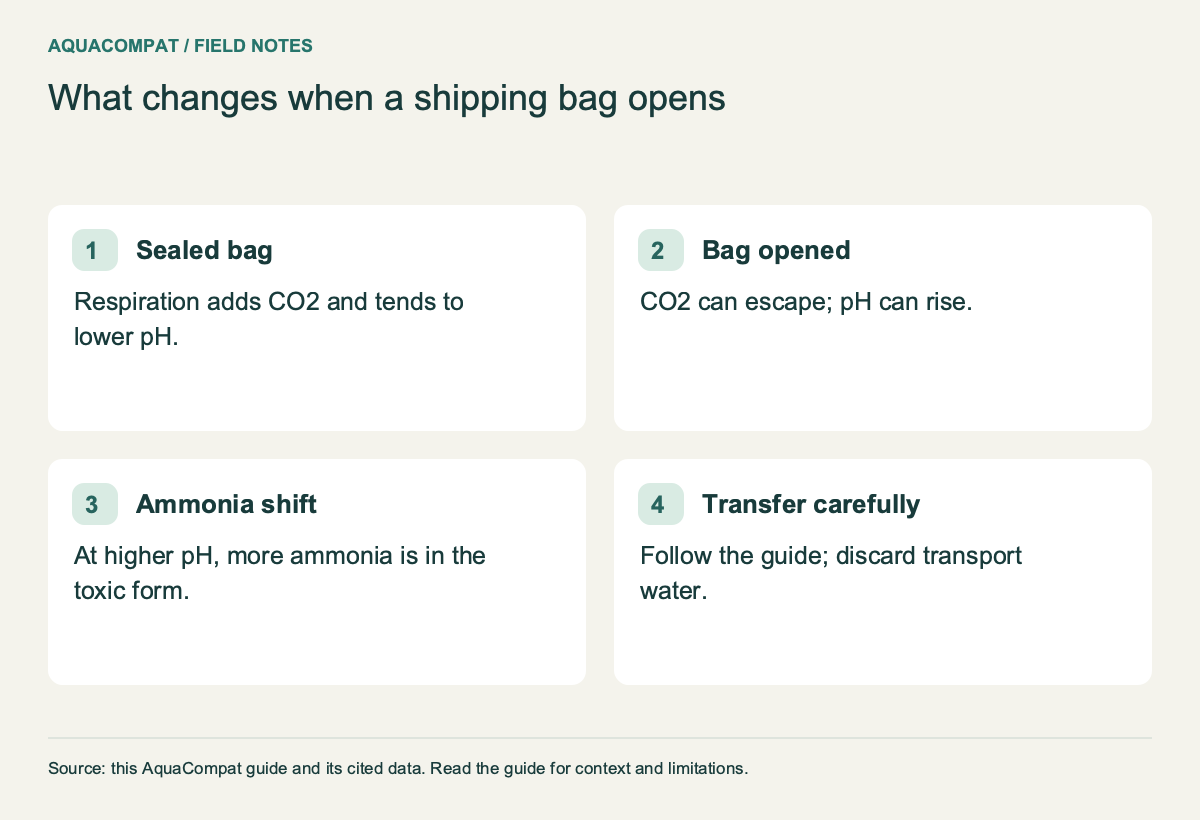
- pH. Carbon dioxide builds up in a sealed bag and lowers pH. UF/IFAS explains this, and Chewy warns that pH rises once the bag is opened.
- Ammonia. Fish keep excreting ammonia in the bag. At the bag’s lower pH more of it stays in the less toxic ionised form; as pH rises after opening, more shifts to the toxic form.
The table compares the two common methods on the points the sources cover.
| Float method | Drip method | |
|---|---|---|
| How it works | Float the sealed bag, then add small amounts of tank water | Siphon tank water into a container holding the fish, drop by drop |
| Time | Bag floated about 20–30 minutes (Merck); then tank water added until volume about doubles (Chewy) | 30–90 minutes (Chewy) |
| Mainly equalises | Temperature first, then chemistry | Temperature and chemistry together |
| Suited to | Hardy freshwater fish | Sensitive fish and invertebrates |
| Evidence base | Expert and hobby guidance | One hobby source (single-source) |
How do you float-acclimate new fish?
You float-acclimate fish by letting the sealed bag reach tank temperature, then mixing in tank water in small amounts before netting the fish out. The Merck Veterinary Manual’s pet-owner guidance and Chewy’s hobby guide set out the steps below.
- Float the sealed bag. Merck floats it about 20–30 minutes so its temperature matches the tank; Chewy gives 15 to 20 minutes for hardy freshwater fish.
- Open the bag and add tank water. Chewy adds small amounts of tank water at intervals until the volume in the bag has roughly doubled.
- Net the fish into the tank. Lift the fish out with a net rather than tipping the bag.
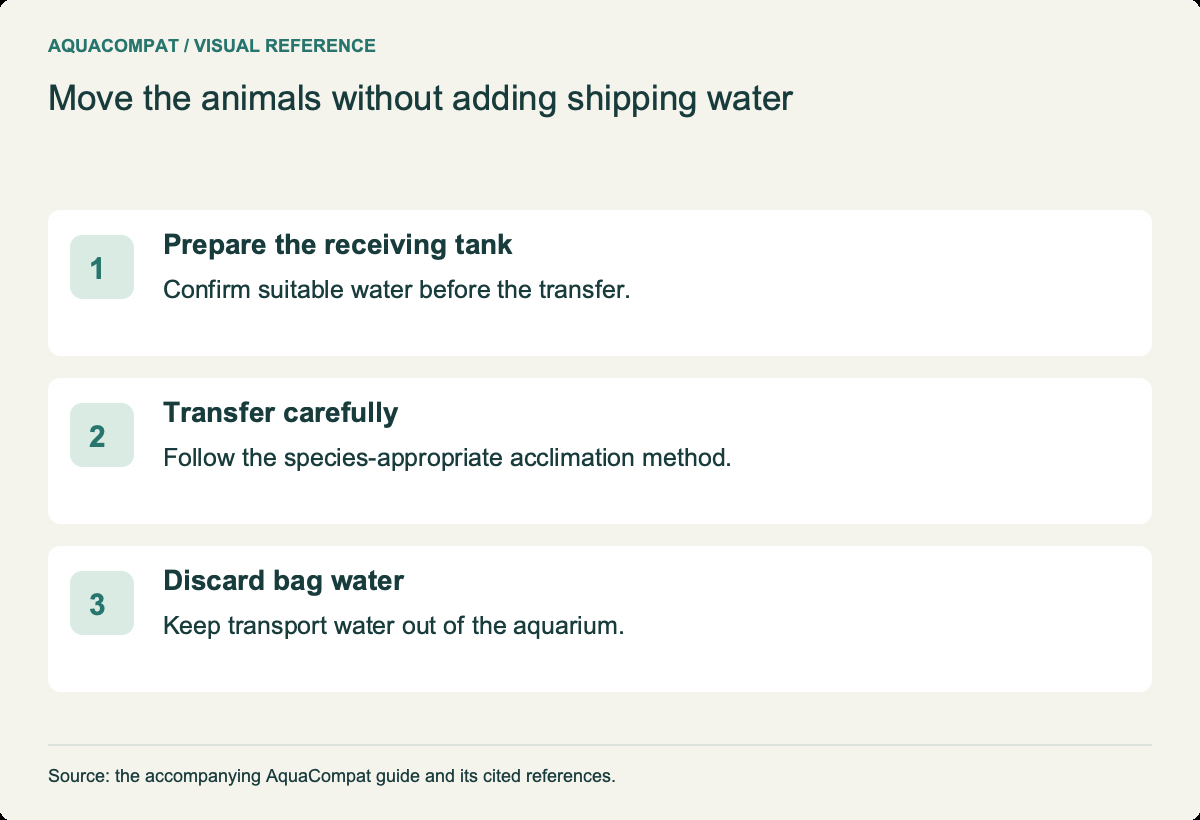
- Discard the bag water. Merck says never let transport-bag water enter the aquarium, and Chewy says not to pour it in.
The float method handles temperature well because the sealed bag sits in tank water. It handles chemistry less finely, because each addition of tank water is a step change rather than a gradual one. That is why the hobby source reserves it for hardy fish.
How do you drip-acclimate fish and shrimp?
You drip-acclimate by running a slow siphon of tank water into a container holding the new arrivals until the volume has doubled. Chewy’s guide recommends this for sensitive fish and invertebrates, and UF/IFAS describes a similar approach in fish-farm transport: placing the transport container beside the holding tank and gradually adding holding-tank water through an airline to prevent rapid temperature and pH changes.
- Move fish and bag water into a clean container. The container sits beside the tank, as in the UF/IFAS description.
- Start a slow siphon. Use airline tubing from the tank; Chewy sets the flow at about 2 to 4 drops per second.
- Let the volume double. At that rate Chewy expects 30–90 minutes.
- Net the animals in and discard the water. As with floating, none of the acclimation water should go into the tank.
Shrimp are the usual reason keepers choose the drip method. Green Aqua stresses that shrimp tolerate changes in temperature, pH or softness poorly, and the guide to TDS in shrimp tanks explains how far apart shop water and a home tank can be. The drip figures come from one hobby source, so the fact base marks them as single-source.
Is drip acclimation better than floating?
No study shows that it is. Our fact base found no controlled study comparing survival after drip and float acclimation, and the guidance for both methods is expert opinion. The drip method changes water chemistry more gradually, which is the stated reason Chewy recommends it for sensitive species, but more gradual has not been measured against faster in a published trial.
What the sources do agree on is narrower: temperature should change slowly, bag water should be discarded, and very large temperature differences need longer. Choose the method that fits the animal, and spend the effort on matching temperature and not tipping bag water into the tank, which every source supports.
How slowly should water temperature change during acclimation?
Temperature should change by no more than 1 °F or °C per hour, the general handling and transport rule in the Merck Veterinary Manual. For large differences UF/IFAS FA119 sets a threshold: when the bag and tank differ by more than 10 °C, acclimate slowly over two hours or more, while noting that some species tolerate faster acclimation.
The sources disagree on where that threshold sits. FA119 gives 10 °C in its acclimation section but more than 5.5 °C (10 °F) in its own summary, and Merck’s per-hour rule is stricter than either. Where they differ, the per-hour rule is the more cautious one to follow. The species temperature ranges in the aquarium temperature guide by species show how much room each fish has once it is in the tank.
Why does opening the bag make ammonia more dangerous?
Opening the bag lets carbon dioxide escape, pH rises, and more of the ammonia in the bag shifts into its toxic un-ionized form. UF/IFAS FA119 explains that CO2 building up in transport bags lowers pH and keeps more ammonia in the less toxic ionised form; Chewy warns that pH rises when the bag is opened.
The size of that shift is large. UF/IFAS gives the toxic share of total ammonia as 0.006 fraction of TAN (pH 7.0, 26 °C / 78.8 °F), against 0.0574 fraction of TAN (pH 8.0, 26 °C): roughly a tenfold rise for one pH unit at the same temperature. Fish that sit for a long time in opened, mixed bag water are therefore exposed to more toxic ammonia as the water comes up toward tank pH. The nitrogen cycle guide explains the chemistry, and the aquarium pH guide shows the pH range each species is kept in.
Should you pour the bag water into your tank?
No. Merck’s pet-owner guidance says transport-bag water should never enter the aquarium, and Chewy’s guide says to net fish out and discard the bag or acclimation water. Tipping the bag is the quickest way to finish, but it adds the bag’s accumulated ammonia, and the shop’s water, to your tank. Netting the fish takes a few extra seconds and avoids both.
Bag water can also carry drug-resistant bacteria. Antibiotics are routinely added to shipping water, and a 2009 PLoS ONE study by the UK laboratory Cefas sampled 25 consignments of tropical fish arriving in the UK in 2008; half of the Aeromonas bacteria it isolated from the fish and their water tolerated 15 or more antibiotics.
What goes wrong when acclimation is rushed or the tank is not ready?
Rushed acclimation shocks fish with sudden temperature or pH change; an unready tank harms them after acclimation has gone perfectly. The first is an acclimation failure and the second is not, but both show up in the days after new fish arrive. Losses in the shipment itself are now low: UF/IFAS Extension (FA124, revised 2023) reports death-on-arrival from exporter to importer reduced to less than 5 %, citing a 2005 trade figure. That figure covers the journey to the importer, not the days after a fish reaches a home tank.
Rushed acclimation
Releasing fish straight from a cool bag into warm water breaks Merck’s 1 °F or °C per hour rule, and a fast pour of tank water into the bag changes pH in one step. Sensitive species and invertebrates are the most exposed, which is the reason the drip method exists.
Unready tank
No acclimation method protects fish from a tank whose biofilter cannot process their waste. Testing ammonia, nitrite, pH and temperature before you buy shows whether the tank is ready, and kits for that are compared among the aquarium test kits we recommend. Keeping the tank stable after new fish arrive is part of the routine in the aquarium maintenance schedule, and the other setup topics are in the water chemistry and setup guides.
Questions people ask
How long should I float a fish bag?
The Merck Veterinary Manual’s pet-owner guide floats the bag about 20–30 minutes to equalise temperature, and Chewy’s hobby guide gives 15 to 20 minutes for hardy freshwater fish. After that, Chewy adds small amounts of tank water until the volume roughly doubles. If the temperature gap is large, Merck’s rule of no more than 1 °F or °C per hour means waiting longer.
Should I drip-acclimate cherry shrimp?
The drip method is the one Chewy recommends for invertebrates, and Green Aqua stresses that shrimp tolerate changes in temperature, pH and softness poorly. Cherry shrimp are listed at pH 6.5–8.0 and 6–10 dGH; if your tank sits well away from the shop’s water, a slow drip over 30–90 minutes spreads that change out.
What if the bag and tank temperatures are very different?
Go slowly. UF/IFAS FA119 says a difference of more than 10 °C calls for acclimation over two hours or more, and its own summary uses a lower 5.5 °C threshold. Merck’s general rule of 1 °F or °C per hour is stricter, so follow that where you can.
Can I leave fish in the opened bag for a long drip?
Long acclimation after opening has a cost: UF/IFAS and Chewy explain that pH rises once the bag is opened, shifting ammonia toward its toxic form. That is a reason not to stretch acclimation far beyond the published times: Chewy’s drip method finishes in 30–90 minutes, and Merck’s float in about 20–30 minutes. Discard the acclimation water at the end.
Sources 21 documents from 14 publishers
- Aquarium Co-Op (aquariumcoop.com): “Care Guide for Cherry Shrimp”
- Chewy (Hilary Jaffe) (chewy.com): “How To Acclimate Fish the Right Way”
- Dr Tim's Aquatics (manufacturer) (drtimsaquatics.com): “Fishless Cycling”
- Green Aqua (greenaqua.hu): “Shrimp in the aquarium”
- Merck Veterinary Manual (merckvetmanual.com): “Environmental Diseases of Aquatic Animals in Aquatic Systems (Francis-Floyd, Yanong, Petty)”; “Providing a Home for Fish (pet owner version)”; “Management of Aquarium Fish, Petty, Francis-Floyd and Yanong”
- PLoS ONE, Verner-Jeffreys et al. (Cefas) (journals.plos.org): “High Prevalence of Multidrug-Tolerant Bacteria and Associated Antimicrobial Resistance Genes Isolated from Ornamental Fish and Their Carriage Water”
- Practical Fishkeeping (practicalfishkeeping.co.uk): “How to Cycle a Fish Tank: The Complete Guide”; “Frequently asked questions on Neocaridina shrimps”
- SaltyShrimp (product information via Furry Critter Network) (furrycritter.com): “SaltyShrimp Remineralizers for Invertebrates”
- Shrimp and Snail Breeder (aquariumbreeder.com): “Red Cherry Shrimp: detailed guide, care, diet and breeding”
- Shrimp Science (shrimpscience.com): “Red Cherry Shrimp - Care Guide”; “General Hardness (GH) For Shrimp Tanks”
- Southern Regional Aquaculture Center (srac.msstate.edu): “SRAC 4606: Interpretation of Water Analysis Reports for Fish Culture (Stone, Shelton, Haggard, Thomforde)”; “How to Start a Biofilter, SRAC Publication No. 4502, DeLong and Losordo”; “Nitrite in Fish Ponds, SRAC Publication No. 462, Durborow, Crosby and Brunson”; “Recirculating Aquaculture Tank Production Systems: Management of Recirculating Systems, SRAC Publication No. 452”
- UF/IFAS EDIS (ask.ifas.ufl.edu): “FA119: On-Farm Transport of Ornamental Fish (Crosby, Hill, Martinez, Watson, Pouder, Yanong)”
- UF/IFAS Extension (Livengood and Chapman) (edis.ifas.ufl.edu): “FA124: The Ornamental Fish Trade: An Introduction with Perspectives for Responsible Aquarium Fish Ownership”
- University of Florida IFAS Extension (EDIS) (ask.ifas.ufl.edu): “Ammonia in Aquatic Systems (FA16/FA031), Francis-Floyd, Watson, Petty and Pouder”
All sources accessed . Every number on this page comes from these documents.