What tasks does an aquarium need, and how often?
An aquarium needs light daily attention, a weekly or fortnightly water change with testing, and occasional plant and filter care. Routine maintenance covers water quality monitoring, partial water changes that remove old water, filtration, waste removal and aeration, as the Merck Veterinary Manual describes it. The table groups each published task by how often the sources say to do it; the sections after it explain the reasons and where the sources disagree.
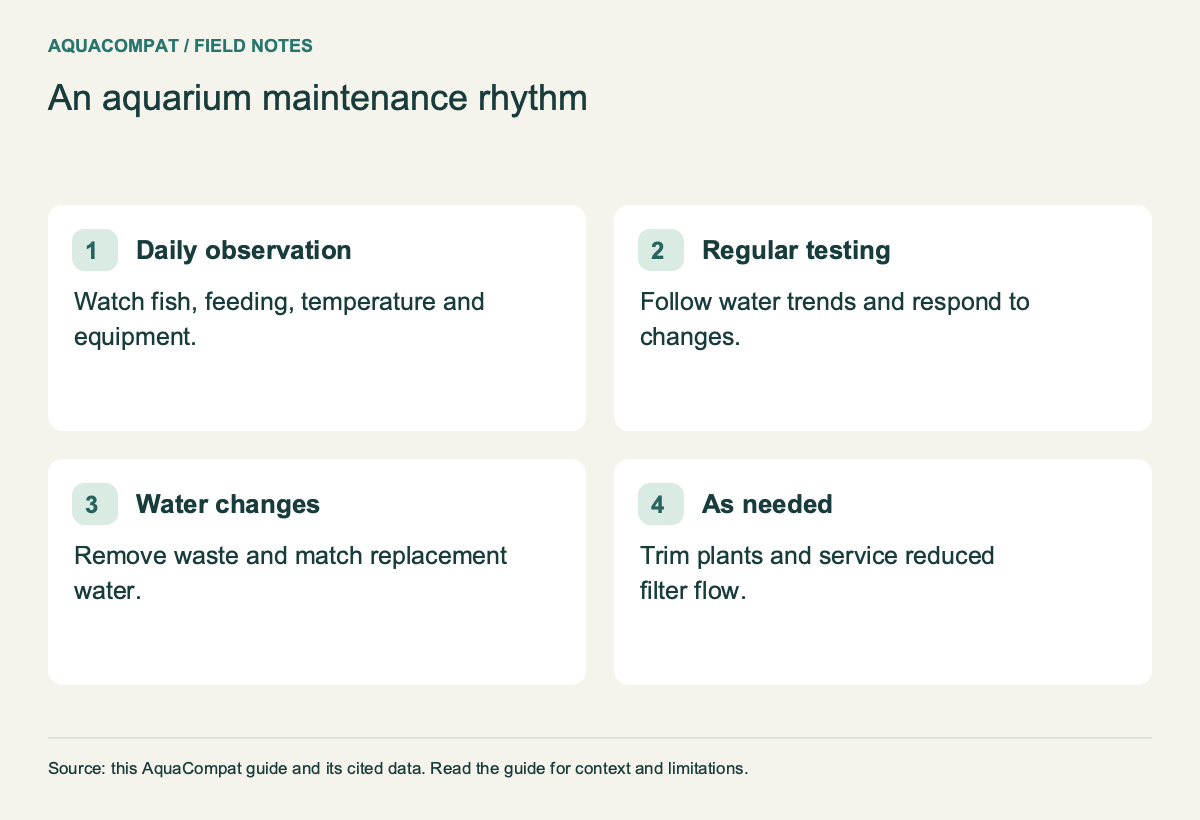
| How often | Task | Published guidance |
|---|---|---|
| Daily | Feed lightly | AquariumScience.org suggests about 1–2% of fish body weight a day |
| Daily | Run lights on a timer | 8–10 hours/day for established planted tanks (Tropica) |
| Daily | Watch fish at feeding time | Gasping at the surface can signal ammonia, nitrite or low oxygen (Merck) |
| Weekly | Partial water change | About 25 % weekly (Practical Fishkeeping) or 30 % per change timed by nitrate (Aquarium Co-Op) |
| Weekly | Test nitrate | Keep below about 40 ppm (Practical Fishkeeping; Aquarium Co-Op) |
| With each water change | Clean the gravel | Listed with water changes as algae prevention |
| Little and often | Trim plants | Small, frequent trims rather than one heavy cut (Tropica) |
| Every 2 weeks | Water change and full test | Every 2 weeks (interval): pH, alkalinity, ammonia, nitrite, nitrate (Merck) |
| Monthly | Root tabs for root feeders | About monthly (Aquarium Co-Op) |
| As needed | Rinse filter media in old tank water | Never in tap water; never replace all media at once |
Which aquarium tasks should you do every day?
Daily tasks are feeding lightly, keeping the light period steady and looking at the fish. None needs equipment beyond a timer, but each prevents a problem that later takes a water change or a treatment to fix.
Feeding
Overfeeding is the daily habit most linked to problems in the sources. AquariumScience.org suggests about 1–2% of fish body weight per day in its planaria guidance and about 1% in its cloudy-water guidance, and surplus food feeds both pests and bacterial blooms. Every extra meal also means more fish waste, and the ammonia fish excrete is the first compound in the nitrogen cycle.
Lighting
The algae sources in our fact base advise keeping lighting consistent with a timer and avoiding direct sunlight, as part of algae prevention. Planted tanks start at about 6 hours/day for the first weeks, then move to 8–10 hours/day.
A quick look at the fish
Gasping or hanging at the surface, lethargy and refusing food are the signs Merck lists for ammonia and nitrite problems. Heavy algae or bacterial cloudiness can also lower oxygen, with the same gasping as the result.
How much water should you change each week?
About a quarter to a third of the tank each week suits most aquariums, adjusted to how heavily the tank is stocked and fed. The three main sources frame it differently.
- Practical Fishkeeping: about 25 % weekly, described as working for most people.
- Aquarium Co-Op: 30 % per change, scheduled by how fast nitrate rises, with a warning that very large changes can stress fish and plants.
- Merck Veterinary Manual: a change every 2 weeks (interval), with the amount set by stocking level and no fixed percentage.
These figures do not conflict so much as describe different starting points: two hobby sources give a default, and the veterinary source gives an interval. Merck adds that small containers such as goldfish bowls need more frequent and larger changes, perhaps 50 % per week (up to). Whatever the amount, treat the new water first; the guide to testing and treating tap water covers chlorine and chloramine.
Why must the change remove old water?
Merck warns that topping up evaporated water is not a water change. If old water is never removed, organic acids build up and pH can collapse, a condition known as old tank syndrome. Removing and replacing water also restores the carbonate buffer that nitrifying bacteria use up, which the aquarium pH guide explains in more detail.
What should you test, and how often?
Test nitrate weekly and the full set of pH, alkalinity, ammonia, nitrite and nitrate at least every 2 weeks (interval), the interval in Merck’s maintenance schedule. Nitrate is the reading that tells you whether your water change is large enough, because it is the end product of the nitrogen cycle and leaves mainly through water changes.
The sources disagree on how much nitrate is acceptable. Practical Fishkeeping and Aquarium Co-Op keep it below about 40 ppm, or within that margin of tap water, while Merck’s reference range for freshwater systems is stricter, below 20 mg/L (freshwater reference range, less than). UF/IFAS warns that with little water exchange nitrate can exceed 250 mg/L. Test your source water too, because new water can bring nitrate with it: in USGS sampling of about 2,100 private domestic wells between 1991 and 2004, 4.4 percent of wells exceeded the EPA drinking-water limit of 10 mg/L nitrate-nitrogen, most often in agricultural areas. Planted tanks are a deliberate exception: Aquarium Co-Op aims for 25–50 ppm nitrate as a plant nutrient when dosing all-in-one fertiliser.
Test more often after any disease treatment. UF/IFAS notes that medications, especially antibiotics, can harm nitrifying bacteria, so ammonia and nitrite should be checked more frequently afterwards. Liquid kits for each reading are compared among the aquarium test kits we recommend.
Which tasks belong on a monthly schedule?
Monthly tasks are mostly plant feeding; filter care has no fixed date in the sources. Aquarium Co-Op adds root tabs about monthly for root-feeding plants such as swords and cryptocorynes, while Tropica’s substrate capsules release nutrients over months, so the interval depends on the product.
Filter media
The sources give no fixed cleaning interval for filter media, but they agree on how to do it. Aquarium Co-Op and AquariumScience.org advise against over-cleaning or replacing all media at once, because removing the bacteria can trigger a bloom, and recommend rinsing media in old tank water. Practical Fishkeeping warns that chlorinated tap water kills the bacteria outright. If media must be replaced, change it in stages so the biofilter is never removed in one go.
Plants
Tropica recommends trimming a little and often, because heavy trimming can upset the tank’s balance. Stem plants are cut above a lower leaf and the cuttings replanted; carpets can be trimmed like a lawn.
How does the schedule differ for a new tank?
A new tank needs more testing and smaller steps until its biofilter is established. Practical Fishkeeping says most aquariums take 4–6 weeks to cycle, and UF/IFAS gives 6–8 weeks for a biofilter to reach full capacity. During that time the routine is set by test results, not by the calendar. The guide to cycling a new aquarium (fishless method) covers the dosing and testing that replace a normal schedule in the first weeks.
New arrivals are the other moment the schedule changes. Adding fish raises the ammonia load, so testing ammonia and nitrite in the days after stocking shows whether the biofilter is keeping up. The steps for introducing them safely are in how to acclimate new fish.
Does a bigger water change always mean a healthier tank?
No. Aquarium Co-Op warns that very large water changes can stress fish and plants, and it times changes by nitrate rather than maximising volume. Regular moderate changes keep conditions steady, which matters most for sensitive species: Green Aqua stresses that shrimp tolerate changes in temperature, pH or softness poorly. The exception is an emergency, covered in the next section, where a large change is the right response because the water is already dangerous.
The opposite belief, that a cycled tank no longer needs water changes, is the more harmful one. The nitrogen cycle stops at nitrate, so nitrate keeps rising, and old water that is never removed leads toward the pH collapse Merck describes as old tank syndrome.
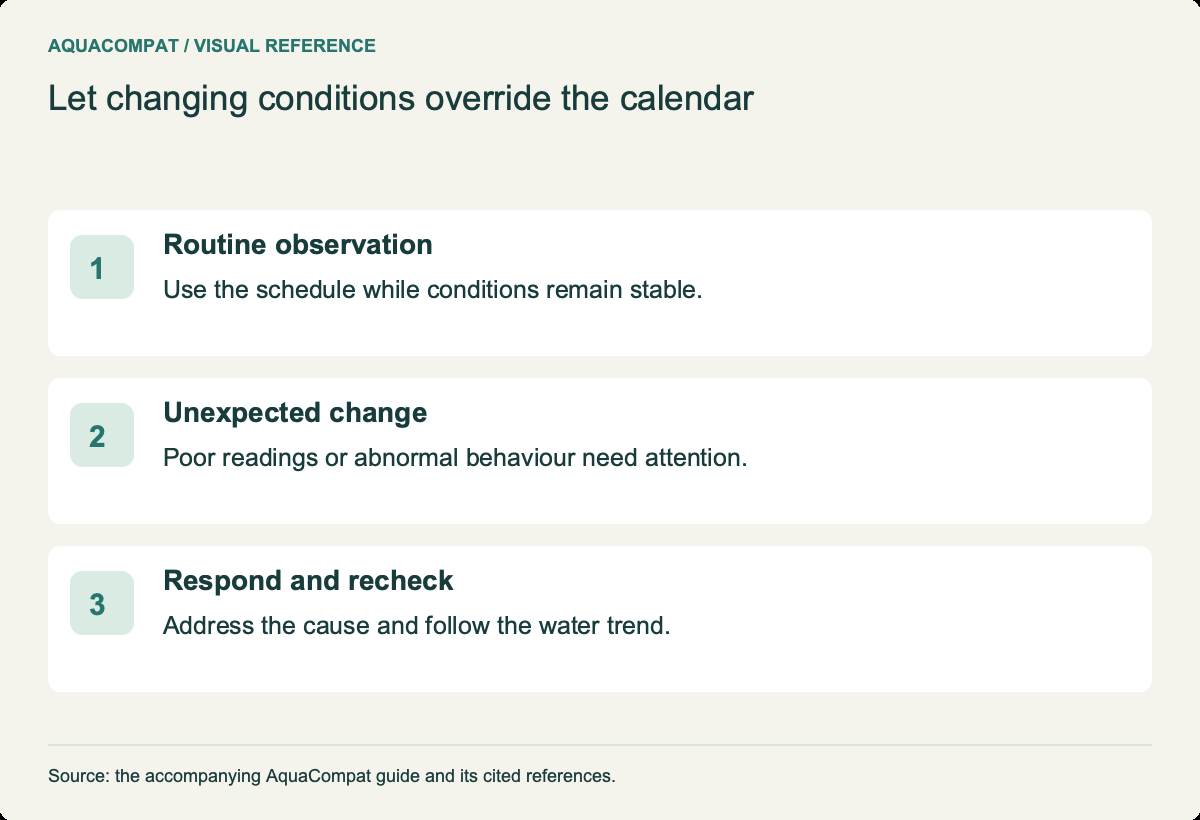
When should you break the schedule and act at once?
Break the schedule whenever a test shows ammonia or nitrite, because those call for an immediate water change rather than the next routine one. The published responses are below.
- Any ammonia detected: UF/IFAS advises stopping or reducing feeding for 1 to 3 days and changing 25–50 % of the water, provided the source water has no ammonia.
- Total ammonia at 2 mg/L or more in a new tank: Merck advises changing 50 % or more, and testing frequently.
- Nitrite from 0.1 mg/L nitrite: UF/IFAS and Merck give this as the level at which nitrite can be toxic; water changes lower it, and the steps are set out under new tank syndrome.
Cloudy water is a different case. A white bloom in a cycling tank usually clears on its own, and Aquarium Co-Op and AquariumScience.org advise against big water changes during one; the guide to cloudy aquarium water explains how to tell the causes apart. The other topics in this series are collected in the water chemistry and setup guides.
Questions people ask
Can I change water every two weeks instead of weekly?
Yes, if your tests support it. The Merck Veterinary Manual’s schedule sets a change every 2 weeks (interval), with the amount set by stocking. Aquarium Co-Op times changes by how fast nitrate rises, so a lightly stocked tank whose nitrate stays below about 40 ppm can go longer than a crowded one.
Should I vacuum the gravel at every water change?
Gravel cleaning is part of the algae prevention routine in the sources, alongside water changes and avoiding overfeeding. Our fact base gives no rule on whether every change needs a full vacuum. Pair it with your water change, since that is how the sources group it, and remove the waste you lift rather than stirring it back in.
How often should I clean the filter?
The sources in our fact base give no fixed interval. They agree on method instead: rinse media in old tank water, never under the tap, and never replace all of it at once, because Aquarium Co-Op and AquariumScience.org say removing the bacteria can trigger a bloom. Test ammonia and nitrite in the days after cleaning to confirm the biofilter is intact.
Do planted tanks need fewer water changes?
Plants take up nitrate, and Aquarium Co-Op notes that fast growers such as water sprite remove it much faster than anubias or java fern. The same source still says water changes are the fastest way to lower nitrate, and planted tanks fed with fertiliser are deliberately run at 25–50 ppm, so they still need regular changes.
What should I do before a holiday?
The sources in our fact base do not cover holiday care directly. What they do support is that fish can go without food for short periods: UF/IFAS notes that stopping feeding for 1 to 3 days does not usually harm fish other than fry. A water change and full test before leaving gives the tank the best starting point.
Sources 41 documents from 14 publishers
- Aquarium Co-Op (aquariumcoop.com): “Guide to Aquarium Water Changes”; “How to Balance Aquarium Lights to Grow Healthy Plants (& Avoid Algae)”; “How to Use Root Tabs to Fertilize Your Live Aquarium Plants”; “How to Clear Up Cloudy Fish Tank Water with 5 Easy Methods”; “How to Fight the 6 Most Common Types of Algae in Your Fish Tank”; “How to Get Rid of Blue-Green Algae in Freshwater Aquariums”; “Is Nitrate Good or Bad for Your Aquarium?”; “Beginner's Guide to Fertilizing Your Planted Tank the EASY Way”; “CO2 in Planted Aquariums: What Does It Really Do and Is It Natural?”; “What is PAR? Lighting & Brightness Explained for Planted Tanks”; “Which Planted Tank Fertilizer Is Right for You?”; “How to Set Up a Low Tech Planted Aquarium for Beginners”; “Monte Carlo (plant care page)”
- AquariumScience.org (aquariumscience.org): “6.2.3 Cloudy Water”
- Greater Washington Aquatic Plant Association (GWAPA) (gwapa.org): “Algae in the Planted Aquarium (K. Weinhold)”
- Green Aqua (greenaqua.hu): “Shrimp in the aquarium”
- LiveAquaria (liveaquaria.com): “Algae Identification in Freshwater Tanks and Proper Removal”
- Merck Veterinary Manual (merckvetmanual.com): “Disorders and Diseases of Fish (pet owner version)”; “Special Considerations for Fish (pet owner version)”; “Routine Health Care of Fish (pet owner version)”; “Providing a Home for Fish (pet owner version)”; “Environmental Diseases of Aquatic Animals in Aquatic Systems, Francis-Floyd, Yanong and Petty”; “Management of Aquarium Fish, Petty, Francis-Floyd and Yanong”
- Practical Fishkeeping (practicalfishkeeping.co.uk): “How often should I change my water?”; “Why is my aquarium water cloudy?”; “Problem solver: New Tank Syndrome”; “How to Cycle a Fish Tank: The Complete Guide”
- SaltyShrimp (product information via Furry Critter Network) (furrycritter.com): “SaltyShrimp Remineralizers for Invertebrates”
- Seachem Laboratories (seachem.com): “Flourish Excel product instructions”
- Southern Regional Aquaculture Center (srac.msstate.edu): “SRAC Publication No. 466: Algae Blooms in Commercial Fish Production Ponds”; “SRAC Publication No. 4605: Algal Toxins in Pond Aquaculture (J.H. Rodgers Jr.)”; “Nitrite in Fish Ponds, SRAC Publication No. 462, Durborow, Crosby and Brunson”; “How to Start a Biofilter, SRAC Publication No. 4502, DeLong and Losordo”; “SRAC 4606: Interpretation of Water Analysis Reports for Fish Culture (Stone, Shelton, Haggard, Thomforde)”
- Tropica Aquarium Plants (tropica.com): “Starting a new aquarium (growing-in guide)”; “Fertiliser and CO2 for your aquarium”; “Hardscape and bottom layer in the tank”; “Trimming”
- University of Florida IFAS Extension (ask.ifas.ufl.edu): “FA084: Use of Antibiotics in Ornamental Fish Aquaculture (R.P.E. Yanong)”
- University of Florida IFAS Extension (EDIS) (ask.ifas.ufl.edu): “Ammonia in Aquatic Systems (FA16/FA031), Francis-Floyd, Watson, Petty and Pouder”
- US Geological Survey (pubs.usgs.gov): “The Quality of Our Nation's Waters: Quality of Water from Domestic Wells in Principal Aquifers of the United States, 1991-2004, Overview of Major Findings (Circular 1332)”
All sources accessed . Every number on this page comes from these documents.