What makes a good tank mate for any species?
A good tank mate is a species that can live in the same water for its whole life without harming or being harmed by the species you start from. Four questions decide it, in this order.
- Does the water overlap? Temperature comes first, because the tank holds one temperature for everything in it. The Goldfish at 59–70 °F (15–21 °C) and the Discus at 79–86 °F (26–30 °C) sit at opposite ends of the species in the data, which is why both have short lists.
- Can either one eat the other? Adult size decides predation. The Oscar reaches 14 in (35.6 cm), while the Neon Tetra reaches 1.2 in (3 cm).
- Will either one harass the other? Temperament and sourced behaviour notes, such as fin-nipping or aggression toward long-finned fish, decide this.
- Will the tank hold both groups? Schooling species need their full group, so the tank has to fit every school at adult size.
Each list applies these questions to every candidate and ranks the results by verdict and score. The exact weights and deal-breakers live on the methodology page for compatibility scores, because they belong to a versioned method rather than to any one species. Every row in a ranked list links to the matching pair guide where one exists, so you can read the reasons behind a single result.
Which species have tank mates lists?
Tank mates lists cover the species most often used as the centrepiece of a tank, grouped here by how many companions they accept.
Species with many compatible companions
The best corydoras tank mates include most small peaceful fish that share water of 70–81 °F (21–27 °C), and the cory is one of the easiest species to fit into a community. The guide to guppy tank mates favours species that accept hard, alkaline water around pH 7.0–8.0. The bristlenose pleco companion list is similarly broad, failing mainly with species that need very different water or can eat it. The kuhli loach tank mates suit soft, warm water at pH 3.5–7.0.
Species that need careful choices
The betta fish tank mates list ranks calm, short-finned fish that are not labyrinth fish, and none of them rates as risk-free. The angelfish companion ranking turns mainly on size, because angelfish reach 6 in (15.2 cm) and the sources record them eating neon-sized tetras. The discus tank mates guide is limited by the discus' warm, soft water.
Species with very few companions
The list of oscar tank mates is short because the oscar eats any fish small enough to swallow, according to Seriously Fish and Aquarium Co-Op. The goldfish companion guide starts from other goldfish, because the coldwater range rules out most tropical fish.
Invertebrates and groups
The cherry shrimp tank mates list is the reverse of the others: it asks which fish will not eat the shrimp. The aquarium snail tank mates list covers the Nerite Snail, Mystery Snail and Assassin Snail together, and the African cichlid tank mates list covers the Peacock Cichlid, Kenyi Cichlid and Yellow Lab, which need hard, alkaline water; the peacock's published range alone is pH 7.5–8.5.
How do you read a ranked tank mates list?
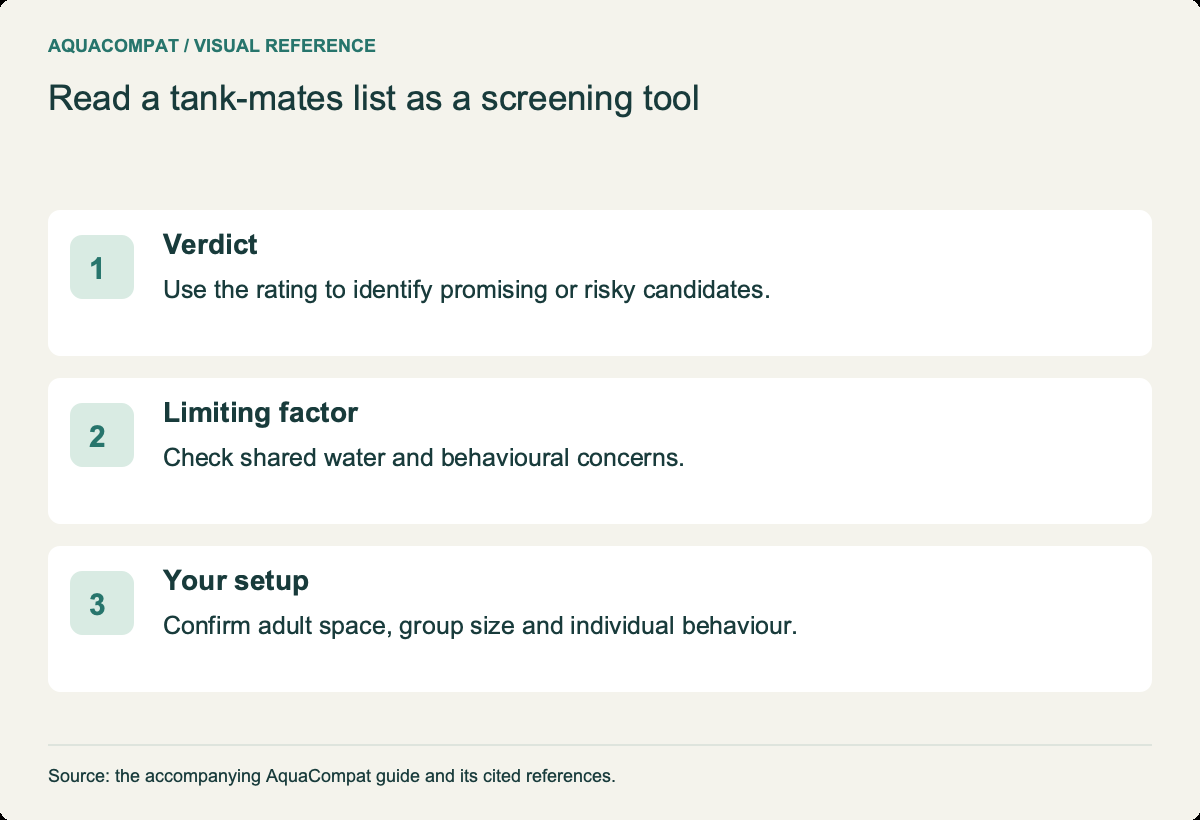
Read a ranked list from the top down and stop at the first species that fits your tank size and water. Each row gives the candidate's verdict, its score out of 10, the shared temperature and pH, and the smallest tank that suits both species.
The shared temperature and pH columns matter more than the score when you plan a whole community. Two candidates can each match your centrepiece but not each other: the Guppy needs pH 7.0–8.0, while the Kuhli Loach needs pH 3.5–7.0, so a list that ranks both highly for one species does not mean they belong together. Check the companions against each other with the two-species compatibility checker, or check the full stocking at once with the stocking calculator for mixed tanks.
The smallest tank column is for the pair alone. A list may show 20 US gal (76 L) for the corydoras and neon tetra, but adding a third school raises the space needed. The fish compatibility guides index explains how to work through every pair in a community.
Which species are better kept with their own kind?
Some species are better kept in a group of their own than with other species, and their lists say so first. The clearest cases come from the species' own fact files.
- Betta Fish: Seriously Fish says the species is best kept alone, and males must never share a tank. Any tank mate is a calculated risk.
- Goldfish: the safest companions are other goldfish of the same body type, with fast single-tailed varieties kept apart from slow fancy ones, which care sources say they outcompete or nip.
- Discus: discus need a group of 6, and the discus tank alone needs 67 US gal (254 L) before any tank mate is added.
- African cichlids: the three cichlids in the data share hard water, but Seriously Fish advises against keeping the kenyi cichlid with peacock cichlids, and that pair reads incompatible at 2/10.
Are small peaceful fish safe with shrimp?
No, not reliably. A common assumption is that any peaceful community fish is a safe shrimp tank mate, but Aquarium Co-Op notes that almost all fish will eat baby shrimp, so a shrimp colony needs dense cover even among small, peaceful species. Peaceful describes how a fish treats other fish, not whether it eats invertebrates.
The scores reflect that. The Harlequin Rasbora, a peaceful schooling fish, reads caution with cherry shrimp at 7/10, while the Mystery Snail, which does not prey on shrimp, reads compatible. Snails carry their own exception: the Assassin Snail hunts other snails, so its pairing with the Nerite Snail reads caution even though both are invertebrates.
Which tank mates fail most often, and why?
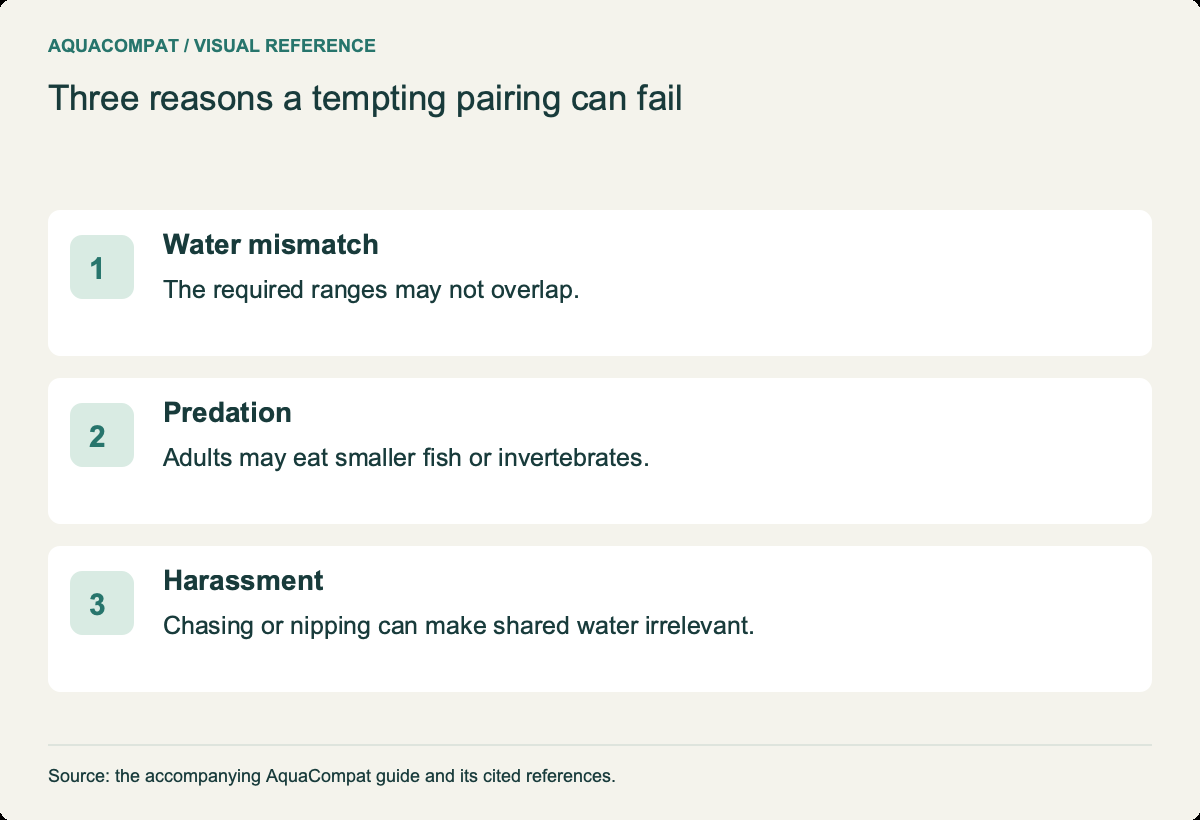
Tank mates fail most often for three reasons: the water never overlaps, the larger fish eats the smaller one, or a semi-aggressive species targets a calmer one. The ranked lists put these failures at the bottom so that the reason is visible, not just the verdict.
- No shared water. Coldwater goldfish and tropical fish are the clearest case: the Betta Fish at 72–86 °F (22–30 °C) and the Goldfish at 59–70 °F (15–21 °C) read incompatible. Hard-water and soft-water species fail the same way on pH: the Bristlenose Pleco and the Peacock Cichlid read incompatible.
- Predation. A fish that eats small fish fails with any tank mate it outgrows several times over. The Oscar and Neon Tetra read incompatible, and so do the Angelfish and Neon Tetra.
- Aggression. Semi-aggressive species rarely fail outright on temperament alone, but sourced behaviour notes, such as a betta treating long-finned fish as rivals, hold their pairings down. The guide to whether bettas and guppies can share a tank shows how a full water match still ends in a caution verdict.
A failed pairing is not a judgement on either species. Each of these fish has strong companions on its own list; they simply need a different tank from one another.
How does tank size change the list?
Tank size removes candidates from the bottom of the minimum-tank column up. A species whose own minimum is larger than your tank cannot go in it, however well it scores. The Cherry Shrimp needs only 5 US gal (19 L), the Corydoras 20 US gal (76 L) and the Oscar 75 US gal (284 L).
For small tanks, the guide to the best fish for a 10-gallon community tank filters the species by minimum tank and checks three stockings pair by pair. One size up, the 20-gallon planted tank stocking guide applies the same minimum-tank filter to a planted layout, where the larger volume brings species such as the Corydoras and Zebra Danio, each listed at 20 US gal (76 L), into range.
All tank mates lists
- Best Betta Fish Tank MatesCalm, short-finned companions ranked, picks by tank size, shrimp, snails and fish to avoid.
- Best Corydoras Tank MatesSmall peaceful fish that share the cory's moderate water, plus fish to avoid.
- Best Guppy Tank MatesHard-water community fish ranked, fin-nippers, crossbreeding and fry pressure.
- Best Cherry Shrimp Tank MatesWhich fish eat shrimp, which snails are safe and how to protect a colony.
- Best Oscar Tank MatesWhy few species qualify, which fish an oscar eats and the tank size needed.
- Best Angelfish Tank MatesSize-safe companions ranked and the small fish angelfish eat.
- Best Kuhli Loach Tank MatesSoft, warm-water companions ranked, with fish and snails to avoid.
- Best African Cichlid Tank MatesPeacock, kenyi and yellow lab cichlids: hard-water companions and risky mixes.
- Best Bristlenose Pleco Tank MatesThe broad list of community fish that suit a bristlenose, and the few that fail.
- Best Goldfish Tank MatesWhy other goldfish come first, coldwater limits and tropical fish to avoid.
- Best Aquarium Snail Tank MatesNerite, mystery and assassin snails: fish that leave snails alone and snail predators.
- Best Discus Tank MatesWarm, soft-water companions ranked, group size and species to avoid.
Questions people ask
Why does a species rank highly on one list but not on another?
Are the lists the same as the compatibility checker?
Why is there no list for my species?
Do the lists assume a planted tank or a bare one?
Sources 87 documents from 16 publishers
- Applesnail.net (applesnail.net): “How to take care of apple snails”; “Quick guide”; “Pomacea diffusa”
- Aquarium Co-Op (aquariumcoop.com): “Care Guide for Fancy Goldfish”; “Oscar Fish Care Guide”; “Care Guide for Cory Catfish”; “Guppy Care Guide”; “Care Guide for Kuhli Loaches”; “Freshwater Angelfish Care Guide”; “Betta Fish Care Guide”; “Care Guide for Dwarf Gouramis”; “10 Best Top-Dwelling Fish for Your Freshwater Community Aquarium”; “Goldfish Tank Mates”; “Amano Shrimp Care Guide”; “Discus Fish Care Guide”; “Care Guide for Cherry Shrimp”; “Care Guide for Harlequin Rasboras and Lambchop Rasboras”; “Care Guide for Mystery Snails”; “Care Guide for Assassin Snails”; “Care Guide for Nerite Snails”; “Care Guide for Plecostomus”; “Care Guide for Zebra and Leopard Danios”
- AquariumInfo.org (aquariuminfo.org): “Apple Snail”
- FishBase (fishbase.se): “Symphysodon aequifasciatus, Blue discus: species summary”; “Astronotus ocellatus, Oscar: species summary”; “Paracheirodon innesi summary page”; “Pterophyllum scalare, Freshwater angelfish: species summary”; “Length-weight relationships for Pterophyllum scalare”; “Length-weight relationships for Astronotus ocellatus”; “Osteogaster aenea, Bronze corydoras”; “Betta splendens, Siamese fighting fish: species summary”; “Carassius auratus, Goldfish: species summary”; “Length-weight relationships for Carassius auratus”; “Maylandia lombardoi summary (Bayesian length-weight estimate)”; “Aulonocara stuartgranti summary page”; “Trigonostigma heteromorpha summary page”; “Poecilia reticulata, Guppy: species summary”
- fishkeeping.co.uk (fishkeeping.co.uk): “Goldfish Size, Life Expectancy and Tank Recommendations”; “Keeping Goldfish - The Right Way”
- Maidenhead Aquatics (fishkeeper.co.uk species data sheet) (fishkeeper.co.uk): “Guppy data sheet”; “Angelfish data sheet”; “Oscar data sheet”; “Hybrid Peacock (Aulonocara sp.) data sheet”; “Neon Tetra data sheet”; “Siamese Fighting Fish/Betta data sheet”; “Kenyi data sheet”; “Harlequin Rasbora data sheet”; “Zebra Nerite Snail”
- Neotropical Ichthyology (Crampton 2008) (scielo.br): “Ecology and life history of an Amazon floodplain cichlid: the discus fish Symphysodon”
- Ornamental Aquatic Trade Association (OATA) (ornamentalfish.org): “How to look after fancy goldfish”; “How to look after goldfish in an aquarium / fish tank”
- PlanetCatfish (via Internet Archive snapshot, 2025) (web.archive.org): “Osteogaster aenea (Bronze Cory) Cat-eLog data sheet”; “Ancistrus sp. (3) Common Bristlenose Catfish Cat-eLog data sheet”
- Practical Fishkeeping (practicalfishkeeping.co.uk): “What can I keep in my hard water aquarium?”; “What water temperature do goldfish need?”; “How can I breed goldfish in my aquarium?”; “Frequently asked questions on Neocaridina shrimps”; “An introduction to Shrimp”; “A guide to the small rasboras from the genus Trigonostigma”; “Bristlenose catfish: the hardworking Ancistrus”
- Seriously Fish (seriouslyfish.com): “Symphysodon aequifasciatus”; “Astronotus ocellatus”; “Paracheirodon innesi (Neon Tetra)”; “Osteogaster aenea (Bronze Cory)”; “Poecilia reticulata”; “Pangio semicincta ('Kuhli' Loach)”; “Pterophyllum scalare”; “Aulonocara stuartgranti”; “Aulonocara baenschi”; “Betta splendens”; “Maylandia lombardoi”; “Trigonostigma heteromorpha (Harlequin)”; “Ancistrus sp. '3' (Common Bristlenose Catfish)”; “Danio rerio (Zebra Danio)”
- Shrimp and Snail Breeder (aquariumbreeder.com): “Cherry Shrimp in a Community Tank”; “Red Cherry Shrimp: detailed guide, care, diet and breeding”; “How Copper Affects Dwarf Shrimp”; “Assassin Snail: detailed guide, care, diet and breeding”; “Nerite Snails: detailed guide, care, diet and breeding”
- Shrimp Science (shrimpscience.com): “Red Cherry Shrimp - Care Guide”; “General Hardness (GH) For Shrimp Tanks”; “Carbonate Hardness (KH) For Shrimp Tanks”; “TDS For Shrimp Tanks”
- Tropical Fish Hobbyist Magazine (tfhmagazine.com): “Astronotus sp.”; “Betta splendens”
- UF/IFAS EDIS (ask.ifas.ufl.edu): “Evolution, Culture, and Care for Betta splendens (FA212)”
- Wikipedia (en.wikipedia.org): “Vittina natalensis”
All sources accessed . Every number on this page comes from these documents.