What makes a good tank mate for guppies?
A good guppy tank mate is a peaceful fish that leaves long fins alone, cannot swallow a guppy and is happy in hard, alkaline water. The guppy (Poecilia reticulata) is a small livebearer from north-eastern South America and the southern Caribbean, and domestic males carry long, trailing fins. Four criteria follow from the published data.
- No fin-nippers. Seriously Fish warns against fin-nippers such as tiger barbs and serpae tetras, and Aquarium Co-Op says to avoid aggressive fish that nip fins. Long-finned males are the targets.
- Too small to eat a guppy. Guppies reach only 2.4 in (6.1 cm), so any fish that eats small fish and is a few times longer is a threat. Aquarium Co-Op calls guppies a risky angelfish tank mate for exactly this reason.
- Hard, alkaline water. Guppies need 68–82 °F (20–28 °C), pH 7.0–8.0 and 8–30 dGH; the hardness figure comes from Seriously Fish alone. Soft-water fish such as neon tetras and kuhli loaches share only the lower edge of that pH range.
- No territorial bullies. Seriously Fish says male dwarf gouramis can be very aggressive towards gaudy species, and a brightly coloured male guppy fits that description.
Swim level is rarely a problem. Aquarium Co-Op notes that livebearers such as guppies swim all over the tank, so bottom dwellers and mid-water schools both fit around them. The pH and hardness criteria are explained in more depth in the guides to aquarium pH by species and general and carbonate hardness. Other species in our tank mates by species series follow the same four-part logic.
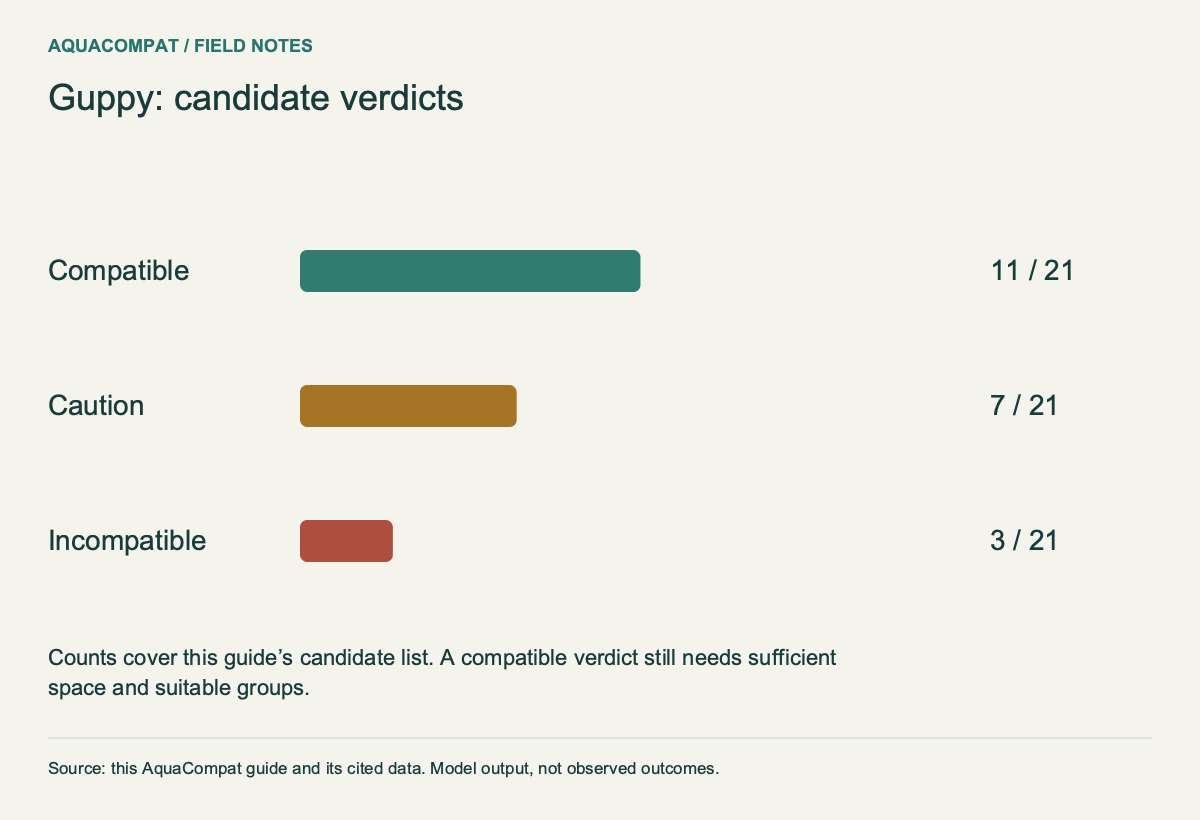
| Species | Verdict | Score | Shared temperature | Shared pH | Smallest tank |
|---|---|---|---|---|---|
| Endler's Livebearer | compatible | 10/10 | 75–81 °F (24–27 °C) | pH 7.0–8.0 | 10 US gal (38 L) |
| Mystery Snail | compatible | 10/10 | 70–78 °F (21–26 °C) | pH 7.2–8.0 | 10 US gal (38 L) |
| Nerite Snail | compatible | 10/10 | 72–79 °F (22–26 °C) | pH 7.2–8.0 | 10 US gal (38 L) |
| Platy | compatible | 10/10 | 68–77 °F (20–25 °C) | pH 7.0–8.0 | 20 US gal (76 L) |
| Corydoras | compatible | 9/10 | 70–81 °F (21–27 °C) | pH 7.0–7.5 | 20 US gal (76 L) |
| Harlequin Rasbora | compatible | 9/10 | 72–79 °F (22–26 °C) | pH 7.0–7.5 | 20 US gal (76 L) |
| Molly | compatible | 9/10 | 70–82 °F (21–28 °C) | pH 7.5–8.0 | 20 US gal (76 L) |
| Bristlenose Pleco | compatible | 8/10 | 72–79 °F (22–26 °C) | pH 7.0–7.2 | 20 US gal (76 L) |
| Cardinal Tetra | compatible | 8/10 | 73–82 °F (23–28 °C) | pH 7.0–7.5 | 20 US gal (76 L) |
| Kuhli Loach | compatible | 8/10 | 74–79 °F (23–26 °C) | pH 7.0–7.0 | 20 US gal (76 L) |
| Neon Tetra | compatible | 8/10 | 70–77 °F (21–25 °C) | pH 7.0–7.5 | 20 US gal (76 L) |
| Cherry Shrimp | caution | 7/10 | 70–79 °F (21–26 °C) | pH 7.0–8.0 | 10 US gal (38 L) |
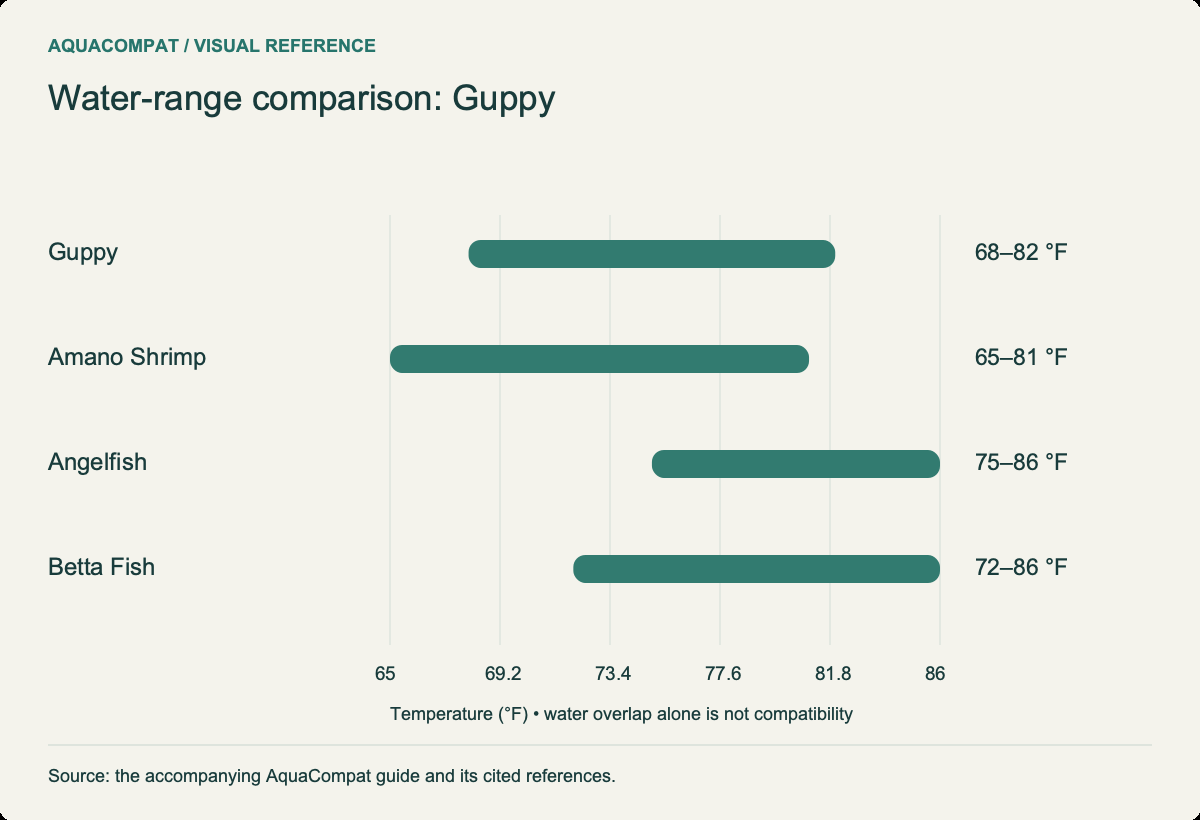
| Amano Shrimp | caution | 7/10 | 68–81 °F (20–27 °C) | pH 7.0–7.5 | 10 US gal (38 L) |
| Betta Fish | caution | 7/10 | 72–82 °F (22–28 °C) | pH 7.0–8.0 | 20 US gal (76 L) |
| Discus | caution | 7/10 | 79–82 °F (26–28 °C) | pH 7.0–7.6 | 75 US gal (284 L) |
| Dwarf Gourami | caution | 7/10 | 72–81 °F (22–27 °C) | pH 7.0–7.5 | 29 US gal (110 L) |
| GloFish Tetra | caution | 7/10 | 68–79 °F (20–26 °C) | pH 7.0–7.0 | 20 US gal (76 L) |
| Zebra Danio | caution | 7/10 | 68–75 °F (20–24 °C) | pH 7.0–8.0 | 20 US gal (76 L) |
| Oscar | incompatible | 3/10 | 74–80 °F (23–27 °C) | pH 7.0–8.0 | 125 US gal (473 L) |
| Angelfish | incompatible | 3/10 | 75–82 °F (24–28 °C) | pH 7.0–8.0 | 90 US gal (341 L) |
| Goldfish | incompatible | 3/10 | 68–70 °F (20–21 °C) | pH 7.0–8.0 | 55 US gal (208 L) |
Which fish can live with guppies?
Other livebearers, small peaceful schooling fish and calm bottom dwellers can all live with guppies, and they appear in roughly that order in the table above.
Platies and mollies
Platies are the closest match, at 10/10. They share pH 7.0–8.0 and 68–77 °F (20–25 °C) with guppies, and Seriously Fish describes them as very peaceful, lacking the aggression of some swordtails and mollies. Mollies score 9/10. They also want hard, alkaline water, but Seriously Fish notes that larger adults, especially sailfin males, may pick on smaller fish, and Aquarium Co-Op says mollies nibble at things and that slow, long-finned fish may be poor tank mates. A fancy male guppy is that kind of fish, so watch a molly tank closely.
Harlequin rasboras and tetras
Harlequin rasboras score 9/10, and our harlequin data lists livebearers among the groups it suits. Neon tetras and cardinal tetras both score 8/10 and 8/10. All three are peaceful, but they come from softer water, so the shared pH with guppies narrows to pH 7.0–7.5. The search query “can guppies live with neon tetras” has a qualified yes for an answer: the temperament fits, and the water works only at the neutral point of both ranges.
Corydoras, kuhli loaches and bristlenose plecos
Corydoras score 9/10 with guppies and share 70–81 °F (21–27 °C); PlanetCatfish calls the bronze cory a perfect community citizen, and the corydoras tank mates guide ranks guppies among its good companions. Kuhli loaches score 8/10 and bristlenose plecos 8/10, but both prefer softer water, sharing only pH 7.0–7.0 and pH 7.0–7.2 respectively.
Which fish should never live with guppies?
Oscars, goldfish and angelfish fail outright with guppies in our data: two because they eat fish the size of a guppy, and one because it needs much colder water.
Oscar and angelfish
Oscars score 3/10. Seriously Fish and Aquarium Co-Op both describe the oscar as a predator that eats any fish small enough to swallow, and at 14 in (35.6 cm) it is many times longer than a guppy. Angelfish score 3/10 for a similar reason on a smaller scale: Seriously Fish says angelfish may eat neon-sized fish, and Aquarium Co-Op names guppies as risky angelfish tank mates because of their size and fin vulnerability. The angelfish tank mates guide lists larger companions that suit it.
Goldfish
Goldfish score 3/10. They are coldwater fish kept at 59–70 °F (15–21 °C), so the shared temperature is only 68–70 °F (20–21 °C). Fishkeeping.co.uk adds that goldfish eat anything that fits in their mouth, and the Ornamental Aquatic Trade Association reports fin-nipping among goldfish. The goldfish tank mates page covers coldwater companions instead.
Fin-nippers and territorial fish to approach with caution
Four more species are not outright failures but carry a specific risk to guppies. Zebra danios score 7/10: Aquarium Co-Op says they may nip fins if their school is too small. GloFish tetras score 7/10 because the black tetra they are bred from has a fin-nipping reputation that Seriously Fish says a shoal of 12 or more largely curbs. Dwarf gouramis score 7/10 because males can turn on brightly coloured fish. Bettas score 7/10, since Seriously Fish says a male betta may attack fish with trailing fins as rivals; the full reasoning is in can betta fish and guppies live together, and the compatible tank mates for bettas page shows safer betta companions.
How do guppy fry and breeding change the choice of tank mates?
Guppies breed so readily that any guppy tank becomes a tank of guppy fry, and that changes what the tank mates are doing. The sources agree on the pace, though not on the exact numbers. Aquarium Co-Op says females give birth roughly every 30 days; FishBase gives 20–40 young about every four weeks; Seriously Fish gives a gestation of four to six weeks with 5–100 fry. Seriously Fish adds that a female can keep producing broods for six months or more after a single mating, and FishBase says males mature at about two months.
Fry are prey for almost everything
Aquarium Co-Op says adult guppies eat their own fry unless dense cover is provided, and most of the community fish on this page eat fry too. Our data records fry or egg predation for platies, mollies, Endler’s livebearers, kuhli loaches and dwarf gouramis, and Aquarium Co-Op says the dwarf gourami snacks on anything that fits in its mouth, including baby fish. None of the sources measures how many fry survive with a given tank mate, so we do not rank species on that.
Breeding pressure and stocking
Aquarium Co-Op warns that guppy numbers can outgrow small tanks, and it advises one male to two or three females so that males do not harass any one female. Plan the tank mates around the adult group you intend to keep, then use the stocking calculator to see how much room the fish that survive will take. A tank that can only just hold guppies and their companions on day one may be overstocked within a few months.
That breeding rate is why farms supply livebearers in such numbers: the USDA 2023 Census of Aquaculture counted 23.4 million freshwater livebearers sold by 84 US farms in 2023. Surplus guppies should go to a shop or another keeper, because USGS lists guppies as locally established at warm-water sites in 6 states, mostly after fish farm or aquarium releases.
Can guppies live with shrimp and snails?
Guppies live well with snails, and with adult dwarf shrimp, but they eat baby shrimp.
Snails
Nerite snails and mystery snails both score 10/10 and 10/10. They want the same hard, alkaline water as guppies, sharing pH 7.2–8.0, and no source in our data says guppies eat or harass snails. Aquarium Co-Op says mystery snails also need calcium-rich water to keep their shells sound, which suits a guppy tank.
Shrimp
Cherry shrimp score 7/10 with guppies. Shrimp and Snail Breeder says guppies are a problem for small shrimp and make shrimp breeding almost impossible, so adult cherry shrimp may survive while the colony fails to grow. The two share 8–10 dGH of hardness. Amano shrimp score 7/10 on the same baby-shrimp rule, but Aquarium Co-Op states that amanos cannot reproduce in freshwater, so there are no amano shrimplets in the tank for guppies to eat. The fish that can live with cherry shrimp page explains how shrimp predation is scored for every species.
Which guppy tank mates fit a 10 or 20-gallon tank?
A 10-gallon tank fits guppies with snails or shrimp, while most fish companions need 20 US gal (76 L). Our guppy minimum is 10 US gal (38 L), based on Seriously Fish’s 45 × 30 cm base; Aquarium Co-Op accepts 5 gallons for a trio but prefers 10 to 20 gallons because of breeding.
10-gallon tank
Nerite snails, mystery snails, cherry shrimp, amano shrimp and Endler’s livebearers all calculate at 10 US gal (38 L) with guppies. Of these, the snails are the simplest; shrimp lose their young and Endler’s crossbreed with guppies. The guide to the best fish for a 10-gallon community tank shows how guppies fit into a small community.
20-gallon tank
At 20 gallons the fish options open up. Platies, mollies, harlequin rasboras, neon and cardinal tetras, corydoras, kuhli loaches and bristlenose plecos all calculate at 20 US gal (76 L), largely because their own minimums are higher than the guppy’s.
29 gallons and larger
Dwarf gouramis calculate at 29 US gal (110 L) with guppies, because the method adds a margin for a semi-aggressive species. To test a planned mix at any size, use the species compatibility checker.
Are Endler’s livebearers good guppy tank mates?
Not if you want to keep either line pure. Endler’s livebearers score 10/10 with guppies because they share water, size and temperament almost perfectly. Seriously Fish and Aquarium Co-Op both warn that the two species crossbreed and produce fertile hybrids. Practical Fishkeeping reports Prof. John Endler’s view that most Endler’s in the hobby are already guppy hybrids, and FishBase lists the Endler’s livebearer as Endangered on the IUCN Red List.
The score is not wrong; it answers a narrower question. Our method measures whether two species can share a tank without harming each other, and hybridisation is not one of its factors. If you value a pure Endler’s strain, or a pure guppy line, keep the two species in separate tanks.
Questions people ask
Can guppies live with goldfish?
No. The pair scores 3/10 because goldfish are coldwater fish and share only 68–70 °F (20–21 °C) with guppies. Fishkeeping.co.uk also says goldfish eat anything that fits in their mouth, and an adult goldfish grows large enough to fit a guppy.
Can guppies live with mollies?
Usually, yes. The pair scores 9/10, and both prefer hard, alkaline water. Seriously Fish notes that large sailfin males may pick on smaller fish, and Aquarium Co-Op says slow, long-finned fish may be poor molly tank mates, so watch fancy male guppies. Mollies need 20 US gal (76 L) themselves.
Can a betta live with guppies?
It is risky. The pair scores 7/10 because Seriously Fish says male bettas may attack fish with trailing fins as rivals, and male guppies have them. No source in our data tests a betta with female guppies only. The pair needs 20 US gal (76 L) together.
How many guppies should I keep with other fish?
FishBase recommends groups of five or more, and Aquarium Co-Op advises one male to two or three females. Because females give birth about every 30 days, the group grows quickly, so count the fry when you plan tank mates and tank size. Our guppy minimum is 10 US gal (38 L).
Will guppies eat cherry shrimp?
They eat baby shrimp. Shrimp and Snail Breeder says guppies are a problem for small shrimp and make breeding almost impossible, and the pairing scores 7/10 for that reason. No source says guppies eat adult cherry shrimp, which reach 1.5 in (3.8 cm).
Sources 126 documents from 21 publishers
- Applesnail.net (applesnail.net): “How to take care of apple snails”; “Quick guide”; “Pomacea diffusa”; “Apple snail FAQ”
- Aquarium Co-Op (aquariumcoop.com): “Guppy Care Guide”; “Top 5 Dither Fish to Help Shy or Aggressive Fish in Freshwater Tanks”; “Care Guide for Dwarf Gouramis”; “Care Guide for Platy Fish: Feeding, Breeding, and Tank Mates”; “Care Guide for Mollies: Feeding, Breeding, and Tank Mates”; “Care Guide for Harlequin Rasboras and Lambchop Rasboras”; “Care Guide for Cardinal Tetras”; “Betta fish tank mates”; “What Is Neon Tetra Disease and How Can It Be Prevented?”; “Neon and Cardinal Tetras: Beginner Schooling Fish”; “Care Guide for Cory Catfish”; “Care Guide for Kuhli Loaches”; “Care Guide for Plecostomus”; “Oscar Fish Care Guide”; “Freshwater Angelfish Care Guide”; “Care Guide for Fancy Goldfish”; “Goldfish Tank Mates”; “Care Guide for Amano Shrimp”; “Care Guide for Zebra and Leopard Danios”; “Care Guide for GloFish”; “Betta Fish Care Guide”; “10 Best Top-Dwelling Fish for Your Freshwater Community Aquarium”; “Endler's Livebearer Care Guide”; “Care Guide for Nerite Snails”; “Care Guide for Mystery Snails”; “Care Guide for Cherry Shrimp”
- AquariumInfo.org (aquariuminfo.org): “Apple Snail”
- Crustacean Research 49 (Hamasaki et al. 2020) (jstage.jst.go.jp): “Dietary effects of phytoplankton and zooplankton on larval survival, duration and growth of four Caridina species”
- Crustacean Research 50 (Kondo, Hamasaki, Dan 2021) (jstage.jst.go.jp): “Larval performance of three amphidromous shrimp species in the genus Caridina under different temperature and salinity conditions”
- FishBase (fishbase.se): “Poecilia reticulata, Guppy: species summary”; “Length-weight relationships for Poecilia reticulata”; “Trichogaster lalius, Dwarf gourami: species summary”; “Length-weight relationships for Trichogaster lalius”; “Xiphophorus maculatus, Southern platyfish: species summary”; “Poecilia sphenops, Molly: species summary”; “Poecilia latipinna, Sailfin molly: species summary”; “Length-weight relationships for Poecilia sphenops”; “Trigonostigma heteromorpha summary (Bayesian length-weight estimate)”; “Paracheirodon innesi summary (Bayesian length-weight estimate)”; “Paracheirodon axelrodi summary (Bayesian length-weight estimate)”; “Osteogaster aenea, Bronze corydoras”; “Length-weight relationships for Osteogaster aenea”; “Pangio kuhlii summary (Bayesian length-weight estimate)”; “Astronotus ocellatus, Oscar: species summary”; “Length-weight relationships for Astronotus ocellatus”; “Pterophyllum scalare, Freshwater angelfish: species summary”; “Length-weight relationships for Pterophyllum scalare”; “Carassius auratus, Goldfish: species summary”; “Length-weight relationships for Carassius auratus”; “Danio rerio summary (Bayesian length-weight estimate)”; “Betta splendens, Siamese fighting fish: species summary”; “Gymnocorymbus ternetzi summary (Bayesian length-weight estimate)”; “Poecilia wingei summary (Bayesian length-weight estimate)”
- fishkeeping.co.uk (fishkeeping.co.uk): “Goldfish Size, Life Expectancy and Tank Recommendations”; “Keeping Goldfish - The Right Way”
- GloFish (Spectrum Brands) (glofish.com): “GloFish FAQs”; “International Use and License Notice”
- Maidenhead Aquatics (fishkeeper.co.uk species data sheet) (fishkeeper.co.uk): “Guppy data sheet”; “Platy data sheet”; “Molly data sheet”; “Harlequin Rasbora data sheet”; “Neon Tetra data sheet”; “Oscar data sheet”; “Angelfish data sheet”; “Black Widow Tetra (Black Skirt Tetra) data sheet”; “Siamese Fighting Fish/Betta data sheet”; “Zebra Nerite Snail”; “Amano Shrimp”
- Ornamental Aquatic Trade Association (OATA) (ornamentalfish.org): “How to look after fancy goldfish”; “How to look after goldfish in an aquarium / fish tank”
- PlanetCatfish (via Internet Archive snapshot, 2025) (web.archive.org): “Osteogaster aenea (Bronze Cory) Cat-eLog data sheet”; “Ancistrus sp. (3) Common Bristlenose Catfish Cat-eLog data sheet”
- Practical Fishkeeping (practicalfishkeeping.co.uk): “Aquarium trade may have spread gourami virus”; “Quick guide to livebearers”; “A guide to the small rasboras from the genus Trigonostigma”; “How long will my fish live?”; “Cardinal tetra, Paracheirodon axelrodi”; “What can I keep in my hard water aquarium?”; “Bristlenose catfish: the hardworking Ancistrus”; “What water temperature do goldfish need?”; “How can I breed goldfish in my aquarium?”; “Endler's livebearers are nearly all hybrids!”; “Will these snails starve without algae?”; “What can I add for algae control?”; “Frequently asked questions on Neocaridina shrimps”; “Amano shrimp: Spineless heroes (Nathan Hill)”; “An introduction to Shrimp”
- Practical Fishkeeping (Julian Dignall) (practicalfishkeeping.co.uk): “Focus on commonly kept Corydoras”
- Seriously Fish (seriouslyfish.com): “Poecilia reticulata”; “Poecilia wingei”; “Trichogaster lalius”; “Xiphophorus maculatus”; “Poecilia sphenops”; “Poecilia latipinna”; “Trigonostigma heteromorpha (Harlequin)”; “Paracheirodon innesi (Neon Tetra)”; “Paracheirodon axelrodi (Cardinal Tetra)”; “Osteogaster aenea (Bronze Cory)”; “Pangio semicincta ('Kuhli' Loach)”; “Ancistrus sp. '3' (Common Bristlenose Catfish)”; “Astronotus ocellatus”; “Pterophyllum scalare”; “Danio rerio (Zebra Danio)”; “Gymnocorymbus ternetzi (Black Widow Tetra)”; “Betta splendens”
- Shrimp and Snail Breeder (aquariumbreeder.com): “Cherry Shrimp in a Community Tank”; “Nerite Snails: detailed guide, care, diet and breeding”; “Red Cherry Shrimp: detailed guide, care, diet and breeding”; “Amano Shrimp: detailed guide, care, diet and breeding”; “How Copper Affects Dwarf Shrimp”
- Shrimp Science (shrimpscience.com): “Red Cherry Shrimp - Care Guide”; “General Hardness (GH) For Shrimp Tanks”; “Amano Shrimp”; “Carbonate Hardness (KH) For Shrimp Tanks”; “TDS For Shrimp Tanks”
- Tropical Fish Hobbyist Magazine (tfhmagazine.com): “Astronotus sp.”; “Betta splendens”
- U.S. Geological Survey (nas.er.usgs.gov): “Poecilia reticulata (Guppy) species profile, Nonindigenous Aquatic Species Database”
- UF/IFAS EDIS (ask.ifas.ufl.edu): “Evolution, Culture, and Care for Betta splendens (FA212)”
- USDA National Agricultural Statistics Service (data.nass.usda.gov): “2023 Census of Aquaculture, Volume 3, Special Studies, Part 2 (AC-22-SS-2)”
- Wikipedia (en.wikipedia.org): “Vittina natalensis”
All sources accessed . Every number on this page comes from these documents.