What makes a good tank mate for a betta?
A good betta tank mate is a fish the betta will not read as a rival, that cannot eat or harass the betta, and that is comfortable in the betta’s water. The betta fish (Betta splendens) is a labyrinth fish, meaning it breathes air at the surface, and domestic males were bred for colour and long fins. Four criteria follow from what the sources record about it.
- Not a rival. Seriously Fish states that a male betta may attack fish with trailing fins or a betta-like body shape, treating them as rivals, and Aquarium Co-Op says other labyrinth fish such as dwarf gouramis tend not to get along with bettas. Long fins and labyrinth anatomy are the two traits that rule a species out most often.
- Not a fin-nipper. The betta’s own fins are a target. Fast schooling fish with a nipping reputation, such as zebra danios and black tetras, lower the score even when the betta is not the aggressor.
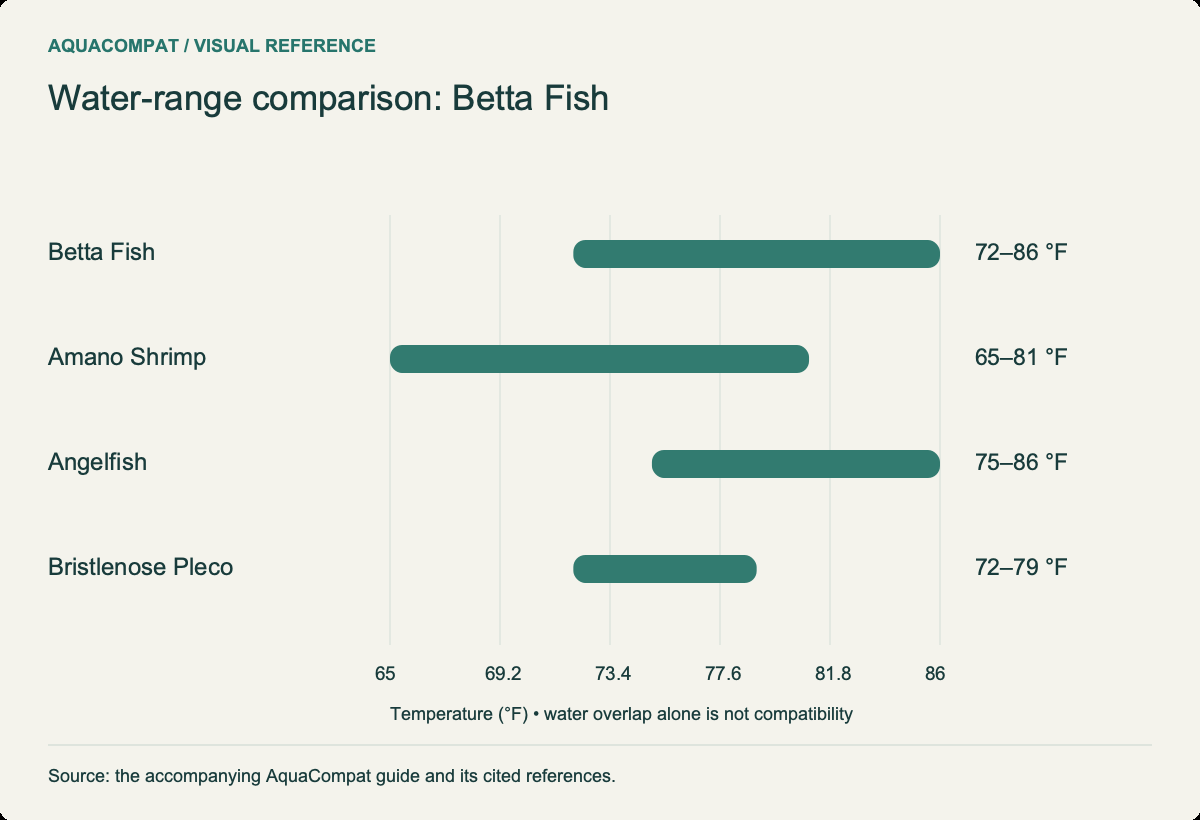
- Shared warm water. The betta needs 72–86 °F (22–30 °C) and pH 6.0–8.0. Species that need cooler water, such as goldfish at 59–70 °F (15–21 °C), share no temperature range with it.
- The right size. Our betta data records that bettas eat fish small enough to swallow; Maidenhead Aquatics warns that tankmates too tiny may be mistaken for a snack. At the other end, large predators such as oscars can swallow a betta, which grows only to 2.8 in (7.1 cm).
Swim level matters less. Bettas prefer the upper third of the tank, according to Aquarium Co-Op, so bottom dwellers such as corydoras and kuhli loaches overlap with them least. The full care picture, including water and diet, is in the betta fish profile.
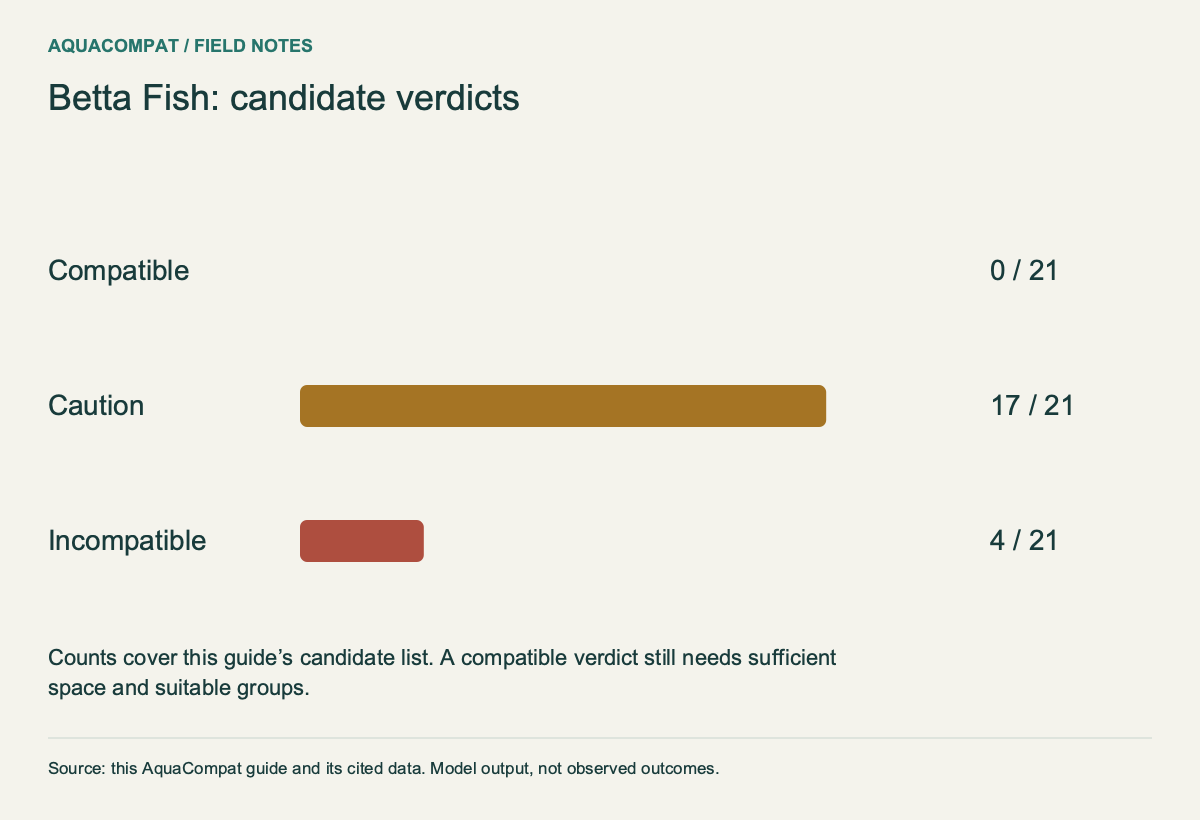
| Species | Verdict | Score | Shared temperature | Shared pH | Smallest tank |
|---|---|---|---|---|---|
| Bristlenose Pleco | caution | 7/10 | 72–79 °F (22–26 °C) | pH 6.0–7.2 | 40 US gal (151 L) |
| Harlequin Rasbora | caution | 7/10 | 72–79 °F (22–26 °C) | pH 6.0–7.5 | 29 US gal (110 L) |
| Nerite Snail | caution | 7/10 | 72–79 °F (22–26 °C) | pH 7.2–8.0 | 20 US gal (76 L) |
| Angelfish | caution | 7/10 | 75–86 °F (24–30 °C) | pH 6.0–8.0 | 90 US gal (341 L) |
| Cardinal Tetra | caution | 7/10 | 73–84 °F (23–29 °C) | pH 6.0–7.5 | 29 US gal (110 L) |
| Corydoras | caution | 7/10 | 72–81 °F (22–27 °C) | pH 6.5–7.5 | 40 US gal (151 L) |
| Discus | caution | 7/10 | 79–86 °F (26–30 °C) | pH 6.0–7.6 | 125 US gal (473 L) |
| Kuhli Loach | caution | 7/10 | 74–79 °F (23–26 °C) | pH 6.0–7.0 | 29 US gal (110 L) |
| Mystery Snail | caution | 7/10 | 72–78 °F (22–26 °C) | pH 7.2–8.0 | 20 US gal (76 L) |
| Amano Shrimp | caution | 7/10 | 72–81 °F (22–27 °C) | pH 6.0–7.5 | 20 US gal (76 L) |
| Cherry Shrimp | caution | 7/10 | 72–79 °F (22–26 °C) | pH 6.5–8.0 | 20 US gal (76 L) |
| GloFish Tetra | caution | 7/10 | 72–79 °F (22–26 °C) | pH 6.0–7.0 | 40 US gal (151 L) |
| Guppy | caution | 7/10 | 72–82 °F (22–28 °C) | pH 7.0–8.0 | 20 US gal (76 L) |
| Molly | caution | 7/10 | 72–82 °F (22–28 °C) | pH 7.5–8.0 | 40 US gal (151 L) |
| Neon Tetra | caution | 7/10 | 72–77 °F (22–25 °C) | pH 6.0–7.5 | 29 US gal (110 L) |
| Platy | caution | 7/10 | 72–77 °F (22–25 °C) | pH 7.0–8.0 | 29 US gal (110 L) |
| Zebra Danio | caution | 6/10 | 72–75 °F (22–24 °C) | pH 6.0–8.0 | 40 US gal (151 L) |
| Dwarf Gourami | incompatible | 3/10 | 72–81 °F (22–27 °C) | pH 6.0–7.5 | 29 US gal (110 L) |
| Oscar | incompatible | 3/10 | 74–80 °F (23–27 °C) | pH 6.0–8.0 | 125 US gal (473 L) |
| Endler's Livebearer | incompatible | 3/10 | 75–81 °F (24–27 °C) | pH 7.0–8.0 | 20 US gal (76 L) |
| Goldfish | incompatible | 3/10 | no overlap | pH 6.0–8.0 | 75 US gal (284 L) |
Which fish are the safest betta tank mates?
Every betta pairing in our data is rated caution at most, because the sources record high aggression in bettas; the scoring method caps such pairings. The numbers below are each pairing’s fit score before that cap, which shows how well water, size and behaviour line up.
The safest fish for a betta are small, short-finned and peaceful, and the top of the table above is made up of exactly those. Each one is listed below with the source evidence behind its score.
Harlequin rasbora
The harlequin rasbora scores 9/10 with a betta. Aquarium Co-Op specifically recommends it as a betta tank mate, describing an easygoing temperament, and Seriously Fish calls it very peaceful indeed. It shares 72–79 °F (22–26 °C) with the betta and needs a school of at least 8. The guide to how to keep harlequin rasboras covers its own needs, and the harlequin vs chili vs galaxy rasbora guide compares it with smaller rasboras.
Bristlenose pleco and corydoras
Two bottom dwellers rank highly because they stay out of the betta’s water. The bristlenose pleco scores 9/10; Aquarium Co-Op says it eats only animals already dead, and its territorial streak is aimed at its own kind and similar-shaped bottom dwellers. Read more on keeping bettas with bristlenose plecos. Corydoras score 8/10, and PlanetCatfish calls the bronze cory a perfect citizen for community tanks. Corydoras need a group of 6 or more, which pushes the shared tank to 40 US gal (151 L).
Kuhli loach and cardinal tetra
The kuhli loach scores 8/10. Seriously Fish describes it as peaceful with other fish, and it is shy and nocturnal, so it rarely crosses the betta’s path; the kuhli loach tank mates page ranks its other companions. The cardinal tetra scores 8/10 and shares a wide band of 73–84 °F (23–29 °C), because it tolerates warmer water than the neon tetra. Practical Fishkeeping says cardinals do not bother other species.
The neon tetra scores lower, at 7/10, mainly because it shares only 72–77 °F (22–25 °C) with the betta. The full reasoning is in the guide to bettas and neon tetras compatibility.
Which tank mates fit a 5, 10 or 20-gallon betta tank?
Tank size narrows the list quickly: in our data no betta pairing calculates below 20 US gal (76 L), and most fish companions need 29 US gal (110 L) or more. The shared figure takes the larger of the two species’ minimum tanks, adds a margin because the betta is semi-aggressive, and rounds up to the next common tank size.
5-gallon betta tank
A 5-gallon tank suits a betta on its own. Our betta minimum is 10 US gal (38 L), based on Seriously Fish’s 45 × 30 cm footprint, while Aquarium Co-Op gives 5–10 gallons as a minimum and recommends 10. The nerite snail’s own minimum is 5 US gal (19 L), so it is the only companion that fits a 5-gallon tank on paper, but our paired figure for the two is larger. We do not list any fish tank mate for 5 gallons. A 2024 Animal Welfare study found that male bettas in 0.5 L bowls swam less than in larger tanks and set 10 L (about 2.6 gallons) as the minimum for full swimming behaviour, so a 5-gallon tank clears that floor for a betta alone.
10-gallon betta tank
A 10-gallon tank still falls below every paired figure in our data. The care sources behind the betta profile note that some individual bettas tolerate peaceful nano fish in planted 10–20 gallon tanks, so a nerite or Mystery Snail is the lowest-risk addition at this size. For fish, the fish for a 10-gallon community tank we recommend shows what a 10-gallon can hold, and the stocking calculator checks a planned list.
20-gallon betta tank
At 20 gallons the options open up to the species whose shared figure is 20 US gal (76 L): nerite snails, mystery snails, Cherry Shrimp, Amano Shrimp and guppies. The shrimp and guppies carry cautions, explained in the sections below and in the guide to keeping bettas with guppies.
29 gallons and larger
Schooling fish need more room. Harlequin rasboras, cardinal tetras, kuhli loaches and neon tetras all calculate at 29 US gal (110 L) with a betta, and corydoras and bristlenose plecos at 40 US gal (151 L).
Can bettas live with shrimp and snails?
Bettas live well with snails, but shrimp are a gamble. The difference comes down to what the sources record about the betta as a hunter.
Snails
No source in our data says bettas eat snails. The nerite snail scores 9/10; Shrimp and Snail Breeder calls it a very peaceful herbivore, though Aquarium Co-Op and Maidenhead Aquatics list fish that nip antennae among its threats. The mystery snail scores 8/10, with one caveat from Aquarium Co-Op: bettas may mistake its long antennae for worms and nip them, so Co-Op prefers other snails with bettas. The guide to keeping bettas with mystery snails covers that risk in detail.
Shrimp
Shrimp score lower because the betta hunts small invertebrates. Shrimp and Snail Breeder calls bettas hunters and does not recommend keeping them with cherry shrimp, which reach only 1.5 in (3.8 cm). The cherry shrimp pairing scores 7/10, and bettas and cherry shrimp compatibility covers the dense moss and plant cover that Aquarium Co-Op and Shrimp and Snail Breeder say cherry shrimp need in any community tank. Amano shrimp grow larger, to 2 in (5.1 cm), and score 7/10; no source in our data addresses bettas with amano shrimp specifically, so the score applies the same dwarf-shrimp caution.
Which fish should never share a betta tank?
Four species fail outright with a betta in our data, each for a different reason, and three more carry fin risks that make them poor choices.
Other labyrinth fish
The dwarf gourami scores 8/10. Both species are territorial labyrinth fish, and Aquarium Co-Op says gouramis tend not to get along with bettas; Seriously Fish adds that male dwarf gouramis can be very aggressive with other anabantoids. See how to keep dwarf gouramis for its own care. Another male betta is excluded for the same reason: UF/IFAS EDIS describes males flaring and biting fins on meeting. Space does not solve this: in a 2024 Animal Welfare study from Case Western Reserve University, pairs of males in aquaria of up to 378 L, with plants and rocks for cover, displayed less but did not attack less, and the authors concluded that even very large tanks cannot guarantee two males will coexist.
Long-finned fish
Guppies, Endler’s livebearers and angelfish all carry the trailing fins Seriously Fish says a betta may treat as a rival. Endler’s livebearers fail completely, at 5/10, because at 1 in (2.5 cm) they are also small enough to eat. Angelfish score 8/10 but need 90 US gal (341 L) together, and Aquarium Co-Op calls bettas a risky angelfish tank mate because of size and fin vulnerability; the guide to keeping angelfish with bettas has the detail.
Fin-nippers
Zebra danios score 6/10: Aquarium Co-Op warns they may nip fins in a small school and bother slow fish such as bettas. GloFish tetras score 7/10 because the black tetra they are bred from has a fin-nipping reputation that Seriously Fish says a shoal of 12 or more largely curbs. Mollies are not called fin-nippers outright, but Aquarium Co-Op notes they nibble and that slow long-finned fish may be poor tank mates.
Coldwater fish and large predators
Goldfish score 4/10 because they share no temperature range with bettas, and fishkeeping.co.uk adds that goldfish eat anything that fits in their mouth; can betta fish and goldfish live together covers that pairing. Oscars score 7/10: Seriously Fish and Aquarium Co-Op both describe a predator that eats any fish small enough to swallow, and an adult betta qualifies.
Can a female betta sorority have tank mates?
The published care sources reviewed here do not give a reliable recipe for a female betta sorority or for choosing its tank mates. Our betta data records only that females can also be aggressive and that the cited sources suggest keeping them in groups of five or more rather than in pairs. None of them sets a tank size for a sorority, a stocking order or a list of companions tested with groups of females.
Because the rival response Seriously Fish describes is documented for males, the criteria on this page are the closest guide available: short fins, no labyrinth fish, warm water and nothing small enough to eat. Every species scored in the table above was assessed against a single betta, not a group. Before planning a sorority, read the betta care guide, and treat any sorority-specific stocking advice you find elsewhere as unverified.
Is a betta a good fish for a community tank?
No, not in the usual sense. Bettas are sold beside community fish, but Seriously Fish calls the species unsuitable for a standard community tank and advises keeping it alone, while Aquarium Co-Op says solitary housing is safest. Seriously Fish also notes that ornamental strains appear more aggressive than wild Betta populations. A betta tank with tank mates is a planned exception built around the betta, not a community tank with a betta added.
A high score does not override tank size either. Discus score 8/10 with a betta because their water and temperaments line up, but the pair needs 125 US gal (473 L) and shares only the warm band of 79–86 °F (26–30 °C). To test any other pairing against the same data, use the species compatibility checker.
Questions people ask
What fish can live with a betta in a 10-gallon tank?
In our data, no fish pairing with a betta calculates below 20 US gal (76 L), so we do not list a fish tank mate for 10 gallons. The betta profile’s care sources note that some bettas tolerate peaceful nano fish in planted 10–20 gallon tanks, but individual bettas vary. A nerite snail, scoring 7/10, is the lowest-risk companion at this size.
Can bettas live with other bettas?
Male bettas cannot. UF/IFAS EDIS describes males flaring and biting fins on meeting, and Aquarium Co-Op says males cannot share a tank. Our betta data notes that females can also be aggressive and that sources suggest groups of five or more; the sorority section above explains why we do not give a stocking recipe.
Can a betta live with a pleco?
A bristlenose pleco is one of the best-matched betta tank mates in our data, rated caution like every betta pairing. It stays on the bottom, Aquarium Co-Op says it eats only animals already dead, and its territorial behaviour is aimed at its own kind. The pair needs 40 US gal (151 L) together.
Are tetras good tank mates for bettas?
Some are. Cardinal tetras score 7/10 and neon tetras 7/10, both peaceful schoolers without trailing fins. GloFish tetras score lower, 7/10, because the black tetra they come from has a fin-nipping reputation. All tetras need a school, which pushes the tank to 29 US gal (110 L) or more.
Will a betta eat shrimp?
It may. Shrimp and Snail Breeder calls bettas hunters and does not recommend them with cherry shrimp, and our betta data records that bettas eat dwarf shrimp. The cherry shrimp pairing scores 7/10 for that reason. Amano shrimp are larger, at 2 in (5.1 cm), though no source in our data tests them with bettas directly.
Sources 116 documents from 18 publishers
- Animal Welfare (Cambridge University Press), Oldfield and Murphy, Case Western Reserve University (pmc.ncbi.nlm.nih.gov): “Life in a fishbowl: Space and environmental enrichment affect behaviour of Betta splendens”
- Applesnail.net (applesnail.net): “How to take care of apple snails”; “Quick guide”; “Pomacea diffusa”; “Apple snail FAQ”
- Aquarium Co-Op (aquariumcoop.com): “Care Guide for Fancy Goldfish”; “Betta Fish Care Guide”; “Care Guide for Harlequin Rasboras and Lambchop Rasboras”; “Care Guide for Plecostomus”; “Care Guide for Cory Catfish”; “Care Guide for Kuhli Loaches”; “Care Guide for Cardinal Tetras”; “Neon and Cardinal Tetras: Beginner Schooling Fish”; “Betta fish tank mates”; “Care Guide for Nerite Snails”; “Care Guide for Mystery Snails”; “Care Guide for Cherry Shrimp”; “Care Guide for Amano Shrimp”; “Care Guide for Dwarf Gouramis”; “Endler's Livebearer Care Guide”; “Freshwater Angelfish Care Guide”; “Care Guide for Zebra and Leopard Danios”; “Care Guide for GloFish”; “Goldfish Tank Mates”; “Oscar Fish Care Guide”; “10 Best Top-Dwelling Fish for Your Freshwater Community Aquarium”; “Care Guide for Mollies: Feeding, Breeding, and Tank Mates”; “Top 5 Dither Fish to Help Shy or Aggressive Fish in Freshwater Tanks”; “Discus Fish Care Guide”
- AquariumInfo.org (aquariuminfo.org): “Apple Snail”
- FishBase (fishbase.se): “Betta splendens, Siamese fighting fish: species summary”; “Trigonostigma heteromorpha summary page”; “Ancistrus cirrhosus summary (Bayesian length-weight estimate)”; “Osteogaster aenea, Bronze corydoras”; “Paracheirodon axelrodi summary (Bayesian length-weight estimate)”; “Pangio kuhlii summary (Bayesian length-weight estimate)”; “Length-weight relationships for Osteogaster aenea”; “Paracheirodon innesi summary page”; “Trichogaster lalius, Dwarf gourami: species summary”; “Poecilia wingei, Endlers guppy: species summary”; “Danio rerio summary (Bayesian length-weight estimate)”; “Carassius auratus, Goldfish: species summary”; “Astronotus ocellatus, Oscar: species summary”; “Length-weight relationships for Carassius auratus”; “Length-weight relationships for Astronotus ocellatus”; “Length-weight relationships for Trichogaster lalius”; “Gymnocorymbus ternetzi summary (Bayesian length-weight estimate)”; “Poecilia sphenops, Molly: species summary”; “Poecilia latipinna, Sailfin molly: species summary”; “Length-weight relationships for Poecilia sphenops”; “Pterophyllum scalare, Freshwater angelfish: species summary”; “Length-weight relationships for Pterophyllum scalare”; “Symphysodon aequifasciatus, Blue discus: species summary”
- fishkeeping.co.uk (fishkeeping.co.uk): “Goldfish Size, Life Expectancy and Tank Recommendations”; “Keeping Goldfish - The Right Way”
- GloFish (Spectrum Brands) (glofish.com): “GloFish FAQs”; “International Use and License Notice”
- Maidenhead Aquatics (fishkeeper.co.uk species data sheet) (fishkeeper.co.uk): “Harlequin Rasbora data sheet”; “Neon Tetra data sheet”; “Zebra Nerite Snail”; “Angelfish data sheet”; “Black Widow Tetra (Black Skirt Tetra) data sheet”; “Oscar data sheet”; “Molly data sheet”; “Siamese Fighting Fish/Betta data sheet”; “Discus data sheet”
- Ornamental Aquatic Trade Association (OATA) (ornamentalfish.org): “How to look after fancy goldfish”; “How to look after goldfish in an aquarium / fish tank”
- PlanetCatfish (via Internet Archive snapshot, 2025) (web.archive.org): “Ancistrus sp. (3) Common Bristlenose Catfish Cat-eLog data sheet”; “Osteogaster aenea (Bronze Cory) Cat-eLog data sheet”
- Practical Fishkeeping (practicalfishkeeping.co.uk): “A guide to the small rasboras from the genus Trigonostigma”; “Bristlenose catfish: the hardworking Ancistrus”; “How long will my fish live?”; “What can I keep in my hard water aquarium?”; “Cardinal tetra, Paracheirodon axelrodi”; “Will these snails starve without algae?”; “What can I add for algae control?”; “Frequently asked questions on Neocaridina shrimps”; “Amano shrimp: Spineless heroes (Nathan Hill)”; “An introduction to Shrimp”; “Quick guide to livebearers”; “What water temperature do goldfish need?”; “How can I breed goldfish in my aquarium?”; “Aquarium trade may have spread gourami virus”
- Practical Fishkeeping (Julian Dignall) (practicalfishkeeping.co.uk): “Focus on commonly kept Corydoras”
- Seriously Fish (seriouslyfish.com): “Betta splendens”; “Trigonostigma heteromorpha (Harlequin)”; “Ancistrus sp. '3' (Common Bristlenose Catfish)”; “Osteogaster aenea (Bronze Cory)”; “Pangio semicincta ('Kuhli' Loach)”; “Paracheirodon axelrodi (Cardinal Tetra)”; “Paracheirodon innesi (Neon Tetra)”; “Trichogaster lalius”; “Poecilia wingei”; “Pterophyllum scalare”; “Danio rerio (Zebra Danio)”; “Gymnocorymbus ternetzi (Black Widow Tetra)”; “Astronotus ocellatus”; “Poecilia sphenops”; “Poecilia latipinna”; “Symphysodon aequifasciatus”
- Shrimp and Snail Breeder (aquariumbreeder.com): “Cherry Shrimp in a Community Tank”; “Nerite Snails: detailed guide, care, diet and breeding”; “Red Cherry Shrimp: detailed guide, care, diet and breeding”; “Amano Shrimp: detailed guide, care, diet and breeding”; “How Copper Affects Dwarf Shrimp”
- Shrimp Science (shrimpscience.com): “Red Cherry Shrimp - Care Guide”; “General Hardness (GH) For Shrimp Tanks”; “Amano Shrimp”; “Carbonate Hardness (KH) For Shrimp Tanks”; “TDS For Shrimp Tanks”
- Tropical Fish Hobbyist Magazine (tfhmagazine.com): “Astronotus sp.”; “Betta splendens”
- UF/IFAS EDIS (ask.ifas.ufl.edu): “Evolution, Culture, and Care for Betta splendens (FA212)”
- Wikipedia (en.wikipedia.org): “Vittina natalensis”
All sources accessed . Every number on this page comes from these documents.