How do harlequin, chili and galaxy rasboras differ?
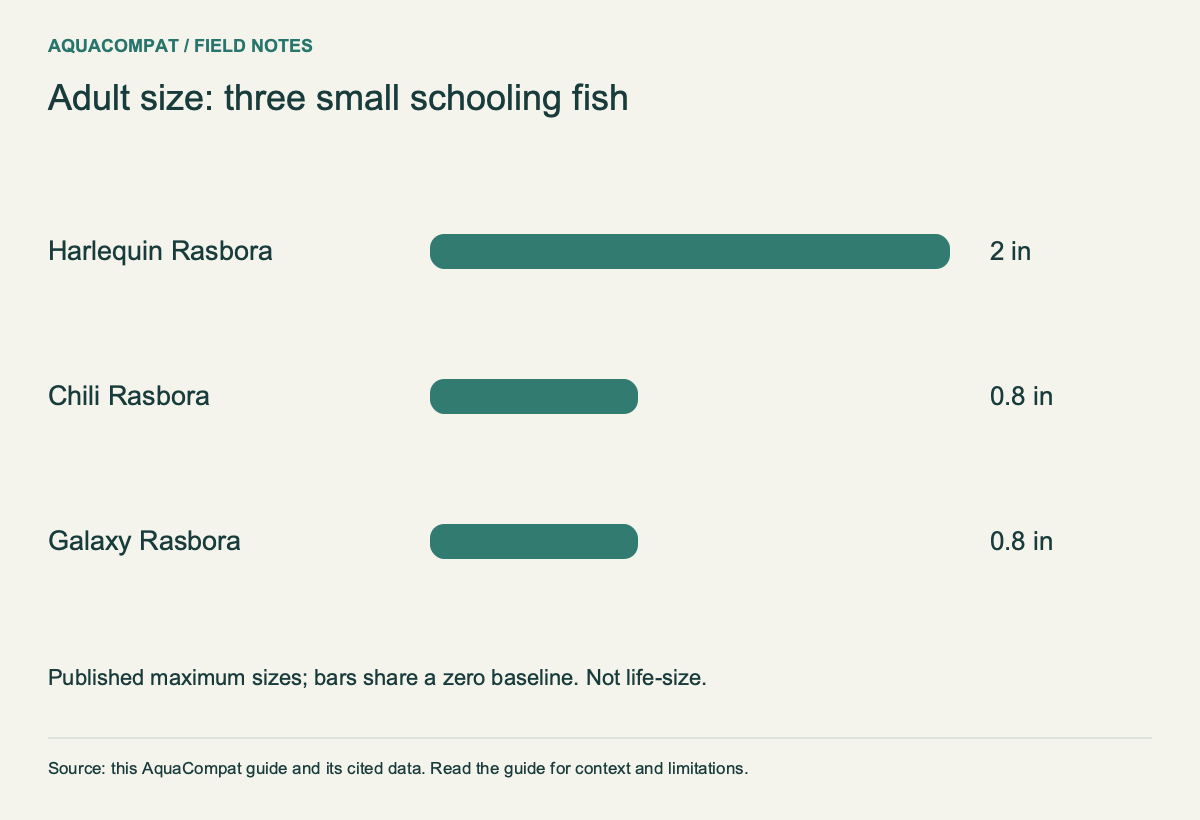
They differ most in size, diet and temperament, and least in water. The harlequin rasbora (Trigonostigma heteromorpha) is a schooling fish from South-East Asian forest streams and peat swamps. The chili rasbora (Boraras brigittae) is one of the smallest aquarium fish, endemic to south-western Borneo. The galaxy rasbora (Danio margaritatus), also sold as the celestial pearl danio, comes from small vegetated ponds in Myanmar and is a Danio, not a true rasbora. The table below sets their published needs side by side.
| Attribute | Harlequin rasbora | Chili rasbora | Galaxy rasbora |
|---|---|---|---|
| Adult size | 2 in (5.1 cm) | 0.8 in (2 cm) | 0.8 in (2 cm) |
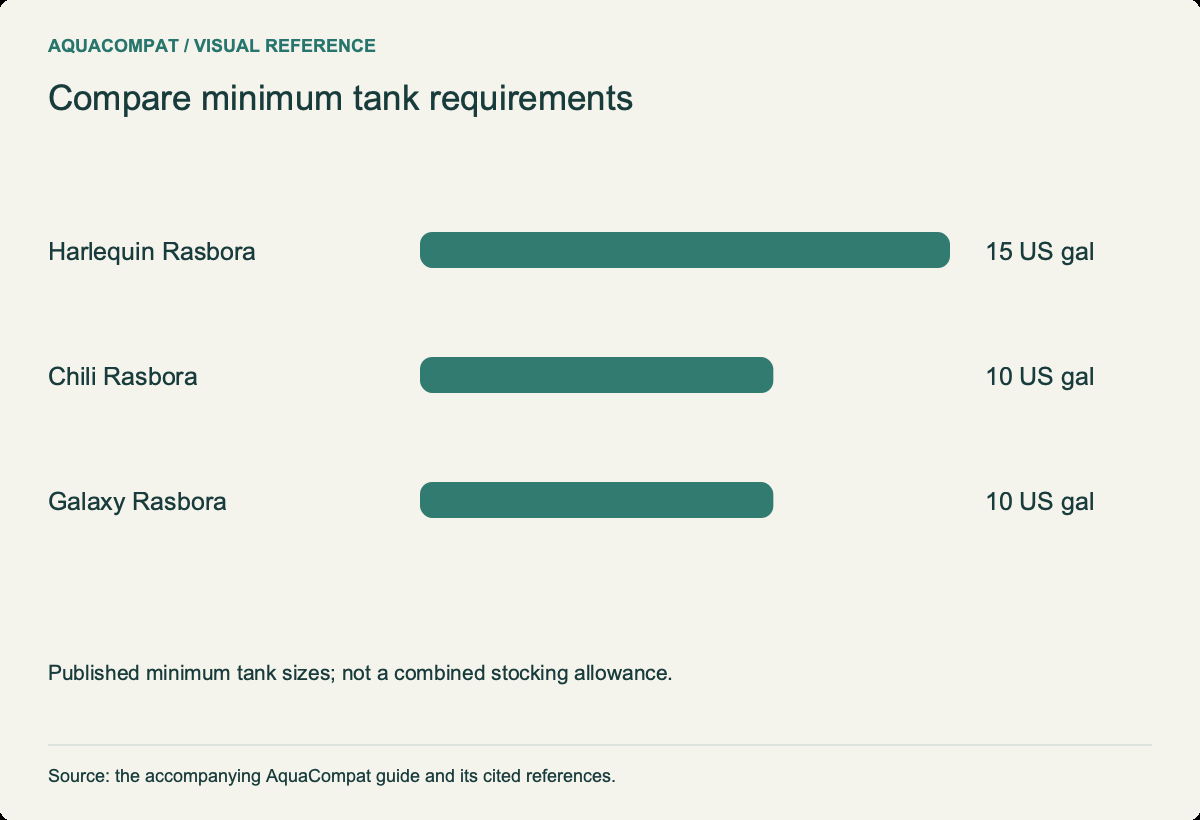
| Minimum tank | 15 US gal (57 L) | 10 US gal (38 L) | 10 US gal (38 L) |
| Minimum group | 8 | 8 | 10 |
| Temperature | 72–79 °F (22–26 °C) | 72–82 °F (22–28 °C) | 72–78 °F (22–26 °C) |
| pH | pH 5.0–7.5 | pH 6.0–7.0 | pH 6.6–7.5 |
| General hardness | 1–12 dGH | 1–10 dGH | 5–15 dGH |
| Temperament | peaceful | peaceful | peaceful |
| Swim level | middle | middle | middle |
| Diet | omnivore | carnivore | carnivore |
| Care level | beginner | intermediate | beginner |
| Breeding difficulty | moderate | moderate | easy |
| Lifespan | up to 6 years | not reliably documented | not reliably documented |
Do harlequin, chili and galaxy rasboras need the same water?
Largely yes: all three share a soft to moderate, near-neutral band, so one tank can suit any of them. The figure below shows each species’ published range and the band all three share.
Where do their water ranges differ?
The galaxy rasbora is the odd one out: it tolerates harder, slightly more alkaline water and less heat than the other two.
pH
The harlequin has the widest pH range, pH 5.0–7.5, and the chili rasbora the narrowest, pH 6.0–7.0. The galaxy sits at pH 6.6–7.5, and Wikipedia describes its wild habitat as slightly alkaline. The chili and galaxy pairing shares pH 6.6–7.0. Our aquarium pH guide explains how to read and hold a target range.
Hardness
Harlequins are listed at 1–12 dGH and chili rasboras at 1–10 dGH, both from soft water. The galaxy runs higher, at 5–15 dGH, though that figure rests on Seriously Fish alone; Aquarium Co-Op says only soft to moderate.
Temperature
The chili rasbora tolerates the warmest water, up to the top of 72–82 °F (22–28 °C). The galaxy has the lowest ceiling at 72–78 °F (22–26 °C): Aquarium Co-Op says it does best at the cooler end and tolerates the top of that range. A tank holding galaxies with either of the others should stay inside 72–78 °F (22–26 °C).
Which rasbora is best for a nano tank?
The chili rasbora and galaxy rasbora are the nano choices; the harlequin is not. Both small species are listed at 10 US gal (38 L), based on Seriously Fish’s 45 × 30 cm footprint, while the harlequin needs 15 US gal (57 L) from a 60 × 30 cm base.
Chili rasbora
The chili rasbora is the smallest at 0.8 in (2 cm). Aquarium Co-Op allows 3 gallons for a planted nano, but Seriously Fish’s footprint is larger and it rates the species moderate because it needs a well-established tank. That means a fully cycled tank with stable readings before the fish go in; the nitrogen cycle guide explains how to get there, and the best aquarium test kits compared cover the ammonia and nitrite tests that confirm it. Seriously Fish calls the chili very peaceful but not an ideal community fish, because it is easily outcompeted or eaten by larger, boisterous species.
Galaxy rasbora
The galaxy rasbora needs the biggest group of the three, at least 10. Aquarium Co-Op recommends 10 to 15 because the fish are timid, gives 10 gallons as a minimum for a small group and suggests 20 gallons or more for 10 to 15 fish. Seriously Fish advises buying as many as possible, ideally 20 or more. Co-Op also says galaxies hide and stress in sparse tanks, so dense planting is part of the requirement. A 20-gallon layout like the 20-gallon planted tank setup gives a full group room.
Harlequin rasbora
Harlequins need a school of 8 or more, which Seriously Fish puts at 8 to 10, and they swim in the middle to upper water. Aquarium Co-Op says a school of six can live in 10 gallons, but Seriously Fish’s footprint implies about 14, so we list 15 US gal (57 L).
Can harlequin, chili and galaxy rasboras live together?
Yes in most tanks, because all three are peaceful schoolers that share 72–78 °F (22–26 °C) and near-neutral water, though the harlequin’s size sets the tank. The chili and harlequin pairing scores 10/10, the chili and galaxy 9/10 and the galaxy and harlequin 9/10. Two nano species can share 10 US gal (38 L), but adding harlequins raises the shared figure to 20 US gal (76 L).
The scores reflect matched water and temperaments. They do not remove Seriously Fish’s caution that chili rasboras are easily outcompeted by larger fish; harlequins are calm, but at 2 in (5.1 cm) they dwarf a 0.8 in (2 cm) chili, so feed fine foods in several spots. The fish compatibility checker guide scores any other combination from the same data.
What do harlequin, chili and galaxy rasboras eat?
Harlequins accept ordinary flake, while chili and galaxy rasboras need small live or frozen foods as well. The harlequin is recorded as an omnivore; Aquarium Co-Op calls it omnivorous, and it takes flake plus small live and frozen foods. The chili is a carnivore and micropredator, and Aquarium Co-Op lists frozen rotifers, cyclops and microworms. Seriously Fish says the galaxy, also a carnivore, accepts small dried foods but should get small live or frozen foods such as Daphnia, Artemia, cyclops and microworms every day.
Which rasbora suits bettas and shrimp?
The harlequin is the rasbora for a betta tank, and the chili is the most shrimp-friendly. Size decides both answers.
With bettas
The betta and harlequin pairing has a fit score of 9/10 and is rated caution; Aquarium Co-Op recommends harlequins as betta tank mates. The chili and galaxy pairings with a betta are rated incompatible and incompatible, because our betta data records that bettas eat fish small enough to swallow, and both nano species are small enough. The betta tank mates ranked list covers the rest.
With shrimp
All three rasboras eat baby shrimp, which is why the cherry shrimp pairings are rated caution for the harlequin, caution for the chili and caution for the galaxy. The chili is the safest: Aquarium Co-Op says adults leave adult shrimp alone, Shrimp and Snail Breeder rates chili rasboras relatively shrimp-safe, and Seriously Fish lists Caridina and Neocaridina shrimp as suitable companions. Shrimp and Snail Breeder says harlequins ignore larger shrimp but take shrimplets, and Aquarium Co-Op says galaxy results with cherry shrimp vary. Crystal red shrimp need cooler water, sharing only 72–74 °F (22–23 °C) with the chili. The neocaridina vs caridina shrimp comparison explains the difference, and the cherry shrimp tank mates hub ranks safer fish.
When does each rasbora struggle?
Each species fails in a different tank. The harlequin struggles least, and the galaxy is the most easily stressed by its surroundings.
- Galaxy rasbora in a sparse tank: Aquarium Co-Op says shy galaxies hide and stress without dense plants. Seriously Fish adds that males spar constantly and nipped fins within a group are common, though the chasing stays within the species.
- Chili rasbora with boisterous fish: Seriously Fish says it is easily outcompeted or eaten by larger, boisterous fish and should be kept only with very small, peaceful species.
- Chili rasbora in a new tank: Seriously Fish wants a well-established tank, so an uncycled nano is a poor start.
- Harlequin rasbora in hard water: harlequins come from soft water, and Aquarium Co-Op says breeding needs warmer, very soft, acidic water. Practical Fishkeeping says they thrive at pH 7.5 or below.
Galaxies can also hybridise with Danio erythromicron, so Seriously Fish advises against keeping the two together.
Is the galaxy rasbora really a rasbora?
No. The galaxy rasbora is Danio margaritatus, a danio. It was discovered in 2006, first traded as Microrasbora sp. ‘Galaxy’, and briefly placed in Celestichthys before moving to Danio, according to Wikipedia, Seriously Fish and FishBase. The trade still sells it under both names. The chili rasbora carries an alternative name too: Seriously Fish and Aquarium Co-Op note that it is sometimes sold as the mosquito rasbora. All three species belong to the same family, Danionidae, and come from soft, vegetated South-East Asian waters, which is why their care overlaps so closely.
The original scientific description (Raffles Bulletin of Zoology, 2007) found the species in small, heavily vegetated ponds, at most about 30 cm deep, in hilly grassland at about 1,040 m elevation near Hopong in Myanmar, and noted that collectors reportedly fished out one pond after another.
Which rasbora should you choose?
Choose by tank size and companions. The harlequin rasbora suits a community of 15 US gal (57 L) or more, a betta tank or a beginner, since Seriously Fish rates it beginner. The chili rasbora suits a mature, soft-water nano with shrimp and no larger fish. The galaxy rasbora suits a densely planted nano with room for a group of 10 or more, and it tolerates slightly harder water than the chili. For more side-by-side guides, the species comparisons index lists every pairing we cover.
Other side-by-side comparisons are collected on the species comparisons page.
Questions people ask
Which is smaller, the chili rasbora or the galaxy rasbora?
They are practically the same size in our data, both about 0.8 in (2 cm). Seriously Fish gives 20 mm standard length for the chili and 21 mm for the galaxy. The chili looks smaller in shops because, as Seriously Fish and Aquarium Co-Op note, juveniles are pale until they colour up.
Can harlequin rasboras live in a 10-gallon tank?
Aquarium Co-Op says a school of six can, but Seriously Fish’s 60 × 30 cm footprint works out at about 14 gallons, and it recommends 8 to 10 fish. We list 15 US gal (57 L) for that reason. A 10-gallon tank suits chili or galaxy rasboras better.
Will galaxy rasboras eat cherry shrimp?
Not adults, in most reports, but Aquarium Co-Op says results vary and shrimplets should be expected to be eaten. The pairing scores 7/10. Dense moss gives shrimplets somewhere to hide.
Do chili rasboras need soft water?
They do best in it. Our range is pH 6.0–7.0 and 1–10 dGH, from Seriously Fish and Aquarium Co-Op. Co-Op says chilis tolerate soft to hard water, but gives no figures, so we use the Seriously Fish hardness range.
Sources 35 documents from 11 publishers
- Aquarium Co-Op (aquariumcoop.com): “Care Guide for Harlequin Rasboras and Lambchop Rasboras”; “Chili Rasbora care guide”; “Celestial Pearl Danio care guide”; “Betta Fish Care Guide”; “Care Guide for Dwarf Gouramis”; “10 Best Top-Dwelling Fish for Your Freshwater Community Aquarium”; “Care Guide for Cherry Shrimp”; “Top 10 Betta Fish Tank Mates”
- FishBase (fishbase.se): “Trigonostigma heteromorpha summary page”; “Danio margaritatus summary page”; “Boraras brigittae summary (Bayesian length-weight estimate)”; “Betta splendens summary (Bayesian length-weight estimate)”
- Maidenhead Aquatics (fishkeeper.co.uk species data sheet) (fishkeeper.co.uk): “Harlequin Rasbora data sheet”; “Siamese Fighting Fish/Betta data sheet”
- Practical Fishkeeping (practicalfishkeeping.co.uk): “A guide to the small rasboras from the genus Trigonostigma”; “How long will my fish live?”; “Frequently asked questions on Neocaridina shrimps”; “An introduction to Shrimp”
- Seriously Fish (seriouslyfish.com): “Boraras brigittae”; “Danio margaritatus (Celestial Pearl Danio)”; “Trigonostigma heteromorpha (Harlequin)”; “Betta splendens”
- Shrimp and Snail Breeder (aquariumbreeder.com): “Cherry Shrimp in a Community Tank”; “Red Cherry Shrimp: detailed guide, care, diet and breeding”; “Crystal Red Shrimp: detailed guide, care, diet and breeding”; “How Copper Affects Dwarf Shrimp”
- Shrimp Science (shrimpscience.com): “Red Cherry Shrimp - Care Guide”; “General Hardness (GH) For Shrimp Tanks”; “Crystal Red Shrimp - Care Guide”; “Carbonate Hardness (KH) For Shrimp Tanks”; “TDS For Shrimp Tanks”
- The Raffles Bulletin of Zoology, T. R. Roberts (lkcnhm.nus.edu.sg): “The "Celestial Pearl Danio", a new genus and species of colourful minute cyprinid fish from Myanmar (Pisces: Cypriniformes)”
- Tropical Fish Hobbyist Magazine (tfhmagazine.com): “Betta splendens”
- UF/IFAS EDIS (ask.ifas.ufl.edu): “Evolution, Culture, and Care for Betta splendens (FA212)”
- Wikipedia (en.wikipedia.org): “Celestial pearl danio”
All sources accessed . Every number on this page comes from these documents.