What pH range do common aquarium species need?
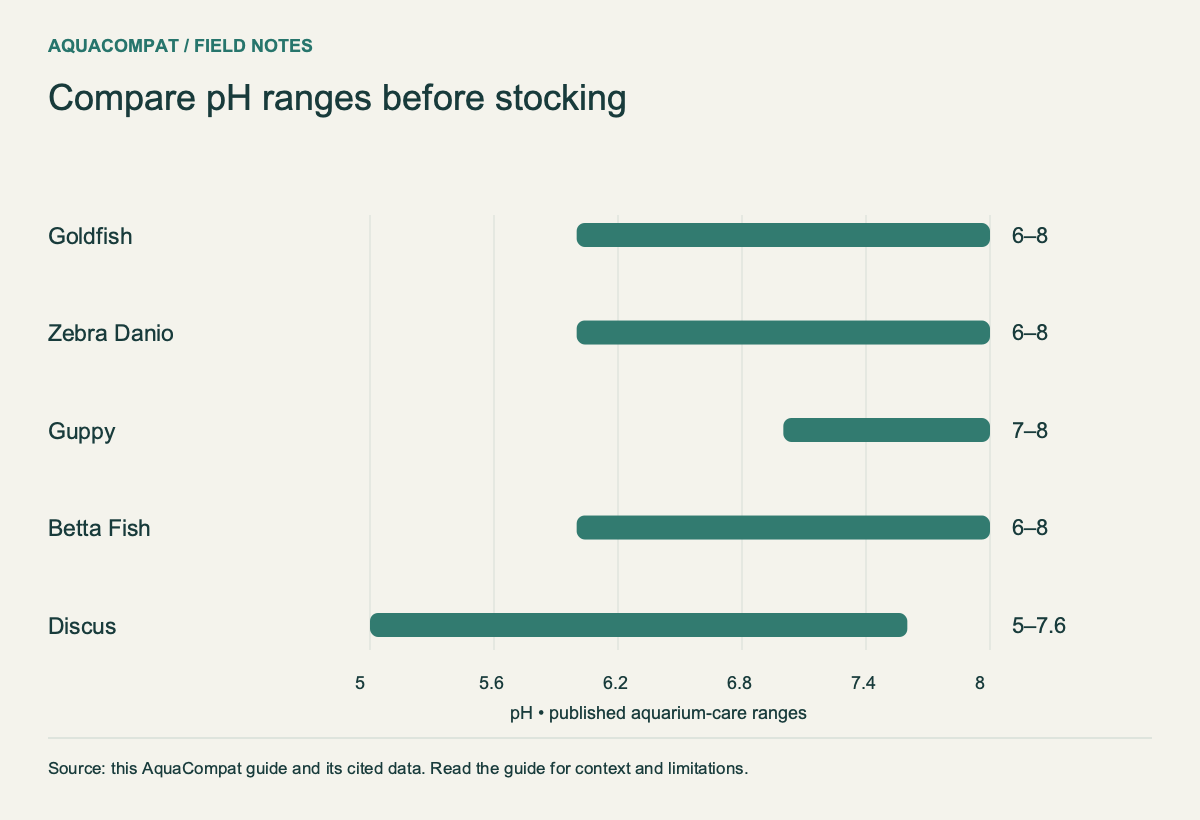
Most freshwater aquarium species need a pH somewhere between slightly acidic and slightly alkaline, and each has its own band within that. Soft-water fish from South American and Southeast Asian streams sit at the acidic end, livebearers and snails sit at the alkaline end, and many popular community species span the middle. The table lists every species we cover, ordered from the most acid-tolerant to the most alkaline, with general hardness alongside because pH and hardness usually move together.
Each range is the band where at least two aquarium-care sources agree, mainly Seriously Fish, FishBase and the Maidenhead Aquatics data sheets. Where sources differ, the species data records each source’s own figure. When two species share a tank, look for the stretch of pH both rows cover; that shared band is what our compatibility scores use.
| Species | Group | pH range | General hardness |
|---|---|---|---|
| Kuhli Loach | Bottom dweller | pH 3.5–7.0 | 0–8 dGH |
| Cardinal Tetra | Tetra | pH 4.0–7.5 | 1–12 dGH |
| Harlequin Rasbora | Rasbora | pH 5.0–7.5 | 1–12 dGH |
| Neon Tetra | Tetra | pH 5.0–7.5 | 1–12 dGH |
| Discus | Cichlid | pH 5.0–7.6 | 0–8 dGH |
| Chili Rasbora | Rasbora | pH 6.0–7.0 | 1–10 dGH |
| GloFish Tetra | Tetra | pH 6.0–7.0 | 5–18 dGH |
| Bristlenose Pleco | Bottom dweller | pH 6.0–7.2 | 2–15 dGH |
| Amano Shrimp | Invertebrate | pH 6.0–7.5 | 6–15 dGH |
| Dwarf Gourami | Labyrinth fish | pH 6.0–7.5 | 2–18 dGH |
| Angelfish | Cichlid | pH 6.0–8.0 | 5–15 dGH |
| Betta Fish | Labyrinth fish | pH 6.0–8.0 | 1–15 dGH |
| Goldfish | Coldwater | pH 6.0–8.0 | 5–19 dGH |
| Oscar | Cichlid | pH 6.0–8.0 | 5–20 dGH |
| Zebra Danio | Danio | pH 6.0–8.0 | 5–20 dGH |
| Crystal Red Shrimp | Invertebrate | pH 6.2–7.0 | 4–6 dGH |
| Corydoras | Bottom dweller | pH 6.5–7.5 | 2–15 dGH |
| Cherry Shrimp | Invertebrate | pH 6.5–8.0 | 6–10 dGH |
| Galaxy Rasbora | Rasbora | pH 6.6–7.5 | 5–15 dGH |
| Guppy | Livebearer | pH 7.0–8.0 | 8–30 dGH |
| Platy | Livebearer | pH 7.0–8.2 | 10–20 dGH |
| Endler's Livebearer | Livebearer | pH 7.0–8.5 | 15–25 dGH |
| Assassin Snail | Invertebrate | pH 7.2–8.0 | 6–20 dGH |
| Mystery Snail | Invertebrate | pH 7.2–8.0 | 8–12 dGH |
| Nerite Snail | Invertebrate | pH 7.2–8.0 | 10–15 dGH |
| Molly | Livebearer | pH 7.5–8.5 | 15–25 dGH |
| Peacock Cichlid | Cichlid | pH 7.5–8.5 | 10–25 dGH |
| Kenyi Cichlid | Cichlid | pH 7.6–8.5 | 10–25 dGH |
| Yellow Lab | Cichlid | pH 7.7–8.5 | 10–25 dGH |
What is pH, and why does one unit matter so much?
pH is the negative logarithm of the hydrogen ion concentration in water. SRAC Publication 464 (Wurts and Durborow) defines the scale this way: 7 is neutral, values below 7 are acidic and values above 7 are basic. Because the scale is logarithmic, each whole unit is a tenfold change in hydrogen ion concentration, so water at pH 6 holds ten times the hydrogen ions of water at pH 7 and a hundred times those at pH 8.
That log scale is why a shift that looks small on a test card can matter to fish. SRAC 464 notes that fish blood averages about pH 7.4 pH, and that the blood in the gills is separated from the surrounding water by only one or two cells. Water far from that value forces the fish to work to keep its blood chemistry stable.
What pH level is safe for freshwater aquarium fish?
A pH of 6.5–9.0 pH is the general recommendation for freshwater fish from SRAC 464 and the Merck Veterinary Manual. Merck gives approximate lethal limits of 4–10 pH (approximate) for many freshwater species, while noting that fish tolerate reasonable fluctuations within their range.
Those are broad, aquaculture-based figures. The species chart above is the more useful guide for a home aquarium, because some popular fish are listed well below 6.5 and others need water above 7.5. The cardinal tetra’s range reaches down to pH 4.0–7.5, while the molly needs pH 7.5–8.5. A safe pH for one tank can therefore be outside the range for another, and a mixed community needs a pH that suits every species in it.
Do wild and tank-bred fish need different pH?
Sometimes they do. Seriously Fish lists domestic bettas at pH 6.0–8.0 but notes that wild-collected bettas prefer 5.0–7.0, and UF/IFAS reports wild betta habitat at about pH 5.3–5.8. For neons, FishBase’s wild-habitat range is narrower than the aquarium ranges given by Seriously Fish and Maidenhead. Seriously Fish notes that commercially farmed neons are more adaptable than wild fish, which is why our ranges use aquarium-care figures rather than wild-habitat ones.
How do you test aquarium pH accurately?
Test pH with a liquid kit, strips or a meter, and read the sample promptly. SRAC 464 advises measuring pH within 30 minutes (max delay after sampling), because carbon dioxide escapes from a standing sample and changes the reading. Test at the same time of day each time: SRAC 464 explains that photosynthesis by plants and algae removes CO2 during the day, which can push pH up in poorly buffered water.
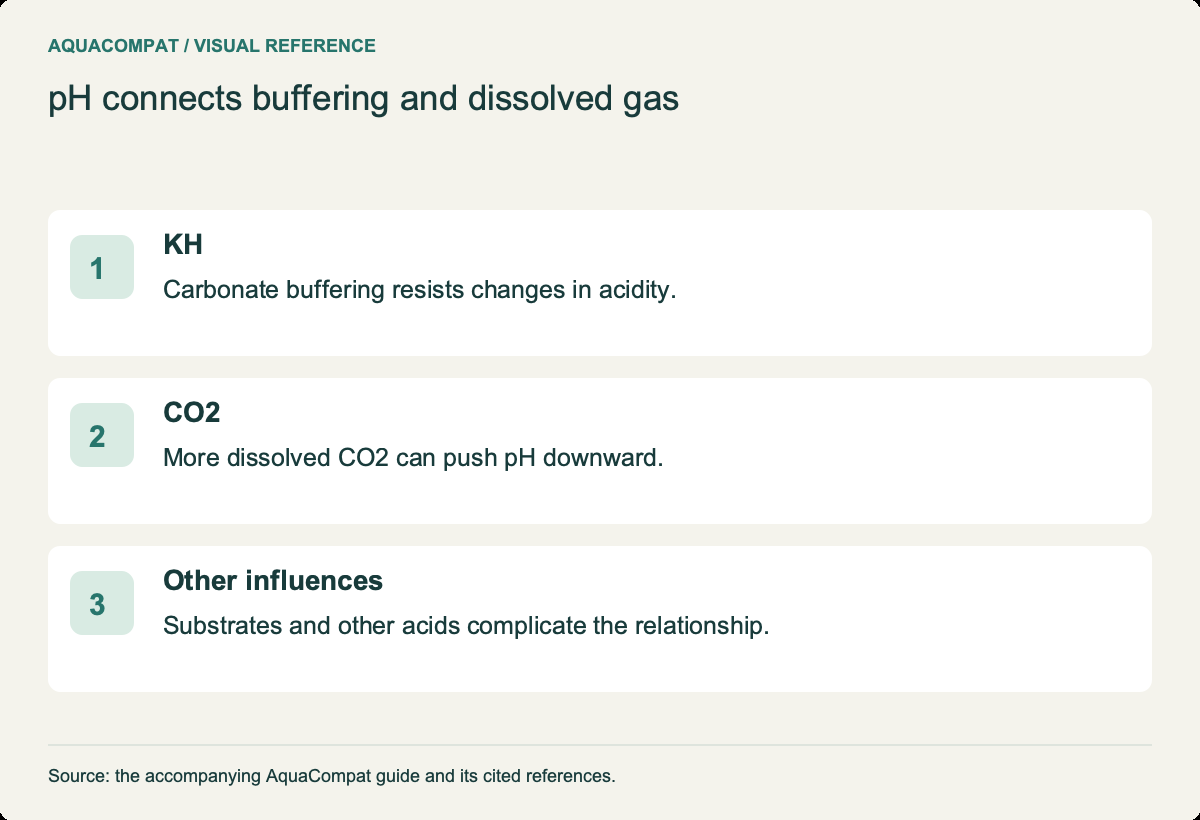
A pH reading on its own tells only half the story, so test carbonate hardness (KH) alongside it. KH shows how strongly the water resists a pH change, which decides whether a low or high reading is stable or about to swing. The comparison of best aquarium test kits compared notes which kits include pH and KH tests.
How can you tell if CO2 is lowering your pH?
Merck describes a simple check: aerate a sample vigorously for an hour and test it again. If pH rises by 1 pH unit rise (more than), excess carbon dioxide is likely. In a planted tank with CO2 injection, a daily pH dip is expected; the guide to CO2 levels in planted tanks covers safe targets.
How do you lower aquarium pH?
You lower aquarium pH mainly by reducing the water’s carbonate buffer or by adding carbon dioxide, and it should be done gradually. Water with moderate to high alkalinity sits near 7.0–8.3 pH and resists change, according to SRAC 464, so pH will not fall far or stay down until that buffer is reduced. The safest approach follows the steps below.
- Test pH and KH first. A high pH with high KH means the buffer is doing its job; acids added on top tend to be neutralised. A high pH with low KH is easier to move but also less stable.
- Decide whether you need to change it at all. If every species you keep is listed for your current pH in the chart above, a steady pH is better than a lower one.
- Dilute with purified water. Reverse osmosis (RO) water has most dissolved minerals removed, per Michigan State University Extension, so mixing it with tap water lowers hardness and carbonate buffer together. The guide to RO and RO/DI water explains why pure RO water must be remineralised before fish can live in it.
- Change pH in small steps. Make each water change with the mixed water rather than switching in one go, and test before each change.
- Keep KH from collapsing. Stop lowering once the target is reached; SRAC 464 warns that low-alkalinity water can swing to dangerously low pH.
Carbon dioxide is the other lever. Dissolved CO2 forms carbonic acid and lowers pH, as SRAC Publications 464 and 468 explain, which is why planted tanks with CO2 injection run at a lower pH while the gas is on.
Do driftwood and leaves lower pH?
Driftwood and leaves are often recommended for acidic tanks, but the sources in our fact base describe only one measured effect: tannins leaching from wood or leaves give the water a brown or yellow tint, according to the Aquarium Co-Op and Practical Fishkeeping material on cloudy and discoloured aquarium water. None of them gives a pH figure for wood or leaves, so this guide does not promise one.
How do you raise aquarium pH?
You raise aquarium pH by adding carbonate buffer, removing excess carbon dioxide, or changing old water for fresh. Which works depends on why the pH is low, so test KH before choosing.
- Change water regularly. Nitrification releases acid and uses up alkalinity, according to UF/IFAS, so pH drifts down in an established tank. Merck’s guidance is to remove old water at each change rather than only topping up, which replaces the lost carbonate. Treat the new water first; the comparison of water conditioners we recommend covers dechlorinators.
- Add sodium bicarbonate for low KH. SRAC Publication 4502 gives 53 g sodium bicarbonate per 3,785 L to raise alkalinity 10 mg/L. Scale the dose to your tank volume, add it in small steps and retest KH and pH between doses.
- Increase surface agitation if CO2 is the cause. If the one-hour aeration test above raises pH sharply, better gas exchange at the surface removes the excess CO2.
- Remineralise purified water. If you use RO water, a remineraliser restores minerals; SaltyShrimp’s GH/KH+ product for Neocaridina shrimp, for example, targets about 2 dKH.
Buffer added this way tends to hold pH in the buffered band of 7.0–8.3 pH that SRAC 464 describes. That suits livebearers, snails and hard-water cichlids such as the Yellow Lab, listed at pH 7.7–8.5, but it is above the range of several soft-water species in the chart. The explanation of GH and KH goes further into buffering and how to raise KH on its own.
How do pH, KH and carbon dioxide work together?
Carbonate hardness (KH) holds pH steady, and carbon dioxide pushes it down; pH is the balance between the two. Carbonates and bicarbonates absorb acid, which is why SRAC 464 describes water with moderate to high alkalinity as stable near 7.0–8.3 pH. In low-alkalinity water the same source warns that pH can become dangerously low as CO2 builds up overnight, or dangerously high when photosynthesis removes CO2 by day.
The relationship is predictable enough to calculate. SRAC 464 explains that pH/KH/CO2 tables rest on the carbonate equilibrium, and that free CO2 is negligible above 8.4 pH for practical purposes. Other acids in the water make those tables less reliable, so treat a calculated CO2 figure as an estimate. Your tap water sets the starting point for all of this, and the guide to tap water for aquariums explains what municipal treatment adds to the water before it reaches the tank.
Why does pH change how toxic ammonia is?
Higher pH shifts ammonia toward its toxic un-ionized form. UF/IFAS figures show that at 26 °C the toxic fraction rises about tenfold between pH 7.0 and pH 8.0. A small ammonia reading is therefore more dangerous in a hard, alkaline livebearer tank than in a soft, acidic tetra tank, as explained in the guide to the nitrogen cycle.
Should you chase an exact pH number?
No. A stable pH inside every resident species’ range matters more than hitting a precise figure. Merck notes that fish tolerate reasonable fluctuations, and most species in the chart above cover at least a full pH unit. Repeatedly adding acids or buffers to reach a number on a label tends to cause the swings it was meant to avoid, especially in water with little KH.
The more useful habit is to choose fish whose ranges already include your tap water’s pH. A tank of livebearers on hard, alkaline tap water, or a school of tetras on soft water, needs no pH adjustment at all. Well water varies more than many keepers expect: USGS sampling of about 2,100 private domestic wells between 1991 and 2004 found a median pH of 7.3, but 14 percent of wells were more acidic than pH 6.5, mostly in the eastern United States, so test your own supply before choosing fish. Mixing species from both ends of the chart is what creates the need to adjust, and the fish compatibility checker shows the shared pH band for any two species before you buy.
What happens when aquarium pH falls too far?
When pH falls too far, the nitrifying bacteria that clear ammonia stop working, and the tank’s biofilter can fail. Two situations cause it.
pH crash during cycling
Practical Fishkeeping links depleted KH during cycling to a pH crash below 6 pH (below), at which point bacterial activity stops and the cycle stalls. Water that starts with little KH is most at risk, and restoring KH addresses the cause.
Old tank syndrome
Merck describes old tank syndrome in established tanks: when old water is not removed, organic acids build up and pH drops sharply, often below 6 pH (often below) and sometimes below 5, killing the nitrifying bacteria. Ammonia then climbs again. Regular partial water changes, as set out in the aquarium maintenance schedule, prevent it. The other water chemistry topics are collected in the water chemistry and setup guides.
Questions people ask
What is the ideal pH for a community aquarium?
There is no single ideal, because the right pH depends on the species. Many popular community fish overlap around neutral: corydoras are listed at pH 6.5–7.5, and bettas at pH 6.0–8.0. Livebearers such as mollies need pH 7.5–8.5, so they rarely suit the same tank as soft-water tetras. Check every species against the chart and keep pH where their ranges overlap.
How fast can I change aquarium pH?
None of the sources in our fact base gives a safe rate of pH change for aquarium fish, so the cautious approach is small steps spread over several water changes, testing between each. Merck notes that fish tolerate reasonable fluctuations, and SRAC 464 warns that poorly buffered water can swing to dangerous pH, which is a reason to change KH and pH slowly together.
Why does my aquarium pH keep dropping?
The most common reason is nitrification. UF/IFAS explains that nitrifying bacteria release acid and consume alkalinity, so pH falls over time unless the carbonate they use is replaced. Topping up evaporated water does not replace it; removing and replacing old water does. In planted tanks, CO2 injection also lowers pH while the gas is running.
Is high pH or low pH more dangerous?
Both extremes are dangerous: Merck gives approximate lethal limits of 4–10 pH (approximate). In everyday tanks the risks differ. High pH makes any ammonia more toxic, because more of it is in the un-ionized form. Low pH can stall the biofilter, as in old tank syndrome. Low pH in water with little KH is also unstable and can fall further quickly.
Can I use RO water to lower pH for neon tetras?
Yes, mixing RO water with tap water lowers hardness and buffer, which brings pH down toward the soft, acidic water neons tolerate. Neon tetras are listed at pH 5.0–7.5 and 1–12 dGH. Pure RO water lacks the minerals fish need for osmotic balance, so it should be mixed or remineralised, never used on its own.
Sources 118 documents from 23 publishers
- Applesnail.net (applesnail.net): “Quick guide”
- Aquarium Co-Op (aquariumcoop.com): “Care Guide for Kuhli Loaches”; “Care Guide for Cardinal Tetras”; “Care Guide for Harlequin Rasboras and Lambchop Rasboras”; “Discus Fish Care Guide”; “Chili Rasbora care guide”; “Care Guide for Plecostomus”; “Care Guide for Amano Shrimp”; “Care Guide for Dwarf Gouramis”; “Freshwater Angelfish Care Guide”; “Oscar Fish Care Guide”; “Care Guide for Zebra and Leopard Danios”; “Care Guide for Cory Catfish”; “Care Guide for Cherry Shrimp”; “Celestial Pearl Danio care guide”; “Guppy Care Guide”; “Endler's Livebearer Care Guide”; “Care Guide for Assassin Snails”; “Care Guide for Mystery Snails”; “Care Guide for Nerite Snails”; “Betta Fish Care Guide”; “10 Best Top-Dwelling Fish for Your Freshwater Community Aquarium”; “What Is Neon Tetra Disease and How Can It Be Prevented?”; “Neon and Cardinal Tetras: Beginner Schooling Fish”; “Top 5 Dither Fish to Help Shy or Aggressive Fish in Freshwater Tanks”; “CO2 for planted tanks”; “How to Clear Up Cloudy Fish Tank Water with 5 Easy Methods”; “Guide to Aquarium Water Changes”
- Aquarium Science (aquariumscience.org) (aquariumscience.org): “Measuring CO2”
- AquariumInfo.org (aquariuminfo.org): “Apple Snail”
- AquariumScience.org (aquariumscience.org): “6.2.3 Cloudy Water”
- Dennerle (dennerle.com): “CO2 Langzeittest (long-term test) instructions 2985/2986”
- FishBase (fishbase.se): “Symphysodon aequifasciatus, Blue discus: species summary”; “Trichogaster lalius, Dwarf gourami: species summary”; “Betta splendens, Siamese fighting fish: species summary”; “Carassius auratus, Goldfish: species summary”; “Danio rerio summary page”; “Osteogaster aenea, Bronze corydoras”; “Paracheirodon innesi summary (Bayesian length-weight estimate)”
- Green Aqua (greenaqua.hu): “Shrimp in the aquarium”
- Maidenhead Aquatics (fishkeeper.co.uk species data sheet) (fishkeeper.co.uk): “Neon Tetra data sheet”; “Discus data sheet”; “Black Widow Tetra (Black Skirt Tetra) data sheet”; “Angelfish data sheet”; “Oscar data sheet”; “Guppy data sheet”; “Platy data sheet”; “Zebra Nerite Snail”; “Molly data sheet”; “Hybrid Peacock (Aulonocara sp.) data sheet”; “Kenyi data sheet”; “Yellow Labidochromis data sheet”; “Siamese Fighting Fish/Betta data sheet”
- Merck Veterinary Manual (merckvetmanual.com): “Environmental Diseases of Aquatic Animals in Aquatic Systems, Francis-Floyd, Yanong and Petty”; “Disorders and Diseases of Fish (pet owner version)”; “Management of Aquarium Fish, Petty, Francis-Floyd and Yanong”; “Special Considerations for Fish (pet owner version)”; “Routine Health Care of Fish (pet owner version)”; “Providing a Home for Fish (pet owner version)”
- Michigan State University Extension (archive) (sanweb.lib.msu.edu): “Reverse Osmosis for Home Treatment of Drinking Water (WQ24, 1990)”
- Ornamental Aquatic Trade Association (OATA) (ornamentalfish.org): “How to look after goldfish in an aquarium / fish tank”
- PlanetCatfish (via Internet Archive snapshot, 2025) (web.archive.org): “Ancistrus sp. (3) Common Bristlenose Catfish Cat-eLog data sheet”; “Osteogaster aenea (Bronze Cory) Cat-eLog data sheet”
- Practical Fishkeeping (practicalfishkeeping.co.uk): “A guide to the small rasboras from the genus Trigonostigma”; “Bristlenose catfish: the hardworking Ancistrus”; “Amano shrimp: Spineless heroes (Nathan Hill)”; “What can I keep in my hard water aquarium?”; “Frequently asked questions on Neocaridina shrimps”; “Quick guide to livebearers”; “Malawi's finest: The Yellow lab, Labidochromis caeruleus”; “How to Cycle a Fish Tank: The Complete Guide”; “How long will my fish live?”; “Why is my aquarium water cloudy?”; “How often should I change my water?”
- SaltyShrimp (product information via Furry Critter Network) (furrycritter.com): “SaltyShrimp Remineralizers for Invertebrates”
- Seriously Fish (seriouslyfish.com): “Pangio semicincta ('Kuhli' Loach)”; “Paracheirodon axelrodi (Cardinal Tetra)”; “Trigonostigma heteromorpha (Harlequin)”; “Paracheirodon innesi (Neon Tetra)”; “Symphysodon aequifasciatus”; “Boraras brigittae”; “Gymnocorymbus ternetzi (Black Widow Tetra)”; “Ancistrus sp. '3' (Common Bristlenose Catfish)”; “Trichogaster lalius”; “Pterophyllum scalare”; “Betta splendens”; “Astronotus ocellatus”; “Danio rerio (Zebra Danio)”; “Osteogaster aenea (Bronze Cory)”; “Danio margaritatus (Celestial Pearl Danio)”; “Poecilia reticulata”; “Xiphophorus maculatus”; “Poecilia wingei”; “Poecilia sphenops”; “Aulonocara stuartgranti”; “Aulonocara baenschi”; “Maylandia lombardoi”; “Labidochromis caeruleus”
- Shrimp and Snail Breeder (aquariumbreeder.com): “Crystal Red Shrimp: detailed guide, care, diet and breeding”; “Red Cherry Shrimp: detailed guide, care, diet and breeding”; “Assassin Snail: detailed guide, care, diet and breeding”; “Nerite Snails: detailed guide, care, diet and breeding”; “Cherry Shrimp in a Community Tank”
- Shrimp Science (shrimpscience.com): “Amano Shrimp”; “Crystal Red Shrimp - Care Guide”; “Red Cherry Shrimp - Care Guide”; “General Hardness (GH) For Shrimp Tanks”
- Southern Regional Aquaculture Center (srac.msstate.edu): “Interactions of pH, Carbon Dioxide, Alkalinity and Hardness in Fish Ponds, SRAC Publication No. 464, Wurts and Durborow”; “SRAC 468: Carbon Dioxide in Fish Ponds (Hargreaves and Brunson)”; “Interpretation of Water Analysis Reports for Fish Culture, SRAC Publication No. 4606”; “SRAC Publication No. 466: Algae Blooms in Commercial Fish Production Ponds”; “How to Start a Biofilter, SRAC Publication No. 4502, DeLong and Losordo”
- Tropical Fish Hobbyist Magazine (tfhmagazine.com): “Betta splendens”
- UF/IFAS EDIS (ask.ifas.ufl.edu): “FA16: Ammonia in Aquatic Systems (Francis-Floyd, Watson, Petty, Pouder)”; “Evolution, Culture, and Care for Betta splendens (FA212)”
- US Geological Survey (pubs.usgs.gov): “The Quality of Our Nation's Waters: Quality of Water from Domestic Wells in Principal Aquifers of the United States, 1991-2004, Overview of Major Findings (Circular 1332)”
- Wikipedia (en.wikipedia.org): “dGH”; “Carbonate hardness”
All sources accessed . Every number on this page comes from these documents.