What should an aquarium water conditioner remove from tap water?
An aquarium water conditioner must remove chlorine and chloramine, the two disinfectants water utilities add to tap water. A water conditioner, also sold as a dechlorinator, is a liquid you add to new water before it touches fish or filter media. UF/IFAS, the US EPA and the Merck Veterinary Manual explain that utilities disinfect with chlorine and that many add ammonia to form chloramine, which lasts longer in the pipes .
Why chlorine matters
Chlorine harms fish at very low levels. The Merck Veterinary Manual reports adverse effects from 0.02 mg/L chlorine and deaths at about 0.04 mg/L chlorine, and both Merck and UF/IFAS set the target at 0 mg/L (none detectable) whenever fish are present.
Why chloramine is harder
Chloramine does not gas off the way chlorine does. UF/IFAS shows that about 24 hours of vigorous aeration can remove free chlorine, but chloramine persists and must be neutralised chemically. The EPA states that more than one in five Americans use chloramine-treated water, so many US tanks need a product rated for both.
Ammonia left behind
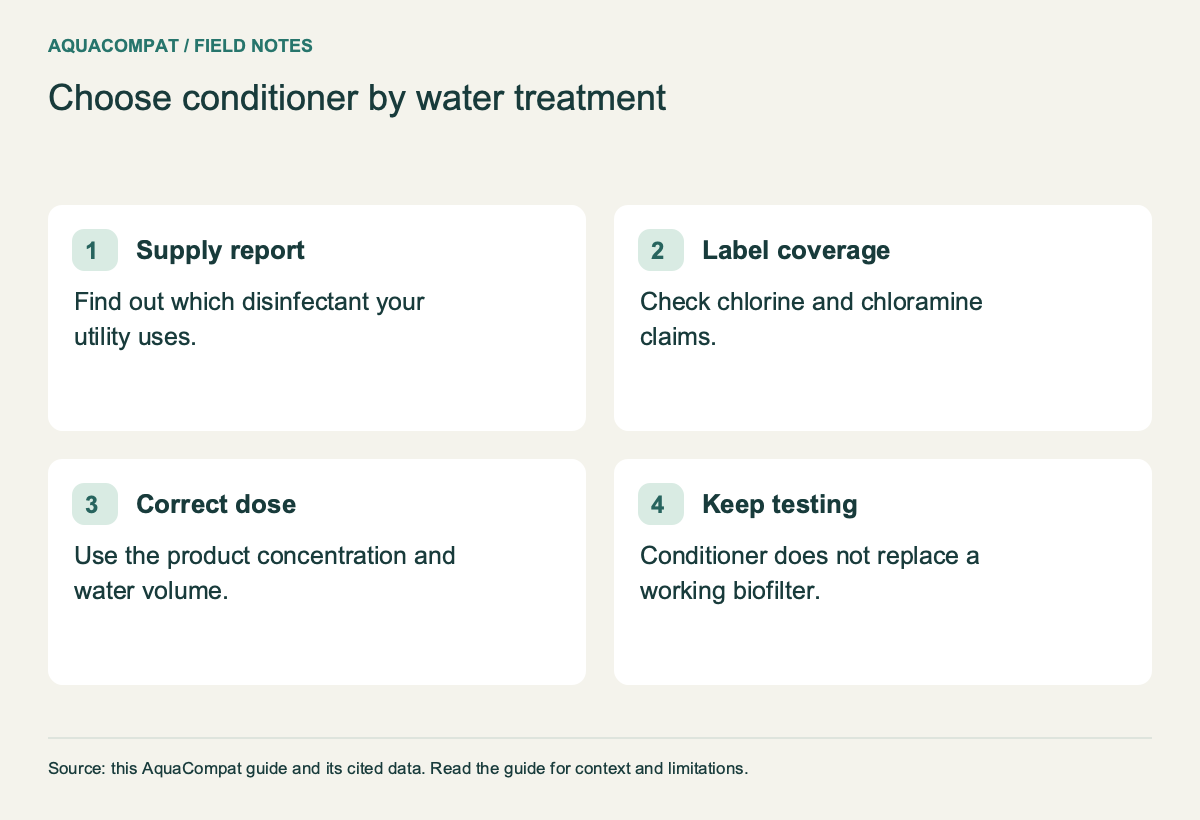
Breaking chloramine apart releases its ammonia. Merck notes that sodium thiosulfate, the classic dechlorinator, frees ammonia when it neutralises chloramine, and recommends products that also bind ammonia. That is the main difference between the four products here, and the guide to aquarium tap water explains how to find out which disinfectant your utility uses.
How much tap water does each conditioner treat per dose?
Seachem Prime, Fritz Complete and API (for chlorine) each treat 50 US gallons per 5 mL, while Tetra AquaSafe Plus treats 10. The table sets each label dose beside the volume one 5 mL capful treats, worked from the same figures.
| Conditioner | Label dose | Treated by 5 mL | Emergency dosing |
|---|---|---|---|
| Seachem Prime | 5 mL per 200 L (50 US gal) of new water | 50 US gal (189 L) | up to 5x normal dose in emergencies |
| Fritz Complete | 1 tsp (5 mL) per 50 US gal (189 L) | 50 US gal (189 L) | may be repeated or increased up to 5x within 24 hours |
| API Tap Water Conditioner, chlorine | 1 mL per 10 US gal (38 L) | 50 US gal (189 L) | Not published |
| API Tap Water Conditioner, chloramine | 5 mL per 30 US gal (114 L) | 30 US gal (114 L) | Not published |
| Tetra AquaSafe Plus | 1 tsp (5 mL) per 10 US gal (38 L); inner ring treats 10 gal; full cap treats 20 gal | 10 US gal (38 L) | Not published |
Which water conditioners also detoxify ammonia and nitrite?
Seachem Prime and Fritz Complete are the two that claim to detoxify ammonia, nitrite and nitrate as well as chlorine and chloramine. API Tap Water Conditioner and Tetra AquaSafe Plus instead list heavy metals as their extra target. The table compares the published claims side by side.
| Conditioner | Neutralises | Ammonia claim | Other notes |
|---|---|---|---|
| Seachem Prime | chlorine, chloramine | Detoxifies ammonia, nitrite, nitrate, binding up to 48 hours | non-acidic, does not affect pH |
| Fritz Complete | chlorine, chloramine, heavy metals; detoxifies ammonia, nitrite and nitrate | Yes, as listed | freshwater and saltwater, including reef and planted |
| API Tap Water Conditioner | chlorine, chloramines, heavy metals (copper, lead, zinc) | Not stated in our source | Separate chlorine and chloramine doses |
| Tetra AquaSafe Plus | chlorine, chloramines, heavy metals | none stated | BioExtract seaweed biopolymers; slime colloids for gills and wounds |
Water conditioners matched to your tap water
Each conditioner below suits a different tap-water situation, from chloramine-treated city water in a cycling tank to a simple chlorine-only supply. AquaCompat did not test them; the notes explain what the label doses and claims mean in practice.
As an Amazon Associate I earn from qualifying purchases. Prices change often, so they are not shown here; the button opens the current listing.

Seachem Prime
- Dose
- 5 mL per 200 L (50 US gal) of new water
- Removes
- chlorine, chloramine
- Detoxifies
- ammonia, nitrite, nitrate
- Binding
- up to 48 hours
Fits: a chloramine-treated city supply, a cycling tank, or large tanks where a small dose per 50 gallons keeps a bottle going a long time.
Skip it if: a faint sulfur smell would bother you; Seachem notes it is normal for Prime.
Check price on Amazon
Fritz Complete
- Removes
- chlorine, chloramine, heavy metals; detoxifies ammonia, nitrite and nitrate
- Emergency
- may be repeated or increased up to 5x within 24 hours
- Use in
- freshwater and saltwater, including reef and planted
- Bottle (listing)
- 16 fl oz
Fits: owners who want the same 5 mL per 50 gallon dose and ammonia detox claim from a second brand, including planted and reef tanks.
Skip it if: you want a published binding duration; Fritz does not state how long its ammonia detox lasts in our sources.
Check price on Amazon
API Tap Water Conditioner
- Chlorine dose
- 1 mL per 10 US gal (38 L)
- Chloramine dose
- 5 mL per 30 US gal (114 L)
- Removes
- chlorine, chloramines, heavy metals (copper, lead, zinc)
- Bottle (listing)
- 16 fl oz
Fits: a chlorine-only supply, where the low 1 mL per 10 gallon dose is economical, or tanks with copper or zinc concerns.
Skip it if: you are cycling a tank on chloramine water and want ammonia binding; API makes no ammonia claim in our source.
Check price on Amazon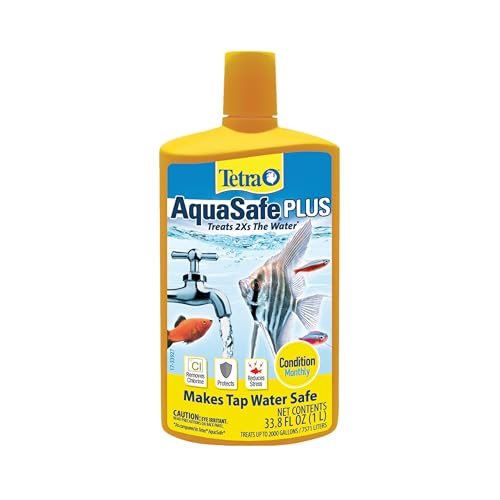
Tetra AquaSafe Plus
- Dosing
- inner ring treats 10 gal; full cap treats 20 gal
- Removes
- chlorine, chloramines, heavy metals
- Ammonia claim
- none stated
- Bottle (listing)
- 33.8 fl oz
Fits: a 10 or 20-gallon tank, where the inner-ring and full-cap marks measure one dose without a syringe.
Skip it if: you change large volumes of chloramine water; at 5 mL per 10 gallons it needs five times the dose of Prime.
Check price on AmazonHow did we choose these water conditioners?
Every conditioner here was chosen by reading manufacturer labels and dose instructions against the tap-water chemistry published by UF/IFAS, the EPA and the Merck Veterinary Manual. We did not test any product for chlorine removal or ammonia binding. The criteria were a published claim to neutralise both chlorine and chloramine, a printed dose we could compare, and a US listing matching the exact product. The Tetra listing we link is AquaSafe Plus, and the dose above is Tetra’s figure for that formula. Prices are left out because they change daily. Our process is on the methodology page.
Which water conditioner should you choose for your tank?
Choose by your tap water first, then by tank size and stocking. Three situations cover most owners.
Chloramine water and a new tank
A tank on chloramine water that is still cycling suits Prime or Fritz Complete. Both neutralise chloramine and claim to detoxify the ammonia it releases, which Merck says thiosulfate alone leaves behind. Seachem also publishes the length of its binding claim, up to 48 hours, which Fritz does not.
Chlorine-only water and small tanks
If your utility uses chlorine only, any of the four products works, and the choice comes down to measuring. API’s chlorine dose is 1 mL per 10 US gal (38 L), and Tetra marks its cap so that inner ring treats 10 gal; full cap treats 20 gal, which suits a 10 or 20-gallon tank with no syringe.
Large tanks and big water changes
For a 55-gallon or larger tank, dose per gallon matters most. A 50 percent change on a 75-gallon tank is about 38 gallons of new water: under one capful of Prime or Fritz, but close to four capfuls of Tetra AquaSafe Plus at its label dose. Prime’s listed bottle is 500 mL, and Seachem sells it in 50 mL, 100 mL, 250 mL, 500 mL, 1 L, 2 L, 4 L bottles.
Does leaving tap water out overnight make it safe for fish?
No, not if your utility uses chloramine. UF/IFAS shows that aeration can drive off free chlorine over about 24 hours, but chloramine persists through aeration, and the EPA confirms it lasts longer than chlorine. Because more than one in five Americans receive chloramine-treated water, standing water is not a safe shortcut for most US owners. Use a conditioner rated for chloramine, and check your utility’s water report to see which disinfectant it uses. The aquarium pH guide explains why the pH of conditioned tap water also matters for ammonia toxicity; Seachem states Prime is non-acidic, does not affect pH.
How long does ammonia binding last?
Ammonia binding is temporary: Aquarium Co-Op puts it at up to about 24 hours, and Seachem claims up to 48 hours for Prime. In both cases the bound ammonia is held in a less toxic form while filter bacteria process it, which is why Seachem advises redosing every 24 to 48 hours in an emergency. Binding does not remove ammonia from the tank or replace a working biofilter. The aquarium nitrogen cycle still has to convert it, and readings from the test kits we compare still show total ammonia even while it is bound.
When is a water conditioner not enough?
A water conditioner is not enough when the tank itself produces more ammonia than the filter can handle. In new tank syndrome, the cause is an immature biofilter, and the Merck Veterinary Manual advises changing at least 50 % of the water once total ammonia reaches 2 mg/L . Seachem and Fritz both allow up to five times the normal dose in those emergencies, but the extra product buys time rather than fixing the cause.
Conditioners also cannot fix water that is wrong for the species. Copper is fatal to shrimp, with Shrimp and Snail Breeder putting the danger level near 0.03 mg/L ; API and Tetra claim to detoxify heavy metals, but neither publishes a copper figure, so the label alone cannot confirm a supply is safe for cherry shrimp kept with fish.
Should you dechlorinate water before cleaning a filter?
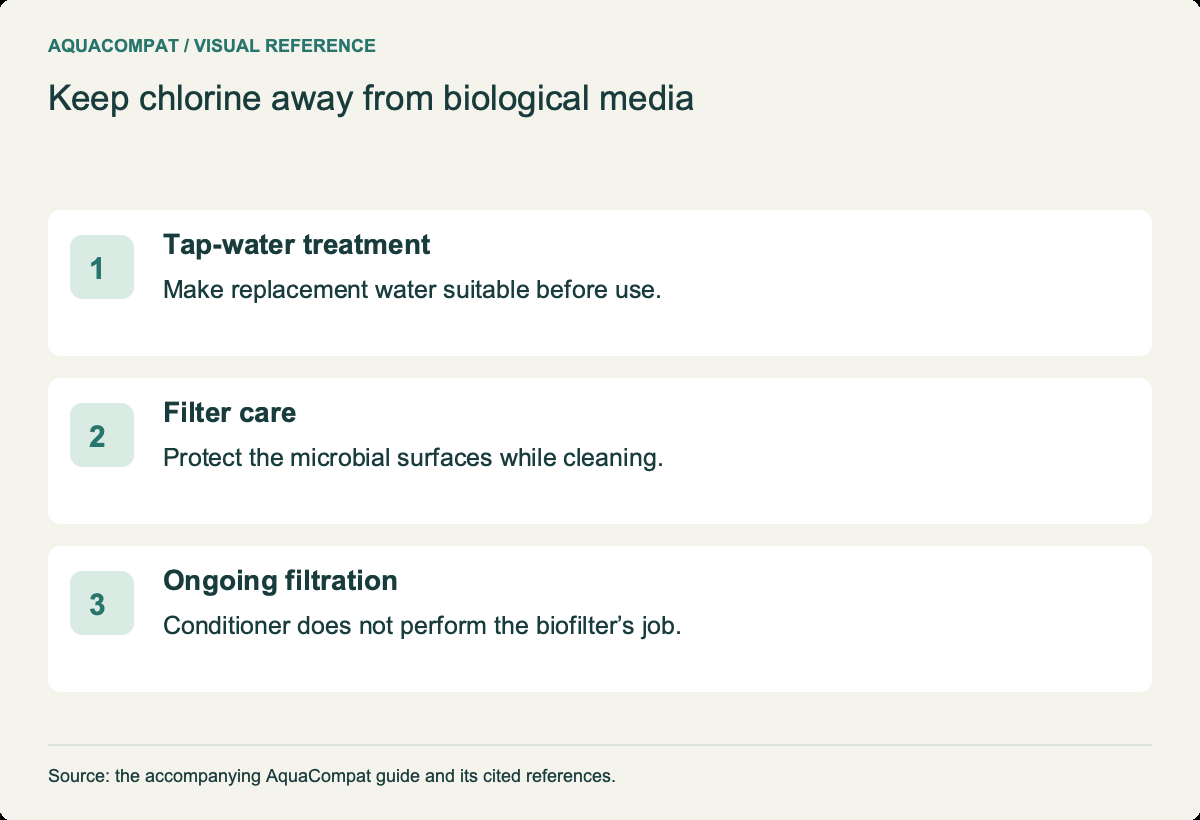
Yes, any water that touches filter media should be free of chlorine. Practical Fishkeeping warns that chlorine in tap water kills the nitrifying bacteria on filter media, so rinse sponges and canister media in conditioned water or water taken from the tank. That applies equally to the canister filters by tank size we recommend and to the best sponge filters for shrimp and fry tanks.
Are these water conditioners sold in Europe?
Tetra lists AquaSafe Plus for the US; we have no verified sales region for Seachem Prime, API Tap Water Conditioner or Fritz Complete. The chloramine figures on this page come from the US EPA and describe US water. European owners should ask their water supplier whether it uses chlorine or chloramine and pick any conditioner that names both on the label, comparing doses per 5 mL as in the table above.
Questions people ask
How much Seachem Prime do I use for a 10-gallon tank?
Seachem’s label dose is 5 mL per 200 L (50 US gal) of new water, which works out to 1 mL per 10 US gallons of new water. Dose for the volume of water you are adding, not the whole tank, unless you are treating an ammonia or nitrite emergency.
Can you overdose a water conditioner?
Seachem allows up to 5x normal dose in emergencies, and Fritz says its dose may be repeated or increased up to 5x within 24 hours. API and Tetra publish no emergency dose in our sources, so stay at their label dose.
Is API Tap Water Conditioner enough for chloramine?
API says it neutralises chloramines, but at a higher dose of 5 mL per 30 US gal (114 L). Merck notes that breaking chloramine releases ammonia, and API makes no ammonia claim in our source, so a fully cycled filter matters more with this product.
Why does Seachem Prime smell of sulfur?
Seachem states that a sulfur smell is normal for Prime , so the odour on its own is not a sign that the bottle has gone off. Seachem gives no further explanation in the source we read.
Do I need a water conditioner with RO water?
Michigan State University Extension notes that RO units commonly use activated carbon prefilters to protect chlorine-sensitive membranes . Check that your unit has one. If you mix RO water with tap water, condition the tap portion for its own volume.
Sources 35 documents from 19 publishers
- Amazon (amazon.com): “API Tap Water Conditioner 16-Ounce Bottle”; “Seachem Prime 500 ml / 17 fl oz”
- Amazon.com (amazon.com): “Tetra AquaSafe Plus Water Conditioner & Dechlorinator For Aquarium, 33.8 oz | Treats 2X the Water as Standard AquaSafe, Makes Tap Water Safe, Reduces Fish Stress, Removes Chlorine, Use Monthly”; “Fritz Aquatics Fritz Complete Water Conditioner/Dechlorinator Instantly Removes Chlorine & Chloramines/Detoxifies Nitrite & Nitrate for Fresh & Salt Water Aquariums (16-Ounce)”
- API Fishcare (apifishcare.com): “API Tap Water Conditioner”
- Aquarium Co-Op (aquariumcoop.com): “Does dechlorinator remove ammonia?”; “Guide to Aquarium Water Changes”; “Care Guide for Cherry Shrimp”
- Fritz Aquatics (fritzaquatics.com): “Fritz Complete”
- Green Aqua (greenaqua.hu): “Shrimp in the aquarium”
- Merck Veterinary Manual (merckvetmanual.com): “Environmental Diseases of Aquatic Animals in Aquatic Systems, Francis-Floyd, Yanong and Petty”; “Disorders and Diseases of Fish (pet owner version)”; “Special Considerations for Fish (pet owner version)”; “Routine Health Care of Fish (pet owner version)”; “Providing a Home for Fish (pet owner version)”
- Michigan State University Extension (archive) (sanweb.lib.msu.edu): “Reverse Osmosis for Home Treatment of Drinking Water (WQ24, 1990)”
- Planted Aquaria (retailer, label text) (plantedaquaria.ca): “Fritz Complete Water Conditioner”
- Practical Fishkeeping (practicalfishkeeping.co.uk): “Problem solver: New Tank Syndrome”; “How often should I change my water?”; “Frequently asked questions on Neocaridina shrimps”; “An introduction to Shrimp”
- SaltyShrimp (product information via Furry Critter Network) (furrycritter.com): “SaltyShrimp Remineralizers for Invertebrates”
- Seachem (seachem.com): “Prime”
- Shrimp and Snail Breeder (aquariumbreeder.com): “Red Cherry Shrimp: detailed guide, care, diet and breeding”; “Cherry Shrimp in a Community Tank”; “How Copper Affects Dwarf Shrimp”
- Shrimp Science (shrimpscience.com): “Red Cherry Shrimp - Care Guide”; “General Hardness (GH) For Shrimp Tanks”; “Carbonate Hardness (KH) For Shrimp Tanks”; “TDS For Shrimp Tanks”
- Southern Regional Aquaculture Center (srac.msstate.edu): “SRAC 4606: Interpretation of Water Analysis Reports for Fish Culture”
- Tetra (Spectrum Brands) (tetra-fish.com): “AquaSafe Plus”
- UF/IFAS EDIS (ask.ifas.ufl.edu): “FA16: Ammonia in Aquatic Systems (Francis-Floyd, Watson, Petty, Pouder)”
- University of Florida IFAS Extension (EDIS) (ask.ifas.ufl.edu): “Teach Aquaculture Curriculum: Chlorine, Friend or Foe? (FA171), Chapman et al.”
- US Environmental Protection Agency (epa.gov): “Chloramines in Drinking Water”
All sources accessed . Every number on this page comes from these documents.