What in tap water can harm aquarium fish?
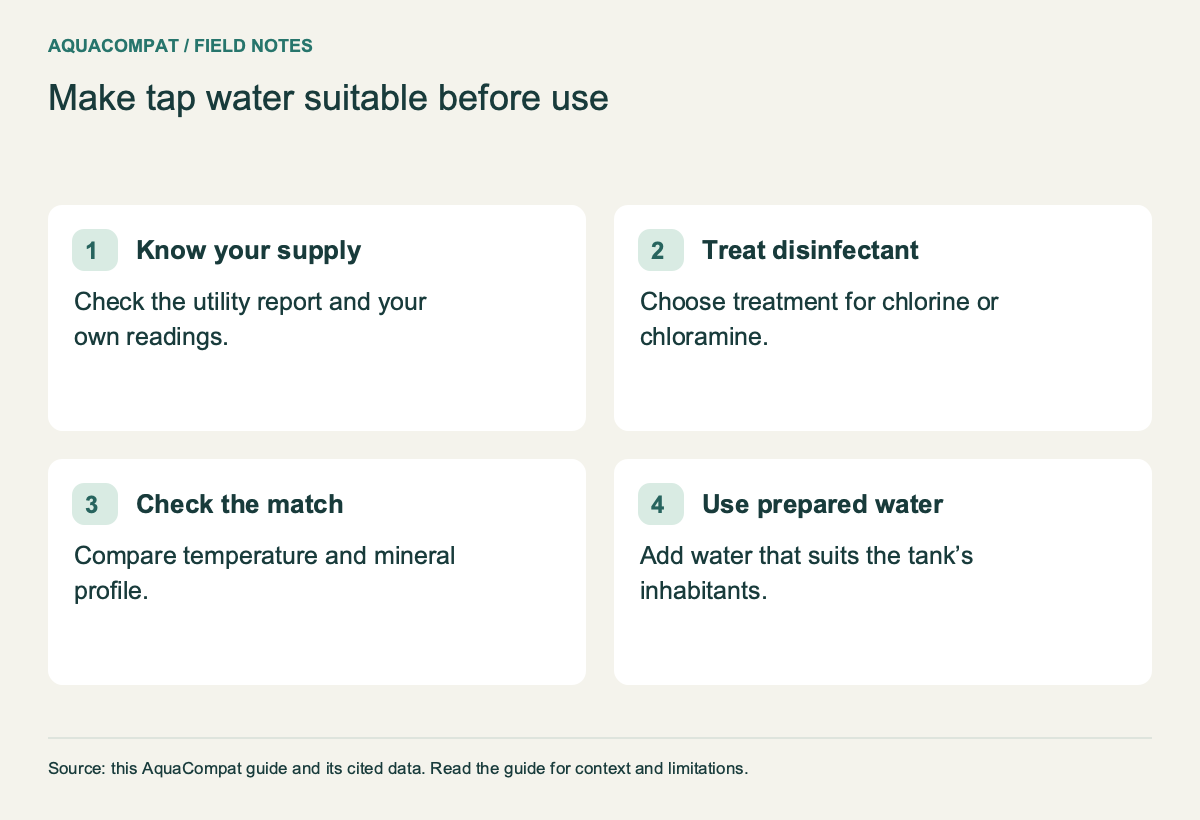
The disinfectants that make tap water safe to drink are the main threat to aquarium fish. Municipal water is treated with chlorine, and many utilities add ammonia to form chloramine, a longer-lasting disinfectant. UF/IFAS Extension (FA171, Chapman and colleagues), the US Environmental Protection Agency and the Merck Veterinary Manual all describe both as safe for people at regulated levels but highly toxic to fish. Tap water must therefore be treated before it touches fish or filter media.
The table lists what the sources in our fact base say about each component, in the order most fishkeepers meet them.
| Component | Why it is in tap water | Risk to fish | How it is removed |
|---|---|---|---|
| Chlorine | Disinfection | Adverse effects from 0.02 mg/L chlorine; deaths at about 0.04 mg/L chlorine | Sodium thiosulfate instantly, or 24 hours of vigorous aeration |
| Chloramine | Longer-lasting disinfection in pipes | Toxic like chlorine and persists through aeration | Chemical conditioner only |
| Ammonia freed from chloramine | Released when chloramine is neutralised | The same ammonia the nitrogen cycle has to clear | Ammonia-binding conditioner, then the biofilter |
| Residual after treatment | Under-dosing or untreated top-ups | Any detectable amount is too much | Target 0 mg/L (none detectable) |
How common is chloramine in tap water?
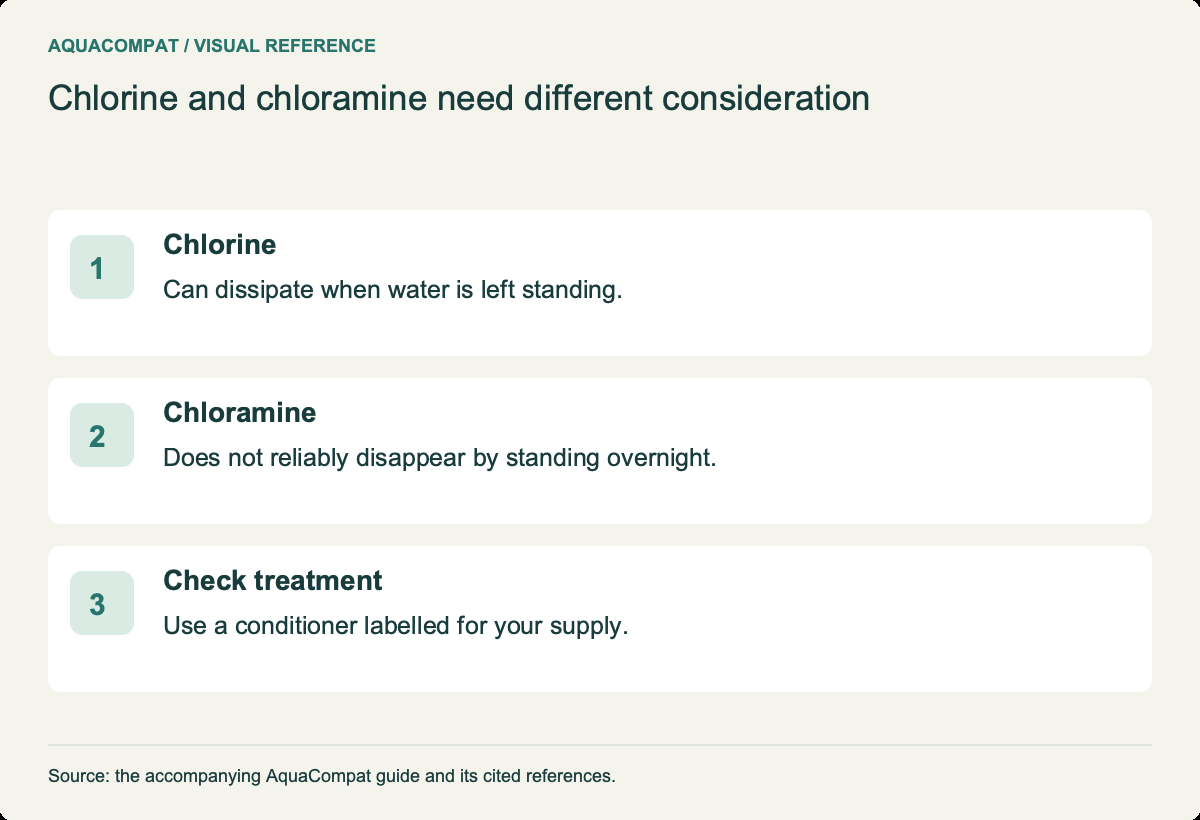
Chloramine is common: the US EPA says more than one in five Americans use chloramine-treated water. Chloramine forms when a utility adds ammonia to chlorine. The EPA explains that utilities choose it to meet rules on disinfection byproducts and because it lasts longer in the distribution pipes. That persistence is the reason it matters to fishkeepers, because the methods that clear chlorine do not clear chloramine.
Our fact base holds no typical residual level for municipal water, so this guide gives no figure for how much chlorine a tap normally carries. The legal ceiling is known: US federal rules allow public systems a maximum residual of 4 mg/L of chlorine or of chloramine, measured as chlorine, a level set for people that sits far above what fish tolerate. Because chloramine is widespread and cannot be aired off, the safe working assumption is that your supply may contain it: treat every litre with a conditioner that handles chloramine, and test the result.
How do you remove chlorine and chloramine from tap water?
You remove both with a water conditioner, also called a dechlorinator, dosed to the volume of new water before it enters the tank. UF/IFAS states that sodium thiosulfate neutralises chlorine instantly, and Merck recommends keeping it on hand. Aeration is the only non-chemical option, and it works for chlorine alone: UF/IFAS describes 24 hours of vigorous aeration to de-gas free chlorine, but chloramine survives aeration and must be neutralised chemically.
Why chloramine needs an ammonia binder
Breaking chloramine apart releases its ammonia. Merck notes that sodium thiosulfate frees ammonia from chloramine, and both Seachem and Aquarium Co-Op recommend conditioners that also bind ammonia. Aquarium Co-Op says binders hold ammonia in a less toxic form for up to about 24 hours while the biofilter processes it; Seachem’s own figure for Prime is up to 48 hours. The two figures come from a hobby retailer and a manufacturer respectively, and neither is an independent test. In a cycled tank the bacteria described in the nitrogen cycle guide clear that ammonia; in a new tank they may not yet exist.
The table compares four common conditioners using their makers’ label claims. It is not a ranking, and the deeper comparison of tap water conditioners covers each product’s limits.
| Conditioner | Neutralises | Ammonia claim | Label dose |
|---|---|---|---|
| Seachem Prime | chlorine, chloramine | Detoxifies ammonia, nitrite, nitrate | 5 mL per 200 L (50 US gal) of new water |
| Fritz Complete | chlorine, chloramine, heavy metals; detoxifies ammonia, nitrite and nitrate | Included in the neutralising claim | 5 mL per 50 US gal |
| API Tap Water Conditioner | chlorine, chloramines, heavy metals (copper, lead, zinc) | Not stated in our data | 1 mL per 10 US gal (38 L) (chlorine); 5 mL per 30 US gal (114 L) (chloramine) |
| Tetra AquaSafe Plus | chlorine, chloramines, heavy metals | none stated | 5 mL per 10 US gal |
How much conditioner should you add?
Dose for the volume of new water you are adding, following the label, because each product is concentrated differently. Seachem Prime’s label gives 5 mL per 200 L (50 US gal), dosed to the new water only, not the whole tank. API’s conditioner is the one in the table with separate doses: the lower rate covers chlorine and heavy metals, and the higher rate applies where chloramine is present. Tetra AquaSafe Plus needs the most product per gallon of the four, at 5 mL per 10 US gal.
Two products allow higher doses in emergencies. Seachem permits up to 5x normal dose in emergencies, and Fritz says Complete may be repeated or increased up to 5x within 24 hours for very high chloramine or nitrite. Those are manufacturer instructions for specific emergencies, not routine doses. Seachem also states that Prime is non-acidic, does not affect pH, and notes that a sulfur smell from the bottle is normal.
What should you test in tap water before using it?
After treatment, tap water should test at zero chlorine, and its pH, hardness, ammonia and nitrate should be known before fish depend on it. Merck and UF/IFAS both require 0 mg/L (none detectable) of chlorine or chloramine when animals are present. The checks below are listed in order of how directly they affect fish.
- Chlorine. Confirm none is detectable after dosing, especially the first time you use a new conditioner or a new source.
- Ammonia. Chloraminated water carries ammonia that a conditioner binds but does not remove, so a tap sample can show ammonia on a test kit.
- pH and KH. Your tap sets the tank’s starting pH and its buffer against swings; the guide to aquarium pH explains how the two interact.
- GH. General hardness decides whether soft-water or hard-water species will suit the tank, as set out in the GH and KH guide.
- Nitrate. Practical Fishkeeping and Aquarium Co-Op judge tank nitrate against tap water, aiming to stay below about 40 ppm or within that margin of the tap reading.
Temperature is the last check. Merck’s general rule for handling fish is a change of no more than 1 °F or °C per hour, so new water should be matched to the tank before it goes in; species ranges are listed in the aquarium temperature guide by species. Kits that cover all five readings are compared in the guide to choosing aquarium test kits.
Does your tap water suit the species you want to keep?
Treated tap water suits a species when its pH and hardness fall inside that species’ published range, and the easiest tank to run is one stocked to match the tap. Hard, alkaline tap water suits livebearers: mollies are listed at pH 7.5–8.5 and 15–25 dGH. Soft-water fish sit at the other end: neon tetras are listed at pH 5.0–7.5 and 1–12 dGH. A tap reading that fits one of those species will usually miss the other.
When tap water is too hard for the fish or shrimp you want, the usual fix is to dilute it with purified water rather than chase pH with chemicals. The guide to RO/DI water for aquariums explains when that is worth doing and why pure RO water must be remineralised. For deciding which species share a tank, the fish compatibility checker shows the shared pH and hardness band for any two species.
Can you just leave tap water to stand overnight?
No, standing water is not a reliable treatment. The only non-chemical method in the sources is vigorous aeration for 24 hours, which UF/IFAS describes for free chlorine; still water in a bucket is not the same as vigorous aeration. More importantly, chloramine persists through aeration, so on a chloraminated supply, which the EPA puts at more than one in five Americans, no amount of standing makes the water safe. A conditioner dosed to the new water volume is the method every source supports.
What goes wrong when tap water is not treated?
Untreated tap water harms fish directly and kills the filter bacteria that protect them. The second problem is easy to miss because it shows up days later.
Chlorine in the tank
Merck’s thresholds leave almost no margin: adverse effects begin around 0.02 mg/L chlorine and deaths at about 0.04 mg/L chlorine. A water change or top-up with untreated tap water can expose fish to chlorine at or above those levels.
Chlorine on the filter
Practical Fishkeeping warns that the chlorine in tap water kills the beneficial bacteria in filter media, so media should never be rinsed under the tap. Losing those bacteria lets ammonia build again, the same problem a new tank faces before it has cycled. Rinse media in old tank water instead. If you are starting from scratch, how to cycle a new aquarium (fishless method) sets out the routine, and the conditioner you choose should be one that neutralises chlorine before any media or bacteria product goes in.
Where does tap water fit with the rest of aquarium water care?
Tap water is the starting point for every other water parameter: once it is dechlorinated, its pH, hardness and nitrate set the baseline the tank drifts from between water changes. Treat every litre, test the result, and choose species whose ranges include what comes out of your tap. The other topics are collected in the water chemistry and setup guides.
Questions people ask
How do I know if my tap water has chloramine?
The sources behind this guide give no home test that distinguishes chloramine from chlorine, so the cautious approach is to assume it. The US EPA says more than one in five Americans use chloramine-treated water, so assume it may be present and use a conditioner that both neutralises chloramine and binds the ammonia it releases.
Why does my treated tap water show ammonia?
Chloramine is chlorine combined with ammonia. Merck explains that neutralising it with sodium thiosulfate frees that ammonia, and an ammonia-binding conditioner holds it in a less toxic form rather than removing it. Aquarium Co-Op says binders work for up to about 24 hours, which gives a cycled biofilter time to process it.
Can I use hot tap water for water changes?
Our fact base has no source on hot-water plumbing for aquariums, so this guide cannot say whether it is safe for your pipes. What the sources do give is a temperature rule: Merck advises a change of no more than 1 °F or °C per hour when handling fish, so whatever water you use should match the tank temperature before it goes in.
Do I need to dechlorinate water for a fishless cycle?
Yes. Practical Fishkeeping warns that chlorine kills nitrifying bacteria, and a fishless cycle exists only to grow those bacteria. Treat the fill water and every later top-up so that tests show 0 mg/L (none detectable) of chlorine before ammonia dosing starts.
Do water conditioners remove heavy metals?
Three of the four conditioners in the table claim to. API says its Tap Water Conditioner detoxifies heavy metals such as copper, lead and zinc, and Tetra and Fritz list heavy metals among what their products neutralise. These are manufacturer claims without a published concentration limit in our data, so they are not a substitute for avoiding copper in tanks with shrimp or snails.
Sources 22 documents from 14 publishers
- API Fishcare (apifishcare.com): “API Tap Water Conditioner”
- Aquarium Co-Op (aquariumcoop.com): “Does dechlorinator remove ammonia?”; “Guide to Aquarium Water Changes”
- Fritz Aquatics (fritzaquatics.com): “Fritz Complete”
- Maidenhead Aquatics (fishkeeper.co.uk species data sheet) (fishkeeper.co.uk): “Molly data sheet”; “Neon Tetra data sheet”
- Merck Veterinary Manual (merckvetmanual.com): “Environmental Diseases of Aquatic Animals in Aquatic Systems, Francis-Floyd, Yanong and Petty”; “Disorders and Diseases of Fish (pet owner version)”; “Special Considerations for Fish (pet owner version)”; “Routine Health Care of Fish (pet owner version)”; “Providing a Home for Fish (pet owner version)”
- Planted Aquaria (retailer, label text) (plantedaquaria.ca): “Fritz Complete Water Conditioner”
- Practical Fishkeeping (practicalfishkeeping.co.uk): “Problem solver: New Tank Syndrome”; “How often should I change my water?”
- Seachem Laboratories (manufacturer) (seachem.com): “Prime”
- Seriously Fish (seriouslyfish.com): “Poecilia sphenops”; “Paracheirodon innesi (Neon Tetra)”
- Tetra (Spectrum Brands) (tetra-fish.com): “AquaSafe Plus”
- UF/IFAS EDIS (ask.ifas.ufl.edu): “FA16: Ammonia in Aquatic Systems (Francis-Floyd, Watson, Petty, Pouder)”
- University of Florida IFAS Extension (EDIS) (ask.ifas.ufl.edu): “Teach Aquaculture Curriculum: Chlorine, Friend or Foe? (FA171), Chapman et al.”
- US Code of Federal Regulations (eCFR) (ecfr.gov): “40 CFR 141.65 Maximum residual disinfectant levels”
- US Environmental Protection Agency (epa.gov): “Chloramines in Drinking Water”
All sources accessed . Every number on this page comes from these documents.