Check two species
Pick any two species. The verdict uses the same data and scoring as every pair guide on this site.
How does the checker decide?
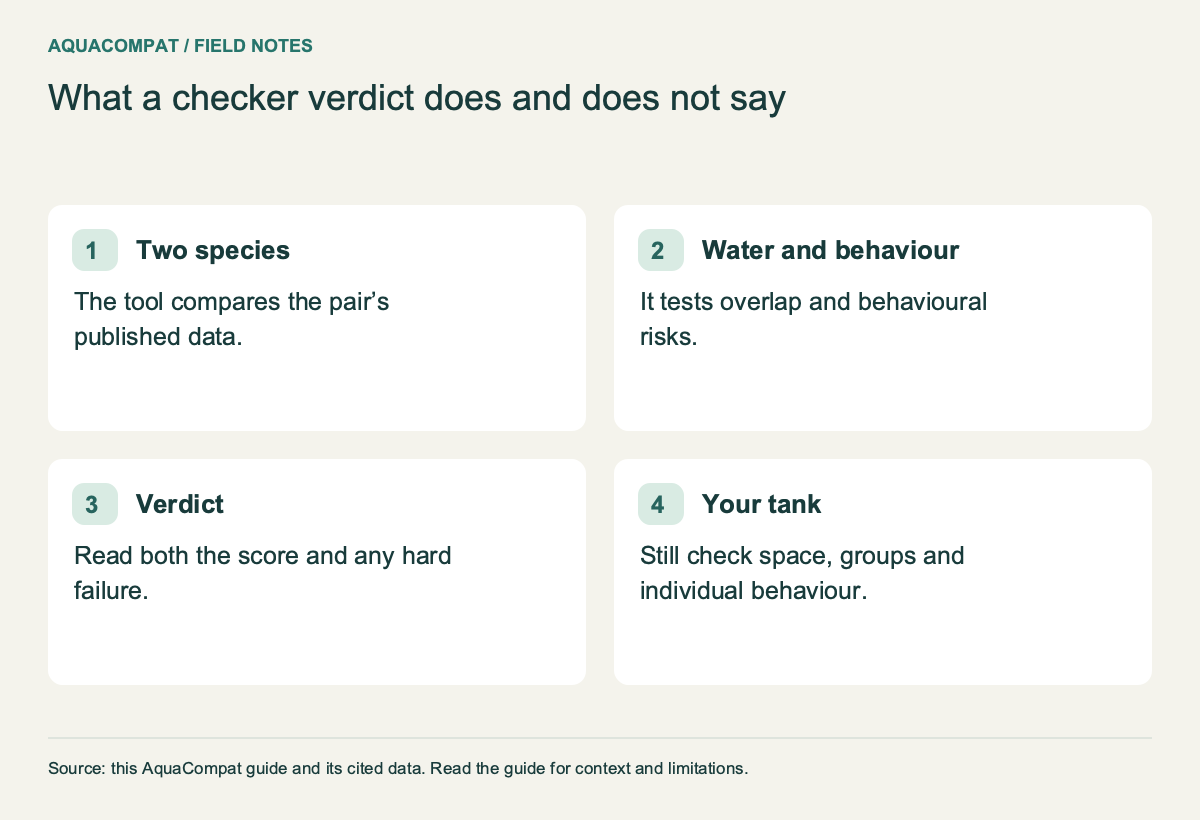
The checker decides by comparing the two species' published fact files on six weighted factors and turning the result into a score out of 10. Temperature overlap and temperament each count for 25%, adult size and predation risk for 20%, pH overlap for 15%, general hardness (GH) overlap for 10% and swim level for 5%. GH, short for general hardness, is the amount of dissolved calcium and magnesium in the water, measured in degrees (dGH). The full formula, including how each overlap is measured and how missing data is handled, is set out on the AquaCompat methodology page; the summary below is what you need to read a result.
| Result line | Weight | Full marks when | Biggest penalty when |
|---|---|---|---|
| Temperature overlap | 25% | One range fits inside the other | No shared range: deal-breaker |
| pH overlap | 15% | One range fits inside the other | No shared range: deal-breaker |
| Hardness overlap | 10% | One range fits inside the other | No shared range: factor scores 0 |
| Temperament | 25% | Both species are peaceful | Aggressive with peaceful: deal-breaker |
| Size and predation | 20% | Adult lengths are within 1.5 times each other | Three times longer and a documented predator: deal-breaker |
| Swim level | 5% | Species use different layers, or either uses the whole tank | Both keep to the same single layer |
| Smallest tank together | Not scored | Shown in US gallons and litres | Raised by half when either species is semi-aggressive |
Which problems make a pair incompatible on their own?
Four deal-breakers make a pair incompatible regardless of its other factors, and each one caps the score at 3. They are the problems that no amount of good matching elsewhere can fix:
- the two species share no temperature range;
- the two species share no pH range;
- the larger species is at least three times the length of the smaller one and its fact file records it eating smaller animals;
- an aggressive species is paired with a peaceful one.
A missing hardness overlap is deliberately not on this list. It costs the pair its full 10% hardness weight, but because hardness depends heavily on the source water you use, it lowers the score rather than deciding it. When a deal-breaker applies, the result panel names it on a separate line under the factor list.
How do you read a checker result?
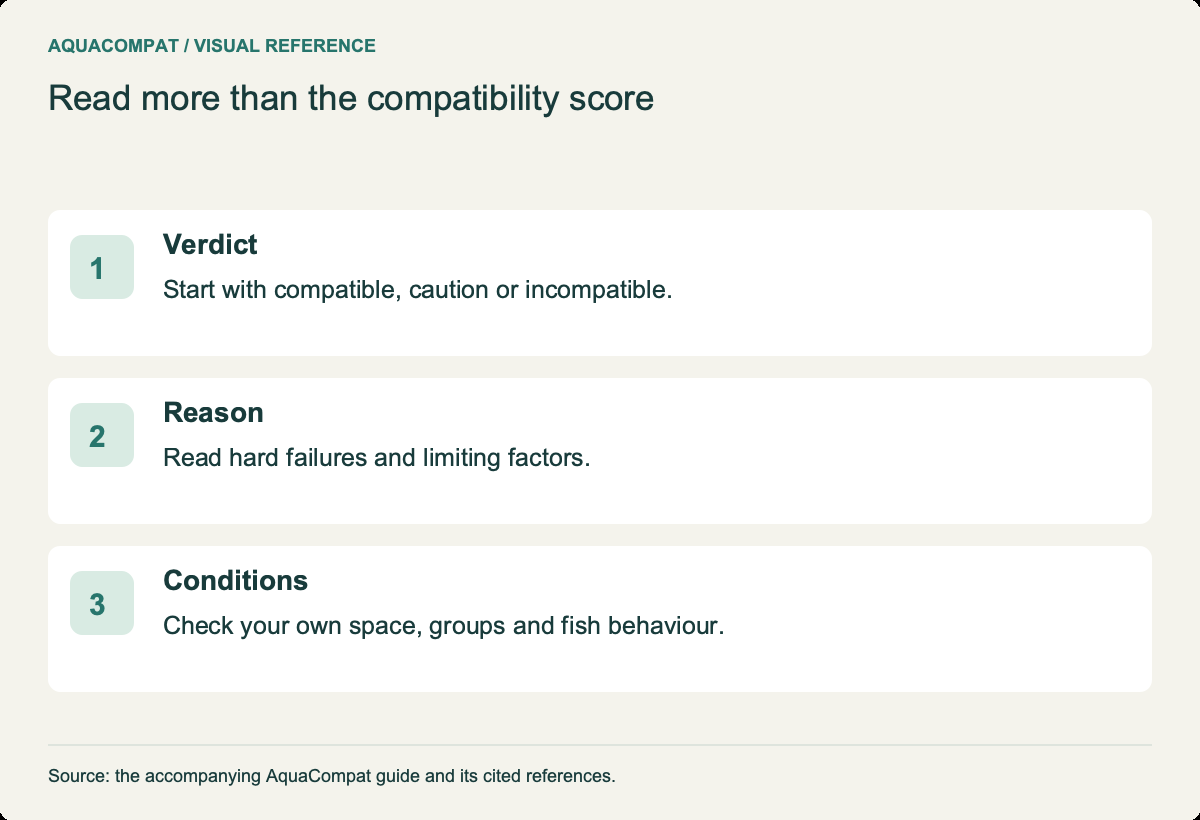
Read the verdict first, then the factor lines that scored lowest, then the smallest tank. The verdict label and the score out of 10 sit at the top of the panel. Each factor line below shows that factor's own score out of 10 and, for the three water factors, the shared range in °F and °C, pH units or dGH.
What does each verdict mean?
Each verdict maps to a score band and a practical next step:
- Compatible (8 to 10): the species overlap on water and size and neither threatens the other. Set the tank to the shared ranges shown.
- Caution (5 to 7): the pair can work, but at least one factor is weak. Find the lowest factor line; that is the condition you will have to manage, such as a narrow temperature band or a semi-aggressive fish.
- Incompatible (1 to 4): the factors are too far apart, or a deal-breaker applies. Look for a different tank mate.
What does "not scored" mean?
A factor marked not scored had no qualifying data for one of the species, so it was left out and the other weights were scaled up to fill its share. Invertebrates such as shrimp and snails often have no recorded swim level, for example. A verdict with one small factor missing is still useful, but treat it as resting on less evidence.
How should you use the smallest tank figure?
Use the smallest tank figure as a floor for those two species alone. It starts from the larger of the two species' own minimum tank sizes, adds half again if either fish is semi-aggressive, and rounds up to a standard tank size. It does not account for the rest of your community, so a third or fourth species can push the real minimum higher.
What do real checker results look like?
The four pairs below show how the factors combine in practice. Each one is a common question, and each produces a different kind of result. Scores and shared ranges are read live from the pair data, so they always match what the checker shows.
Betta fish and guppy
The betta and guppy pairing currently returns caution with a score of 7 out of 10. The water lines are not the weak point here: the two share a temperature band of 72–82 °F (22–28 °C) and a pH band of pH 7.0–8.0. Size is close too, with a 2.8 in (7.1 cm) betta against a 2.4 in (6.1 cm) guppy. The factor that pulls the score down is temperament: a semi-aggressive betta with a peaceful guppy scores 0.55 on a factor worth a quarter of the total. Seriously Fish notes that a male betta may attack fish with trailing fins, which describes many fancy guppies, and the betta and guppy guide looks at that risk alongside the full factor breakdown. The smallest tank for the pair is 20 US gal (76 L).
Betta fish and neon tetra
The betta and neon tetra pairing returns caution at 7 out of 10, and it shows how a narrow water overlap and a size gap stack up. Neon tetras are listed at 70–77 °F (21–25 °C) and bettas at 72–86 °F (22–30 °C), so the shared temperature band is only 72–77 °F (22–25 °C), at the cool end of the betta's range. The betta is more than twice the neon's 1.2 in (3 cm) length, which costs points on the size factor, and the same 0.55 temperament score applies. The semi-aggressive betta also raises the smallest tank to 29 US gal (110 L). The bettas and neon tetras compatibility page goes through each factor in more detail.
Neon tetra and oscar
The neon tetra and oscar pairing is the clearest deal-breaker among common species. An adult oscar reaches 14 in (35.6 cm), many times the neon tetra's length, and the oscar's fact file records Seriously Fish and Aquarium Co-Op describing it as a predator that will eat any fish small enough to swallow. That combination triggers the predation deal-breaker, so the pair returns incompatible with a capped score of 3, even though the two share a temperature band of 74–77 °F (23–25 °C). Matching water never rescues a predator and prey pairing. The oscar's own needs also set a smallest tank of 125 US gal (473 L).
Guppy and molly
The guppy and molly pairing returns compatible at 9 out of 10, the profile of two livebearers that want similar water. Both are labelled peaceful, so temperament scores full marks, and their temperature ranges share 70–82 °F (21–28 °C). Their pH overlap of pH 7.5–8.0 is narrower, because mollies are listed at pH 7.5–8.5, higher than most of the community fish in the checker. Mollies also grow to 5 in (12.7 cm), about twice a guppy's length, which costs some points on size. The guppy and molly pairing sets out the shared ranges side by side.
Which species are included in the checker?
The checker includes 22 freshwater species in nine groups, and every possible pair among them, 231 in total, has a score. Each species has a care guide with its full sourced ranges. The species are listed below by group.
- Tetras: Neon Tetra (neon tetra care guide), Cardinal Tetra (cardinal tetra profile) and GloFish Tetra (GloFish tetra profile).
- Livebearers: Guppy (guppy profile), Molly (molly profile), Platy (platy profile) and Endler's Livebearer (Endler's livebearer profile).
- Cichlids: Angelfish (angelfish profile), Discus (discus profile) and Oscar (oscar profile).
- Labyrinth fish: Betta Fish (betta care guide) and Dwarf Gourami (dwarf gourami profile).
- Catfish and bottom dwellers: Corydoras (corydoras profile), Bristlenose Pleco (bristlenose pleco profile) and Kuhli Loach (kuhli loach profile).
- Shrimp and snails: Cherry Shrimp (cherry shrimp profile), Amano Shrimp (Amano shrimp profile), Mystery Snail (mystery snail profile) and Nerite Snail (nerite snail profile).
- Rasboras: Harlequin Rasbora (harlequin rasbora profile).
- Danios: Zebra Danio (zebra danio profile).
- Coldwater fish: Goldfish (goldfish profile).
Goldfish are the outlier in this list. As a coldwater species they share little temperature range with most tropical fish, and their temperament has no qualifying source yet, so their pairs are scored on the remaining factors. For a ranked list of partners for one fish rather than a single pair, the tank mates hubs such as compatible tank mates for bettas and neon tetra tank mates sort every scored pair from best to worst.
What can the compatibility checker not tell you?
The compatibility checker cannot tell you how your particular fish will behave, and it scores two species at a time. A fish compatibility chart built from published ranges describes the species, not the individual, and these limits follow from that:
- Individual fish differ. A peaceful species can produce a bully, and a semi-aggressive betta can ignore its tank mates. Watch new additions closely for the first weeks.
- Pairs, not communities. A five-species tank involves ten pairs, and the checker does not add their bioloads together. Check each pair, then size the tank for the whole group.
- Captive-bred ranges. Displayed ranges aim at captive-bred aquarium stock. Wild-caught fish, such as some discus, can need water closer to their native habitat.
- Behaviour beyond predation. Fin-nipping and males fighting their own kind appear as notes on each species page, but only documented predation feeds the size score.
- Not veterinary advice. For illness or medication questions, consult an aquatic veterinarian.
The contrasting case matters too: an incompatible result is not a judgement on either species, only on that pairing. A betta that scores poorly with one tetra can still score well with a bottom dweller, so the next step after a poor result is usually another check, not giving up on the fish.
Is matching water parameters enough to make fish compatible?
No. Shared water parameters are necessary but not sufficient, which is why temperature, pH and hardness together carry only half of the score. The neon tetra and oscar example above shares a temperature band, yet the oscar's size and documented predation make the pairing a deal-breaker. The opposite also holds: two peaceful species of similar size can still fail if their temperature ranges never meet, as happens between coldwater goldfish and tropical species such as discus or angelfish. Read the guide to aquarium water parameters for what each range means, then let the checker weigh it against temperament and size.
Questions people ask
Can I check more than two species at once?
The checker scores one pair at a time, because each verdict is calculated between two fact files. To plan a tank of three or more species, check every pair in the group; four species means six checks. If every pair is compatible or caution, size the tank for the largest minimum and the combined number of fish.
Why does my pair show a caution verdict when people keep them together?
Caution means the pair can work but at least one factor is weak, often a narrow shared temperature band or a semi-aggressive species. Many keepers succeed with caution pairs by managing that factor. The lowest factor line in the result tells you which condition needs attention.
How often are the checker's scores updated?
Scores are recalculated from the species fact files every time the site is rebuilt. When a source is added, a range is corrected or a single-source value gains a second source, every pair involving that species updates at once. The current species data was verified on 21 October 2026.
Why is my fish not in the checker?
The checker covers 22 species whose temperature, pH, size and temperament could be sourced from published references. A species is added only once its fact file meets that standard, because a pair score built on guessed ranges would be misleading. You can suggest a species through the contact page.
Sources 19 documents from 5 publishers
- Aquarium Co-Op (aquariumcoop.com): “Betta Fish Care Guide”; “Guppy Care Guide”; “Oscar Fish Care Guide”; “Care Guide for Mollies: Feeding, Breeding, and Tank Mates”
- FishBase (fishbase.se): “Betta splendens, Siamese fighting fish: species summary”; “Poecilia reticulata, Guppy: species summary”; “Paracheirodon innesi summary page”; “Astronotus ocellatus, Oscar: species summary”
- Maidenhead Aquatics (fishkeeper.co.uk species data sheet) (fishkeeper.co.uk): “Guppy data sheet”; “Neon Tetra data sheet”; “Oscar data sheet”; “Molly data sheet”
- Seriously Fish (seriouslyfish.com): “Betta splendens”; “Poecilia reticulata”; “Paracheirodon innesi (Neon Tetra)”; “Astronotus ocellatus”; “Poecilia sphenops”; “Poecilia latipinna”
- UF/IFAS EDIS (ask.ifas.ufl.edu): “Evolution, Culture, and Care for Betta splendens (FA212)”
All sources accessed . Every number on this page comes from these documents.