What water parameters does every aquarium keeper need to understand?
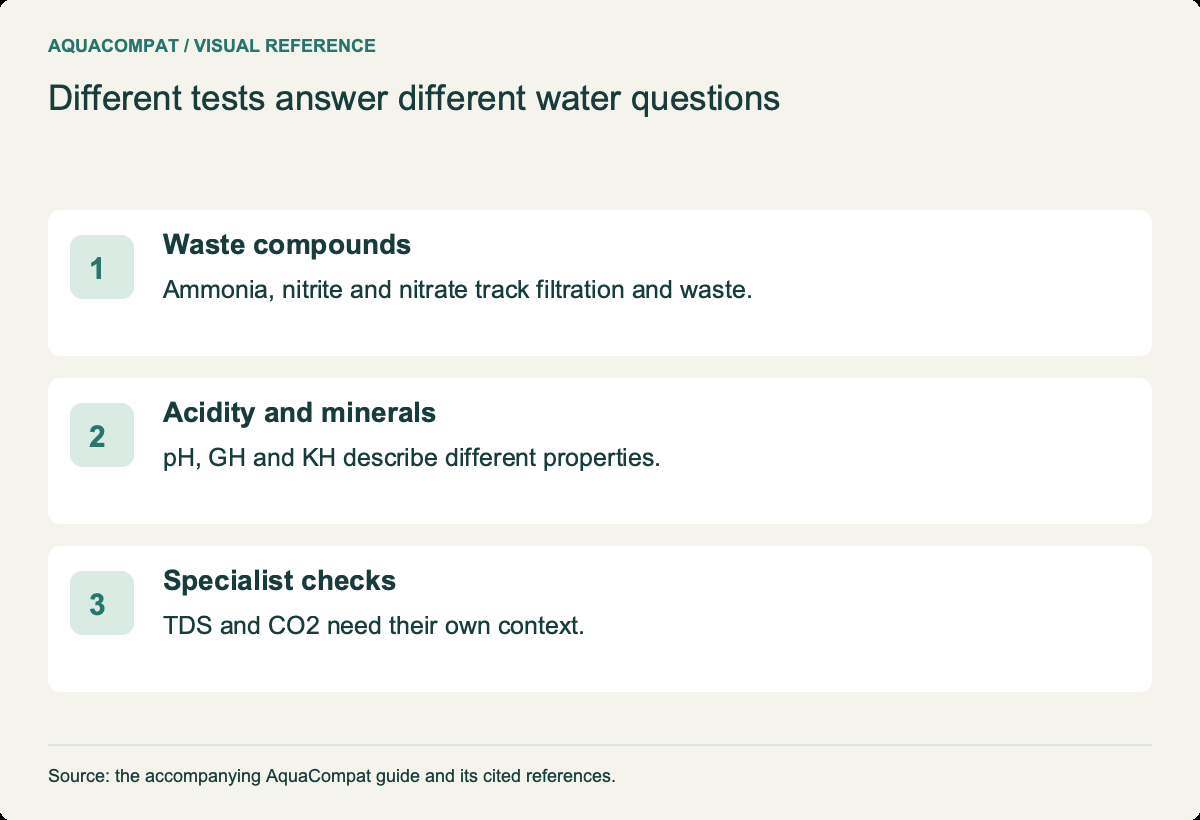
Every aquarium keeper needs to understand five things about tank water: temperature, pH, hardness, the nitrogen compounds (ammonia, nitrite and nitrate) and, for shrimp and planted tanks, dissolved solids and carbon dioxide. A water parameter is any measurable property of the water that affects whether a species can live in it. The table gives one published reference value for each and the guide that explains it.
| Parameter | What it measures | Published reference value | Guide |
|---|---|---|---|
| Temperature | How warm the water is | Tropical community fish: 75–80 °F (hobby references) | Temperature by species |
| pH | How acidic or alkaline the water is | Freshwater fish in general: 6.5–9.0 pH (SRAC, Merck) | Aquarium pH |
| GH and KH | Dissolved calcium and magnesium; carbonate buffer | 1 dGH or dKH = 17.848 mg/L (ppm) CaCO3 per 1 dGH | GH and KH |
| Ammonia | Fish waste before bacteria process it | Gill damage from 0.05 mg/L un-ionized ammonia (UF/IFAS) | Nitrogen cycle |
| Nitrite | The middle stage of the cycle | Toxic from 0.1 mg/L nitrite | Nitrogen cycle |
| Nitrate | The end product, removed by water changes | Freshwater reference: 20 mg/L (freshwater reference range, less than) (Merck) | Maintenance schedule |
| TDS | Total dissolved solids | Neocaridina shrimp: 200–250 ppm | TDS for shrimp |
| CO2 | Dissolved carbon dioxide | Can be toxic to fish above 12 mg/L (Merck) | CO2 in planted tanks |
In what order should a beginner read the guides?
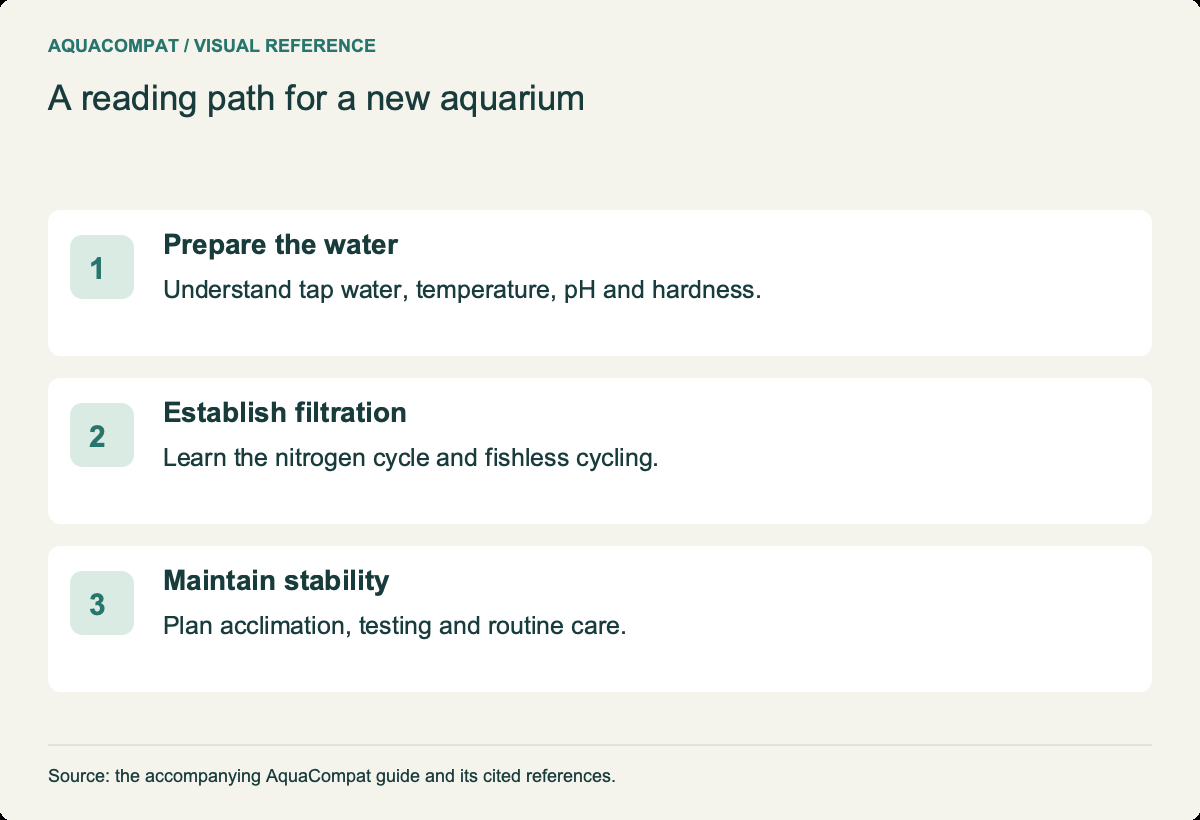
A beginner should read the guides in the order a tank is built: cycle first, then water, then fish, then routine care. Each step depends on the one before it, so reading out of order tends to produce the classic mistake of buying fish for an uncycled tank. The recommended reading order is set out below.
- The aquarium nitrogen cycle. How bacteria turn ammonia into nitrite and nitrate, and why a new tank is unsafe until they do.
- The fishless cycling method. How to grow those bacteria with dosed ammonia before any fish arrive, and how to tell when the cycle is complete.
- How to prepare tap water for aquariums. Chlorine, chloramine and what a conditioner must remove from every refill.
- The aquarium temperature chart. Tropical versus coldwater fish, and how to set a heater for a mixed tank.
- The aquarium pH guide. What pH measures, the ranges species need and why stability matters more than a target number.
- The general and carbonate hardness explainer. Soft versus hard water and how KH holds pH steady.
- The guide to acclimating new fish. Float and drip methods for moving fish from the bag into the tank.
- The weekly aquarium maintenance schedule. Water changes, testing and filter care once the tank is stocked.
After these eight, a keeper who wants live plants moves on to the planted-tank guides, and a keeper who wants shrimp reads the TDS and RO guides. Both groups are covered further down.
How do water parameters decide which fish can share a tank?
Water parameters decide which fish can share a tank because two species can only live together inside the range both tolerate. Temperature, pH and hardness are three of the six factors in every AquaCompat pair score, and the shared band of two ranges is the figure that matters, not either range alone.
The soft-versus-hard split shows how large the differences are. The Neon Tetra is listed at pH 5.0–7.5 and 1–12 dGH, while the Molly needs pH 7.5–8.5 and 15–25 dGH. The two share almost no water, however peaceful both are. A Corydoras at pH 6.5–7.5 sits between them and overlaps both.
Temperature splits species in the same way. The goldfish at 59–70 °F (15–21 °C) and the discus at 79–86 °F (26–30 °C) have no temperature in common at all. The two-species compatibility checker prints the shared range for any pair, and the fish compatibility guides explain each pairing in full. The scoring rules themselves sit on the methodology page.
How long does it take to set up a new aquarium?
Setting up a new aquarium takes several weeks before the first fish, because published sources give between 4–6 weeks and 6–8 weeks for the nitrifying bacteria to establish. The sources disagree on the exact figure, and the spread is worth knowing.
- UF/IFAS Extension gives 6–8 weeks for a new biofilter, and the Merck Veterinary Manual gives 6–8 weeks.
- Practical Fishkeeping says most tanks take 4–6 weeks.
- Dr Tim's Aquatics, which sells a bacteria starter, gives 30–45 days for a fishless cycle without its product.
Rather than counting days, the cycle is complete when a dose of ammonia clears to zero ammonia and nitrite within 24 hours, the test both Dr Tim's and Practical Fishkeeping use. The fishless cycling guide walks through that test.
Moving the first fish in is quicker. The Merck Veterinary Manual suggests floating the bag for about 20–30 minutes to match temperature, and gives 1 °F or °C per hour as the maximum safe rate of temperature change. A drip method, described by Chewy, takes 30–90 minutes.
What routine keeps aquarium water stable once fish are in?
A routine of regular partial water changes and testing keeps aquarium water stable, because nitrate keeps building between changes even in a fully cycled tank. Published schedules differ slightly. Practical Fishkeeping suggests about 25 % weekly, while the Merck Veterinary Manual's schedule changes water every 2 weeks (interval), with the amount set by how heavily the tank is stocked.
The nitrate level that should trigger more changes also varies by source. Aquarium Co-Op calls nitrate under 40 ppm safe, and Practical Fishkeeping uses the same figure above the level in your tap water, while Merck's freshwater reference value is stricter, at 20 mg/L (freshwater reference range, less than). Sensitive species and shrimp tanks are safer at the lower figure.
The maintenance guide sets these into a weekly and monthly plan, and the aquarium test kit comparison covers the kits used to read nitrate.
Does clear water mean an aquarium is safe?
No. Clear water says nothing about whether an aquarium is safe, because the most dangerous compounds in a new tank are invisible. This is the misconception behind many early fish deaths.
The Merck Veterinary Manual and Practical Fishkeeping both note that ammonia and nitrite are colourless, so a tank can look spotless while poisoning its fish; a test kit is the only way to confirm. Chlorine is just as invisible, and Merck reports fish deaths at 0.04 mg/L chlorine. The reverse is also true: a cloudy bacterial bloom in a cycling tank often looks alarming but is a water-quality signal rather than proof of danger.
The habit that replaces the myth is simple: test ammonia, nitrite and nitrate on a schedule, and test again whenever fish behave differently. The new tank syndrome guide lists the signs that a new tank's water is harming fish.
Which guides cover planted tanks and shrimp tanks?
Five guides cover planted tanks and shrimp tanks, which need more control over light, carbon dioxide and dissolved minerals than a basic fish tank.
Planted tanks
Start with the planted tank setup steps, then decide between a low-tech and a high-tech tank. Aquarium Co-Op describes low-tech as low light, no added CO2 and light fertilising, and lists 10–20 PAR as low light, against 40–50+ PAR for demanding carpet plants. The low-tech planted tank guide covers the easier route. Tropica suggests a photoperiod of 8–10 hours/day once plants settle in. The CO2 guide then explains why targets for high-tech tanks sit close to the level Merck warns can harm fish.
Shrimp tanks
Shrimp keepers track total dissolved solids (TDS), the combined minerals in the water. SaltyShrimp targets 100–150 ppm for Caridina bee shrimp and 200–250 ppm for Neocaridina such as cherry shrimp. Reaching the lower figure usually needs reverse osmosis (RO) water, which Green Aqua describes as 5–10 ppm before minerals are added back. The RO and DI water guide covers remineralising it, and notes from Michigan State University Extension that an RO unit can send 50–90 % of incoming water down the drain.
When do general water guidelines fail a particular species?
General water guidelines fail whenever a species sits at the edge of, or outside, the broad band they describe. A general figure is a starting point for fish as a whole, not a target for your fish.
pH is the clearest example. SRAC and Merck recommend 6.5–9.0 pH for freshwater fish in general, yet the Kuhli Loach is listed at pH 3.5–7.0 and the Cardinal Tetra at pH 4.0–7.5, both reaching well below that band. Temperature works the same way: the hobby tropical range of 75–80 °F is too warm for goldfish and the lower end is too cool for discus.
Nitrate shows how guidance itself changes over time. UF/IFAS notes an older view that freshwater fish tolerate around 200 mg/L nitrate (traditional view), alongside newer concern about long-term exposure, while Merck's aquarium reference is far lower. When a general guide and a species range disagree, the species range wins, and the species care data lists each one with its sources.
All water chemistry and setup guides
- The Nitrogen CycleHow bacteria turn ammonia into nitrite and nitrate, toxic levels and cycle time.
- How to Cycle a New Aquarium (Fishless Method)Dosing ammonia to grow the biofilter before any fish arrive.
- Tap Water for AquariumsChlorine, chloramine and how to make tap water safe for fish.
- Aquarium Temperature Guide by SpeciesA fish temperature chart, tropical versus coldwater, and heater settings.
- Aquarium pHSafe pH ranges by species, testing, and raising or lowering pH slowly.
- GH and KH ExplainedGeneral and carbonate hardness, unit conversions and buffering.
- How to Acclimate New FishFloat and drip methods and safe rates of temperature change.
- Aquarium Maintenance ScheduleWater change size and frequency, testing and filter care.
- How to Start a Planted TankSubstrate, light, fertiliser and planting order for a new planted tank.
- Low-Tech Planted Tank GuideEasy plants under low light with no added CO2.
- CO2 Levels in Planted TanksPlant CO2 targets, fish safety limits and reading a drop checker.
- TDS in Shrimp TanksDissolved solids targets for Caridina and Neocaridina shrimp.
- RO/DI Water for AquariumsWhat reverse osmosis removes and how to remineralise it.
Questions people ask
Which water chemistry guide should a complete beginner read first?
Do I need to adjust pH or hardness for most community fish?
How many tests does a new keeper need to run?
Are the planted-tank guides needed for a few easy plants?
Why do the guides give more than one figure for the same thing?
Sources 94 documents from 20 publishers
- All Pond Solutions (allpondsolutions.co.uk): “Aquarium Heater Buying Guide”
- Aquarium Co-Op (aquariumcoop.com): “How to Choose the Right Aquarium Heater”; “Care Guide for Cory Catfish”; “Care Guide for Fancy Goldfish”; “Guide to Aquarium Water Changes”; “CO2 in Planted Aquariums: What Does It Really Do and Is It Natural?”; “What is PAR? Lighting & Brightness Explained for Planted Tanks”; “How to Balance Aquarium Lights to Grow Healthy Plants (& Avoid Algae)”; “Is Nitrate Good or Bad for Your Aquarium?”; “How to Use Root Tabs to Fertilize Your Live Aquarium Plants”; “Which Planted Tank Fertilizer Is Right for You?”; “Beginner's Guide to Fertilizing Your Planted Tank the EASY Way”; “How to Set Up a Low Tech Planted Aquarium for Beginners”; “Monte Carlo (care page)”; “Care Guide for Kuhli Loaches”; “Care Guide for Cardinal Tetras”; “Anubias Nana (care page)”; “Java Fern (care page)”; “Cryptocoryne Wendtii 'Green' (care page)”; “Java Moss (care page)”; “Care Guide for Java Moss”; “Amazon Sword Plant (care page)”; “Vallisneria (care page)”; “How to Care for Hornwort (Ceratophyllum demersum) in Aquariums & Ponds”; “Water Sprite (care page)”; “Marimo Moss Ball Care Guide”; “Dwarf Sagittaria (care page)”
- Aquasabi (aquasabi.de): “Anubias barteri var. nana”; “Microsorum pteropus”; “Cryptocoryne wendtii 'Green'”; “Taxiphyllum barbieri 'Java moss'”; “Echinodorus grisebachii 'Bleherae'”; “Vallisneria spiralis”; “Ceratopteris thalictroides”; “Sagittaria subulata”
- Chewy (Hilary Jaffe) (chewy.com): “How To Acclimate Fish the Right Way”
- Dr Tim's Aquatics (manufacturer) (drtimsaquatics.com): “Fishless Cycling”
- FishBase (fishbase.se): “Osteogaster aenea, Bronze corydoras”; “Symphysodon aequifasciatus, Blue discus: species summary”
- Flowgrow Aquatic Plant Database (flowgrow.de): “Anubias barteri var. nana”; “Microsorum pteropus”; “Cryptocoryne wendtii 'grün'”; “Taxiphyllum barbieri (Java moss)”; “Echinodorus grisebachii 'Bleherae'”; “Vallisneria spiralis”; “Ceratophyllum demersum”; “Ceratopteris thalictroides”; “Aegagropila linnaei”; “Sagittaria subulata”; “Micranthemum tweediei”
- Green Aqua (greenaqua.hu): “Shrimp in the aquarium”
- Maidenhead Aquatics (fishkeeper.co.uk species data sheet) (fishkeeper.co.uk): “Neon Tetra data sheet”; “Molly data sheet”
- Merck Veterinary Manual (merckvetmanual.com): “Environmental Diseases of Aquatic Animals in Aquatic Systems, Francis-Floyd, Yanong and Petty”; “Management of Aquarium Fish, Petty, Francis-Floyd and Yanong”; “Providing a Home for Fish (pet owner version)”; “Routine Health Care of Fish (pet owner version)”; “Disorders and Diseases of Fish (pet owner version)”; “Special Considerations for Fish (pet owner version)”
- Michigan State University Extension (archive) (sanweb.lib.msu.edu): “Reverse Osmosis for Home Treatment of Drinking Water (WQ24, 1990)”
- Ornamental Aquatic Trade Association (OATA) (ornamentalfish.org): “How to look after fancy goldfish”
- PlanetCatfish (via Internet Archive snapshot, 2025) (web.archive.org): “Osteogaster aenea (Bronze Cory) Cat-eLog data sheet”
- Practical Fishkeeping (practicalfishkeeping.co.uk): “How to Cycle a Fish Tank: The Complete Guide”; “How often should I change my water?”; “Problem solver: New Tank Syndrome”
- SaltyShrimp (product information via Furry Critter Network) (furrycritter.com): “SaltyShrimp Remineralizers for Invertebrates”
- Seriously Fish (seriouslyfish.com): “Paracheirodon innesi (Neon Tetra)”; “Poecilia sphenops”; “Osteogaster aenea (Bronze Cory)”; “Symphysodon aequifasciatus”; “Pangio semicincta ('Kuhli' Loach)”; “Paracheirodon axelrodi (Cardinal Tetra)”
- Southern Regional Aquaculture Center (srac.msstate.edu): “Interactions of pH, Carbon Dioxide, Alkalinity and Hardness in Fish Ponds, SRAC Publication No. 464, Wurts and Durborow”; “Nitrite in Fish Ponds, SRAC Publication No. 462, Durborow, Crosby and Brunson”; “How to Start a Biofilter, SRAC Publication No. 4502, DeLong and Losordo”; “Recirculating Aquaculture Tank Production Systems: Management of Recirculating Systems, SRAC Publication No. 452”
- Tropica Aquarium Plants (tropica.com): “Starting a new aquarium (growing-in guide)”; “Fertiliser and CO2 for your aquarium”; “Hardscape and bottom layer in the tank”; “Trimming”; “Anubias barteri var. nana (101)”; “Microsorum pteropus (008)”; “Cryptocoryne wendtii 'Green' (109)”; “Taxiphyllum barbieri 'Bogor Moss' (003 TC)”; “Echinodorus grisebachii 'Bleherae' (071)”; “Vallisneria 'Gigantea' (054)”; “Vallisneria spiralis 'Tiger' (055A)”; “Ceratophyllum demersum (021A POR)”; “Ceratopteris thalictroides (005A)”; “Aegagropila linnaei (000 CST)”; “Sagittaria subulata (079)”; “Micranthemum tweediei 'Monte Carlo' (025)”
- University of Florida IFAS Extension (EDIS) (ask.ifas.ufl.edu): “Ammonia in Aquatic Systems (FA16/FA031), Francis-Floyd, Watson, Petty and Pouder”
- Wikipedia (en.wikipedia.org): “dGH”
All sources accessed . Every number on this page comes from these documents.