How much CO2 do different planted tanks need?
The CO2 a planted tank needs depends on how demanding its plants are and how bright its light is. Carbon dioxide (CO2) is the gas plants turn into tissue by photosynthesis; dissolved in aquarium water it forms carbonic acid, which is why it also lowers pH. Tropica sorts its plants into difficulty groups and gives a CO2 band for each, while Aquarium Co-Op describes the low baseline that an unfertilised, uninjected tank runs on.
The table lists every published CO2 figure in our fact base, from the lowest to the highest, alongside the fish-health limits that sit in the same range. Plant targets and fish limits come from different kinds of source, so read the last column before choosing a target.
| Situation | CO2 level | Source | Source type |
|---|---|---|---|
| Low-tech tank, no injection | 2–3 ppm | Aquarium Co-Op | Hobby reference |
| Plants rated Medium | 10–15 mg/L | Tropica | Plant grower |
| Fish toxicity warning | Above 12 mg/L | Merck Veterinary Manual | Veterinary |
| Plants rated Advanced | 15–30 mg/L | Tropica | Plant grower |
| Lush plant growth | 20–25 mg/L | Dennerle | Manufacturer |
| Pond critical level | 20 mg/L | SRAC Publication 468 | Aquaculture extension |
| Catfish tolerance with good oxygen | 20–30 mg/L | SRAC Publication 464 | Aquaculture extension |
| High-tech reference point | 30 ppm | Aquariumscience.org; Aquarium Co-Op | Hobby reference |
What does CO2 do for aquarium plants?
CO2 is the main nutrient aquarium plants use and the main factor limiting their growth. Tropica describes it that way, and Aquarium Co-Op adds that injecting CO2, with light and fertiliser to match, gives faster and stronger growth. A tank short of CO2 can therefore grow slowly even when its nitrogen, phosphorus and potassium are plentiful, because the scarcest input sets the pace.
The amount a plant can use is set by light. Aquarium Co-Op rates low light at about 10–20 PAR, which suits anubias and cryptocorynes running on the baseline CO2 a tank picks up from the air and from animal respiration. Demanding stem and carpeting plants do best at 40–50+ PAR, and at that brightness the same source says added CO2 is usually needed to keep algae from taking over. If you are still choosing a fixture, the guide to aquarium lights for plant growth compares PAR output by model.
Low-tech and high-tech tanks
The hobby splits planted tanks into two styles by CO2. A low-tech tank uses low light, no injected CO2 and light fertilising about once a week. A high-tech tank uses bright light, pressurised CO2 and heavier fertilising, and needs more maintenance. Tropica’s Medium and Advanced plants fall in the second group, because it says they need added CO2. The rooting medium matters too: root feeders such as swords and cryptocorynes draw nutrients from below, and the comparison of the best substrate for planted tanks covers nutrient-rich soils.
Is 30 ppm CO2 safe for fish?
The published sources do not agree, and no source in our fact base shows that 30 ppm is safe for aquarium fish. The Merck Veterinary Manual states that CO2 above 12 mg/L can be toxic to fish, a condition called hypercarbia. Every planted-tank target above Tropica’s Medium band is higher than that: Dennerle’s 20–25 mg/L, the 30 ppm hobby reference, and the top of Tropica’s Advanced band.
The aquaculture sources give the hobby figures some support, with conditions attached. SRAC Publication 464 (Wurts and Durborow) reports that channel catfish tolerate 20–30 mg/L when CO2 builds up slowly and dissolved oxygen stays above 5 mg/L. SRAC Publication 468 (Hargreaves and Brunson) treats 20 mg/L as a critical pond level and notes that CO2 becomes more toxic as oxygen falls. Both describe pond and farm fish, not tetras, rasboras or shrimp.
Put plainly: plant growers and hobbyists aim for CO2 levels that a veterinary reference flags as potentially toxic, and the only tolerance data above that line comes from catfish in well-oxygenated ponds. Planted-tank owners who inject should therefore keep oxygen high, raise CO2 gradually, and watch fish behaviour as closely as the drop checker.
How do pH, KH and CO2 relate in a planted tank?
pH, carbonate hardness (KH) and CO2 are tied together by the carbonate equilibrium, so knowing any two lets you estimate the third. KH, also called alkalinity, is the water’s carbonate and bicarbonate buffer; the guide to GH and KH explains it in full. Dissolved CO2 pushes pH down against that buffer, so at a fixed KH a lower pH means more CO2.
SRAC 464 shows how the published pH/KH/CO2 tables work. A factor is chosen from the measured pH and temperature, using factors from Tucker (1984), and multiplied by total alkalinity in mg/L as CaCO3. The publication’s worked example uses pH 7.2, 25 °C and 103 mg/L alkalinity, which gives a factor of 0.124 and about 12.8 mg/L of CO2.
Why the estimate can mislead
The calculation assumes carbonates are the only thing setting pH. Aquariumscience.org points out that other acids in the water make the estimate less reliable. SRAC 464 adds two practical limits: free CO2 is negligible above 8.4 pH, and pH must be measured within 30 minutes of sampling, because CO2 escapes from a standing sample. The pH side of this balance is covered in the aquarium pH guide, and kits that read both pH and KH are compared among aquarium test kits we recommend.
How does a drop checker show CO2 levels?
A drop checker shows CO2 by colour: it holds a reference solution of known KH mixed with a pH indicator, and as CO2 lowers that solution’s pH the indicator changes colour. With the KH fixed, the colour tracks CO2, which is the pH/KH relationship above in miniature.
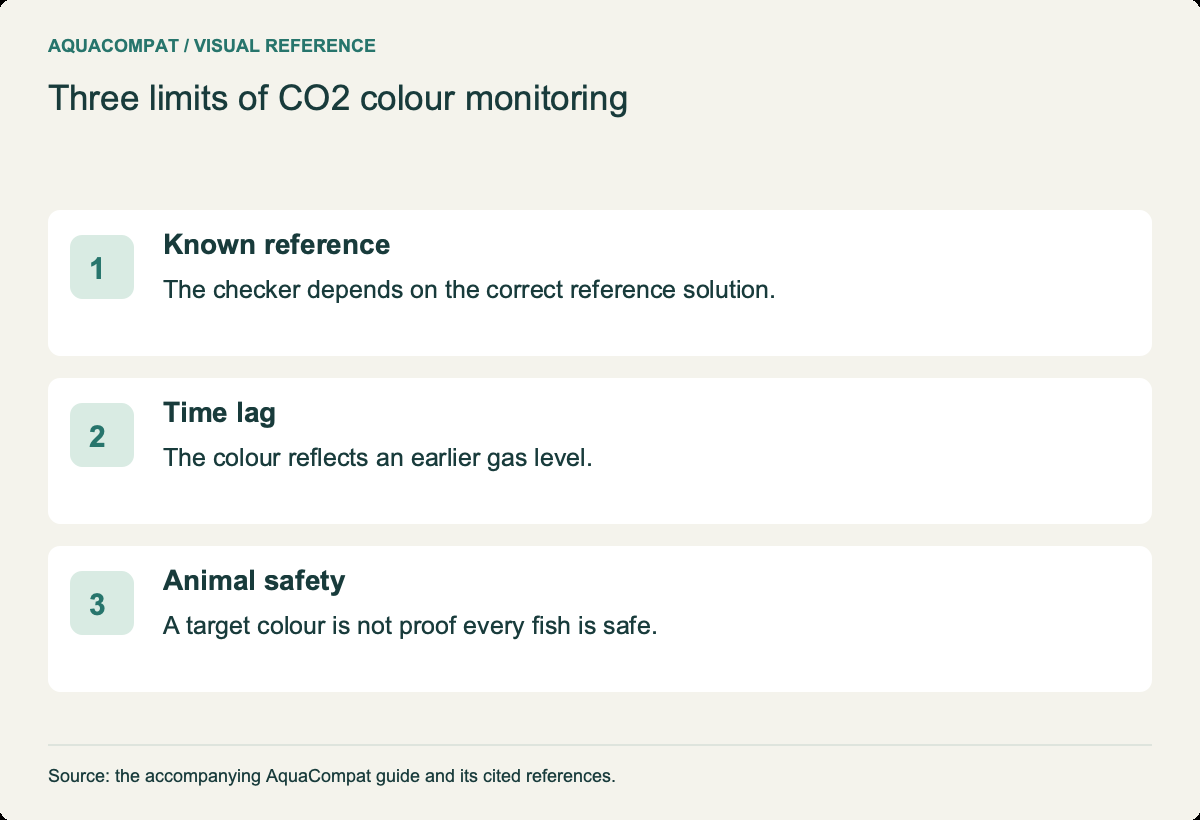
Aquariumscience.org recommends filling a drop checker with a 4 dKH reference solution plus indicator rather than tank water, so the KH is known. Dennerle and Aquariumscience.org both read the colours the same way: blue means too little CO2, green means the target and yellow means too much. The FZONE glass checker in our equipment data ships with 4 dKH / pH indicator solution, 15 ml and is read after about 1 hour, so it shows the level an hour ago, not now.
What does green actually mean?
Green covers a band, and the two sources calibrate it differently. Aquariumscience.org reads green with a 4 dKH fill as roughly 25 to 35 ppm and uses 30 ppm as the common target. Dennerle’s long-term test calibrates green to about 20 mg/L and recommends 20–25 mg/L. A green checker therefore sits at or above Merck’s fish-toxicity warning in both readings. Regulators, diffusers and checkers are compared in the roundup of CO2 systems for planted aquariums.
Do all planted tanks need CO2 injection?
No. Tropica says its easy plants tolerate low light and manage without added CO2, and Aquarium Co-Op notes that plants in low-tech tanks live on the 2–3 ppm produced by gas exchange and fish respiration. For a tank of anubias, java fern, cryptocorynes and mosses under low light, injection adds cost and risk without a matching benefit. The low-tech planted tank guide covers that approach in detail.
Injection starts to pay off when you want plants from Tropica’s Medium or Advanced groups, carpets, or fast stem growth under strong light. The light, CO2 and fertiliser then have to rise together. A new tank should also ease in: Tropica starts with about 6 hours/day of light for the first weeks, before moving to 8–10 hours/day. The order of those first weeks is set out in how to start a planted tank.
Does more CO2 always mean faster plant growth?
No. Extra CO2 only speeds growth when light and nutrients are also available, because plants are limited by whichever input is scarcest. Aquarium Co-Op and Tropica describe plants and algae competing for the same light, nutrients and CO2; when one is out of proportion, algae takes the surplus. Pushing CO2 into a dimly lit tank may leave the plants no faster while raising the gas level that Merck links to fish toxicity.
The reverse error is more common: bright light added without CO2. Aquarium Co-Op says the brighter the light, the more CO2 and fertiliser plants need, and that high light without CO2 tends to favour algae. Matching the three inputs, rather than maximising one, is what the published guidance asks for.
What happens when CO2 is too high or too low?
Too much CO2 puts fish at risk; too little mainly hands the tank to algae. The two failures look different and need different responses.
Too much CO2
A yellow drop checker means more CO2 than the target, according to both Dennerle and Aquariumscience.org. Merck flags fish toxicity above 12 mg/L, and SRAC 468 warns that low dissolved oxygen makes CO2 more toxic. In poorly buffered water SRAC 464 also warns that CO2 and carbonic acid can push pH dangerously low, and Merck’s aeration test shows that vigorous aeration drives excess CO2 out. Reducing the injection rate and increasing surface agitation therefore address both the gas and the oxygen side of the problem.
Too little CO2
A blue checker under strong light points to the imbalance Aquarium Co-Op associates with algae. Black beard algae is the type most often tied to CO2: GWAPA, cited in the guide to aquarium algae types and fixes, suggests stable CO2 of 20 to 30 ppm in planted tanks to discourage it. Lowering the light to suit the CO2 you have is the alternative to injecting more.
Where does CO2 fit with the rest of planted tank care?
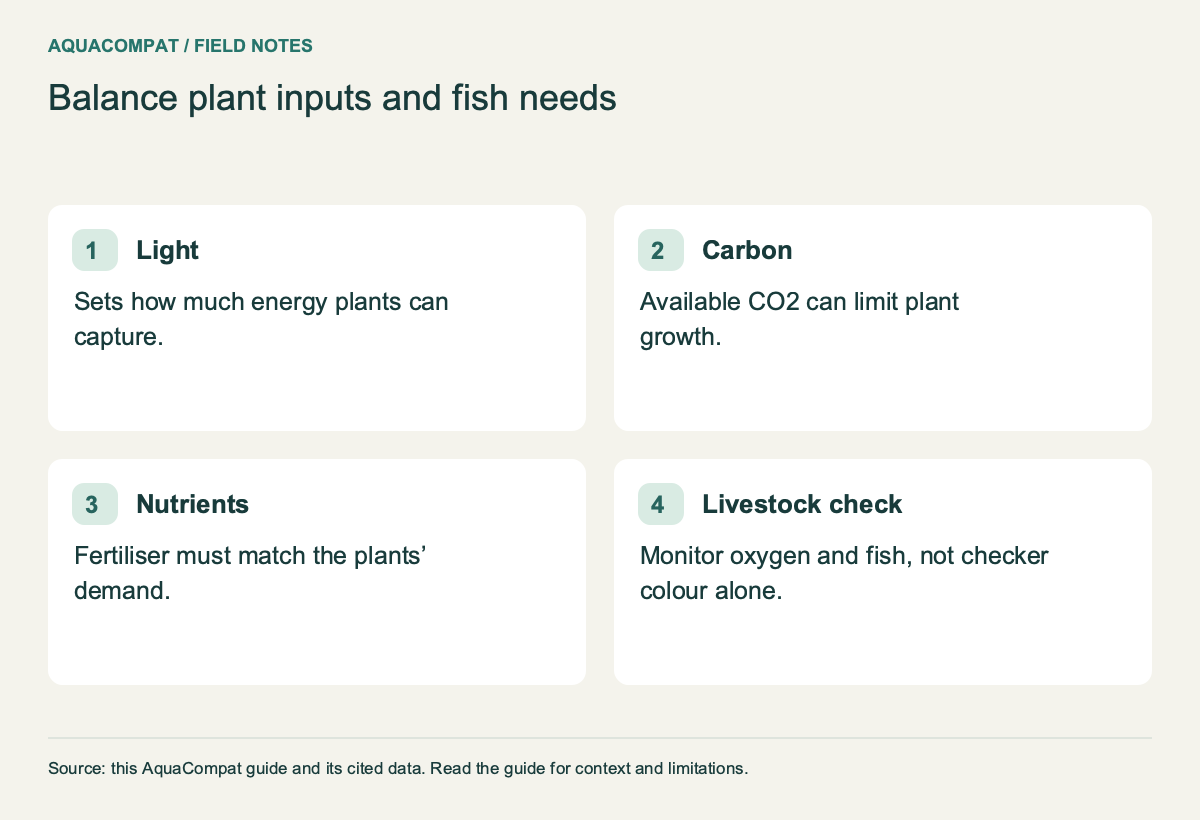
CO2 is one of three planted-tank inputs, alongside light and nutrients, and it is the only one that also changes pH and can harm fish directly. Decide first whether your plants need injection; if they do, choose a target with the Merck warning in mind, confirm it with pH and KH readings and a drop checker, and keep oxygen high. Tropica also advises trimming a little and often rather than all at once, and the guide to choosing aquascaping tools covers scissors and tweezers for that job. The other chemistry topics are collected in the water chemistry and setup guides.
Questions people ask
What CO2 level should a beginner aim for?
A beginner can aim for no injected CO2 at all, using easy plants that Tropica says manage without it and the 2–3 ppm a low-tech tank supplies. If you do inject, Tropica’s Medium band of 10–15 mg/L is the lowest published target and the closest to the Merck Veterinary Manual’s fish-toxicity warning of 12 mg/L.
Why should a drop checker use 4 dKH solution instead of tank water?
A drop checker reads CO2 from the pH of its reservoir, and that only works if the reservoir’s KH is known. Aquariumscience.org recommends a 4 dKH reference solution for that reason. Tank water can carry other acids or a different KH, which shifts the colour without any change in CO2.
Should CO2 run at night?
None of the sources in our fact base gives an on and off schedule for injection. SRAC 464 explains that photosynthesis removes CO2 by day and that, in poorly buffered water, CO2 can build up and drive pH dangerously low, while SRAC 468 warns that CO2 becomes more toxic as dissolved oxygen falls. Those two points argue for not adding gas when plants are not photosynthesising.
Can I calculate CO2 from my pH and KH readings?
Yes, as an estimate. SRAC 464 multiplies a factor chosen by pH and temperature by alkalinity in mg/L as CaCO3; its worked example gives about 12.8 mg/L. Measure pH within 30 minutes of sampling. Aquariumscience.org warns that other acids in the water make the estimate less reliable.
Does CO2 injection lower pH enough to harm soft-water fish?
CO2 lowers pH in proportion to how little buffer the water has, so the effect is largest in low-KH water. The bigger risk the sources describe is the gas itself: Merck sets its fish-toxicity warning at 12 mg/L, regardless of pH. Check that every species you keep tolerates the lower pH while the gas is running.
Sources 31 documents from 13 publishers
- Amazon (FZONE listing) (amazon.com): “FZONE Aquatic CO2 Glass Drop Checker (B07YCQ77JJ)”
- Aquarium Co-Op (aquariumcoop.com): “CO2 for planted tanks”; “CO2 in Planted Aquariums: What Does It Really Do and Is It Natural?”; “Is Nitrate Good or Bad for Your Aquarium?”; “How to Balance Aquarium Lights to Grow Healthy Plants (& Avoid Algae)”; “What is PAR? Lighting & Brightness Explained for Planted Tanks”; “How to Use Root Tabs to Fertilize Your Live Aquarium Plants”; “Which Planted Tank Fertilizer Is Right for You?”; “Beginner's Guide to Fertilizing Your Planted Tank the EASY Way”; “How to Set Up a Low Tech Planted Aquarium for Beginners”; “Monte Carlo (plant care page)”; “How to Fight the 6 Most Common Types of Algae in Your Fish Tank”; “How to Get Rid of Blue-Green Algae in Freshwater Aquariums”
- Aquarium Science (aquariumscience.org) (aquariumscience.org): “Measuring CO2”
- Dennerle (dennerle.com): “CO2 Langzeittest (long-term test) instructions 2985/2986”
- Greater Washington Aquatic Plant Association (GWAPA) (gwapa.org): “Algae in the Planted Aquarium (K. Weinhold)”
- LiveAquaria (liveaquaria.com): “Algae Identification in Freshwater Tanks and Proper Removal”
- Merck Veterinary Manual (merckvetmanual.com): “Environmental Diseases of Aquatic Animals in Aquatic Systems (Francis-Floyd, Yanong, Petty)”; “Disorders and Diseases of Fish (pet owner version)”
- Practical Fishkeeping (practicalfishkeeping.co.uk): “How to Cycle a Fish Tank: The Complete Guide”
- Seachem Laboratories (seachem.com): “Flourish Excel product instructions”
- Southern Regional Aquaculture Center (srac.msstate.edu): “SRAC 464: Interactions of pH, Carbon Dioxide, Alkalinity and Hardness in Fish Ponds (Wurts and Durborow)”; “SRAC 468: Carbon Dioxide in Fish Ponds (Hargreaves and Brunson)”; “SRAC Publication No. 466: Algae Blooms in Commercial Fish Production Ponds”; “SRAC Publication No. 4605: Algal Toxins in Pond Aquaculture (J.H. Rodgers Jr.)”
- Tropica Aquarium Plants (tropica.com): “Fertiliser and CO2 for your aquarium”; “Starting a new aquarium (growing-in guide)”; “Hardscape and bottom layer in the tank”; “Trimming”
- University of Florida IFAS Extension (ask.ifas.ufl.edu): “FA084: Use of Antibiotics in Ornamental Fish Aquaculture (R.P.E. Yanong)”
- University of Florida IFAS Extension (EDIS) (ask.ifas.ufl.edu): “Ammonia in Aquatic Systems (FA16/FA031), Francis-Floyd, Watson, Petty and Pouder”
All sources accessed . Every number on this page comes from these documents.