What specs matter when choosing substrate for a planted tank?
Four specs decide whether a substrate suits a planted tank: whether it changes water chemistry, whether it carries nutrients, how it must be prepared, and how much you need for the right depth. Brand matters less than matching these to the plants and animals you plan to keep.
Active soil or inert gravel
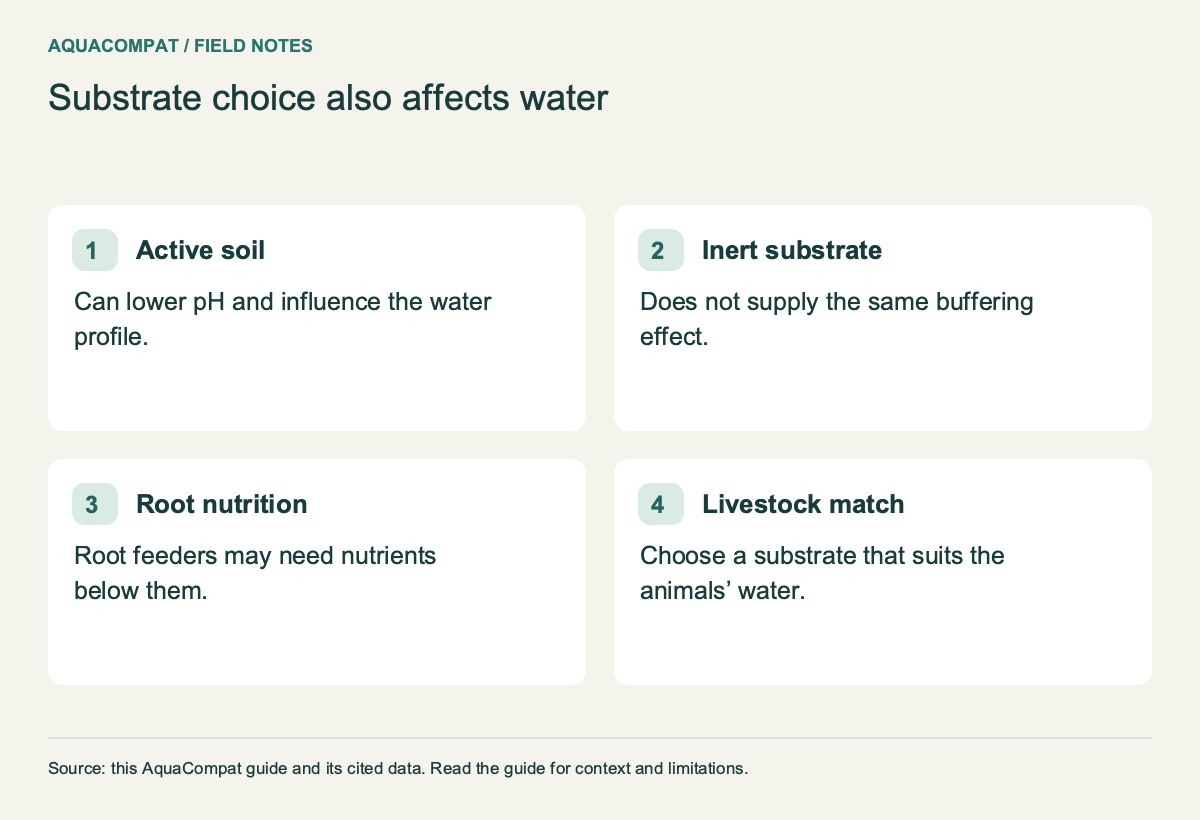
An active soil is a baked granular soil that changes the water it sits in, usually by lowering pH and hardness. ADA describes Amazonia Ver.2 as active aqua soil (black soil), Tropica calls its product an active soil of natural volcanic minerals; complete substrate, and UNS describes Controsoil as an active soil: blend of soil and volcanic ash, low nutrient. An inert substrate leaves the water alone: Seachem’s Flourite Black is a porous clay gravel that the maker says does not alter pH. Fluval sits between the two, describing Stratum as a volcanic soil substrate that supports neutral to slightly acidic pH.
pH and hardness effect
The chemistry claim matters more than any other spec, because it decides which fish and shrimp can share the tank. Only UNS publishes a hardness effect: Controsoil lowers total hardness and stabilises pH to about 6.8 over time. ADA, Tropica, Fluval and Seachem publish no figure for KH, the carbonate hardness that buffers pH. The difference between GH and KH explains why a soil that strips KH also makes pH less stable.
Nutrients and preparation
Nutrient content and set-up steps vary more than the marketing suggests. ADA ships Amazonia with the Amazonia Supplement for nutrient enrichment, Controsoil is sold as low nutrient with low ammonia release, and Fluval tells you to gently rinse in a colander without agitating. UNS says Controsoil needs no rinsing required, while Seachem notes that Flourite is not chemically coated or treated and may need its dust rinsed off.
| Substrate | Type | pH effect | Hardness effect | Nutrients | Preparation |
|---|---|---|---|---|---|
| ADA Aqua Soil Amazonia Ver.2 | Active soil | makes water slightly acidic | Not published | Supplement layer included | Not published |
| Tropica Aquarium Soil | Active soil, complete substrate | lowers pH; slightly affects water chemistry | Not published | Complete substrate, no other layer | Frequent water changes for 4 weeks |
| UNS Controsoil | Active soil, low nutrient | stabilises pH to about 6.8 over time | lowers total hardness | Low; low ammonia release | no rinsing required |
| Fluval Plant and Shrimp Stratum | Volcanic soil | supports neutral to slightly acidic pH | Not published | Not published | Gentle rinse |
| Seachem Flourite Black | Inert clay gravel | does not alter pH | Not published | Not published | Rinse residual dust |
Which planted tank substrates lower pH and hardness?
Amazonia, Tropica Aquarium Soil and Controsoil all lower pH by their makers’ own description, and Controsoil is the only one that also claims to lower hardness. ADA writes that water tends to become slightly acidic with Amazonia Ver.2. Tropica says its soil lowers pH and slightly affects water chemistry. UNS gives the most precise target, stabilising toward pH 6.8 over time. Fluval’s wording for Stratum is softer: it supports neutral to slightly acidic pH rather than pushing water there.
Seachem is the outlier. Flourite Black is sold as life of the aquarium and does not alter pH, so the tank keeps the chemistry of your tap water. That makes it the right base when the stocking depends on hard, alkaline water. The pH requirements by species show how far apart those needs can be: guppies take pH 7.0–8.0, while harlequin rasboras take pH 5.0–7.5.
Planted tank substrates matched to water type
Each substrate below was chosen for a water type and a stocking, using the published claims above. AquaCompat did not test any of them; the notes explain what each maker’s specifications mean for plants, fish and shrimp.
As an Amazon Associate I earn from qualifying purchases. Prices change often, so they are not shown here; the button opens the current listing.

ADA Aqua Soil Amazonia Ver.2 (9 L)
- Type
- active aqua soil (black soil)
- pH effect
- makes water slightly acidic
- Included
- Amazonia Supplement for nutrient enrichment
- Sizes
- Normal 3 L, Normal 9 L, Powder 3 L
Fits: a high-tech planted tank with soft-water fish, where the bundled supplement layer feeds root-heavy plants from the start.
Skip it if: you keep hard-water species such as livebearers or nerite snails; ADA says water tends to turn slightly acidic.
Check price on Amazon
Tropica Aquarium Soil (3 L)
- Type
- active soil of natural volcanic minerals; complete substrate
- Grain size
- 2–3 mm
- pH effect
- lowers pH; slightly affects water chemistry
- Start-up
- 25–50% water changes at least twice weekly for first 4 weeks
Fits: a first soil tank where you want one product with no separate nutrient layer, and a published grain size of 2 to 3 mm.
Skip it if: you cannot manage twice-weekly 25 to 50% water changes for the first four weeks, which Tropica recommends.
Check price on Amazon
UNS Controsoil (3 L, Normal)
- pH effect
- stabilises pH to about 6.8 over time
- Hardness
- lowers total hardness
- Ammonia release
- low
- Bag per tank
- 1 L for 2 gal; 3 L for 9 gal; 10 L for 20 gal
Fits: a soft-water shrimp or nano tank, since UNS publishes both a pH target of about 6.8 and a hardness-lowering effect, with low ammonia release.
Skip it if: your stocking needs hard water; the maker says it lowers total hardness.
Check price on Amazon
Fluval Plant and Shrimp Stratum (8.8 lb)
- Type
- volcanic soil substrate
- pH effect
- supports neutral to slightly acidic pH
- Other claims
- porous for bacteria; shelter for newborn shrimp; will not discolour water
- Bag sizes
- 2 kg (4.4 lb), 4 kg (8.8 lb), 8 kg (17.6 lb)
Fits: a community planted tank or a cherry shrimp colony, where Fluval’s claimed shelter for newborn shrimp and porous grains are useful.
Skip it if: you need a published hardness or nutrient figure; Fluval gives neither.
Check price on Amazon
Seachem Flourite Black (7 kg)
- Type
- porous clay gravel
- pH effect
- does not alter pH
- Lifespan
- life of the aquarium
- Bag sizes
- 3.5, 7 kg
Fits: a planted tank with hard-water species, or anyone who wants a substrate that never needs replacing; dose root tabs for heavy root feeders.
Skip it if: you want the substrate itself to soften water for Caridina shrimp or blackwater fish.
Check price on AmazonHow deep should planted tank substrate be?
A planted tank should have at least 2–3 in of substrate, according to Aquarium Co-Op’s beginner set-up guide. Tropica allows a slope instead: its hardscape guide puts gravel at 3 to 4 cm at the front, rising to 6 to 8 cm at the back, over a half to 1 cm nutrient layer placed where strong-rooted plants will go . The slope keeps the foreground low for short plants and gives tall root feeders depth at the back.
Does a planted tank need substrate layers?
Layering depends on the product. ADA’s Amazonia Supplement is spread under the soil, and Tropica’s older method uses a thin nutrient layer under plain gravel. Tropica Aquarium Soil is sold as a complete substrate that needs no other layer, and Controsoil is a single low-nutrient soil. With inert Flourite there is no nutrient layer at all, so root feeding comes from tabs instead.
How much substrate to buy
Makers publish two ways to size an order. UNS maps bags to tanks: 1 L for 2 gal; 3 L for 9 gal; 10 L for 20 gal. Tropica gives a formula instead: litres = length cm x width cm x depth cm / 1000. Seachem offers online project calculator by tank dimensions and depth. For a 20-gallon tank, the UNS guide points to a 10 L bag, while the matched Amazon listing is the 3 L size, so a 20-gallon tank needs several.
Which planted tank substrate is safest for shrimp?
Controsoil and Stratum are the strongest shrimp choices on paper, but the right one depends on which shrimp you keep. Crystal red shrimp, a Caridina, need soft, acidic water at pH 6.2–7.0 and 4–6 dGH, which is the water an active soil produces. Cherry shrimp, a Neocaridina, are more tolerant at pH 6.5–8.0 and 6–10 dGH, so they do well on soil or gravel. The Caridina and Neocaridina shrimp compared page sets out why the two groups rarely share water.
Three published claims point to Controsoil for Caridina: it lowers total hardness, steadies pH near 6.8, and has low ammonia release, which matters because Practical Fishkeeping says any trace of ammonia or nitrite is dangerous to cherry shrimp . Fluval’s shrimp claim is about structure rather than chemistry: it says Stratum’s grains give newborn shrimp shelter. Tropica pairs its soil with twice-weekly water changes for the first four weeks, so shrimp should wait until that start-up period is over. Whatever you choose, stock shrimp only after the tank is fully cycled; the fish that can share a cherry shrimp tank page covers which fish leave the colony room to grow.
How did we choose these substrates?
Every substrate here was chosen by comparing makers’ published claims on chemistry, nutrients and preparation. We did not lay any of them in our own tanks, so the notes report what each maker states and what that implies for plants and livestock. The criteria, in order, were a published pH or chemistry claim, a clear product type (active soil or inert gravel), published preparation or start-up guidance, and a US listing that matches the exact product and bag size. CaribSea’s Moonlight Sand was considered but left out: it is a decorative inert sand with no planted-tank nutrient or chemistry claim, so it belongs on a general sand page. Prices are left out because they change daily. The full research approach is on our methodology page.
Do all aquarium plants need a nutrient-rich substrate?
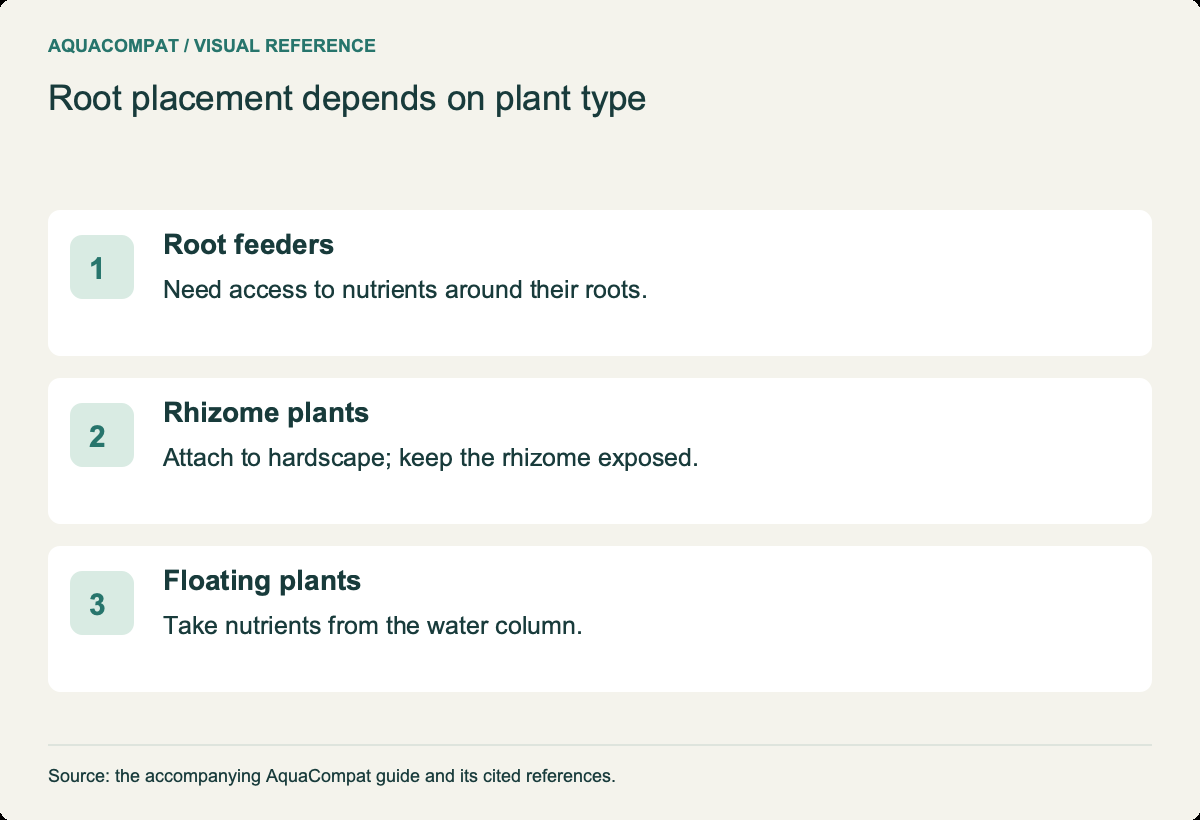
No. Many popular aquarium plants never root into the substrate at all, so a plain inert gravel grows them well. Tropica and Aquarium Co-Op both say mosses, floating plants and plants attached to rock or wood, such as anubias and java fern, feed mainly from the water and need liquid fertiliser rather than root tabs. Anubias nana’s placement is listed as attach to hardscape, and Tropica warns its rhizome may rot if buried.
Root feeders are where substrate choice counts. Aquarium Co-Op names swords, cryptocorynes, bulb plants as plants that take most nutrients from the substrate, and the Amazon sword is listed as a heavy root feeder. In inert Flourite, Aquarium Co-Op places root tabs about every 5–6 in in a grid, topped up about monthly. A nutrient soil such as Amazonia covers that need at the start, while Tropica says its own substrate capsules release nutrients over 6 to 9 months.
When does an active soil work against your fish?
An active soil works against any stocking that needs hard, alkaline water. Nerite snails are listed at pH 7.2–8.0 and 10–15 dGH, and Aquarium Co-Op notes that cracked or eroded nerite shells in soft water signal a need for more calcium and minerals . Endler’s livebearers want 15–25 dGH. A soil that lowers hardness and steers pH toward 6.8 pulls the water out of those ranges, so these animals belong over inert Flourite.
Soft-water stockings show the other side. Harlequin rasboras, at 1–12 dGH, and kuhli loaches, at pH 3.5–7.0, sit comfortably in the water an active soil makes. Kuhlis add one caution: Seriously Fish says they like to dig and recommends a soft sandy substrate , so check the grain of any soil before choosing it for them. The stockings on the fish for a 20-gallon planted tank we recommend page are split by exactly this choice of substrate.
How does substrate choice fit with light and CO2?
Substrate is one of three inputs, with light and CO2, and a rich soil only pays off when the other two keep pace. Tropica calls CO2 the main plant nutrient and the main factor limiting growth, and Aquarium Co-Op notes that brighter light raises the demand for both CO2 and fertiliser. A nutrient soil under weak light can leave spare nutrients for algae, which Tropica and Aquarium Co-Op both describe. The guide to CO2 levels in planted tanks covers the targets, and the light and gas side of the set-up is compared in the aquarium lights for plant growth we recommend and the CO2 systems for planted aquariums we recommend.
Planting into a soil is easier with long tweezers and curved scissors, and the aquascaping tools we recommend page lists them. For every other piece of equipment, the equipment buyer guides hub has the full set.
Questions people ask
Can I put aqua soil on top of gravel?
The makers here do not describe capping gravel with soil. ADA spreads its supplement under Amazonia, and Tropica uses a thin nutrient layer under plain gravel, which is the reverse order. Tropica Aquarium Soil is sold as a complete substrate that needs no other layer, so the simplest option is one soil at the depth Aquarium Co-Op gives, 2–3 in.
Is Fluval Stratum good for cherry shrimp?
It is a reasonable fit. Fluval says Stratum supports neutral to slightly acidic pH and that its grains shelter newborn shrimp. Cherry shrimp are listed at pH 6.5–8.0, a range that covers neutral and slightly acidic water. Fluval publishes no hardness effect, so test GH after set-up to confirm it stays inside 6–10 dGH.
Does Seachem Flourite need root tabs?
For root-feeding plants, yes. Seachem sells Flourite as a porous clay gravel and publishes no nutrient content, so swords and cryptocorynes depend on tabs. Aquarium Co-Op places them about every 5–6 in and re-doses about monthly. Epiphytes like anubias and java fern feed from the water and need liquid fertiliser instead.
How long does active soil keep lowering pH?
None of the makers here publishes a lifespan for the pH effect. UNS says Controsoil stabilises pH to about 6.8 over time, and Seachem says Flourite lasts the life of the aquarium, but Seachem’s product does not alter pH at all. Track pH and KH monthly with a test kit to see when a soil’s effect fades.
Sources 56 documents from 15 publishers
- Aqua Design Amano (adana.co.jp): “AQUA SOIL series”; “MAKE & KEEP: Aqua Soil Amazonia Ver.2”
- Aquarium Co-Op (aquariumcoop.com): “Guppy Care Guide”; “How to Set Up a Low Tech Planted Aquarium for Beginners”; “Is Nitrate Good or Bad for Your Aquarium?”; “How to Balance Aquarium Lights to Grow Healthy Plants (& Avoid Algae)”; “CO2 in Planted Aquariums: What Does It Really Do and Is It Natural?”; “What is PAR? Lighting & Brightness Explained for Planted Tanks”; “How to Use Root Tabs to Fertilize Your Live Aquarium Plants”; “Which Planted Tank Fertilizer Is Right for You?”; “Beginner's Guide to Fertilizing Your Planted Tank the EASY Way”; “Monte Carlo (plant care page)”; “Care Guide for Cherry Shrimp”; “Anubias Nana (care page)”; “Amazon Sword Plant (care page)”; “Care Guide for Nerite Snails”; “Care Guide for Harlequin Rasboras and Lambchop Rasboras”; “Care Guide for Kuhli Loaches”
- FishBase (fishbase.se): “Pangio kuhlii summary (Bayesian length-weight estimate)”
- Flowgrow Aquatic Plant Database (flowgrow.de): “Anubias barteri var. nana”
- Fluval (Hagen) (fluvalaquatics.com): “Plant and Shrimp Stratum”
- Maidenhead Aquatics (fishkeeper.co.uk species data sheet) (fishkeeper.co.uk): “Guppy data sheet”; “Zebra Nerite Snail”
- PetSmart (retailer, maker copy) (petsmart.com): “Fluval Plant & Shrimp Stratum”
- Practical Fishkeeping (practicalfishkeeping.co.uk): “A guide to the small rasboras from the genus Trigonostigma”; “Frequently asked questions on Neocaridina shrimps”; “An introduction to Shrimp”; “Will these snails starve without algae?”; “What can I add for algae control?”; “Quick guide to livebearers”; “How long will my fish live?”
- Seachem Laboratories (seachem.com): “Flourite Black”
- Seriously Fish (seriouslyfish.com): “Poecilia reticulata”; “Trigonostigma heteromorpha (Harlequin)”; “Poecilia wingei”; “Pangio semicincta ('Kuhli' Loach)”
- Shrimp and Snail Breeder (aquariumbreeder.com): “Crystal Red Shrimp: detailed guide, care, diet and breeding”; “Red Cherry Shrimp: detailed guide, care, diet and breeding”; “Cherry shrimp in a community tank: how to make it successful”; “How Copper Affects Dwarf Shrimp”; “Nerite Snails: detailed guide, care, diet and breeding”
- Shrimp Science (shrimpscience.com): “Crystal Red Shrimp - Care Guide”; “Red Cherry Shrimp - Care Guide”; “General Hardness (GH) For Shrimp Tanks”; “Carbonate Hardness (KH) For Shrimp Tanks”; “TDS For Shrimp Tanks”
- Tropica Aquarium Plants (tropica.com): “Aquarium Soil”; “Aquarium Soil 3 L (product detail, Danish)”; “Hardscape and bottom layer in the tank”; “Starting a new aquarium (growing-in guide)”; “Fertiliser and CO2 for your aquarium”; “Trimming”; “Anubias barteri var. nana (101)”; “Echinodorus grisebachii 'Bleherae' (071)”
- Ultum Nature Systems (ultumnaturesystems.com): “Controsoil”
- Wikipedia (en.wikipedia.org): “Vittina natalensis”
All sources accessed . Every number on this page comes from these documents.