What specs matter when choosing a CO2 system for a planted aquarium?
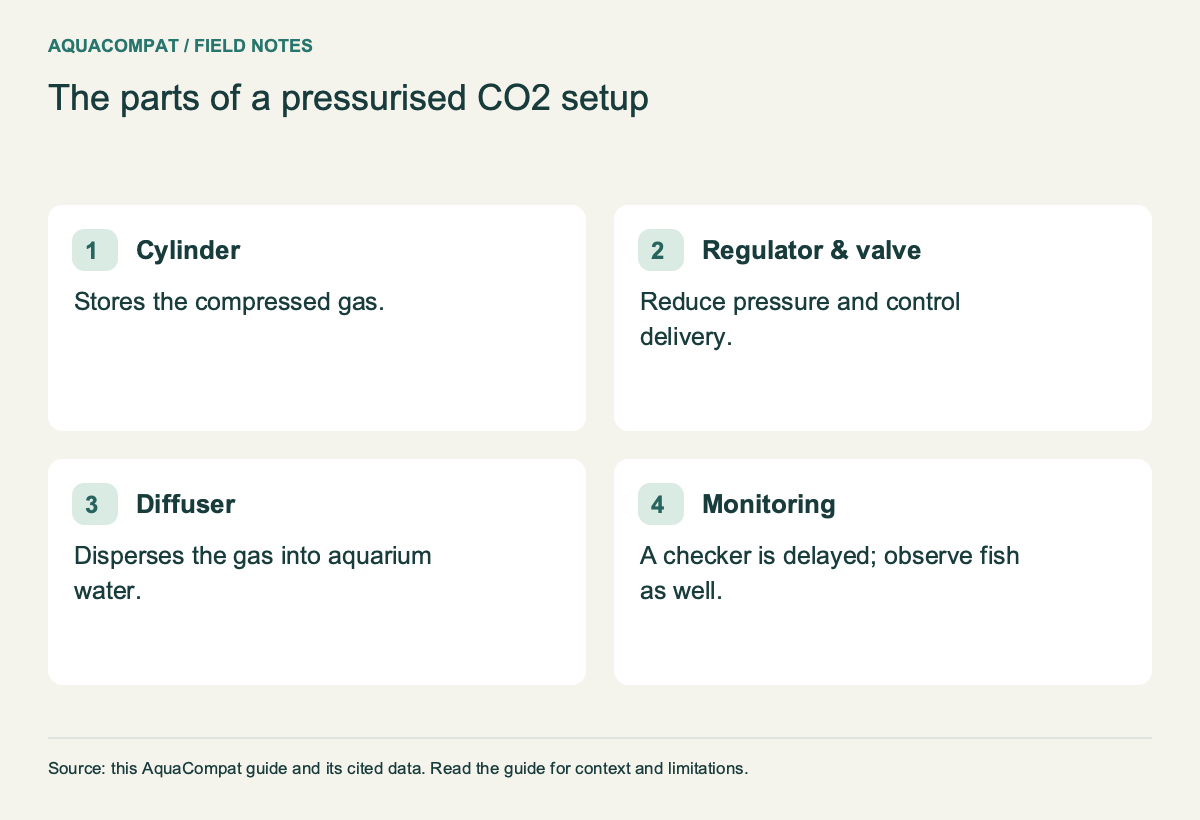
Five parts decide how well a CO2 system works: the gas source, the regulator, the needle valve and bubble counter, the solenoid, and the diffuser. A sixth item, a drop checker, does not add CO2 but tells you how much is in the water.
Gas source: cartridge or cylinder
A disposable cartridge is the simplest start. Fluval’s kit ships with a 45 g cartridge of the Disposable cartridge type, with refills sold separately. A regulator such as the FZONE Pro instead screws onto a refillable cylinder; FZONE lists a CGA320 fitting for North American cylinders. FZONE’s listing does not confirm that a cylinder or diffuser is included, so budget for both.
Regulator stages
A regulator reduces cylinder pressure to a working pressure. FZONE says its 2 stages design holds output pressure steady as the cylinder empties, with an adjustable output of 0–65 PSI and a safety valve that opens above 100 PSI. Fluval does not publish how many stages its regulator valve has.
Needle valve, bubble counter and solenoid
The needle valve sets the flow and the bubble counter lets you see it. FZONE’s needle valve can be set as low as 1 bubble per 3 seconds, and the regulator carries 2 manifold blocks, each with needle valve, so one cylinder can feed one or two tanks. A solenoid is an electric valve that a timer can open and close; FZONE fits a 12 V DC unit designed for use with a timer. Fluval publishes no solenoid for its kit.
Diffuser
The diffuser breaks the gas into fine bubbles so it dissolves. Fluval includes a Ceramic diffuser plus a 2-in-1 bubble counter and check valve. The FZONE regulator needs a diffuser bought separately.
| Product | Role | Gas source | Stages | Solenoid | Diffuser | Rated tank |
|---|---|---|---|---|---|---|
| Fluval Pressurized 45 g CO2 Kit | Complete starter kit | 45 g disposable cartridge | Not published | Not published | Ceramic, included | Up to 30 US gal |
| FZONE Pro Dual Stage Regulator | Regulator for refillable cylinder | Cylinder, CGA320 | 2 stages | 12 V DC | Not confirmed in listing | No rating; depends on cylinder and diffuser |
| FZONE Glass Drop Checker | CO2 monitor | None | None | None | None | No rating |
CO2 systems matched to tank and budget
Each item below was chosen for a role in a CO2 set-up, using the published specifications above. AquaCompat did not run any of them; the notes explain what the specifications mean in practice.
As an Amazon Associate I earn from qualifying purchases. Prices change often, so they are not shown here; the button opens the current listing.

Fluval Pressurized 45 g CO2 Kit
- Cartridge
- 45 g
- Gas source
- Disposable cartridge
- In the box
- 45 g cartridge, regulator valve, ceramic diffuser, 2-in-1 bubble counter/check valve, bracket, hose
- Regulator warranty
- 2 years
Fits: a first CO2 set-up on a 10 to 30-gallon planted tank, with diffuser, bubble counter and check valve already in the box.
Skip it if: you want CO2 to switch off on a timer; Fluval publishes no solenoid, and cartridge life is not published either.
Check price on Amazon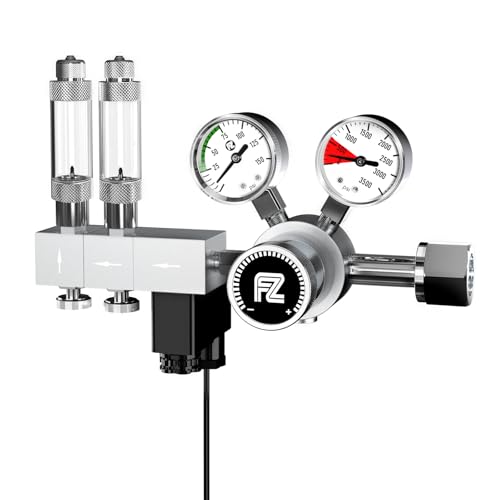
FZONE Pro Dual Stage CO2 Regulator
- Stages
- 2 stages
- Working pressure
- 0–65 PSI
- Solenoid
- 12 V DC
- Outputs
- 2 manifold blocks, each with needle valve
Fits: a long-term high-tech tank, or two tanks fed from one cylinder, where a timed solenoid and steady dual-stage pressure are worth the extra parts.
Skip it if: you do not want to source a CGA320 cylinder and diffuser separately; the listing does not confirm either is included.
Check price on Amazon
FZONE Glass Drop Checker
- Solution
- 4 dKH / pH indicator solution, 15 ml
- Colour scale
- Blue = low CO2, green = sufficient, yellow = too much
- Reading time
- 1 hour
- In the box
- 1 drop checker, 1 suction cup, 15 ml solution
Fits: every injected tank, since it comes with a 4 dKH reference solution rather than relying on tank water.
Skip it if: you need an instant reading; the maker says to read it after about an hour.
Check price on AmazonHow much CO2 should a planted tank hold?
Published planted-tank targets sit around 20 to 30 mg/L, but the fish-safety figure is lower, so the right level is the lowest one that grows your plants. Dennerle recommends 20–25 mg/L for lush growth, and Aquariumscience.org and Aquarium Co-Op use 30 ppm as the high-tech reference. Plant needs are lower for easier species: Tropica says its Medium plants need about 10–15 mg/L and its Advanced plants 15–30 mg/L.
The Merck Veterinary Manual sets the caution. It lists CO2 above 12 mg/L as potentially toxic to fish, which is below every planted-tank target above. SRAC 464 reports channel catfish tolerating 20–30 mg/L when CO2 builds slowly and oxygen is high, so tolerance depends on conditions. Start low, raise the flow slowly, and watch the fish. The CO2 levels in planted tanks guide sets the targets out in full.
How do you read a drop checker?
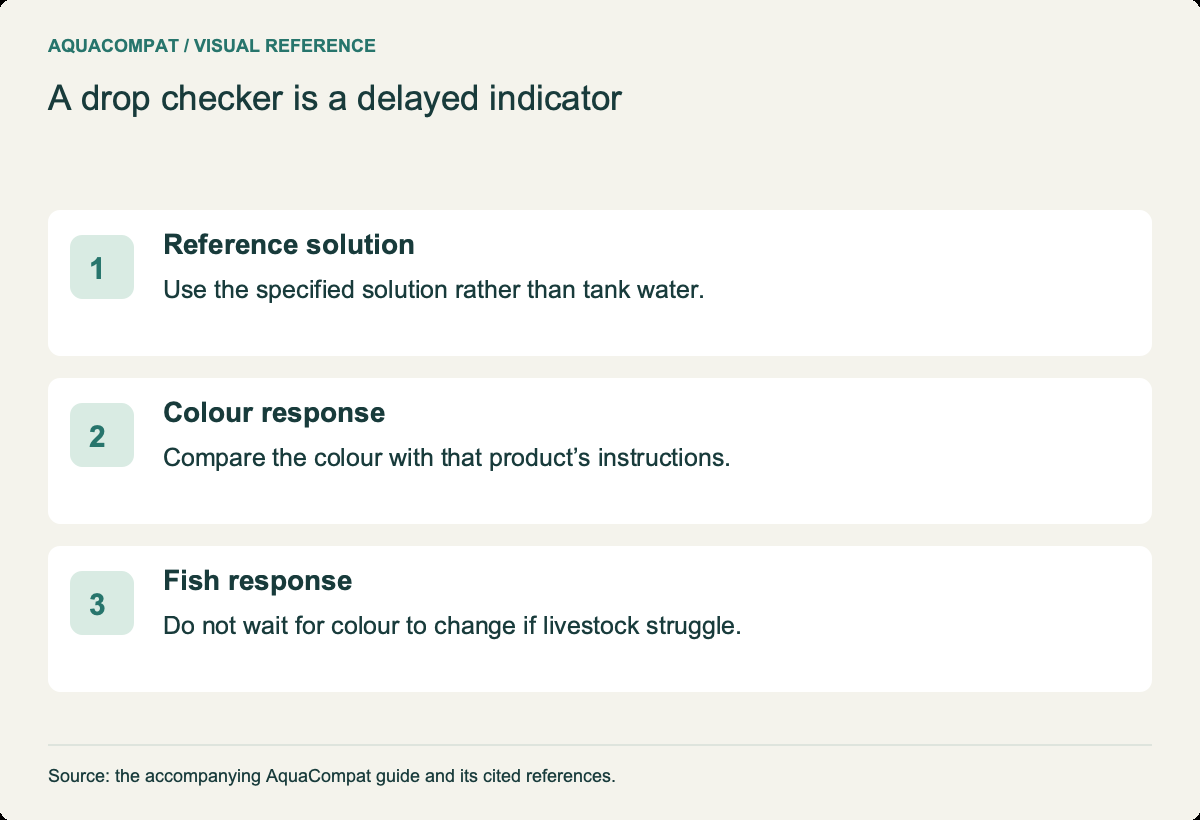
A drop checker shows CO2 by colour: Blue = low CO2, green = sufficient, yellow = too much. Aquariumscience.org recommends filling it with a 4 dKH reference solution rather than tank water, and says green with that solution corresponds to roughly 25 to 35 ppm . Dennerle calibrates its own test so that green sits near 20 mg/L.
The colour lags behind the tank. FZONE says to fill the checker half full, mount it and read it after about 1 hour, so adjust the needle valve in small steps and wait before adjusting again. FZONE includes 4 dKH / pH indicator solution, 15 ml in the box.
How did we choose these CO2 products?
Each product here was chosen by comparing published specifications against the roles a CO2 system needs: a gas source, a regulator, and a way to monitor the result. We did not run them on our own tanks. The criteria, in order, were a clear published spec for the gas source and pressure control, inclusion of the parts a beginner would otherwise forget (diffuser, check valve, bubble counter), and a US listing that matches the exact model number named in the specification file. Products we could not tie to a specification file were left out. Prices are omitted because they change daily. The AquaCompat research method explains the approach in full.
Does every planted tank need injected CO2?
No. Low-tech tanks run on the CO2 already in the water, which Aquarium Co-Op puts at roughly 2–3 ppm from surface gas exchange and animal respiration. Easy plants manage on that: anubias nana’s CO2 need is listed as not required, and java fern, cryptocoryne wendtii and java moss are all not required. Monte Carlo is the counter-example: its CO2 need is listed as required, because Tropica says it needs the additive to form a compact carpet.
Light decides whether injection becomes necessary. Aquarium Co-Op says that the brighter the light, the more CO2 and fertiliser plants need, and that high light without CO2 tends to favour algae. A strong light such as those in the choosing aquarium lights for plant growth guide is the main reason to add a CO2 system.
When does CO2 injection go wrong?
CO2 injection goes wrong in three ways: too much gas for the fish, too little oxygen, or too little buffering in the water. The first is the most common misconception, that more CO2 always means better growth. Tropica and Aquarium Co-Op say growth depends on light, CO2 and nutrients in balance, and Merck’s 12 mg/L figure shows how close the plant targets sit to fish limits.
- Low oxygen: SRAC 468 treats 20 mg/L as a critical level in ponds and notes that CO2 toxicity rises as dissolved oxygen falls.
- Soft water: carbonate hardness (KH) buffers pH. SRAC 464 notes that in low-alkalinity water pH can become dangerously low from CO2 and carbonic acid .
- A quick check: the Merck Veterinary Manual says that if an hour of vigorous aeration raises pH by 1 pH unit rise (more than), excess CO2 is likely.
pH and KH tables can estimate CO2, but SRAC 464 bases them on a factor multiplied by alkalinity, and Aquariumscience.org notes that other acids in the water make the estimate less reliable. Read the pH and CO2 relationship before relying on a chart, and confirm with a drop checker.
Which CO2 system suits a 20-gallon tank?
For a 20-gallon planted tank, the Fluval 45 g kit is the simpler match, because retailers rate it for aquariums up to 30 gallons . It leaves headroom, includes a diffuser, and needs no cylinder. Fluval does not publish how long a cartridge lasts, so expect to buy refills on a schedule you learn from use.
The FZONE regulator carries no tank rating, since output depends on the cylinder and diffuser you pair with it. It suits a 20-gallon tank that will run CO2 for years, or a pair of tanks, where the two needle valves can feed both. The stockings on the best fish for a 20-gallon planted tank page include shrimp and soft-water fish, so any injection there should start low and rise slowly.
How does CO2 fit with substrate and light?
CO2 works only alongside the right light and nutrients. Tropica calls CO2 the main plant nutrient and main growth limiter, and Aquarium Co-Op says injection with matching light and fertiliser gives faster, stronger growth. A nutrient soil feeds the roots of heavy feeders; the choosing substrate for planted tanks guide compares soils and inert gravel by pH effect. Faster growth also means more trimming, and the best aquascaping tools page covers scissors for that job. For the rest of the equipment list, see the equipment buyer guides.
Questions people ask
Can I use a CO2 system with shrimp?
Yes, but our fact base holds no separate CO2 limit for shrimp, so treat Merck’s fish figure as the caution. Green Aqua notes that shrimp tolerate changes in pH poorly and that stability matters most , and CO2 moves pH. Raise the needle valve in small steps, read the checker after about 1 hour each time, and never let it turn yellow, which FZONE calls a dangerous excess.
What colour should a drop checker be?
Green. FZONE’s scale reads Blue = low CO2, green = sufficient, yellow = too much. With a 4 dKH solution, Aquariumscience.org links green to roughly 25 to 35 ppm, while Dennerle calibrates green near 20 mg/L. If fish gasp at the surface while it is green, reduce the flow anyway.
Is a dual-stage regulator worth it?
For a cylinder you plan to run for years, it can be. FZONE says its dual-stage design holds output pressure steady as the cylinder empties, which keeps the bubble rate you set from drifting. On a small tank with a short-term plan, a cartridge kit such as Fluval’s is simpler.
How many bubbles per second should CO2 run at?
No source in our fact base gives a bubble rate, because it depends on tank volume, diffuser and plant load. Use the drop checker rather than a bubble count to judge the level. FZONE says its needle valve can go as low as 1 bubble per 3 seconds, which is a sensible starting point to raise from.
Sources 27 documents from 16 publishers
- Amazon (amazon.com): “Fluval Pressurized 1.6oz CO2 Kit, 17554 (B074RHS1BM)”
- Amazon (FZONE listing) (amazon.com): “FZONE Pro Dual Stage Aquarium CO2 Regulator CGA320 (B0838KXK5D)”; “FZONE Aquatic CO2 Glass Drop Checker (B07YCQ77JJ)”
- Aquarium Co-Op (aquariumcoop.com): “CO2 for planted tanks”; “CO2 in Planted Aquariums: What Does It Really Do and Is It Natural?”; “Anubias Nana (care page)”; “Java Fern (care page)”
- Aquarium Science (aquariumscience.org) (aquariumscience.org): “Measuring CO2”
- Aquasabi (aquasabi.de): “Anubias barteri var. nana”; “Microsorum pteropus”
- Dennerle (dennerle.com): “CO2 Langzeittest (long-term test) instructions 2985/2986”
- Flowgrow Aquatic Plant Database (flowgrow.de): “Micranthemum tweediei”
- Green Aqua (greenaqua.hu): “Shrimp in the aquarium”
- Huggle Pets (hugglepets.co.uk): “Fluval Pressurized 45g CO2 Kit”
- LiveAquaria (liveaquaria.com): “Fluval Pressurized 45 g CO2 Kit for Aquariums up to 30 Gallons”
- Merck Veterinary Manual (merckvetmanual.com): “Environmental Diseases of Aquatic Animals in Aquatic Systems (Francis-Floyd, Yanong, Petty)”; “Disorders and Diseases of Fish (pet owner version)”
- Practical Fishkeeping (practicalfishkeeping.co.uk): “How to Cycle a Fish Tank: The Complete Guide”
- SaltyShrimp (product information via Furry Critter Network) (furrycritter.com): “SaltyShrimp Remineralizers for Invertebrates”
- Southern Regional Aquaculture Center (srac.msstate.edu): “Interactions of pH, Carbon Dioxide, Alkalinity and Hardness in Fish Ponds, SRAC Publication No. 464, Wurts and Durborow”; “SRAC 468: Carbon Dioxide in Fish Ponds (Hargreaves and Brunson)”; “SRAC 4606: Interpretation of Water Analysis Reports for Fish Culture (Stone, Shelton, Haggard, Thomforde)”
- Tropica Aquarium Plants (tropica.com): “Fertiliser and CO2 for your aquarium”; “Anubias barteri var. nana (101)”; “Microsorum pteropus (008)”; “Micranthemum tweediei 'Monte Carlo' (025)”
- University of Florida IFAS Extension (EDIS) (ask.ifas.ufl.edu): “Ammonia in Aquatic Systems (FA16/FA031), Francis-Floyd, Watson, Petty and Pouder”
All sources accessed . Every number on this page comes from these documents.