What specs matter when choosing a light for plant growth?
Four specs decide whether a light suits a planted tank: the tank length it fits, how much light it puts out, its spectrum, and how its schedule is controlled. Water resistance is a fifth check for open-top tanks.
Fit by tank length
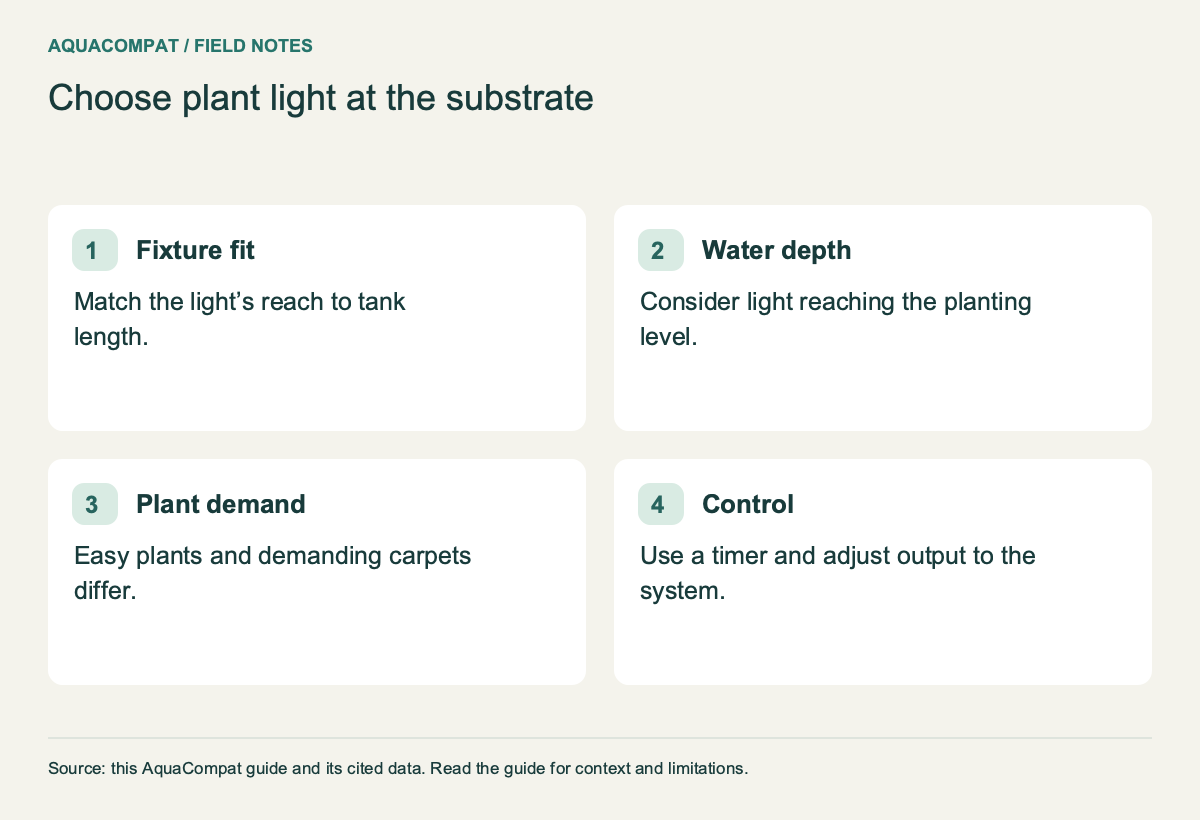
Planted tank lights are rated by tank length, not by gallons. Fluval sizes the Plant 3.0 for 15–24 in tanks, Chihiros sizes the WRGB II PRO 60 for 60–80 cm, and Nicrew sizes this SkyLED for 48–60 in.
Output: watts, lumens and PAR
PAR is the measure planted-tank sources use for light that plants can use. Aquarium Co-Op treats about 10–20 PAR as low light, which suits anubias and cryptocoryne, and 40–50+ PAR as high light for demanding and carpeting plants. None of the three makers here publishes a PAR reading at depth, so the comparison has to rely on watts and lumens. Those figures rank the lights against each other but do not tell you which PAR band a plant at the bottom of your tank receives.
All three are LED fixtures. The US Department of Energy’s 2021 consumer lighting guide says LEDs use up to 90 % less energy than incandescent bulbs and can last up to four times longer than a compact fluorescent lamp.
Spectrum
All three lights mix colours. Fluval lists 3000K x14, 6500K x55, 15000K x6, pink x6, 460nm x6, 480nm x12 diodes; Chihiros uses WRGB (white, red, green, blue channels); Nicrew combines 6500K white + 450nm blue + 660nm red. Adjustable channels on the Fluval and Chihiros let you tune colour; the Nicrew’s controller sets day and night programmes.
Controls and water resistance
Scheduling matters as much as brightness, as the photoperiod section below shows. Fluval offers Bluetooth, FluvalSmart app; 24-hour programmable cycle; Chihiros uses Bluetooth, My Chihiros app; Wi-Fi via optional Smart Wifi Hub; Nicrew uses a Wired LCD controller; programmable day/night cycles. Fluval rates the Plant 3.0 IP67, a retailer lists the Chihiros at IP43, and Nicrew describes the SkyLED as Sealed, splash resistant with no IP rating.
| Light | Fits tank length | Watts | Lumens | LEDs | Control | Water rating |
|---|---|---|---|---|---|---|
| Fluval Plant 3.0 (22 W) | 15–24 in | 22 W | 1450 lm | 99 LEDs | Bluetooth app, 24-hour programme | IP67 |
| Chihiros WRGB II PRO 60 cm | 60–80 cm | 74 W | 6630 lm | 60 LEDs | Bluetooth app, sunrise and sunset | IP43 |
| Nicrew SkyLED Plus 2.0 (45 W) | 48–60 in | 45 W | Not published | Not published | Wired LCD controller | Sealed, no IP rating |
Which light fits which tank size?
Match the light to the tank’s length first, then check output. The Chihiros specification file notes that 60 to 80 cm is about 24 to 31 inches, which covers common US 24-inch tanks such as the 15-gallon and 20-gallon high, and 30-inch tanks such as the 20-gallon long and 29-gallon . The Fluval Plant 3.0 in this size reaches up to 24 inches, so it fits the 24-inch tanks but not a 30-inch 20-gallon long. The Nicrew SkyLED in this size is the only one of the three for tanks of 48 to 60 inches.
The Chihiros also has a mounting limit: its stand suits glass up to 10 mm thick, and the fixture measures 600 x 140 x 18 mm. The Fluval Plant 3.0 measures 15 x 2.5 x 0.75 in.
Planted tank lights matched to tank length
Each light below was chosen for a tank length, using the published figures above. None was tested by AquaCompat; the notes explain what the specifications suggest about fit, output and control.
As an Amazon Associate I earn from qualifying purchases. Prices change often, so they are not shown here; the button opens the current listing.

Fluval Plant 3.0 (22 W, 15–24 in)
- Fits
- 15–24 in
- Power
- 22 W
- Output
- 1450 lm
- Control
- Bluetooth, FluvalSmart app; 24-hour programmable cycle
Fits: a 15 or 20-gallon high planted tank where you want app-controlled sunrise, midday, sunset and night settings and an IP67 rating.
Skip it if: your tank is 30 inches long, such as a 20-gallon long; this size stops at 24 inches.
Check price on Amazon
Chihiros WRGB II PRO 60 cm
- Fits
- 60–80 cm
- Power
- 74 W
- Output
- 6630 lm
- Spectrum
- WRGB (white, red, green, blue channels)
Fits: a 24 to 30-inch high-tech tank with CO2, where its 6,630 lm rating and four colour channels give room to dim down for easier plants.
Skip it if: you run a low-tech tank without CO2 and do not plan to dim it, or your glass is thicker than 10 mm.
Check price on Amazon
Nicrew SkyLED Plus 2.0 (48–60 in)
- Fits
- 48–60 in
- Power
- 45 W
- Spectrum
- 6500K white + 450nm blue + 660nm red
- Ramp times
- 0, 15, 30, 60, 90 or 120 min
Fits: a 48 to 60-inch planted tank, with six ramp lengths for a gradual sunrise and sunset.
Skip it if: you want app control or a published lumen figure; Nicrew lists neither for this model.
Check price on AmazonHow bright should a planted tank light be?
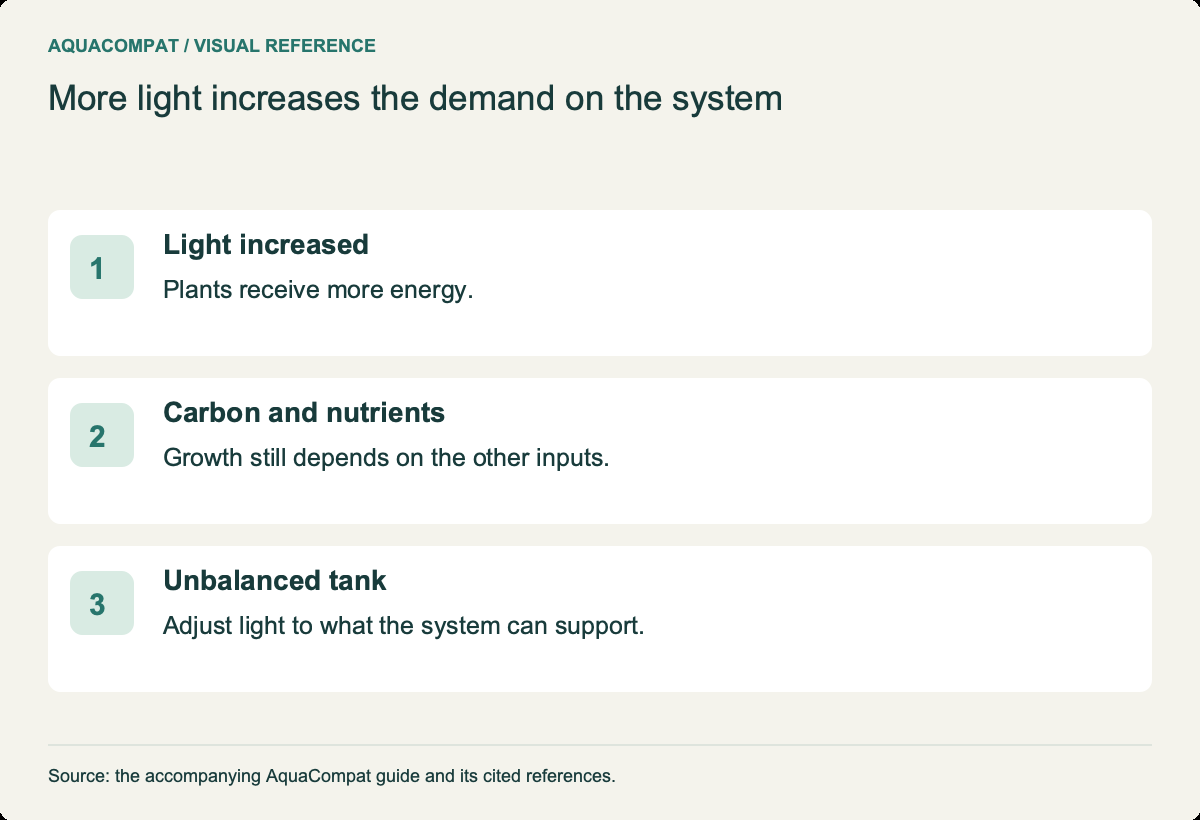
A planted tank light should be only as bright as the CO2 and nutrients can support. Aquarium Co-Op says that the brighter the light, the more CO2 and fertiliser plants need, and that high light without CO2 tends to favour algae. In practice that splits lights into two uses. A low-tech tank, with no injected CO2, wants the 10–20 PAR band; a high-tech tank with CO2 can use 40–50+ PAR.
Of the three, the Chihiros at 74 W and 6630 lm has by far the highest published output for its length, so it is the one most likely to outpace plants without CO2. The Fluval at 22 W publishes 1450 lm. Both app lights can be dimmed, which lets one fixture serve either style. The CO2 levels in planted tanks guide explains the gas side, and the choosing CO2 systems for planted aquariums page compares kits for when the light outgrows the plants’ natural CO2 supply.
How many hours a day should planted tank lights be on?
Planted tank lights should run about 6 hours/day in the first weeks, then about 8–10 hours/day once plants are established. Tropica gives 6 hours for the first 2 to 3 weeks, then 8 to 10 hours. Aquarium Co-Op’s lighting article allows 6 to 8 hours at the start and up to 12 hours later, but says to cut back if algae spreads; its beginner set-up guide suggests 5 to 6 hours to begin . Where these differ, 8 to 10 hours is the overlap.
The schedule below follows those figures. Each light’s timer can hold it: Fluval’s app runs a 24-hour cycle with sunrise, midday, sunset and night settings, Chihiros sets sunrise and sunset ramps in its app, and the Nicrew offers ramp lengths of 0, 15, 30, 60, 90 or 120 min.
| Tank stage | Hours of light per day | Source | Adjust if |
|---|---|---|---|
| Weeks 1–3 (newly planted) | 6 hours/day | Tropica; Aquarium Co-Op gives 6–8 | Algae appears on new leaves |
| After week 3 (established) | 8–10 hours/day | Tropica; overlap with Aquarium Co-Op | Plants grow slowly and no algae shows |
| Mature, fast-growing tank | Up to 12 hours/day | Aquarium Co-Op only | Algae spreads: cut back |
How did we choose these planted tank lights?
Each light here was chosen by comparing makers’ and retailers’ published specifications for three tank-length bands. We did not hang any of them over our own tanks or measure their output. The criteria, in order, were a published fit range by tank length, a published wattage, a programmable schedule with sunrise and sunset ramps, and a US listing matched to the exact size and model. Twinstar’s SA series was on the shortlist but has no specification file or matched listing in our data, so it is not included. No PAR claims appear because none of the makers publishes them at depth. Prices are omitted because they change daily; the methodology behind our picks explains the rest.
Does a brighter light always grow better plants?
No. A brighter light grows better plants only when CO2 and nutrients rise with it; otherwise the surplus light feeds algae. Aquarium Co-Op and Tropica both describe plants and algae competing for the same light, nutrients and CO2, so too much light for the nutrients available, or too many nutrients for the light, hands the surplus to algae. This is the main reason a light sold at its brightest setting can fail in a new tank.
Planting matters as much as the light. Aquarium Co-Op and Tropica advise planting heavily from the start, including fast growers, so the plant mass uses spare nutrients while the tank settles. Water sprite, rated fast, is one that Tropica says helps keep algae down. If green film or hair algae still appears, shorten the photoperiod first; the aquarium algae types and fixes page covers each type.
Which plants grow under a low-power light?
Anubias, java fern, cryptocoryne and java moss all grow under low light. Anubias nana’s light need is listed as low, and Tropica says it grows in shady spots where other plants will not. Java fern and cryptocoryne wendtii are both rated low, and java moss branches more densely under stronger light but manages with less. These plants suit the Nicrew on a long tank, or either app light dimmed down.
Carpeting plants are the exception. Monte Carlo needs medium to high light and is listed as required for CO2, so it should go under a light that can reach the medium to high band, run with CO2 injection.
How does lighting fit with substrate and stocking?
Light, substrate and stocking are chosen together. A nutrient soil and a strong light suit each other, while an inert gravel under a low light suits epiphytes and root tabs; the substrate for planted tanks we recommend compares the options. The fish matter too: the choosing fish for a 20-gallon planted tank page pairs the Fluval Plant 3.0 with three stockings checked pair by pair. Trimming faster growth under strong light needs long scissors, covered in the choosing aquascaping tools guide. The equipment buyer guides hub lists the rest.
Questions people ask
Can I use the Chihiros WRGB II PRO 60 on a low-tech tank?
You can, if you dim it. At 6630 lm it is the strongest light here, and Aquarium Co-Op warns that high light without CO2 tends to favour algae. Its app lets you lower each of the four channels, so set it well below full output and raise it only if plants stall without algae appearing.
Should planted tank lights have a sunrise ramp?
All three lights here offer one, so you can choose whether to use it. The Nicrew offers ramps of 0, 15, 30, 60, 90 or 120 min, and the Fluval and Chihiros apps set sunrise and sunset. Count only the full-light hours toward the 8–10 hours/day target.
Does a 20-gallon planted tank need a 30-inch light?
Only if it is a 20-gallon long. The Chihiros specification file places the 20-gallon high among 24-inch tanks and the 20-gallon long among 30-inch tanks. The Fluval Plant 3.0 in the 22 W size fits up to 15–24 in, so it suits the high but not the long.
Do aquarium plants need a dark period?
Every schedule our sources give includes one. Tropica tops out at 8–10 hours/day, and Aquarium Co-Op allows no more than 12 hours of light, so even the longest published schedule leaves at least half the day dark. Fluval’s app includes a night setting for that period.
Sources 33 documents from 11 publishers
- Amazon (amazon.com): “Fluval Plant 3.0 LED Planted Aquarium Lighting, 22 Watts, 15-24 Inches (B083QP62MP)”; “Chihiros WRGB II PRO LED Aquarium Light 60cm (B09YQXLX2T)”
- Amazon (NICREW listing) (amazon.com): “NICREW SkyLED Plus Aquarium Plant Light, 48-60 Inches, 45 Watts (B08JYFDS5S)”
- Aquarium Co-Op (aquariumcoop.com): “CO2 in Planted Aquariums: What Does It Really Do and Is It Natural?”; “What is PAR? Lighting & Brightness Explained for Planted Tanks”; “How to Balance Aquarium Lights to Grow Healthy Plants (& Avoid Algae)”; “Is Nitrate Good or Bad for Your Aquarium?”; “How to Use Root Tabs to Fertilize Your Live Aquarium Plants”; “Which Planted Tank Fertilizer Is Right for You?”; “Beginner's Guide to Fertilizing Your Planted Tank the EASY Way”; “How to Set Up a Low Tech Planted Aquarium for Beginners”; “Monte Carlo (care page)”; “Water Sprite (care page)”; “Anubias Nana (care page)”; “Java Fern (care page)”
- Aquasabi (aquasabi.de): “Chihiros LED System Serie WRGB II PRO 60”; “Anubias barteri var. nana”; “Microsorum pteropus”
- Bulk Reef Supply (bulkreefsupply.com): “Fluval Plant 3.0 Bluetooth LED Light”
- Chihiros (chihiros.com): “Chihiros WRGB II Pro LED Light”
- Flowgrow Aquatic Plant Database (flowgrow.de): “Ceratopteris thalictroides”; “Micranthemum tweediei”
- Fluval (Hagen) (fluvalaquatics.com): “Plant 3.0 product page”
- GreenAqua (greenaqua.hu): “Chihiros WRGB II Pro 60 cm LED light”
- Tropica Aquarium Plants (tropica.com): “Starting a new aquarium (growing-in guide)”; “Fertiliser and CO2 for your aquarium”; “Hardscape and bottom layer in the tank”; “Trimming”; “Ceratopteris thalictroides (005A)”; “Anubias barteri var. nana (101)”; “Microsorum pteropus (008)”; “Micranthemum tweediei 'Monte Carlo' (025)”
- U.S. Department of Energy, Energy Saver (energy.gov): “Consumer Guide to Energy-Efficient Lighting (DOE/EE-2465)”
All sources accessed . Every number on this page comes from these documents.