What general hardness do common aquarium species need?
Aquarium species range from very soft-water fish to fish that need hard, mineral-rich water, and their GH ranges barely overlap at the extremes. Discus and kuhli loaches sit at the soft end, Lake Malawi cichlids, mollies and Endler’s livebearers at the hard end, and most community fish fall in between. The table orders every species we cover from softest to hardest, with pH alongside because hard water is usually alkaline and soft water is usually acidic.
The ranges come from aquarium-care sources such as Seriously Fish and the Maidenhead Aquatics data sheets, and wild-habitat figures from FishBase are recorded separately where they differ. Few care sources publish a KH range for fish, so KH figures appear only for the species that have one, in a second table further down.
| Species | Group | General hardness | pH range |
|---|---|---|---|
| Discus | Cichlid | 0–8 dGH | pH 5.0–7.6 |
| Kuhli Loach | Bottom dweller | 0–8 dGH | pH 3.5–7.0 |
| Chili Rasbora | Rasbora | 1–10 dGH | pH 6.0–7.0 |
| Cardinal Tetra | Tetra | 1–12 dGH | pH 4.0–7.5 |
| Harlequin Rasbora | Rasbora | 1–12 dGH | pH 5.0–7.5 |
| Neon Tetra | Tetra | 1–12 dGH | pH 5.0–7.5 |
| Betta Fish | Labyrinth fish | 1–15 dGH | pH 6.0–8.0 |
| Bristlenose Pleco | Bottom dweller | 2–15 dGH | pH 6.0–7.2 |
| Corydoras | Bottom dweller | 2–15 dGH | pH 6.5–7.5 |
| Dwarf Gourami | Labyrinth fish | 2–18 dGH | pH 6.0–7.5 |
| Crystal Red Shrimp | Invertebrate | 4–6 dGH | pH 6.2–7.0 |
| Angelfish | Cichlid | 5–15 dGH | pH 6.0–8.0 |
| Galaxy Rasbora | Rasbora | 5–15 dGH | pH 6.6–7.5 |
| GloFish Tetra | Tetra | 5–18 dGH | pH 6.0–7.0 |
| Goldfish | Coldwater | 5–19 dGH | pH 6.0–8.0 |
| Oscar | Cichlid | 5–20 dGH | pH 6.0–8.0 |
| Zebra Danio | Danio | 5–20 dGH | pH 6.0–8.0 |
| Cherry Shrimp | Invertebrate | 6–10 dGH | pH 6.5–8.0 |
| Amano Shrimp | Invertebrate | 6–15 dGH | pH 6.0–7.5 |
| Assassin Snail | Invertebrate | 6–20 dGH | pH 7.2–8.0 |
| Mystery Snail | Invertebrate | 8–12 dGH | pH 7.2–8.0 |
| Guppy | Livebearer | 8–30 dGH | pH 7.0–8.0 |
| Nerite Snail | Invertebrate | 10–15 dGH | pH 7.2–8.0 |
| Platy | Livebearer | 10–20 dGH | pH 7.0–8.2 |
| Kenyi Cichlid | Cichlid | 10–25 dGH | pH 7.6–8.5 |
| Peacock Cichlid | Cichlid | 10–25 dGH | pH 7.5–8.5 |
| Yellow Lab | Cichlid | 10–25 dGH | pH 7.7–8.5 |
| Endler's Livebearer | Livebearer | 15–25 dGH | pH 7.0–8.5 |
| Molly | Livebearer | 15–25 dGH | pH 7.5–8.5 |
What is the difference between GH and KH?
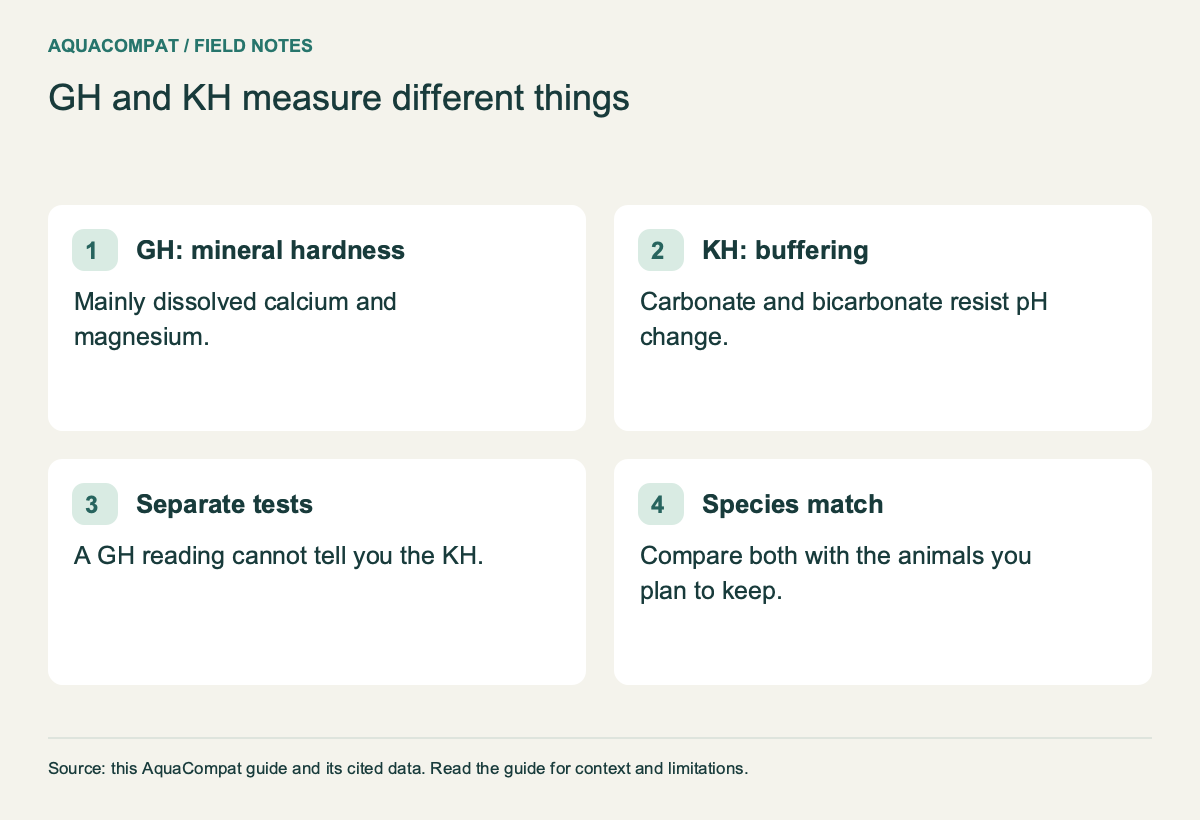
GH measures the minerals in water, and KH measures its ability to resist a change in pH. General hardness counts divalent ions, mainly calcium and magnesium. Carbonate hardness counts carbonate and bicarbonate ions; aquarium KH tests effectively measure carbonate alkalinity, the water’s capacity to neutralise acid. Wikipedia’s entries on dGH and carbonate hardness, and SRAC Publication 464, define them this way.
The two are easy to confuse because both are reported in the same unit, mg/L as calcium carbonate (CaCO3). SRAC Publication 4606 explains that this is a convention: CaCO3 has a molecular weight of 100 g/mol (CaCO3 molecular weight), which makes conversion simple. Sharing a unit does not make them the same thing. SRAC 464 notes that when limestone supplies both, hardness and alkalinity come out similar, but water can also have high hardness with little alkalinity.
Why do fish care about GH, and why does the tank care about KH?
GH matters mainly to the animals. Fish need some minimum mineral content to keep their osmotic balance, according to SRAC 4606, and snails need calcium for their shells. KH matters mainly to the tank’s chemistry. It stops acids from the nitrogen cycle and from carbon dioxide pulling pH down, as explained in the guide to aquarium pH.
How do you convert between dGH, dKH and ppm?
One degree of general hardness equals 17.848 mg/L (ppm) CaCO3 per 1 dGH, and one degree of carbonate hardness converts by the same factor. Test kits report hardness in different units depending on the brand and country, so the conversions below are worth keeping beside the kit. Degrees (dGH and dKH) are German degrees; mg/L and ppm are the same thing at aquarium concentrations.
| Unit | Equivalent |
|---|---|
| 1 dGH | 17.848 mg/L (ppm) CaCO3 per 1 dGH |
| 1 dKH | 17.848 mg/L (ppm) CaCO3 per 1 dKH |
| 1 dGH in molar terms | 0.17832 mmol/L Ca2+/Mg2+ per 1 dGH |
| 1 grain per gallon | 17.1 mg/L as CaCO3 per 1 grain per gallon |
| German hardness classes | <8.4 soft; 8.4–14 medium; >14 hard dGH (German WRMG 2007) |
Which aquarium fish need hard water?
Livebearers, Lake Malawi cichlids and aquarium snails are the species in our data that need hard water. The details differ by group, and each group’s sources say something specific about why.
- Mollies. Listed at 15–25 dGH. Our molly data records that the fish becomes disease-prone in soft or acidic water, including the condition sometimes called livebearer disease.
- Lake Malawi cichlids. The Yellow Lab, Kenyi cichlid and peacock cichlids are each listed at 10–25 dGH or close to it, and the Maidenhead Aquatics data sheets say hard water is essential for them.
- Guppies, platies and Endler’s livebearers. Guppies are listed at 8–30 dGH, and Aquarium Co-Op describes their ideal as hard, mineral-rich water. Platies sit at 10–20 dGH and Endler’s at 15–25 dGH.
- Snails. The mystery snail needs calcium-rich water, and Applesnail.net warns against water that is too soft; pits in the shell signal a mineral shortage. Nerite snails show cracked or eroded shells in soft water.
If your tap water is hard, these are the species that suit it without adjustment. Hard water is common in the United States: in USGS sampling of about 2,100 private domestic wells between 1991 and 2004, about 60 percent had hardness above 120 mg/L as CaCO3, mostly in the east-central and western states where carbonate aquifers are widespread. The ranked African cichlid tank mates and guppy tank mates pages list hard-water companions, and the tank mates for aquarium snails page covers what can share a snail tank.
Which aquarium fish prefer soft water?
Discus, kuhli loaches, small rasboras and South American tetras are the soft-water species in our data. Discus are listed at 0–8 dGH; Seriously Fish gives a lower range than that, and the Aqualog reference in our discus data reports no measurable hardness in wild discus water. Kuhli loaches sit at 0–8 dGH, and the common soft-water schooling fish follow close behind: neon tetras at 1–12 dGH, cardinal tetras at 1–12 dGH and harlequin rasboras at 1–12 dGH.
Several soft-water species tolerate harder water when tank-bred. Aquarium Co-Op notes that captive-bred angelfish in the United States come from hard Florida water but adapt to soft water, and Seriously Fish reports that commercially farmed neon tetras are more adaptable than wild fish. That flexibility is why a medium-hard tap supply suits many community tanks. The discus tank mates page lists companions for the softest, warmest end of the chart.
Why does KH keep pH stable?
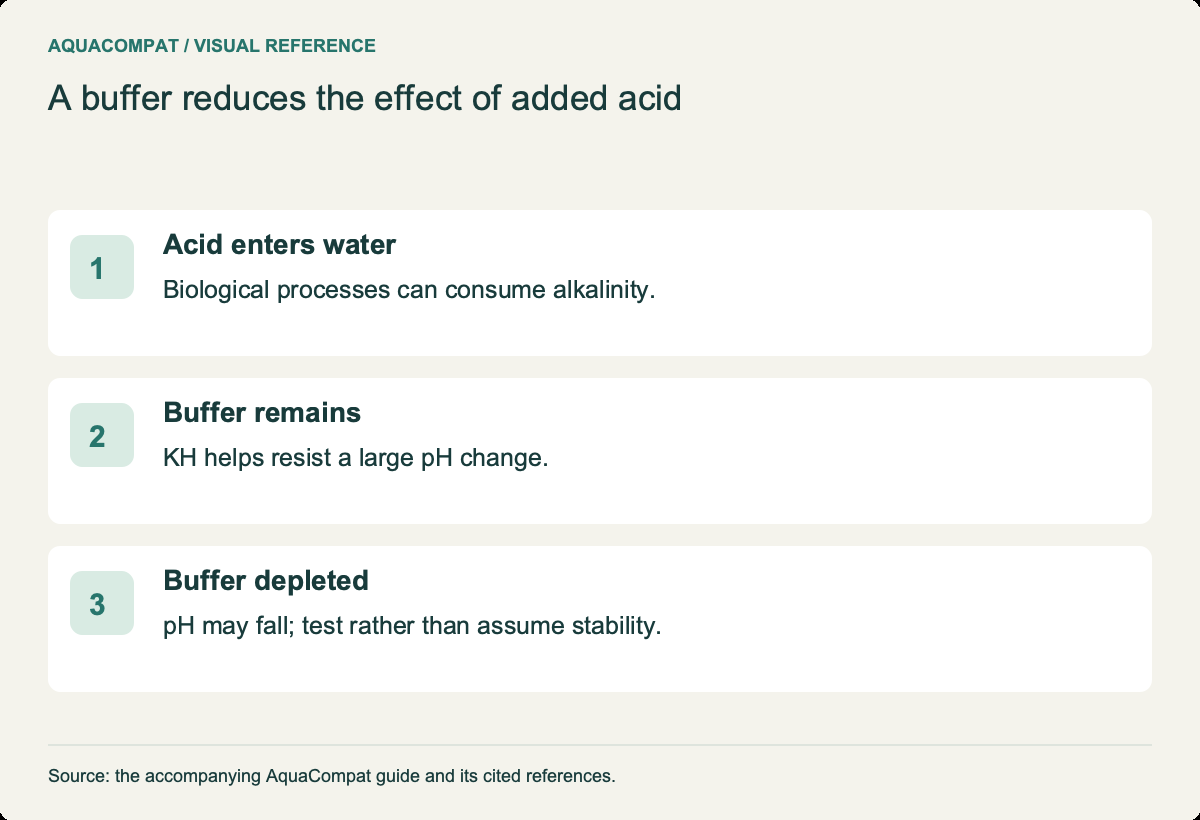
KH keeps pH stable because carbonates and bicarbonates absorb acid before it can lower pH. SRAC 464 explains that water with moderate to high alkalinity stays near 7.0–8.3 pH and does not swing widely, while low-alkalinity water can swing to dangerously low or high pH. KH is used up over time: UF/IFAS notes that nitrifying bacteria consume alkalinity, so KH falls in an aquarium and must be replenished or pH drops. The process behind that is explained in the guide to the nitrogen cycle.
How much KH does a tank need?
Sources set the minimum at different levels. SRAC 464 gives a desirable total alkalinity of 75–200 mg/L as CaCO3 for fish ponds, with 20 mg/L as the minimum. The Merck Veterinary Manual, writing for aquaria, says alkalinity of 50 mg/L or less inhibits the biofilter and recommends at least 100 mg/L as CaCO3 (minimum). For a fish tank with a biofilter, Merck’s figure is the more relevant one; soft-water shrimp tanks are the main exception, covered below.
| Species | Carbonate hardness | General hardness |
|---|---|---|
| Amano Shrimp | 0–10 dKH | 6–15 dGH |
| Crystal Red Shrimp | 0–2 dKH | 4–6 dGH |
| Assassin Snail | 2–10 dKH | 6–20 dGH |
| Cherry Shrimp | 2–8 dKH | 6–10 dGH |
| Goldfish | 5–15 dKH | 5–19 dGH |
| Nerite Snail | 5–12 dKH | 10–15 dGH |
How do you raise KH without changing pH?
You raise KH with sodium bicarbonate, and pH moves least when the tank already sits in the buffered range. SRAC Publication 4502 gives the dose as 53 g sodium bicarbonate per 3,785 L to raise alkalinity 10 mg/L. Because bicarbonate is a buffer, it pulls pH toward the stable band SRAC 464 describes, 7.0–8.3 pH, rather than pushing it ever higher. A tank already in that band may therefore gain KH with little pH change, while a soft, acidic tank will see pH rise as KH rises. No source in our data shows a way to raise KH in acidic water without some pH increase.
- Test KH and pH. Note both readings before adding anything.
- Work out the dose. Scale the SRAC 4502 figure to your tank’s volume and to the KH increase you want, using the unit conversions above.
- Add it in stages. Dissolve the bicarbonate in tank water and add part of the dose, then retest after the water has mixed.
- Check that pH stays inside your fish’s range. Compare the new reading with every species in the GH and pH chart above.
- Repeat at water changes. Because nitrification uses up KH, the dose is ongoing in soft-water areas rather than a one-off fix.
A KH test is needed to do this safely, and the comparison of best aquarium test kits compared shows which kits include GH and KH tests.
How do you raise or lower GH?
You raise GH by adding calcium and magnesium salts, and you lower it by diluting with purified water. Remineralisers made for shrimp keeping show the first approach: SaltyShrimp’s Bee Shrimp Mineral GH+ adds GH without KH at about 2–3 g per 10 L RO water, while its GH/KH+ version for Neocaridina adds both at about 3 g per 10 L RO water. For lowering GH, reverse osmosis removes most dissolved minerals, according to Michigan State University Extension, so mixing RO water with tap water lowers hardness in proportion. Pure RO water must be remineralised before use, because fish need some minimum salt content to stay in osmotic balance.
Where your water starts matters before any of this. The tap water for aquariums guide explains what utilities add to tap water, and the guide to RO and RO/DI water for aquariums covers purified water in more depth.
How do GH and KH needs differ for shrimp?
Shrimp tanks are where GH and KH are managed most precisely. Cherry shrimp (Neocaridina) are listed at 6–10 dGH and 2–8 dKH. Caridina bee shrimp need softer water: SaltyShrimp’s figures in our TDS data put them at 100–150 ppm TDS with GH 4–6 and no KH, which is why their remineraliser adds GH alone. Stability matters more than any single number, because shrimp tolerate sudden changes in softness poorly. The guide to TDS in shrimp tanks explains how total dissolved solids relate to GH, and the Caridina and Neocaridina comparison sets the two shrimp groups side by side.
Does hard water always mean a high, stable pH?
No. Hard water usually comes with high alkalinity, but not always. SRAC 464 points out that water can have high hardness with little alkalinity, and in that case it is hard without being well buffered. A high GH reading on its own therefore does not mean pH will stay put; only a KH reading tells you that. The reverse holds too: a tank can have modest GH but enough KH to keep pH steady.
That is why both tests matter. GH tells you whether the water suits the species, and KH tells you whether the water will stay suitable from one week to the next.
What happens when KH runs out?
When KH runs out, pH can fall quickly and the biofilter can stop working. Practical Fishkeeping links depleted KH during cycling to a pH crash below 6 pH (below), at which point the nitrifying bacteria stop functioning and the cycle stalls. In established tanks Merck describes a related failure, old tank syndrome, in which pH falls sharply as organic acids build up without water changes. Soft tap water gives the least margin against both. Regular water changes and, where needed, small bicarbonate doses keep KH from reaching zero; the water chemistry and setup guides cover the related topics.
Questions people ask
Is GH or KH more important for fish?
Both matter for different reasons. GH decides whether the water suits a species, so a molly listed at 15–25 dGH does poorly in very soft water. KH decides whether pH stays steady, and Merck recommends at least 100 mg/L as CaCO3 (minimum) alkalinity for a working biofilter. A tank needs both in a suitable range.
What GH and KH should a community tank have?
Choose GH from the species you keep: many community fish overlap in medium water, for example corydoras at 2–15 dGH and bettas at 1–15 dGH. For KH, Merck’s minimum for biofilter function is 100 mg/L as CaCO3 (minimum), which you can convert to degrees with the factor in the unit table. Soft-water shrimp tanks are run with less KH by design.
Can baking soda raise GH?
No. Baking soda is sodium bicarbonate, which adds carbonate alkalinity (KH) but no calcium or magnesium, so GH stays the same. SRAC 4502 gives 53 g sodium bicarbonate per 3,785 L to raise alkalinity 10 mg/L. To raise GH you need a calcium and magnesium source, such as a remineraliser made for aquarium or shrimp use.
Why is my KH zero but my GH high?
SRAC 464 explains that hardness and alkalinity can differ: water can hold plenty of calcium and magnesium with little carbonate. KH also falls over time because nitrifying bacteria consume it, according to UF/IFAS. A zero KH reading means pH is unbuffered and can swing, so restore some KH even if GH looks fine.
Do I need to adjust hardness for tank-bred fish?
Often not. Tank-bred fish tend to be more adaptable than wild ones; Aquarium Co-Op says US captive-bred angelfish come from hard Florida water but adapt to soft, and Seriously Fish says farmed neons are more adaptable than wild stock. If your tap water already falls inside every species’ range in the chart, leave it alone and aim for stability.
Sources 116 documents from 22 publishers
- Applesnail.net (applesnail.net): “Quick guide”; “Pomacea diffusa”; “How to take care of apple snails”; “Apple snail FAQ”
- Aqualog (aqualog.de): “Discus (lexicon profile)”
- Aquarium Co-Op (aquariumcoop.com): “Discus Fish Care Guide”; “Care Guide for Kuhli Loaches”; “Chili Rasbora care guide”; “Care Guide for Cardinal Tetras”; “Care Guide for Harlequin Rasboras and Lambchop Rasboras”; “Care Guide for Plecostomus”; “Care Guide for Cory Catfish”; “Care Guide for Dwarf Gouramis”; “Freshwater Angelfish Care Guide”; “Celestial Pearl Danio care guide”; “Oscar Fish Care Guide”; “Care Guide for Zebra and Leopard Danios”; “Care Guide for Cherry Shrimp”; “Care Guide for Amano Shrimp”; “Care Guide for Assassin Snails”; “Care Guide for Mystery Snails”; “Guppy Care Guide”; “Care Guide for Nerite Snails”; “Endler's Livebearer Care Guide”; “Care Guide for Mollies: Feeding, Breeding, and Tank Mates”; “Top 5 Dither Fish to Help Shy or Aggressive Fish in Freshwater Tanks”; “Betta fish tank mates”
- AquariumInfo.org (aquariuminfo.org): “Apple Snail”
- FishBase (fishbase.se): “Symphysodon aequifasciatus summary (Bayesian length-weight estimate)”; “Betta splendens, Siamese fighting fish: species summary”; “Osteogaster aenea, Bronze corydoras”; “Trichogaster lalius, Dwarf gourami: species summary”; “Carassius auratus, Goldfish: species summary”; “Danio rerio summary page”; “Poecilia sphenops, Molly: species summary”; “Poecilia latipinna, Sailfin molly: species summary”; “Length-weight relationships for Poecilia sphenops”; “Labidochromis caeruleus summary (Bayesian length-weight estimate)”; “Pterophyllum scalare, Freshwater angelfish: species summary”; “Length-weight relationships for Pterophyllum scalare”
- Green Aqua (greenaqua.hu): “Shrimp in the aquarium”
- Maidenhead Aquatics (fishkeeper.co.uk species data sheet) (fishkeeper.co.uk): “Discus data sheet”; “Neon Tetra data sheet”; “Angelfish data sheet”; “Black Widow Tetra (Black Skirt Tetra) data sheet”; “Oscar data sheet”; “Guppy data sheet”; “Zebra Nerite Snail”; “Platy data sheet”; “Kenyi data sheet”; “Hybrid Peacock (Aulonocara sp.) data sheet”; “Yellow Labidochromis data sheet”; “Molly data sheet”
- Merck Veterinary Manual (merckvetmanual.com): “Environmental Diseases of Aquatic Animals in Aquatic Systems, Francis-Floyd, Yanong and Petty”; “Management of Aquarium Fish, Petty, Francis-Floyd and Yanong”; “Disorders and Diseases of Fish (pet owner version)”
- Michigan State University Extension (archive) (sanweb.lib.msu.edu): “Reverse Osmosis for Home Treatment of Drinking Water (WQ24, 1990)”
- Neotropical Ichthyology (Crampton 2008) (scielo.br): “Ecology and life history of an Amazon floodplain cichlid: the discus fish Symphysodon”
- Ornamental Aquatic Trade Association (OATA) (ornamentalfish.org): “How to look after goldfish in an aquarium / fish tank”; “How to look after fancy goldfish”
- PlanetCatfish (via Internet Archive snapshot, 2025) (web.archive.org): “Ancistrus sp. (3) Common Bristlenose Catfish Cat-eLog data sheet”; “Osteogaster aenea (Bronze Cory) Cat-eLog data sheet”
- Practical Fishkeeping (practicalfishkeeping.co.uk): “A guide to the small rasboras from the genus Trigonostigma”; “Bristlenose catfish: the hardworking Ancistrus”; “What can I keep in my hard water aquarium?”; “Frequently asked questions on Neocaridina shrimps”; “Amano shrimp: Spineless heroes (Nathan Hill)”; “Quick guide to livebearers”; “Malawi's finest: The Yellow lab, Labidochromis caeruleus”; “Will these snails starve without algae?”; “What can I add for algae control?”; “How to Cycle a Fish Tank: The Complete Guide”
- SaltyShrimp (product information via Furry Critter Network) (furrycritter.com): “SaltyShrimp Remineralizers for Invertebrates”
- Seriously Fish (seriouslyfish.com): “Symphysodon aequifasciatus”; “Pangio semicincta ('Kuhli' Loach)”; “Boraras brigittae”; “Paracheirodon axelrodi (Cardinal Tetra)”; “Trigonostigma heteromorpha (Harlequin)”; “Paracheirodon innesi (Neon Tetra)”; “Betta splendens”; “Ancistrus sp. '3' (Common Bristlenose Catfish)”; “Osteogaster aenea (Bronze Cory)”; “Trichogaster lalius”; “Pterophyllum scalare”; “Danio margaritatus (Celestial Pearl Danio)”; “Gymnocorymbus ternetzi (Black Widow Tetra)”; “Astronotus ocellatus”; “Danio rerio (Zebra Danio)”; “Poecilia reticulata”; “Xiphophorus maculatus”; “Maylandia lombardoi”; “Aulonocara stuartgranti”; “Aulonocara baenschi”; “Labidochromis caeruleus”; “Poecilia wingei”; “Poecilia sphenops”; “Poecilia latipinna”
- Shrimp and Snail Breeder (aquariumbreeder.com): “Crystal Red Shrimp: detailed guide, care, diet and breeding”; “Red Cherry Shrimp: detailed guide, care, diet and breeding”; “Assassin Snail: detailed guide, care, diet and breeding”; “Nerite Snails: detailed guide, care, diet and breeding”; “Cherry shrimp in a community tank: how to make it successful”
- Shrimp Science (shrimpscience.com): “Crystal Red Shrimp - Care Guide”; “Red Cherry Shrimp - Care Guide”; “General Hardness (GH) For Shrimp Tanks”; “Amano Shrimp”; “Carbonate Hardness (KH) For Shrimp Tanks”
- Southern Regional Aquaculture Center (srac.msstate.edu): “Interactions of pH, Carbon Dioxide, Alkalinity and Hardness in Fish Ponds, SRAC Publication No. 464, Wurts and Durborow”; “SRAC 4606: Interpretation of Water Analysis Reports for Fish Culture (Stone, Shelton, Haggard, Thomforde)”; “How to Start a Biofilter, SRAC Publication No. 4502, DeLong and Losordo”
- Tropical Fish Hobbyist Magazine (tfhmagazine.com): “Labidochromis caeruleus”
- University of Florida IFAS Extension (EDIS) (ask.ifas.ufl.edu): “Ammonia in Aquatic Systems (FA16/FA031), Francis-Floyd, Watson, Petty and Pouder”
- US Geological Survey (pubs.usgs.gov): “The Quality of Our Nation's Waters: Quality of Water from Domestic Wells in Principal Aquifers of the United States, 1991-2004, Overview of Major Findings (Circular 1332)”
- Wikipedia (en.wikipedia.org): “dGH”; “Carbonate hardness”; “Vittina natalensis”
All sources accessed . Every number on this page comes from these documents.