What makes a good tank mate for discus?
A good discus tank mate thrives in very warm, soft water, eats calmly enough not to outcompete a shy fish, and is too large to be eaten. Discus (Symphysodon spp.) are disc-shaped cichlids from lowland Amazon floodplain lakes and flooded forests; Seriously Fish gives an adult length of 5.5 in (14 cm). Four criteria follow from the published sources.
- Very warm water. Our discus range is 79–86 °F (26–30 °C), from Seriously Fish and FishBase. That lower limit sits above the upper limit of many community fish, so temperature decides most discus verdicts.
- Soft water. Discus need pH 5.0–7.6 and 0–8 dGH. Livebearers and snails, which prefer hard, alkaline water, share little of that range.
- Calm feeding. Aquarium Co-Op describes discus as slow, shy feeders that fast-feeding tankmates outcompete, and Seriously Fish and Co-Op both say the species is very skittish and needs cover and calm companions.
- Not small enough to eat. Maidenhead Aquatics says tankmates must not be small enough for an adult discus to eat, and Shrimp and Snail Breeder says dwarf shrimp become discus food.
Discus are rated advanced in our data; Aquarium Co-Op calls them notorious for being extremely difficult to keep, so tank mates should add as little stress as possible. This page is one of our tank mates by species guides, which rank each species with the same method.
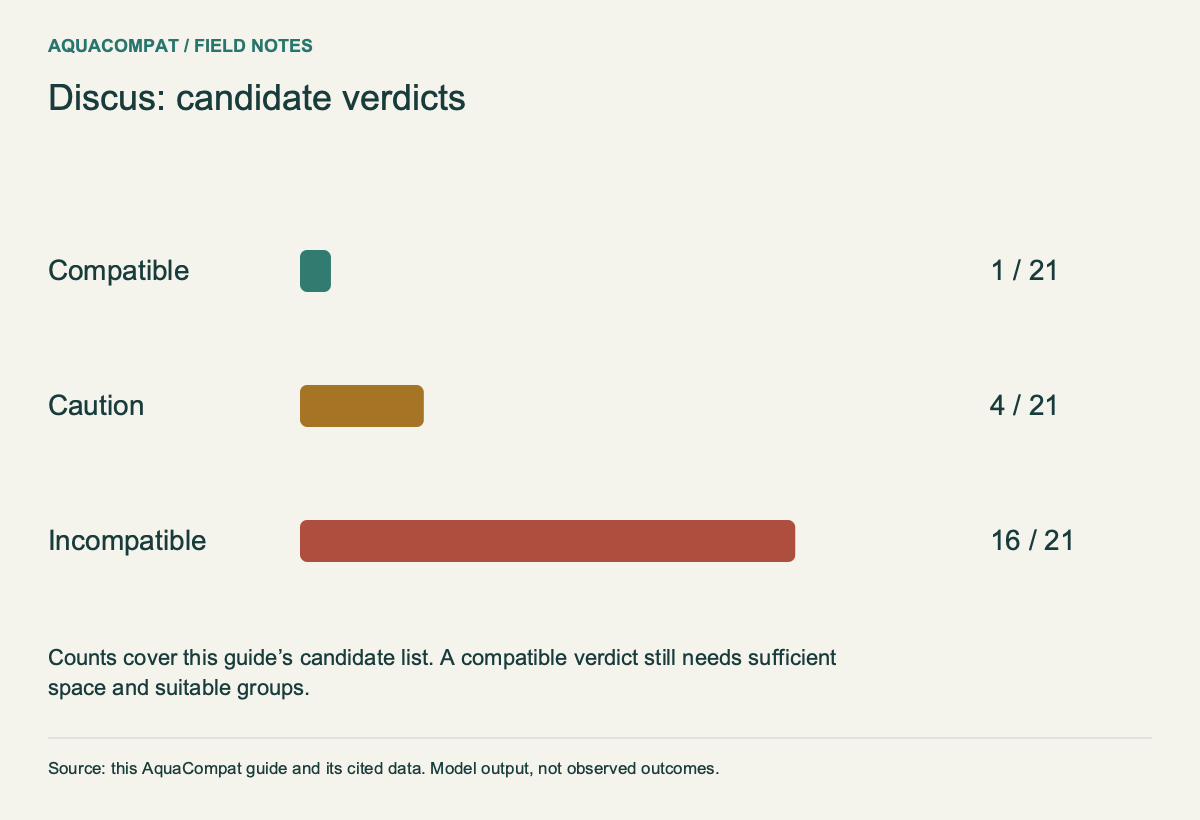
| Species | Verdict | Score | Shared temperature | Shared pH | Smallest tank |
|---|---|---|---|---|---|
| Angelfish | compatible | 8/10 | 79–86 °F (26–30 °C) | pH 6.0–7.6 | 125 US gal (473 L) |
| Betta Fish | caution | 7/10 | 79–86 °F (26–30 °C) | pH 6.0–7.6 | 125 US gal (473 L) |
| Cardinal Tetra | caution | 7/10 | 79–84 °F (26–29 °C) | pH 5.0–7.5 | 75 US gal (284 L) |
| Guppy | caution | 7/10 | 79–82 °F (26–28 °C) | pH 7.0–7.6 | 75 US gal (284 L) |
| Molly | caution | 6/10 | 79–82 °F (26–28 °C) | pH 7.5–7.6 | 75 US gal (284 L) |
| Bristlenose Pleco | incompatible | 3/10 | 79–79 °F (26–26 °C) | pH 6.0–7.2 | 75 US gal (284 L) |
| Corydoras | incompatible | 3/10 | 79–81 °F (26–27 °C) | pH 6.5–7.5 | 75 US gal (284 L) |
| Kuhli Loach | incompatible | 3/10 | 79–79 °F (26–26 °C) | pH 5.0–7.0 | 75 US gal (284 L) |
| Dwarf Gourami | incompatible | 3/10 | 79–81 °F (26–27 °C) | pH 6.0–7.5 | 125 US gal (473 L) |
| GloFish Tetra | incompatible | 3/10 | 79–79 °F (26–26 °C) | pH 6.0–7.0 | 75 US gal (284 L) |
| Harlequin Rasbora | incompatible | 3/10 | 79–79 °F (26–26 °C) | pH 5.0–7.5 | 75 US gal (284 L) |
| Amano Shrimp | incompatible | 3/10 | 79–81 °F (26–27 °C) | pH 6.0–7.5 | 75 US gal (284 L) |
| Goldfish | incompatible | 3/10 | no overlap | pH 6.0–7.6 | 75 US gal (284 L) |
| Mystery Snail | incompatible | 3/10 | no overlap | pH 7.2–7.6 | 75 US gal (284 L) |
| Neon Tetra | incompatible | 3/10 | no overlap | pH 5.0–7.5 | 75 US gal (284 L) |
| Nerite Snail | incompatible | 3/10 | 79–79 °F (26–26 °C) | pH 7.2–7.6 | 75 US gal (284 L) |
| Cherry Shrimp | incompatible | 3/10 | 79–79 °F (26–26 °C) | pH 6.5–7.6 | 75 US gal (284 L) |
| Endler's Livebearer | incompatible | 3/10 | 79–81 °F (26–27 °C) | pH 7.0–7.6 | 75 US gal (284 L) |
| Platy | incompatible | 3/10 | no overlap | pH 7.0–7.6 | 75 US gal (284 L) |
| Zebra Danio | incompatible | 3/10 | no overlap | pH 6.0–7.6 | 75 US gal (284 L) |
| Oscar | incompatible | 3/10 | 79–80 °F (26–27 °C) | pH 6.0–7.6 | 125 US gal (473 L) |
Which fish are the best discus tank mates?
The best discus tank mates are the few warm-water species that are also too large to eat, and only a handful of species in our data clear both bars. Each is described below with the evidence behind its score.
Angelfish
Angelfish score 8/10 with discus. Both are Amazon cichlids, they share 79–86 °F (26–30 °C) and pH 6.0–7.6, and the angelfish, at 6 in (15.2 cm), is close to the discus in size. The pairing needs 125 US gal (473 L) because the angelfish is semi-aggressive, and Seriously Fish notes that angelfish squabble with their own kind and chase fish from spawning sites. The angelfish tank mates guide covers the pairing from the angelfish side.
Betta
Bettas also score 7/10, because their range of 72–86 °F (22–30 °C) reaches as high as the discus range and their pH ranges overlap widely, at pH 6.0–7.6. Treat that result with care. Seriously Fish advises keeping bettas alone and calls them unsuitable for a standard community, and the pair needs 125 US gal (473 L). The ranked list of betta fish tank mates shows which companions suit a betta better.
Cardinal tetra
Cardinal tetras score 7/10, with a caution verdict. They share 79–84 °F (26–29 °C) and a wide pH band, and Aquarium Co-Op lists cardinals as suitable discus tankmates. The caution comes from size: a cardinal grows to only 1.4 in (3.6 cm), and Maidenhead Aquatics says tankmates must not be small enough for adult discus to eat. Practical Fishkeeping suggests 77–82 °F for a Rio Negro cardinal biotope, which overlaps the cool end of the discus range.
Guppy and molly
Guppies score 7/10 and mollies 6/10. Both share 79–82 °F (26–28 °C), but both prefer harder water than discus. Guppies share pH 7.0–7.6, and mollies only pH 7.5–7.6; Seriously Fish and Aquarium Co-Op say mollies become disease-prone in soft or acidic water, which is exactly what discus are kept in.
How do wild and captive-bred discus change the tank mate list?
Farm-raised discus are often kept warmer than the wild range, and that warmer figure removes most remaining tank mates. Our displayed range of 79–86 °F (26–30 °C) comes from Seriously Fish and FishBase, but the sources disagree at both ends.
Temperature
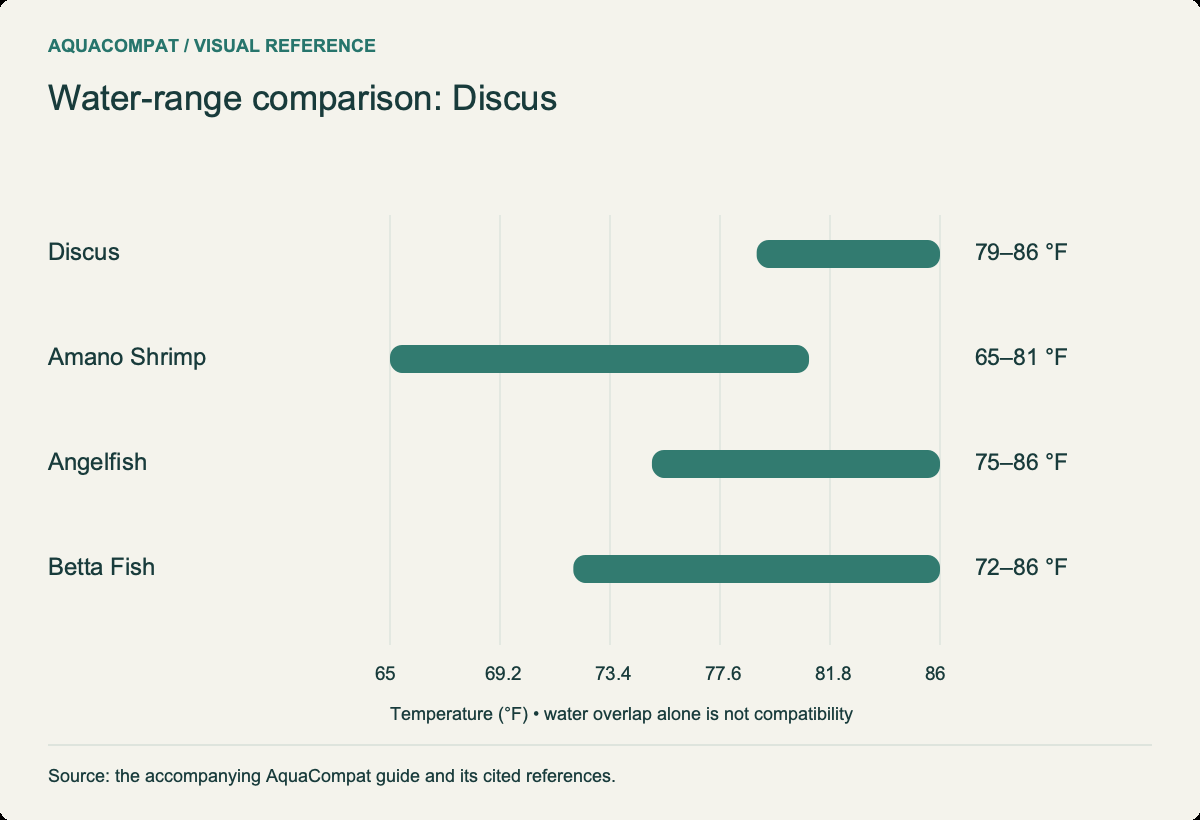
Maidenhead Aquatics gives 81–86 °F, and Aquarium Co-Op recommends 85–86 °F because farm-raised discus are kept warm. At that higher figure, cardinal tetras (73–84 °F (23–29 °C)) and guppies (68–82 °F (20–28 °C)) are above their upper limits, which leaves angelfish (75–86 °F (24–30 °C)) and bettas as the only fish in our data whose ranges still reach it. Read the temperature guide for tropical species before choosing a heater setting for a mixed tank.
pH and hardness
The pH and hardness sources disagree widely. Seriously Fish gives pH 5.0–7.0 and Maidenhead Aquatics pH 6.0–6.5, while Aquarium Co-Op says both wild and captive-bred discus do well at pH 6.8–7.6. Aqualog records wild discus water at pH 4–5 with no measurable hardness, and Seriously Fish gives 0–5 dGH, against Maidenhead’s upper limit of 8 dH and Co-Op’s soft to medium. The practical effect for tank mates is that Co-Op’s more neutral water suits livebearers such as guppies better, while the soft, acidic water recorded for wild habitats favours soft-water fish only. The aquarium pH guide explains how to measure and hold a target.
Our data does not separate wild-caught from captive-bred discus as different entries, so the scores on this page use the consensus range. If you keep farm-raised discus at Co-Op’s temperature, re-check each tank mate against that figure rather than against the table.
Which fish should never live with discus?
Fish that cannot live in very warm water should never live with discus, and neither should predators or fish small enough to eat. Most species in our data fail on temperature alone.
No shared temperature
Neon tetras, platies, zebra danios, goldfish and mystery snails share no temperature range with discus. Neon tetras, for example, need 70–77 °F (21–25 °C), and goldfish 59–70 °F (15–21 °C). Discus score 3/10 with neons, and Maidenhead Aquatics’ warning about fish small enough to eat applies as well.
Ranges that barely meet
Corydoras, kuhli loaches, bristlenose plecos, harlequin rasboras, GloFish tetras, dwarf gouramis and Endler’s livebearers all have upper limits that reach the discus range by only a degree or two. Corydoras, at 70–81 °F (21–27 °C), share just 79–81 °F (26–27 °C), and bristlenose plecos 79–79 °F (26–26 °C). A shared range that narrow leaves no margin for heater drift, and at Aquarium Co-Op’s farm-raised temperature it disappears. These fish are better placed in the tanks described in the guides to bristlenose pleco tank mates and kuhli loach tank mates.
Oscars
Oscars score 3/10. They share only 79–80 °F (26–27 °C), grow to 14 in (35.6 cm), and Seriously Fish and Aquarium Co-Op describe them as predators of any fish small enough to swallow, which includes a discus. The guide to compatible tank mates for oscars covers the large, robust fish that suit them.
Are discus aggressive toward tank mates?
No, not toward other species. Discus are cichlids, and cichlids have a reputation for aggression, but Seriously Fish calls the discus peaceful and shy, and Maidenhead Aquatics reports minimal aggression toward suitable companions. Our discus data records its temperament as peaceful.
The aggression that does occur is aimed at other discus. FishBase notes territorial behaviour when breeding, and Aquarium Co-Op says bullying appears in small groups, which is why it starts with 10–12 juveniles rather than a pair. The real risk with tank mates runs the other way: Aquarium Co-Op says fast-feeding tankmates outcompete discus for food, and Seriously Fish and Co-Op say this skittish fish needs calm companions and cover.
How many discus should you keep together?
Keep at least 6 discus. Seriously Fish says the species needs a group, and Aquarium Co-Op starts with 10–12 juveniles in a 75-gallon tank and thins the group to about six adults as they grow. Crampton (2008), in a field study published in Neotropical Ichthyology, records wild discus gathering in dry-season colonies of hundreds among sunken branches.
The group itself takes most of the space in a discus tank, so tank mates come second. Discus breeding is rated hard in our data: Crampton describes eggs laid on submerged roots with care of eggs and larvae, and Aquarium Co-Op says raising fry is very time- and labour-intensive. Captive discus typically live 3–5 years according to Crampton, though Aqualog reports one reaching 17 years.
What tank size do discus and their tank mates need?
Discus pairings with peaceful fish need 75 US gal (284 L) in our data, and pairings with angelfish or bettas need 125 US gal (473 L). The shared figure takes the larger of the two species’ minimum tanks, adds a margin of one half when one species is semi-aggressive, and rounds up to the next common tank size.
Under 55 gallons
No discus tank mate fits a 10, 20 or 29-gallon tank in our data, because the discus minimum alone is 67 US gal (254 L). If you have a small tank, the guide to the best fish for a 10-gallon community tank is a better starting point than discus.
55 to 75 gallons
Our minimum of 67 US gal (254 L) comes from Seriously Fish’s 255-litre tank for a few juveniles or a breeding pair. Aquarium Co-Op recommends 75 gallons for a group, with 55 possible only with frequent water changes, and Aqualog gives 216 litres, about 57 US gallons, as the minimum for a pair. A group of discus with cardinal tetras or guppies calculates at 75 US gal (284 L).
125 gallons
Angelfish or a betta with discus need 125 US gal (473 L) under our method. The stocking calculator checks a full discus community against a given tank.
Can discus live with shrimp and snails?
Discus are a poor match for both, for different reasons. Shrimp are eaten, and snails need cooler, harder water.
Shrimp
Shrimp and Snail Breeder says dwarf shrimp become discus food. Cherry shrimp score 3/10 and amano shrimp 3/10; the cherry shrimp’s range of 70–79 °F (21–26 °C) also meets the discus range only at its upper limit. The guide to cherry shrimp tank mates lists fish that leave shrimp alone.
Snails
Nerite snails score 3/10 and mystery snails 3/10. No source in our discus data says discus eat snails; the problem is water. Mystery snails need 70–78 °F (21–26 °C), below the discus range, and nerites need pH 7.2–8.0, harder and more alkaline than most discus water. Our snail compatibility guide lists better companions.
To score any species not on this page against discus, use the species compatibility checker, which draws on the same data.
Questions people ask
Can discus and angelfish live together?
Yes, in our data, with conditions. The pair scores 8/10, shares 79–86 °F (26–30 °C) and is similar in size. The tank must be at least 125 US gal (473 L), and because Aquarium Co-Op describes discus as slow, shy feeders, make sure the angelfish do not take all the food.
Can discus live with neon tetras?
No. Neon tetras need 70–77 °F (21–25 °C), which shares no range with the discus’s 79–86 °F (26–30 °C), so the pairing scores 3/10. A neon is also small, at 1.2 in (3 cm), and Maidenhead Aquatics says discus tankmates must not be small enough to eat. Cardinal tetras tolerate warmer water and score higher.
Can discus live with cardinal tetras?
They can, with care. The pairing scores 7/10 and Aquarium Co-Op lists cardinals as suitable discus tankmates. They share 79–84 °F (26–29 °C), but Co-Op’s 85–86 °F for farm-raised discus is above the cardinal’s range, and a small cardinal is at some risk from adult discus.
Can discus live with corydoras?
Not in our data. Corydoras need 70–81 °F (21–27 °C), so they share only 79–81 °F (26–27 °C) with discus and the pairing scores 3/10. Corydoras would be kept at the very top of their range permanently, and at warmer farm-raised discus temperatures the overlap disappears.
Can discus live with a bristlenose pleco?
Not comfortably. The bristlenose pleco needs 72–79 °F (22–26 °C), which meets the discus range only at 79–79 °F (26–26 °C), so the pairing scores 3/10. The pleco would live at the top of its range permanently. Our data does not cover other pleco species, so we cannot score them against discus.
Sources 106 documents from 20 publishers
- Applesnail.net (applesnail.net): “How to take care of apple snails”; “Quick guide”; “Pomacea diffusa”; “Apple snail FAQ”
- Aqualog (aqualog.de): “Discus (lexicon profile)”
- Aquarium Co-Op (aquariumcoop.com): “Discus Fish Care Guide”; “Freshwater Angelfish Care Guide”; “Betta Fish Care Guide”; “Care Guide for Dwarf Gouramis”; “10 Best Top-Dwelling Fish for Your Freshwater Community Aquarium”; “Care Guide for Cardinal Tetras”; “Neon and Cardinal Tetras: Beginner Schooling Fish”; “Guppy Care Guide”; “Care Guide for Mollies: Feeding, Breeding, and Tank Mates”; “Top 5 Dither Fish to Help Shy or Aggressive Fish in Freshwater Tanks”; “Care Guide for Fancy Goldfish”; “What Is Neon Tetra Disease and How Can It Be Prevented?”; “Goldfish Tank Mates”; “Care Guide for Amano Shrimp”; “Care Guide for Cory Catfish”; “Care Guide for Plecostomus”; “Care Guide for Kuhli Loaches”; “Oscar Fish Care Guide”; “Care Guide for Cherry Shrimp”; “Care Guide for Nerite Snails”; “Care Guide for Mystery Snails”; “Betta fish tank mates”
- AquariumInfo.org (aquariuminfo.org): “Apple Snail”
- Crustacean Research 49 (Hamasaki et al. 2020) (jstage.jst.go.jp): “Dietary effects of phytoplankton and zooplankton on larval survival, duration and growth of four Caridina species”
- Crustacean Research 50 (Kondo, Hamasaki, Dan 2021) (jstage.jst.go.jp): “Larval performance of three amphidromous shrimp species in the genus Caridina under different temperature and salinity conditions”
- FishBase (fishbase.se): “Symphysodon aequifasciatus, Blue discus: species summary”; “Pterophyllum scalare, Freshwater angelfish: species summary”; “Length-weight relationships for Pterophyllum scalare”; “Betta splendens summary (Bayesian length-weight estimate)”; “Paracheirodon axelrodi summary (Bayesian length-weight estimate)”; “Poecilia reticulata, Guppy: species summary”; “Length-weight relationships for Poecilia reticulata”; “Poecilia sphenops, Molly: species summary”; “Poecilia latipinna, Sailfin molly: species summary”; “Length-weight relationships for Poecilia sphenops”; “Paracheirodon innesi summary page”; “Carassius auratus, Goldfish: species summary”; “Length-weight relationships for Carassius auratus”; “Osteogaster aenea, Bronze corydoras”; “Length-weight relationships for Osteogaster aenea”; “Ancistrus cirrhosus summary (Bayesian length-weight estimate)”; “Pangio kuhlii summary (Bayesian length-weight estimate)”; “Astronotus ocellatus, Oscar: species summary”; “Length-weight relationships for Astronotus ocellatus”
- fishkeeping.co.uk (fishkeeping.co.uk): “Goldfish Size, Life Expectancy and Tank Recommendations”; “Keeping Goldfish - The Right Way”
- Maidenhead Aquatics (fishkeeper.co.uk species data sheet) (fishkeeper.co.uk): “Discus data sheet”; “Angelfish data sheet”; “Siamese Fighting Fish/Betta data sheet”; “Guppy data sheet”; “Molly data sheet”; “Neon Tetra data sheet”; “Oscar data sheet”; “Amano Shrimp”; “Zebra Nerite Snail”
- Neotropical Ichthyology (Crampton 2008) (scielo.br): “Ecology and life history of an Amazon floodplain cichlid: the discus fish Symphysodon”
- Ornamental Aquatic Trade Association (OATA) (ornamentalfish.org): “How to look after fancy goldfish”; “How to look after goldfish in an aquarium / fish tank”
- PlanetCatfish (via Internet Archive snapshot, 2025) (web.archive.org): “Osteogaster aenea (Bronze Cory) Cat-eLog data sheet”; “Ancistrus sp. (3) Common Bristlenose Catfish Cat-eLog data sheet”
- Practical Fishkeeping (practicalfishkeeping.co.uk): “Cardinal tetra, Paracheirodon axelrodi”; “How long will my fish live?”; “Quick guide to livebearers”; “What water temperature do goldfish need?”; “How can I breed goldfish in my aquarium?”; “What can I keep in my hard water aquarium?”; “Bristlenose catfish: the hardworking Ancistrus”; “Frequently asked questions on Neocaridina shrimps”; “Amano shrimp: Spineless heroes (Nathan Hill)”; “An introduction to Shrimp”; “Will these snails starve without algae?”; “What can I add for algae control?”
- Practical Fishkeeping (Julian Dignall) (practicalfishkeeping.co.uk): “Focus on commonly kept Corydoras”
- Seriously Fish (seriouslyfish.com): “Symphysodon aequifasciatus”; “Pterophyllum scalare”; “Betta splendens”; “Paracheirodon axelrodi (Cardinal Tetra)”; “Poecilia reticulata”; “Poecilia sphenops”; “Poecilia latipinna”; “Poecilia wingei”; “Paracheirodon innesi (Neon Tetra)”; “Osteogaster aenea (Bronze Cory)”; “Ancistrus sp. '3' (Common Bristlenose Catfish)”; “Pangio semicincta ('Kuhli' Loach)”; “Astronotus ocellatus”
- Shrimp and Snail Breeder (aquariumbreeder.com): “Cherry Shrimp in a Community Tank”; “Red Cherry Shrimp: detailed guide, care, diet and breeding”; “Amano Shrimp: detailed guide, care, diet and breeding”; “How Copper Affects Dwarf Shrimp”; “Nerite Snails: detailed guide, care, diet and breeding”
- Shrimp Science (shrimpscience.com): “Red Cherry Shrimp - Care Guide”; “General Hardness (GH) For Shrimp Tanks”; “Amano Shrimp”; “Carbonate Hardness (KH) For Shrimp Tanks”; “TDS For Shrimp Tanks”
- Tropical Fish Hobbyist Magazine (tfhmagazine.com): “Betta splendens”; “Astronotus sp.”
- UF/IFAS EDIS (ask.ifas.ufl.edu): “Evolution, Culture, and Care for Betta splendens (FA212)”
- Wikipedia (en.wikipedia.org): “Vittina natalensis”
All sources accessed . Every number on this page comes from these documents.