What makes a good tank mate for aquarium snails?
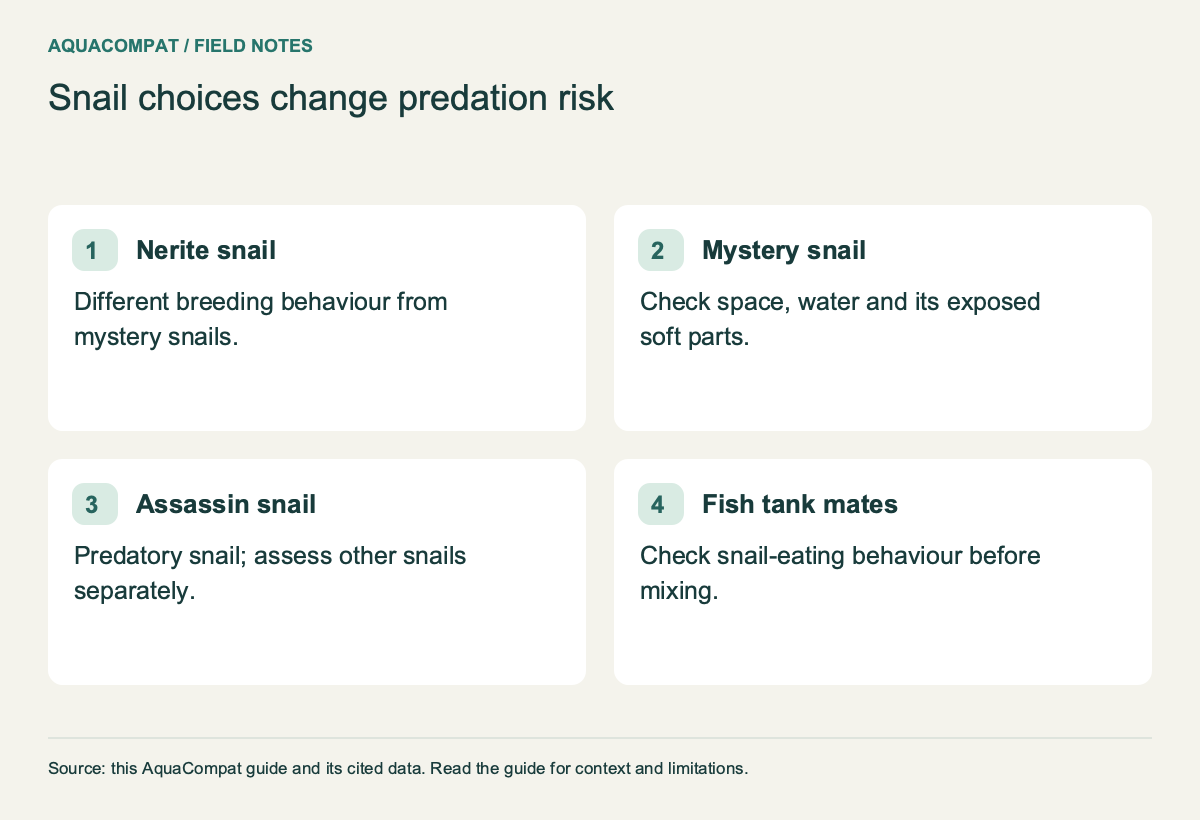
A good snail tank mate does not eat or pick at snails, shares hard, alkaline water and never needs copper-based treatment. The three snails in our fact base are the nerite snail (Neritina natalensis (now Vittina natalensis); hobby name covers several Neritina and related nerites), the mystery snail (Pomacea diffusa) and the assassin snail (Anentome helena). Their published needs give four criteria.
- Not a snail eater. Aquarium Co-Op and Maidenhead Aquatics list pufferfish, snail-eating loaches and large or aggressive cichlids as threats to nerites and mystery snails, and the assassin snail itself eats other snails.
- Not an antenna-nipper. Aquarium Co-Op says bettas may mistake a mystery snail’s long antennae for worms, and the nerite’s sources list fish that nip antennae among its threats.
- Shared alkaline water. All three snails need alkaline water: the nerite at pH 7.2–8.0, the mystery snail at pH 7.2–8.0 and the assassin at pH 7.2–8.0. Soft-water fish with a lower pH ceiling share no range with them.
- A copper-free tank. Maidenhead and Shrimp and Snail Breeder say nerites do not tolerate copper medications, and Aquarium Co-Op calls mystery snails very sensitive to copper, including copper in tap water.
The table below sets the three snails side by side. For other species groups, the tank mates by species index lists every hub.
| Attribute | Nerite snail | Mystery snail | Assassin snail |
|---|---|---|---|
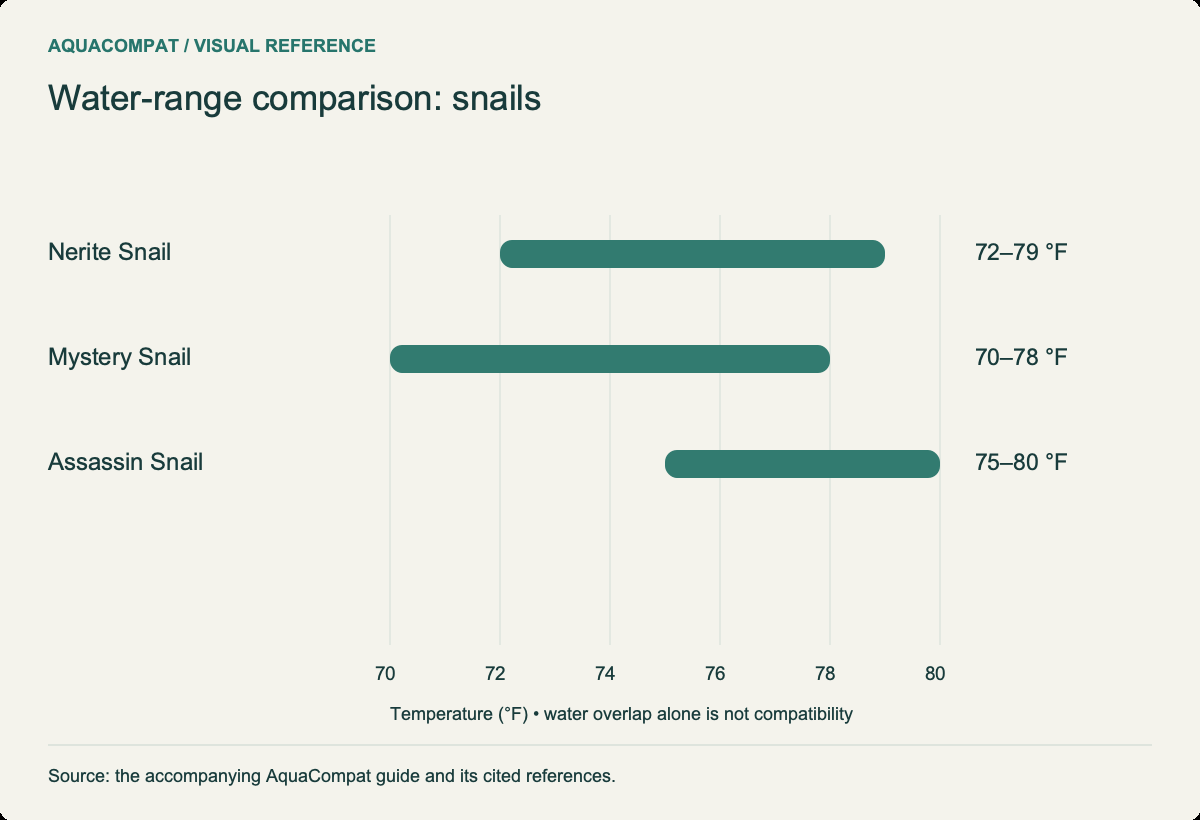
| Temperature | 72–79 °F (22–26 °C) | 70–78 °F (21–26 °C) | 75–80 °F (24–27 °C) |
| pH | pH 7.2–8.0 | pH 7.2–8.0 | pH 7.2–8.0 |
| General hardness | 10–15 dGH | 8–12 dGH | 6–20 dGH |
| Carbonate hardness | 5–12 dKH | not reliably documented | 2–10 dKH |
| Adult size | 1 in (2.5 cm) | 2.6 in (6.6 cm) | 1 in (2.5 cm) |
| Minimum tank | 5 US gal (19 L) | 5 US gal (19 L) | 5 US gal (19 L) |
| Diet | herbivore | omnivore | carnivore |
| Lifespan | 1–2 years | 1–2 years | up to 5 years |
| Breeds in freshwater | No: eggs need brackish or marine water | Yes, readily | Yes, slowly |
| Eats other snails | No | Not recorded for this species | Yes |
Which aquarium snails are best for a community tank?
The nerite snail is the safest all-round choice, the mystery snail suits owners who accept breeding, and the assassin snail is a specialist for pest-snail control. Each fills a different role.
Nerite snail: the algae grazer that cannot overrun a tank
Nerites graze algal film on glass and hardscape, and Practical Fishkeeping notes that algal film is most of what they eat in the wild. Their eggs do not hatch in freshwater: Shrimp and Snail Breeder says the capsules need brackish water and Maidenhead says hatching needs marine conditions, so a nerite population cannot grow in an aquarium. Aquarium Co-Op calls them peaceful and not particularly social, so a single nerite is fine. The nerite pairs well with nano species too, and in our data it is rated compatible with cherry shrimp. Nerites are among the grazers named on the green algae causes and fixes page.
Mystery snail: the larger scavenger
The mystery snail grows to 2.6 in (6.6 cm) and eats fish food, algae, biofilm and dead plants and animals, according to Aquarium Co-Op. Applesnail.net says it leaves healthy plants alone unless starving, though Co-Op notes it will eat duckweed and other small floating plants. It breeds easily: Applesnail.net reports clutches of 200 to 600 eggs laid above the waterline, and Co-Op says one snail per tank prevents breeding. A lid and an air gap are needed because it breathes through a siphon and climbs out of the water to lay. Surplus snails and egg clutches belong in the bin or with another keeper, not in local water: USGS (profile revised 2019) lists Pomacea diffusa, the mystery snail, as established in the wild in Florida and Hawaii.
Assassin snail: the pest-snail hunter
Assassin snails are used to control bladder, ramshorn and Malaysian trumpet snail infestations, according to Aquarium Co-Op and Shrimp and Snail Breeder. They need a male and a female to breed and lay single eggs slowly, so they do not overrun a tank themselves. Once the pest snails are gone, Shrimp and Snail Breeder says they need bloodworm, sinking carnivore pellets or similar protein or they will starve.
Which aquarium fish eat snails?
Pufferfish, snail-eating loaches and large or aggressive cichlids eat snails, according to the care sources for the nerite and mystery snail; Applesnail.net adds turtles. None of those snail specialists is in our species data, so we cannot score them, but the sources leave no doubt about the risk.
Among the species we do hold, no fish is recorded as a confirmed snail eater, but several carry a related risk. The cases are listed below, from greatest risk to least.
- Oscars: Aquarium Co-Op says an oscar eats any fish or invertebrate small enough to fit in its mouth. The nerite and oscar pairing scores 8/10 on water and temperament, but the nerite’s own sources list large cichlids among its threats, so treat that score with care. The oscar tank mates hub covers its other companions.
- African cichlids: the yellow lab, kenyi and peacock are recorded as invertebrate hunters, and Shrimp and Snail Breeder advises against keeping assassin snails with cichlids. The African cichlid compatibility matrix shows each pairing.
- Bettas: no source in our data says bettas eat snails, but Aquarium Co-Op warns they may nip mystery snail antennae and prefers other snails with them. The compatible tank mates for bettas list the nerite as the lowest-risk companion.
- Goldfish: fishkeeping.co.uk says goldfish eat anything that fits in their mouth. They also need cooler water than the nerite and assassin snail.
Several bottom dwellers are recorded as snail-safe. Aquarium Co-Op says bristlenose plecos eat only animals already dead, and it lists mystery snails alongside corydoras, tetras and kuhli loaches; the compatible tank mates for corydoras hub ranks the cory’s other options.
How do nerite, mystery and assassin snails score with common fish?
Most peaceful community fish that share alkaline water score well with all three snails, while soft-water specialists fail on pH alone. The matrix lists each pairing’s verdict and score, calculated from the same published data as the rest of the site; the how scores are calculated page explains the factors.
| Species | Nerite snail | Mystery snail | Assassin snail |
|---|---|---|---|
| Guppy | compatible (10/10) | compatible (10/10) | compatible (10/10) |
| Platy | compatible (9/10) | compatible (9/10) | incompatible (3/10) |
| Molly | compatible (8/10) | compatible (8/10) | compatible (8/10) |
| Corydoras | compatible (8/10) | compatible (9/10) | compatible (8/10) |
| Bristlenose Pleco | compatible (8/10) | compatible (9/10) | caution (7/10) |
| Neon Tetra | compatible (8/10) | compatible (9/10) | incompatible (3/10) |
| Harlequin Rasbora | compatible (8/10) | compatible (9/10) | compatible (8/10) |
| Betta Fish | caution (7/10) | caution (7/10) | caution (7/10) |
| Angelfish | caution (7/10) | caution (7/10) | compatible (8/10) |
| Kuhli Loach | incompatible (3/10) | incompatible (3/10) | incompatible (3/10) |
| Chili Rasbora | incompatible (3/10) | incompatible (3/10) | incompatible (3/10) |
| Goldfish | incompatible (3/10) | incompatible (3/10) | incompatible (3/10) |
| Oscar | compatible (8/10) | caution (7/10) | compatible (8/10) |
| Kenyi Cichlid | incompatible (3/10) | incompatible (3/10) | incompatible (3/10) |
| Cherry Shrimp | compatible (9/10) | compatible (10/10) | compatible (9/10) |
| Amano Shrimp | compatible (9/10) | compatible (9/10) | compatible (9/10) |
| Crystal Red Shrimp | incompatible (3/10) | incompatible (3/10) | incompatible (3/10) |
Can assassin snails live with nerite and mystery snails?
Not safely. Aquarium Co-Op says assassin snails attack mystery, nerite and Sulawesi rabbit snails, and Shrimp and Snail Breeder notes that several assassins may hunt larger prey together. The assassin and nerite pairing has a fit score of 8/10 on water and size and is rated caution; the assassin and mystery snail pairing is rated caution. Predation, not water, is the deciding risk, so keep an assassin only where you want snails removed.
Shrimp are a smaller risk. Aquarium Co-Op lists dwarf shrimp as safe with assassin snails, while Shrimp and Snail Breeder says they catch weak, sick or moulting shrimp and does not recommend them with expensive Caridina. Assassins also eat fish eggs and newly hatched fry, according to Co-Op, so they are a poor choice in a breeding tank.
Do aquarium snails need calcium and hard water?
Yes. Snail shells are built from the minerals in the water and diet, and the sources for both common grazers tie shell damage to soft water. Aquarium Co-Op says cracked or eroded nerite shells in soft water signal a need for more calcium and minerals, and that pits and divots in a mystery snail’s shell signal a mineral shortage. Applesnail.net warns that water for mystery snails should not be too soft, and Co-Op recommends calcium-rich vegetables and snail foods.
General hardness (GH) is the measure that tracks calcium and magnesium. The nerite is listed at 10–15 dGH and the mystery snail at 8–12 dGH; the assassin’s 6–20 dGH comes from Shrimp and Snail Breeder alone. Our guide to general and carbonate hardness explains how to test and raise GH. No source in our data gives a separate calcium figure in mg/L for any of the three snails, so GH is the number to manage.
Can snails share a nano tank with shrimp?
Yes. Nerite and mystery snails are among the best-matched companions for cherry shrimp in our data: the cherry shrimp and mystery snail pairing scores 10/10, and nerites, cherry shrimp and mystery snails all calculate at 5 US gal (19 L) together. Shrimp and Snail Breeder says nerites compete with other snails only for food and do not bother shrimp. The best cherry shrimp companions hub ranks the rest of that list.
In a small community tank with fish, the shared figure rises to the fish’s own minimum. For a full stocking example, see the guide to choosing fish for a 10-gallon community tank, and use the stocking calculator to check whether a planned list fits. Crystal red shrimp are the exception: they need softer, more acidic water than any of the three snails, and share no pH range with the nerite.
When does keeping snails with fish go wrong?
Snail tanks fail most often through medication, soft water or escape, not through tank mates. The main failure points are listed below, most common first.
- Copper treatments. Nerites are intolerant of copper-based medications, and mystery snails are very sensitive to copper and to salt, according to Maidenhead, Shrimp and Snail Breeder and Aquarium Co-Op. Check any treatment label before dosing a tank that holds snails; the white spot disease guide covers which ich treatments are hard on invertebrates.
- Soft, acidic water. Kuhli loaches, chili rasboras and GloFish tetras share no pH range with the nerite, so those pairings fail on water alone.
- Escapes. Co-Op says nerites crawl out of open tanks, and both nerites and mystery snails need a tight-fitting lid.
- Starvation. An assassin snail with no pest snails left needs added protein, and Practical Fishkeeping notes that nerites rely on algal film.
To test a specific pairing against the same data, use the species compatibility checker.
Will nerite snails overrun an aquarium?
No. Nerites lay eggs in freshwater, but the eggs need brackish or marine water to hatch, and Aquarium Co-Op notes that any larvae hatched in freshwater do not survive. The white egg capsules are the part that lasts: Practical Fishkeeping says the hard capsules on wood and rock are difficult to remove. Mystery snails are the opposite case; they breed readily in freshwater, so keeping one snail is the simplest control. Kuhli loaches are a related misconception. They are loaches, but Aquarium Co-Op says they are not known for eating snails, unlike the snail-eating loaches the sources warn about.
Questions people ask
What is the best snail for a community tank?
The nerite snail is the most widely compatible in our data. It grazes algae, ignores fish and shrimp, and cannot breed in freshwater. It scores 10/10 with guppies and 8/10 with corydoras. Keep the water at pH 7.2–8.0 or close to it, and fit a lid because nerites climb out.
Which fish eat snails in an aquarium?
Aquarium Co-Op and Maidenhead Aquatics name pufferfish, snail-eating loaches and large or aggressive cichlids. Among species in our data, oscars eat any invertebrate that fits their mouth, African cichlids hunt invertebrates, and goldfish eat whatever fits. Bettas may nip mystery snail antennae without eating the snail.
Can a mystery snail live with a betta?
It can, with a caveat. The pairing is rated caution. Aquarium Co-Op says bettas may mistake the snail’s long antennae for worms and nip them, so Co-Op prefers nerites with bettas. A planted tank of 20 US gal (76 L) is the shared minimum in our data.
How many assassin snails do I need for pest snails?
The sources give no number per tank for pest control. Aquarium Co-Op says one assassin can live in a small tank and suggests groups of six or more only for breeding. Assassins breed slowly and need both sexes, so a few can be added without the risk of a new infestation.
Why is my snail’s shell cracking?
Soft water is the most likely cause in our sources. Aquarium Co-Op says cracked or eroded nerite shells and pitted mystery snail shells signal a shortage of calcium and minerals. Test general hardness and aim for the snail’s listed range, such as 8–12 dGH for mystery snails, and add calcium-rich foods.
Sources 105 documents from 19 publishers
- Applesnail.net (applesnail.net): “Quick guide”; “Pomacea diffusa”; “How to take care of apple snails”; “Apple snail FAQ”
- Aquarium Co-Op (aquariumcoop.com): “Care Guide for Nerite Snails”; “Care Guide for Mystery Snails”; “Care Guide for Assassin Snails”; “Betta fish tank mates”; “Care Guide for Cherry Shrimp”; “Oscar Fish Care Guide”; “Betta Fish Care Guide”; “Care Guide for Dwarf Gouramis”; “10 Best Top-Dwelling Fish for Your Freshwater Community Aquarium”; “Care Guide for Fancy Goldfish”; “Goldfish Tank Mates”; “Care Guide for Amano Shrimp”; “Care Guide for Plecostomus”; “Guppy Care Guide”; “Care Guide for Platy Fish: Feeding, Breeding, and Tank Mates”; “Care Guide for Mollies: Feeding, Breeding, and Tank Mates”; “Care Guide for Cory Catfish”; “Care Guide for Harlequin Rasboras and Lambchop Rasboras”; “Freshwater Angelfish Care Guide”; “Care Guide for Kuhli Loaches”; “Chili Rasbora care guide”
- AquariumInfo.org (aquariuminfo.org): “Apple Snail”
- FishBase (fishbase.se): “Astronotus ocellatus, Oscar: species summary”; “Length-weight relationships for Astronotus ocellatus”; “Betta splendens, Siamese fighting fish: species summary”; “Carassius auratus, Goldfish: species summary”; “Length-weight relationships for Carassius auratus”; “Ancistrus cirrhosus summary (Bayesian length-weight estimate)”; “Poecilia reticulata, Guppy: species summary”; “Xiphophorus maculatus, Southern platyfish: species summary”; “Osteogaster aenea, Bronze corydoras”; “Paracheirodon innesi summary page”; “Trigonostigma heteromorpha summary page”; “Maylandia lombardoi summary page”; “Pangio kuhlii summary (Bayesian length-weight estimate)”; “Boraras brigittae summary (Bayesian length-weight estimate)”
- fishkeeping.co.uk (fishkeeping.co.uk): “Goldfish Size, Life Expectancy and Tank Recommendations”; “Keeping Goldfish - The Right Way”
- Maidenhead Aquatics (fishkeeper.co.uk species data sheet) (fishkeeper.co.uk): “Zebra Nerite Snail”; “Oscar data sheet”; “Siamese Fighting Fish/Betta data sheet”; “Guppy data sheet”; “Platy data sheet”; “Molly data sheet”; “Neon Tetra data sheet”; “Harlequin Rasbora data sheet”; “Angelfish data sheet”; “Kenyi data sheet”
- Merck Veterinary Manual (merckvetmanual.com): “Environmental Diseases of Aquatic Animals in Aquatic Systems, Francis-Floyd, Yanong and Petty”; “Management of Aquarium Fish, Petty, Francis-Floyd and Yanong”
- Ornamental Aquatic Trade Association (OATA) (ornamentalfish.org): “How to look after goldfish in an aquarium / fish tank”; “How to look after fancy goldfish”
- PlanetCatfish (via Internet Archive snapshot, 2025) (web.archive.org): “Ancistrus sp. (3) Common Bristlenose Catfish Cat-eLog data sheet”; “Osteogaster aenea (Bronze Cory) Cat-eLog data sheet”
- Practical Fishkeeping (practicalfishkeeping.co.uk): “Will these snails starve without algae?”; “What can I add for algae control?”; “Frequently asked questions on Neocaridina shrimps”; “What water temperature do goldfish need?”; “How can I breed goldfish in my aquarium?”; “Bristlenose catfish: the hardworking Ancistrus”; “How long will my fish live?”; “Quick guide to livebearers”; “What can I keep in my hard water aquarium?”; “A guide to the small rasboras from the genus Trigonostigma”; “Amano shrimp: Spineless heroes (Nathan Hill)”
- Seriously Fish (seriouslyfish.com): “Astronotus ocellatus”; “Betta splendens”; “Ancistrus sp. '3' (Common Bristlenose Catfish)”; “Poecilia reticulata”; “Xiphophorus maculatus”; “Poecilia sphenops”; “Poecilia latipinna”; “Osteogaster aenea (Bronze Cory)”; “Paracheirodon innesi (Neon Tetra)”; “Trigonostigma heteromorpha (Harlequin)”; “Pterophyllum scalare”; “Pangio semicincta ('Kuhli' Loach)”; “Boraras brigittae”; “Maylandia lombardoi”
- Shrimp and Snail Breeder (aquariumbreeder.com): “Nerite Snails: detailed guide, care, diet and breeding”; “Assassin Snail: detailed guide, care, diet and breeding”; “Red Cherry Shrimp: detailed guide, care, diet and breeding”; “Cherry Shrimp in a Community Tank”; “Amano Shrimp: detailed guide, care, diet and breeding”; “Crystal Red Shrimp: detailed guide, care, diet and breeding”
- Shrimp Science (shrimpscience.com): “Red Cherry Shrimp - Care Guide”; “General Hardness (GH) For Shrimp Tanks”; “Amano Shrimp”; “Crystal Red Shrimp - Care Guide”
- Southern Regional Aquaculture Center (srac.msstate.edu): “Interactions of pH, Carbon Dioxide, Alkalinity and Hardness in Fish Ponds, SRAC Publication No. 464, Wurts and Durborow”; “Interpretation of Water Analysis Reports for Fish Culture, SRAC Publication No. 4606”; “How to Start a Biofilter, SRAC Publication No. 4502, DeLong and Losordo”
- Tropical Fish Hobbyist Magazine (tfhmagazine.com): “Astronotus sp.”; “Betta splendens”
- U.S. Geological Survey (nas.er.usgs.gov): “Pomacea diffusa (spike-topped applesnail) species profile, Nonindigenous Aquatic Species Database”
- UF/IFAS EDIS (ask.ifas.ufl.edu): “Evolution, Culture, and Care for Betta splendens (FA212)”
- University of Florida IFAS Extension (EDIS) (ask.ifas.ufl.edu): “Ammonia in Aquatic Systems (FA16/FA031), Francis-Floyd, Watson, Petty and Pouder”
- Wikipedia (en.wikipedia.org): “Vittina natalensis”; “dGH”; “Carbonate hardness”
All sources accessed . Every number on this page comes from these documents.