How do you identify ich?
You identify ich by small white spots on the body and fins, usually alongside scratching and heavy mucus. UF/IFAS Extension (Francis-Floyd, Yanong and Pouder) and SRAC Publication 476 (Durborow, Mitchell and Crosby) describe the signs below, listed from most to least commonly noticed.
- White spots. Small white spots like salt grains appear on the skin and fins. Mature parasites reach about 1 mm across and are visible without magnification.
- Flashing and behaviour changes. Fish rub or scratch against objects, produce heavy mucus, become lethargic and refuse food. These signs may appear before any spots do.
- Gill-only infection. The parasite can be confined to the gills, which may look pale and swollen with no spots on the skin at all.
- Sudden deaths. Sometimes the only sign is dead and dying fish.
Timing is a clue. UF/IFAS notes that at the warm temperatures typical of aquarium fish, active disease often shows one to three weeks after fish have been shipped, which is why a recent purchase is the usual starting point. White spots alone are not proof, though: UF/IFAS states that confirmation needs a skin, fin or gill sample examined under a microscope, because other diseases can look similar.
What causes ich?
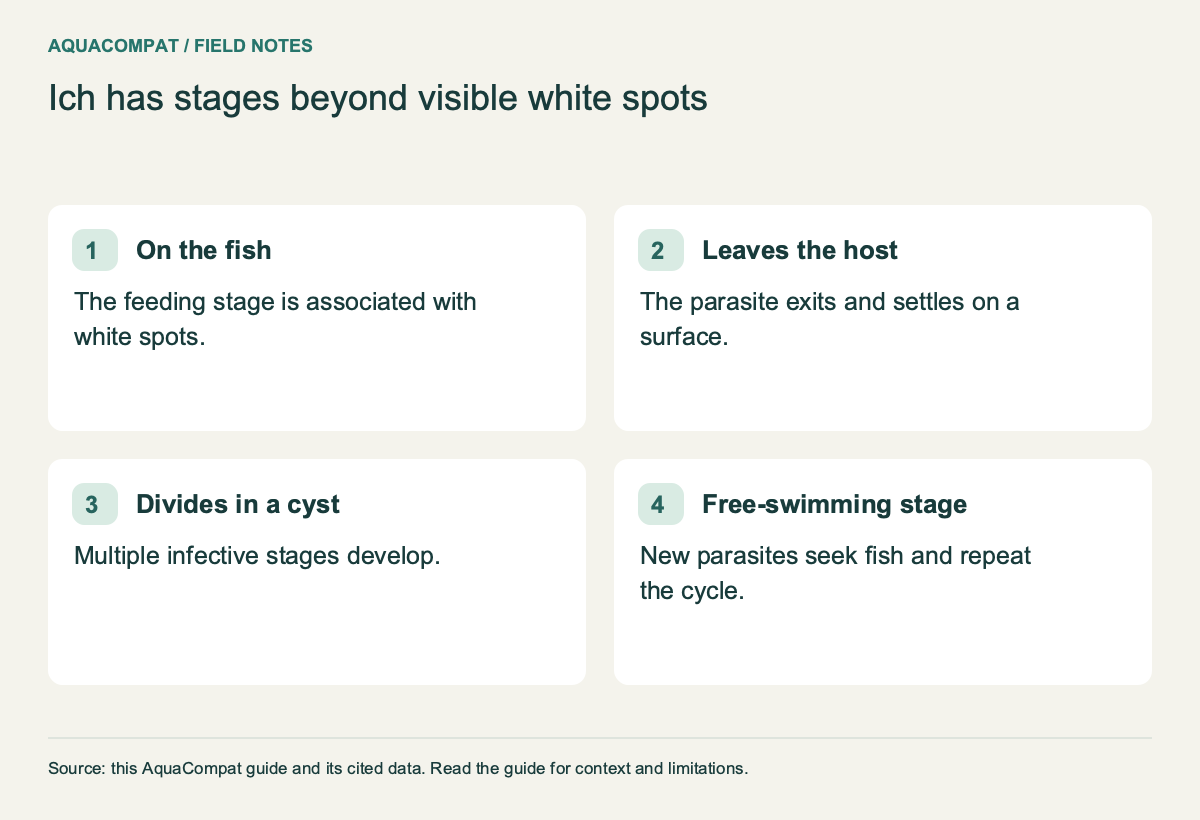
Ich is caused by Ichthyophthirius multifiliis, a large ciliated protozoan that cannot complete its life cycle without a fish host. It is an obligate parasite, so it enters a tank on infected fish or on wet equipment, plants and decor that carry its cysts. Its life cycle has three stages, and only one of them can be reached by medication.
| Stage | Where it is | What it does | Killed by treatment? |
|---|---|---|---|
| Trophont | Under the skin or gill tissue | Feeds on the fish; this is the visible white spot | No |
| Tomont | Encysted on the substrate, plants or glass | Divides inside a sticky cyst; SRAC 476 says one cyst can release as many as 2,000 tomites | No |
| Theront | Swimming freely in the water | Seeks a new host; SRAC 476 says it dies within a day or two without one | Yes |
Why does ich break out in some tanks and not others?
Ich breaks out when the parasite arrives and the fish cannot resist it. Outbreaks commonly follow new fish added without quarantine, or with nets, siphons and plants moved from an infected tank. SRAC 476 adds that poorly nourished fish are more prone to infection. New fish should also go into a tank whose nitrogen cycle is complete, so that ammonia or nitrite problems are not added to a parasite outbreak.
Temperature sets the pace. The warmer the water, the faster the parasite moves from one stage to the next, and the more often treatment has to reach the free-swimming stage. That is why the treatment schedule below is built around the thermometer reading, and why checking the range your species tolerate comes first: the neon tetra profile lists 70–77 °F (21–25 °C), while bettas are listed at 72–86 °F (22–30 °C).
How do you treat ich step by step?
You treat ich by confirming it, then repeating treatment until the free-swimming stage has been hit through several full cycles and deaths have stopped. The steps below follow UF/IFAS Extension FA006, with the temperature schedule from SRAC 476.
- Confirm and act quickly. Confirm with a microscope where possible. UF/IFAS advises medicating as soon as a single parasite is seen, because one organism can produce up to 1,024 offspring per generation.
- Check the water first. Test temperature, pH and alkalinity before choosing a treatment. Alkalinity decides whether copper is safe, and temperature decides how often to dose.
- Choose a treatment the tank’s species tolerate. The options are salt, formalin, copper sulfate or a commercial ich medication, each covered below. Remove shrimp and snails before copper.
- Repeat on schedule. UF/IFAS says that at 75 to 79 °F the life cycle takes about three to six days, so treat daily for at least three to five treatments. At 60 °F, space treatments three to five days apart and give at least five.
- Clean and siphon between doses. Siphoning the substrate removes cysts and reduces the number of parasites in the tank.
- Stop only when deaths stop. UF/IFAS is explicit that treatment should not end until mortality has ceased.
Medications can also set back the biofilter. UF/IFAS advises testing ammonia and nitrite more often after a disease treatment; the comparison of best aquarium test kits compared covers kits that read both.
How often should you treat at each temperature?
SRAC 476 sets the interval by water temperature, and notes that three to seven treatments may be needed.
| Water temperature | Treatment interval (SRAC 476) |
|---|---|
| 75 °F and above | Every day |
| 65–74 °F | Every other day |
| 55–64 °F | Skip 2 days between treatments |
| 45–54 °F | Skip 3 or 4 days between treatments |
Which ich treatments work, and what are their limits?
Salt, formalin, copper and commercial formalin or malachite green products all work against ich, but each one has a species or water-chemistry limit. The sources also disagree on scheduling: SRAC 476 notes that some fish health professionals prefer daily treatment even in cool water instead of skipping days, and the Merck Veterinary Manual recommends daily treatment at home-aquarium temperatures above 26 °C (79 °F), with three to seven treatments.
Salt
Salt is the cheapest option where fish tolerate it. UF/IFAS gives a prolonged bath of 4–5 g/L (ppt), 7-10 days at 75-79 °F as effective in small systems, because free-swimming theronts do not tolerate 3–5 ppt. Merck gives a similar option of raising salinity for one week at 75 °F (24 °C) or warmer. UF/IFAS also notes that most freshwater fish tolerate 5 ppt for several weeks; 3 ppt permanently for many. Live plants may not tolerate raised salinity, so check them as well as the fish. The aquarium salt guide covers dosing and which species to avoid.
Formalin
UF/IFAS gives a typical tank dose of formalin of 25 mg/L, or 1 mL per 10 gallons, and a half dose for formalin-sensitive species. UF/IFAS advises vigorous aeration during formalin treatment and flush the tank with clean water if fish show distress.
Copper sulfate
Copper works but has the narrowest safety margin. UF/IFAS calculates the dose in mg/L as total alkalinity divided by 100, and says never to use it without testing alkalinity. The two sources set different floors: UF/IFAS says not to use copper sulfate below 50 mg/L total alkalinity, while SRAC 476 says it is typically not used below 40 mg/L or above 300 mg/L. Both agree that copper is extremely toxic to fish in low-alkalinity water and that an overdose kills fish. Copper also kills algae, which can crash oxygen, so keep emergency aeration ready.
Commercial formalin and malachite green products
Aquarium Co-Op describes its Ich-X product (formaldehyde, methanol and malachite green) as dosed every 24 hours after a one-third water change, continuing until three symptom-free days have passed, with an airstone running and chemical filtration removed. Merck notes these over-the-counter products are effective, but that malachite green raises regulatory concerns and vets should not dispense it. Always follow the label for the product you use; the guide to fish medications by disease lists alternatives.
Ich medications for home aquariums
The two products below are widely sold ich treatments with different active ingredients. Neither was used or tested by AquaCompat; the notes compare what each manufacturer publishes on its label and product page.
As an Amazon Associate I earn from qualifying purchases. Prices change often, so they are not shown here; the button opens the current listing.

Seachem ParaGuard
- Active ingredients
- aldehydes, malachite green, fish protective polymers
- Invertebrates
- not recommended; if necessary use 1/4 to 1/2 strength
- Scaleless fish
- start at 1/4 to 1/2 dose and increase gradually
- Biofilter
- does not adversely affect biofilter
Fits: a community tank that needs daily dosing through several ich cycles; Seachem states it does not harm the biofilter and gives a reduced starting dose for loaches and other scaleless fish.
Skip it if: you keep shrimp or snails in the same tank; Seachem does not recommend it with invertebrates. Remove Purigen and other chemical filter media before treating.
Check price on Amazon
API Super Ick Cure
- Active ingredients
- nitrofurazone (named in Prop 65 warning); full formula not published on page
- Schedule
- repeat after 48 h; after another 48 h change 25% water
- Scaleless fish
- use 1/2 normal dose
- Filter
- remove activated carbon before treating
Fits: owners who want a defined course: a second dose after 48 hours, then a partial water change 48 hours later, with a half dose for sensitive scaleless fish.
Skip it if: you mind staining; API warns it may stain sealant and ornaments. API does not publish the full formula, and it is not recommended where corals or invertebrates may be sensitive.
Check price on AmazonWhat do the medication labels warn about?
Both labels warn about invertebrates, scaleless fish and filter media, but the details differ. Seachem’s ParaGuard guidance for invertebrates reads “not recommended; if necessary use 1/4 to 1/2 strength”, and for scaleless fish it says to start at 1/4 to 1/2 dose and increase gradually. It also says to remove Purigen and other chemical media during treatment. API’s instructions for Super Ick Cure are to remove activated carbon before treating, to give sensitive scaleless fish a use 1/2 normal dose, and they note that corals/invertebrates may be sensitive; not recommended for reef tanks. API’s schedule is to repeat after 48 h; after another 48 h change 25% water.
Which fish, shrimp and snails are sensitive to ich treatment?
Invertebrates are the most sensitive group, followed by scaleless fish, salt-sensitive species and goldfish under copper. The cautions below come from the ich, copper and species sources in the fact base.
- Shrimp. UF/IFAS (Yanong; Watson and Yanong) states copper is lethal to most invertebrates; move them out and do not return them until free copper is 0.01 mg/L or less, ideally zero. Shrimp and Snail Breeder puts the danger level for cherry shrimp near 0.03 mg/L, far below the roughly 0.6 mg/L used to treat fish. Amano shrimp are equally at risk from copper.
- Snails. Nerite snails are intolerant of copper-based medications, and Aquarium Co-Op and Applesnail.net describe mystery snails as very sensitive to copper and also sensitive to salt.
- Scaleless fish. Seachem names loaches, eels and similar scaleless fish as candidates for a reduced starting dose, and API advises a half dose for sensitive scaleless species.
- Formalin-sensitive fish. UF/IFAS gives a half dose of formalin for species that react badly to the full dose.
- Goldfish under copper. SRAC 476 says goldfish should receive only three-quarters of the calculated copper dose.
Can corydoras take salt for ich?
Corydoras are often described as salt-intolerant, but the evidence is mixed. Hobby belief and some veterinary references treat them as unable to take salt, yet Murphy and Lewbart (1995) kept 80 bronze corydoras at 0–2.0 ppt over 13 weeks and found signs of stress but no significant mortality. That does not cover the higher salt bath used for ich, so a medication without salt is the cautious choice for a tank with corydoras; check the corydoras water parameters before changing temperature or salinity. Merck also notes that wild-caught Amazonian fish may not tolerate permanent low-level salt.
Shrimp and snails are the tank mates most at risk from these treatments, so check the cautions on the cherry shrimp tank mates page before dosing a mixed tank. A reliable aquarium test kit helps confirm that ammonia and nitrite stay at zero while fish recover.
Do the spots disappearing mean the ich is cured?
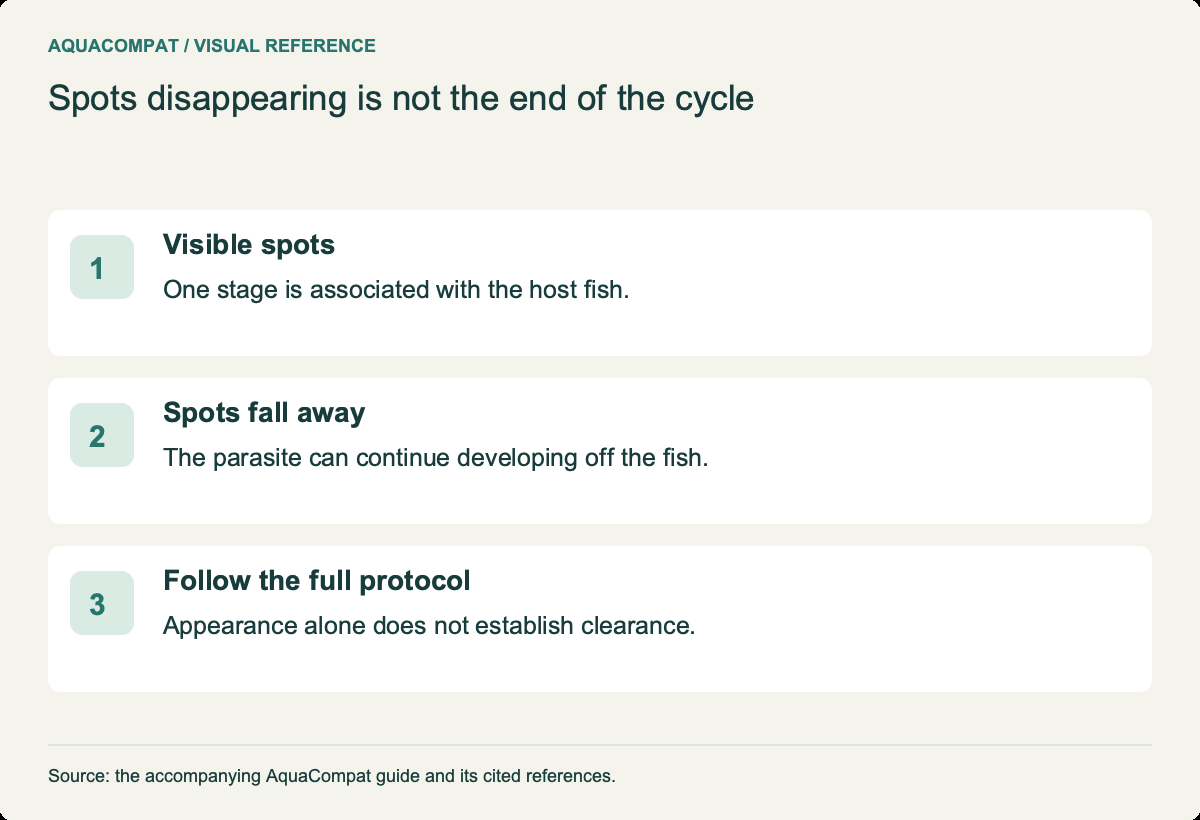
No: the spots disappearing usually means the parasites have left the fish to multiply, not that they are dead. The white spot is the feeding trophont, which drops off the fish, encysts and divides. No treatment kills it on the fish or inside the cyst; only the free-swimming theronts released afterwards are vulnerable. Stopping when the fish look clear leaves the next generation untreated, which is why UF/IFAS says to keep going until deaths have stopped and Aquarium Co-Op’s Ich-X directions run until three symptom-free days have passed.
What else looks like white spot disease?
Several conditions look like ich, which is why UF/IFAS warns against diagnosing it from white spots alone. Heavy mucus sloughing from the skin can look like fungus from a distance, according to SRAC 476. Under the microscope, free-swimming theronts can resemble other ciliates such as Tetrahymena, so UF/IFAS advises finding the trophont stage to confirm. Ragged, fraying fins point to a different, bacterial problem covered under fin rot.
How does ich behave in a cold goldfish tank compared with a tropical tank?
Ich moves more slowly in cold water, so a goldfish tank needs fewer, more widely spaced treatments over a longer period than a tropical community tank. At 60 °F, UF/IFAS spaces treatments three to five days apart and calls for at least five of them, while the same parasite in a tank at 75 to 79 °F needs daily treatment. Copper also behaves differently for goldfish, which SRAC 476 limits to three-quarters of the calculated dose.
Can heat alone cure ich?
Raising the temperature is not a reliable cure, and the evidence on it conflicts. SRAC 476 says ich typically cannot reproduce properly above 85 °F (30 °C) and that a 15 °F change above or below the outbreak temperature can end an episode, yet the same publication reports a Florida outbreak killing fish at 92 °F (33 °C). With results that inconsistent, heat should be treated as an aid to a proper treatment course, never a replacement.
How can you prevent ich?
Quarantine is the main prevention, because ich arrives on infected fish or on wet equipment and plants from an infected tank. UF/IFAS FA006 and the Merck Veterinary Manual recommend a minimum 30-day quarantine; SRAC 476, written for ponds, suggests a week or more of observation. The longer veterinary period is the safer one for an aquarium. A healthy look is no guarantee: a 2023 study in the Brazilian Journal of Biology examined 333 ornamental fish from eight farms in five Brazilian states between November 2018 and March 2019 and found 70.6 % carrying at least one parasite, with ich on 25.8 % of the fish from one São Paulo farm, yet none of the 333 showed white spots. Those were farm fish from one country, not a measure of shop stock everywhere, but they show why quarantine applies to fish that look well. The guide to setting up a quarantine tank explains how.
UF/IFAS adds three more precautions. Do not share undisinfected nets, siphons or equipment between tanks, because tomont cysts are sticky. Hold new plants and substrate without fish for the length of the ich life cycle at the tank’s temperature. Keep fish well fed, since SRAC 476 links starvation to infection. When planning tank mates, the water parameter overlap tool shows which species share a temperature range, which also decides how a future ich treatment would be scheduled.
Quarantine pairs naturally with careful introductions: the guide to acclimating new fish covers the step that follows a clean quarantine.
When should you consult an aquatic vet about ich?
You should consult an aquatic veterinarian or fish health professional if spots persist after a full course, fish keep dying, or you are considering copper or formalin for valuable fish. A vet can confirm the diagnosis by examining skin, fin or gill samples under a microscope, which rules out the look-alikes above. For bettas, which are often kept alone, see how to keep bettas for the temperature and water that support recovery. Other conditions are covered in the full set of fish disease guides.
Questions people ask
Is ich contagious to other fish in the tank?
Yes. Each cyst that drops from an infected fish releases free-swimming theronts that seek new hosts, so every fish in the tank is exposed. SRAC 476 says one cyst can release as many as 2,000 of them. Treat the whole tank, not only the fish showing spots, and do not move nets or decor to another tank without disinfecting them.
Can ich survive in a tank with no fish?
Only briefly. Ich is an obligate parasite, and SRAC 476 says free-swimming theronts die within a day or two without a host. Cysts on plants and decor can keep releasing them for a while, which is why UF/IFAS recommends holding new plants and substrate without fish for the length of the life cycle at the tank’s temperature.
Is aquarium salt safe for shrimp during ich treatment?
The fact base does not establish a safe salt level for shrimp, so the cautious approach is to move shrimp and snails to a separate tank before any treatment. Mystery snails are described as sensitive to salt, and all invertebrates must be kept away from copper. Return them only after the treatment has been removed with water changes.
Should I remove carbon from the filter when treating ich?
Yes, for most medications. API says to remove activated carbon before using Super Ick Cure, Seachem says to remove Purigen and other chemical media during ParaGuard treatment, and Aquarium Co-Op’s Ich-X directions also remove chemical filtration. Keep the biological media running so the nitrogen cycle is not interrupted.
How long does it take to get rid of ich?
It depends on temperature. At 75 to 79 °F, UF/IFAS gives a life cycle of about three to six days and daily treatment for at least three to five doses; at 60 °F, five or more treatments spaced three to five days apart. In every case, continue until deaths have stopped.
Sources 57 documents from 19 publishers
- API (Mars Fishcare) (apifishcare.com): “Super Ick Cure product page”
- Applesnail.net (applesnail.net): “Pomacea diffusa”; “How to take care of apple snails”; “Quick guide”; “Apple snail FAQ”
- Aquarium Co-Op (aquariumcoop.com): “Ich-X product guide”; “Guide to Aquarium Water Changes”; “Care Guide for Cherry Shrimp”; “Care Guide for Amano Shrimp”; “Care Guide for Nerite Snails”; “Care Guide for Mystery Snails”; “Betta fish tank mates”; “5 Quick and Easy Steps for Treating Fin Rot in Aquarium Fish”
- AquariumInfo.org (aquariuminfo.org): “Apple Snail”
- Brazilian Journal of Biology, Dominguez et al., University of São Paulo (scielo.br): “Parasitological diagnosis in ornamental freshwater fish from different fish farmers of five Brazilian states”
- Crustacean Research 49 (Hamasaki et al. 2020) (jstage.jst.go.jp): “Dietary effects of phytoplankton and zooplankton on larval survival, duration and growth of four Caridina species”
- Crustacean Research 50 (Kondo, Hamasaki, Dan 2021) (jstage.jst.go.jp): “Larval performance of three amphidromous shrimp species in the genus Caridina under different temperature and salinity conditions”
- Maidenhead Aquatics (fishkeeper.co.uk species data sheet) (fishkeeper.co.uk): “Neon Tetra data sheet”; “Amano Shrimp”; “Zebra Nerite Snail”
- Merck Veterinary Manual (merckvetmanual.com): “Management of Aquarium Fish, Petty, Francis-Floyd and Yanong”; “Parasitic Diseases of Fish, Petty, Francis-Floyd and Yanong”; “Disorders and Diseases of Fish (pet owner version)”; “Special Considerations for Fish (pet owner version)”; “Routine Health Care of Fish (pet owner version)”; “Providing a Home for Fish (pet owner version)”
- Practical Fishkeeping (practicalfishkeeping.co.uk): “How often should I change my water?”; “Frequently asked questions on Neocaridina shrimps”; “An introduction to Shrimp”; “Amano shrimp: Spineless heroes (Nathan Hill)”; “Will these snails starve without algae?”; “What can I add for algae control?”; “The A-Z of Fish Health, Part 2: F-L, Dr Peter Burgess”
- Seachem (seachem.com): “ParaGuard product page”
- Seriously Fish (seriouslyfish.com): “Paracheirodon innesi (Neon Tetra)”; “Betta splendens”
- Shrimp and Snail Breeder (aquariumbreeder.com): “Red Cherry Shrimp: detailed guide, care, diet and breeding”; “Cherry Shrimp in a Community Tank”; “How Copper Affects Dwarf Shrimp”; “Amano Shrimp: detailed guide, care, diet and breeding”; “Nerite Snails: detailed guide, care, diet and breeding”
- Shrimp Science (shrimpscience.com): “Red Cherry Shrimp - Care Guide”; “General Hardness (GH) For Shrimp Tanks”; “Carbonate Hardness (KH) For Shrimp Tanks”; “TDS For Shrimp Tanks”; “Amano Shrimp”
- Southern Regional Aquaculture Center (srac.msstate.edu): “Ich (White Spot Disease), SRAC Publication No. 476, Durborow, Mitchell and Crosby”; “Columnaris Disease: A Bacterial Infection Caused by Flavobacterium columnare, SRAC Publication No. 479”; “Motile Aeromonas Septicemia (MAS) in Fish, SRAC Publication No. 478 (2019)”
- UF/IFAS EDIS (ask.ifas.ufl.edu): “Evolution, Culture, and Care for Betta splendens (FA212)”
- University of Florida IFAS Extension (EDIS) (ask.ifas.ufl.edu): “Ichthyophthirius multifiliis (White Spot) Infections in Fish (CIR920/FA006), Francis-Floyd, Yanong and Pouder”; “Use of Copper in Marine Aquaculture and Aquarium Systems (FA165), Yanong”; “Use of Copper in Freshwater Aquaculture and Farm Ponds (FA-13), Watson and Yanong”; “Ammonia in Aquatic Systems (FA16/FA031), Francis-Floyd, Watson, Petty and Pouder”; “Use of Antibiotics in Ornamental Fish Aquaculture (Circular 84 / FA084), Yanong”
- VIN / IAAAM Proceedings 1995 (vin.com): “Salt Tolerance in the Callichthyid Catfish (Corydoras aeneus), Murphy and Lewbart”
- Wikipedia (en.wikipedia.org): “Vittina natalensis”
All sources accessed . Every number on this page comes from these documents.