How do you identify fin rot?
You identify fin rot by fin edges that discolour and then fray, leaving bare fin rays where the membrane has eroded. Practical Fishkeeping (Dr Peter Burgess) and Aquarium Co-Op describe the progression below, and the two SRAC fact sheets add the signs of the two bacterial forms; the list runs from the most to the least commonly noticed.
- Whitish or discoloured fin edges. The margin of the tail or dorsal fin turns pale or milky before any tissue is lost.
- Ragged, frayed fins. The membrane erodes back from the edge and the fin rays stick out, giving a split, uneven outline.
- Lethargy and poor appetite. Aquarium Co-Op lists reduced activity and reduced feeding alongside the fin damage.
- Red spots and ulcers. In the Aeromonas form, SRAC Publication 478 and the Merck Veterinary Manual describe fin erosion with haemorrhage, red spots, ulcers and scale loss.
- Brown or yellowish lesions and a pale saddle. In the columnaris form, SRAC Publication 479 describes brown to yellowish-brown lesions on the gills, skin or fins and a pale saddle-shaped band around the body.
- Advanced loss. Fins or tail largely gone, pale tissue sometimes with a pink blush, and the infection spreading onto the body.
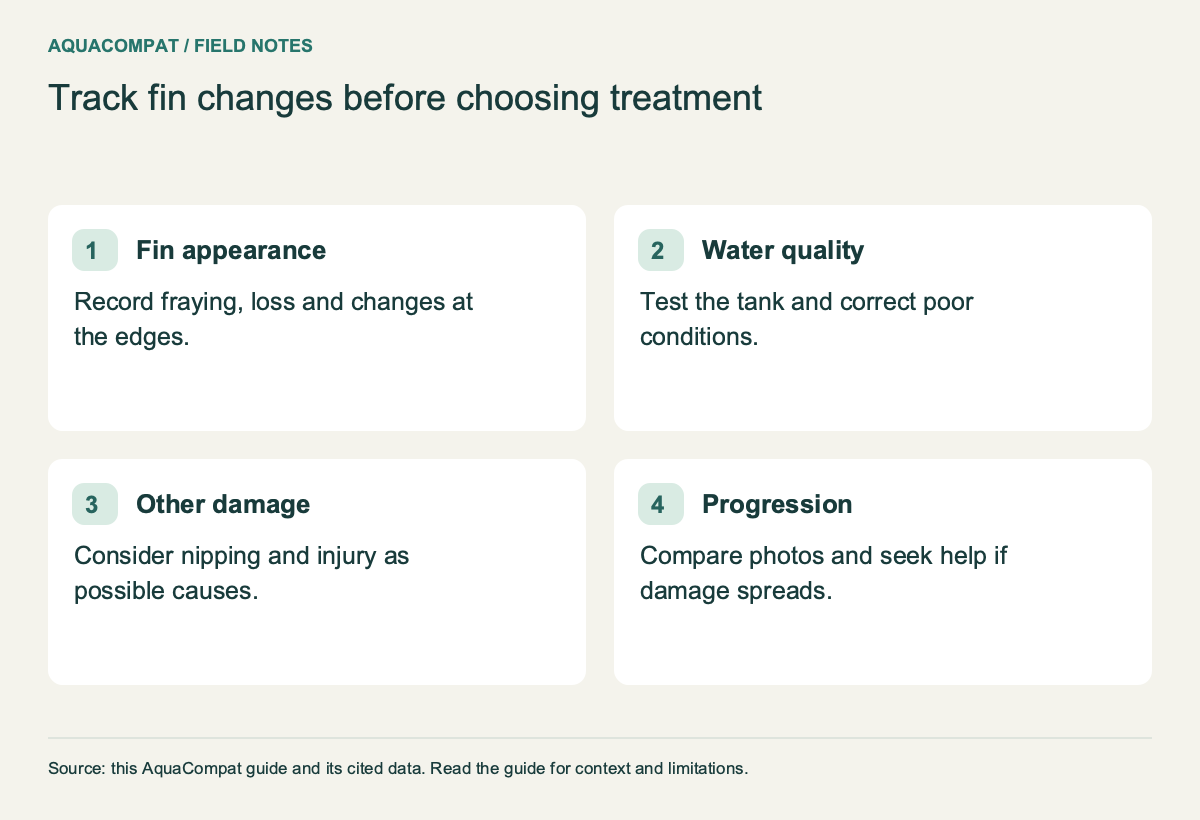
How far the erosion has travelled matters more than how it looks on day one. Practical Fishkeeping and Aquarium Co-Op both say fin rot is generally curable when it is caught before it spreads from the fins to the body.
What causes fin rot?
Fin rot is caused by opportunistic bacteria that attack fins after something else has stressed the fish. SRAC Publication 479 lists low oxygen, high ammonia, high nitrite, handling, injury and crowding as the stressors that favour columnaris, and SRAC 478 links Aeromonas fin erosion to stress in the same way. Practical Fishkeeping names Flavobacterium columnare and unhygienic water. UF/IFAS adds that bacterial infections in ornamental fish are often secondary to management problems, so the stressor is the first thing to find.
Which water problems lead to fin rot?
Ammonia and nitrite are the two water problems to rule out first. UF/IFAS gives 0.05 mg/L un-ionized ammonia as the level at which gill damage starts, and treats nitrite as toxic from 0.1 mg/L nitrite. Both readings climb when a tank is overstocked, overfed or still immature, which is why fin rot so often follows new tank syndrome or a filter that has been cleaned too hard. The nitrogen cycle guide explains how the biofilter turns ammonia into nitrite and nitrate, and why warm, alkaline water makes the same ammonia reading more toxic.
Can tank mates cause fin rot?
Tank mates can start it, because torn fins are open wounds and nipping is a chronic stressor. The species data records the main risks. Long-finned male guppies are targets for fin-nippers such as tiger barbs and serpae tetras. Angelfish fins attract fin-nippers too. Male bettas may attack trailing-finned fish as rivals, so their fin damage comes from aggression rather than habitual nipping. The betta and guppy pairing is rated caution at 7/10 for that reason. Among goldfish, OATA reports boisterous single-tailed fish nipping slow fancy varieties.
How do you treat fin rot step by step?
You treat fin rot by removing the cause first and medicating second. The order below follows Aquarium Co-Op’s five steps and UF/IFAS Circular 84 (Yanong) on antibiotic use in ornamental fish.
- Test the water and remove the stressor. Test ammonia, nitrite, temperature and oxygen and correct any problem. Separate aggressive or nipping tank mates, and remove sharp decor or excessive current. UF/IFAS stresses that bacterial infections are often secondary to management problems. A liquid kit that reads ammonia and nitrite is covered in the guide to choosing aquarium test kits.
- Clean the tank before medicating. Siphon waste and do a water change first. Aquarium Co-Op points out that many medications ask you to pause water changes during treatment, so the water should start clean.
- Treat early with an antibacterial. Use a general antibacterial or fin rot remedy while the damage is still on the fins, and keep antibiotics for advanced cases.
- Use antibiotics properly. UF/IFAS explains that antibiotics only hold bacterial growth back while the fish’s immune system clears the infection. Culture and sensitivity testing by a fish health specialist identifies the right drug. Give the full course at the correct dose and avoid shotgun use of several drugs at once.
- Add aeration. Aquarium Co-Op advises extra aeration during treatment because medications can reduce dissolved oxygen.
The sources disagree on the first-line drug. Aquarium Co-Op recommends erythromycin as its main treatment, while UF/IFAS advises choosing an antibiotic only after culture and sensitivity testing. For a single pet fish, a broad antibacterial and corrected water is the usual home route; for repeated outbreaks or valuable fish, the UF/IFAS approach is the more reliable one.
Fin rot medication for home aquariums
The antibacterial below is widely sold for fin and tail rot. AquaCompat did not use or test it; the notes compare what Seachem publishes on its product page with the treatment guidance from UF/IFAS and Aquarium Co-Op above.
As an Amazon Associate I earn from qualifying purchases. Prices change often, so they are not shown here; the button opens the current listing.

Seachem KanaPlex
- Active ingredient
- kanamycin-based blend
- Listed for
- dropsy, popeye, fin/tail rot, septicemia, cloudy eye, mouth rot (columnaris), fungal infections
- Water dose
- 1 measure per 5 US gal (20 L), every 48 h, max 3 doses
- Invertebrates
- remove all invertebrates
- Filter and UV
- turn off UV; remove carbon/Purigen
Fits: a fish-only tank where fin rot has not responded to clean water alone; Seachem lists fin and tail rot and columnaris among its targets, says it works with established biofilters, and gives a food-soak route for fish that are still eating.
Skip it if: you keep shrimp or snails in the tank; Seachem says to remove all invertebrates. Turn off UV and take out carbon or Purigen first, and note that Seachem caps the water dose at three treatments.
Check price on AmazonWhat does the KanaPlex label say about dosing and filters?
Seachem’s directions give a water dose of 1 measure per 5 US gal (20 L), every 48 h, max 3 doses, and an alternative food dose of 1 scoop KanaPlex + 1 scoop Focus mixed with food, daily up to 1 week. Before treating, Seachem says to turn off UV; remove carbon/Purigen. Its invertebrate instruction is to remove all invertebrates. Seachem states that KanaPlex works with established biofilters, yet UF/IFAS warns that antibiotic baths in general are the least effective route and can damage nitrifying bacteria. Test ammonia and nitrite more often during and after the course, as UF/IFAS advises after any disease treatment, rather than relying on either claim alone.
Which fish, shrimp and snails need care during fin rot treatment?
Invertebrates need the most care, followed by fish whose tank already carries a nitrite or ammonia load and fish that are poor candidates for salt. The cautions below come from the fin rot sources, the maker’s label and the species data.
- Shrimp. Seachem’s instruction to remove all invertebrates covers cherry shrimp and Amano shrimp. Cherry shrimp are also listed as intolerant of any trace of ammonia or nitrite, so the water problem that started fin rot may already be stressing them; the cherry shrimp tank mates guide lists species that share their water safely.
- Snails. Nerite and mystery snails are invertebrates too and should come out for an antibacterial bath.
- The biofilter. UF/IFAS (Circular 84 and FA031) advises testing ammonia and nitrite more often after any disease treatment, because antibiotic baths can damage nitrifying bacteria.
- Salt-sensitive fish. Aquarium Co-Op mentions salt as a slower alternative to antibiotics. Merck names wild-caught Amazonian fish, elephantnose and other mormyrids as possibly intolerant of permanent low-level salt, so check species tolerance before trying it.
- Columnaris-prone species. Columnaris is listed among the common diseases of zebra danios, so a danio with brown or saddle-shaped lesions points to the columnaris form rather than simple fin erosion.
Is medication alone enough to cure fin rot?
No: medication without fixing the cause rarely ends fin rot for good. UF/IFAS describes antibiotics as controlling bacterial growth only while the immune system clears the infection, and a fish kept in water with ammonia, nitrite or low oxygen, or chased by a nipping tank mate, has an immune system working against it. That is why both Aquarium Co-Op and UF/IFAS put water testing and stressor removal before any drug. A tank that returns to the same water or the same stocking after the course is likely to see the infection again.
What else looks like fin rot?
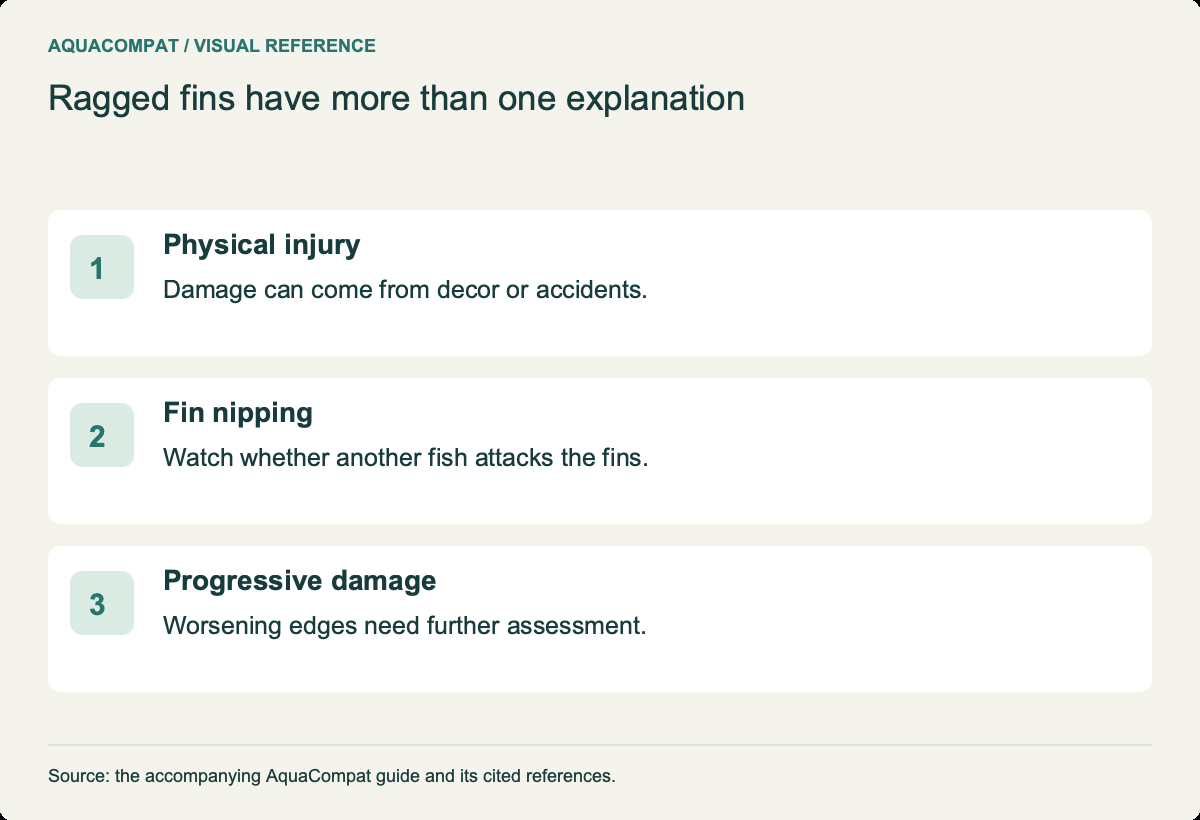
Fin damage from nipping, the columnaris form and some parasitic diseases can all be mistaken for simple fin rot. Torn fins from a fight or a nipping tank mate are the most common look-alike: the species data notes that a male betta’s fin damage usually comes from aggression rather than infection, so check who shares the tank before reaching for medication. SRAC 479 warns that columnaris can be confirmed only by a microscopic wet mount or a culture, and that the brownish colour of its lesions comes partly from debris trapped in them, so colour alone is not a diagnosis. White spots scattered over the fins and body point to ich (white spot disease) instead. A milky haze in the whole tank is a water problem rather than a fin infection, and the page on cloudy aquarium water sorts out its causes.
What if fin rot keeps spreading after treatment?
Fin rot that keeps spreading after clean water and a full antibacterial course needs a diagnosis rather than a second guess at the drug. Mild fin rot and advanced fin rot are different problems. Practical Fishkeeping and Aquarium Co-Op describe fin rot caught on the fins as generally curable. A fish whose erosion has reached the body, or that shows ulcers, red spots or brown lesions, may have an Aeromonas or columnaris infection that a bath treatment cannot reach.
Three things usually explain a failed course. The stressor was never removed: ammonia, nitrite or a nipping tank mate is still present. The drug did not match the bacterium: UF/IFAS explains that only culture and sensitivity testing shows which antibiotic will work, and advises against shotgun use of several drugs. Resistance is common in the trade: a 2009 PLoS ONE study by the UK government laboratory Cefas found that 47 of 94 isolates of Aeromonas taken in 2008 from tropical fish arriving in the UK, and from their shipping water, tolerated 15 or more antibiotics. Or the course was cut short or underdosed: UF/IFAS stresses the full course at the correct dose. UF/IFAS also notes that bath antibiotics are the least effective route and can harm the biofilter, so a second bath course carries its own cost.
When should you consult an aquatic vet about fin rot?
You should consult an aquatic veterinarian if fin loss reaches the body, ulcers appear, or fish keep dying after the water quality has been corrected. A vet can run culture and sensitivity testing to pick an effective drug. In the US, medicated antibiotic feed also needs a veterinary feed directive from a licensed veterinarian.
How can you prevent fin rot?
Clean, stable water and low-stress stocking prevent most fin rot. Aquarium Co-Op recommends regular maintenance, sensible stocking and controlled feeding, and SRAC 478 and 479 add that crowding, handling injuries and abrasions all favour Aeromonas and columnaris. SRAC 478 also advises quarantining new fish and disinfecting nets and equipment between systems.
Choosing tank mates is the part of prevention most often skipped. Long-finned fish such as guppies, angelfish and bettas should not share a tank with known nippers, and the guppy tank mates list ranks which species are safe with those fins. Before adding a new fish, the fish compatibility checker shows whether temperament, size or water needs clash; the scoring method explains how each pair is rated. Other conditions are covered in the full set of fish disease guides.
Questions people ask
Do fins grow back after fin rot?
The fact base does not include a source on fin regrowth, so this page makes no promise about it. What the sources do agree on is timing: Practical Fishkeeping and Aquarium Co-Op both say fin rot is generally curable when caught before it spreads to the body. Treating early, while only the fin edges are affected, gives the fish the best chance of recovering.
Is fin rot contagious to other fish?
The bacteria behind fin rot are opportunists that take hold in stressed fish. If one fish has fin rot, the water, crowding or tank mates that stressed it are present for every other fish in the tank, so test and fix the whole tank. SRAC 478 advises disinfecting nets and equipment between tanks and quarantining new fish to avoid carrying Aeromonas from one system to another.
Can I use aquarium salt instead of antibiotics for fin rot?
Aquarium Co-Op describes salt as an alternative that works more slowly than antibiotics. Check the species first: Merck names wild-caught Amazonian fish, elephantnose and other mormyrids as possibly intolerant of permanent low-level salt, and live plants may not tolerate raised salinity. Salt does not replace fixing the water problem that let the infection start.
Should I remove carbon from the filter when treating fin rot?
Yes, if you use KanaPlex. Seachem says to turn off UV and remove carbon or Purigen during treatment. Keep the biological media running so ammonia and nitrite stay under control, and test both more often during and after the course.
Why does my betta keep getting fin rot?
Repeated fin rot points to a cause that is still present. For a betta, the usual suspects are water quality in a small or uncycled tank and fin damage from tank mates. Male bettas may attack trailing-finned fish as rivals, and fights leave the torn fins that bacteria exploit. Test ammonia and nitrite, review the tank mates, and see a vet if the erosion reaches the body.
Sources 85 documents from 22 publishers
- Applesnail.net (applesnail.net): “Pomacea diffusa”; “How to take care of apple snails”; “Quick guide”; “Apple snail FAQ”
- Aquarium Co-Op (aquariumcoop.com): “5 Quick and Easy Steps for Treating Fin Rot in Aquarium Fish”; “Guppy Care Guide”; “Top 5 Dither Fish to Help Shy or Aggressive Fish in Freshwater Tanks”; “Freshwater Angelfish Care Guide”; “Betta Fish Care Guide”; “Care Guide for Dwarf Gouramis”; “10 Best Top-Dwelling Fish for Your Freshwater Community Aquarium”; “Care Guide for Fancy Goldfish”; “Goldfish Tank Mates”; “Amano Shrimp Care Guide”; “Care Guide for Cherry Shrimp”; “Care Guide for Nerite Snails”; “Care Guide for Mystery Snails”; “Betta fish tank mates”; “Guide to Aquarium Water Changes”; “Care Guide for Zebra and Leopard Danios”; “Ich-X product guide”; “How to Clear Up Cloudy Fish Tank Water with 5 Easy Methods”
- AquariumInfo.org (aquariuminfo.org): “Apple Snail”
- AquariumScience.org (aquariumscience.org): “6.2.3 Cloudy Water”
- FishBase (fishbase.se): “Poecilia reticulata, Guppy: species summary”; “Length-weight relationships for Poecilia reticulata”; “Pterophyllum scalare, Freshwater angelfish: species summary”; “Length-weight relationships for Pterophyllum scalare”; “Betta splendens, Siamese fighting fish: species summary”; “Carassius auratus, Goldfish: species summary”; “Length-weight relationships for Carassius auratus”; “Danio rerio summary (Bayesian length-weight estimate)”
- fishkeeping.co.uk (fishkeeping.co.uk): “Goldfish Size, Life Expectancy and Tank Recommendations”; “Keeping Goldfish - The Right Way”
- Maidenhead Aquatics (fishkeeper.co.uk species data sheet) (fishkeeper.co.uk): “Guppy data sheet”; “Angelfish data sheet”; “Siamese Fighting Fish/Betta data sheet”; “Zebra Nerite Snail”
- Merck Veterinary Manual (merckvetmanual.com): “Disorders and Diseases of Fish (pet owner version)”; “Environmental Diseases of Aquatic Animals in Aquatic Systems, Francis-Floyd, Yanong and Petty”; “Special Considerations for Fish (pet owner version)”; “Routine Health Care of Fish (pet owner version)”; “Providing a Home for Fish (pet owner version)”; “Management of Aquarium Fish, Petty, Francis-Floyd and Yanong”; “Parasitic Diseases of Fish, Petty, Francis-Floyd and Yanong”
- Ornamental Aquatic Trade Association (OATA) (ornamentalfish.org): “How to look after goldfish in an aquarium / fish tank”; “How to look after fancy goldfish”
- PLoS ONE, Verner-Jeffreys et al. (Cefas) (journals.plos.org): “High Prevalence of Multidrug-Tolerant Bacteria and Associated Antimicrobial Resistance Genes Isolated from Ornamental Fish and Their Carriage Water”
- Practical Fishkeeping (practicalfishkeeping.co.uk): “The A-Z of Fish Health, Part 2: F-L, Dr Peter Burgess”; “What water temperature do goldfish need?”; “How can I breed goldfish in my aquarium?”; “Frequently asked questions on Neocaridina shrimps”; “An introduction to Shrimp”; “Will these snails starve without algae?”; “What can I add for algae control?”; “How often should I change my water?”; “Why is my aquarium water cloudy?”
- Seachem (seachem.com): “KanaPlex product page”
- Seriously Fish (seriouslyfish.com): “Poecilia reticulata”; “Poecilia wingei”; “Pterophyllum scalare”; “Betta splendens”; “Danio rerio (Zebra Danio)”
- Shrimp and Snail Breeder (aquariumbreeder.com): “Cherry Shrimp in a Community Tank”; “Red Cherry Shrimp: detailed guide, care, diet and breeding”; “How Copper Affects Dwarf Shrimp”; “Nerite Snails: detailed guide, care, diet and breeding”
- Shrimp Science (shrimpscience.com): “Red Cherry Shrimp - Care Guide”; “General Hardness (GH) For Shrimp Tanks”; “Carbonate Hardness (KH) For Shrimp Tanks”; “TDS For Shrimp Tanks”
- Southern Regional Aquaculture Center (srac.msstate.edu): “Columnaris Disease: A Bacterial Infection Caused by Flavobacterium columnare, SRAC Publication No. 479”; “Motile Aeromonas Septicemia (MAS) in Fish, SRAC Publication No. 478 (2019)”; “Nitrite in Fish Ponds, SRAC Publication No. 462, Durborow, Crosby and Brunson”; “Ich (White Spot Disease), SRAC Publication No. 476, Durborow, Mitchell and Crosby”; “SRAC Publication No. 466: Algae Blooms in Commercial Fish Production Ponds”
- Tropical Fish Hobbyist Magazine (tfhmagazine.com): “Betta splendens”
- UF/IFAS EDIS (ask.ifas.ufl.edu): “Evolution, Culture, and Care for Betta splendens (FA212)”
- University of Florida IFAS Extension (ask.ifas.ufl.edu): “FA031: Ammonia in Aquatic Systems (Francis-Floyd, Watson, Petty, Pouder)”
- University of Florida IFAS Extension (EDIS) (ask.ifas.ufl.edu): “Use of Antibiotics in Ornamental Fish Aquaculture (Circular 84 / FA084), Yanong”; “Ichthyophthirius multifiliis (White Spot) Infections in Fish (CIR920/FA006), Francis-Floyd, Yanong and Pouder”; “Use of Copper in Marine Aquaculture and Aquarium Systems (FA165), Yanong”; “Use of Copper in Freshwater Aquaculture and Farm Ponds (FA-13), Watson and Yanong”
- VIN / IAAAM Proceedings 1995 (vin.com): “Salt Tolerance in the Callichthyid Catfish (Corydoras aeneus), Murphy and Lewbart”
- Wikipedia (en.wikipedia.org): “Vittina natalensis”
All sources accessed . Every number on this page comes from these documents.