How do you identify new tank syndrome?
You identify new tank syndrome by distress and deaths across several species in a recently set-up tank, confirmed by an ammonia or nitrite reading. Practical Fishkeeping, the Merck Veterinary Manual and SRAC Publication 462 describe the signs below, from the most to the least commonly noticed.
- Timing. Problems appear in the first weeks after setup. Merck’s pet owner edition gives one to three weeks, and its professional edition the first two to three weeks.
- Gasping and hanging at the surface. Practical Fishkeeping lists fish gasping or hanging just below the surface.
- Lethargy and refusing food. Practical Fishkeeping lists both; the page on fish not eating covers it as a symptom on its own.
- Unexplained deaths across species. Losses are not confined to one kind of fish, which separates this from a species-specific disease.
- Red gills or bloody streaks in fins. These appear in severe cases. SRAC 462 explains that nitrite turns blood brown (methemoglobin), so fish can suffocate even when the water holds enough oxygen.
None of these signs proves the cause, because ammonia and nitrite are colourless. Practical Fishkeeping is explicit that a test kit is needed to confirm new tank syndrome.
What causes new tank syndrome?
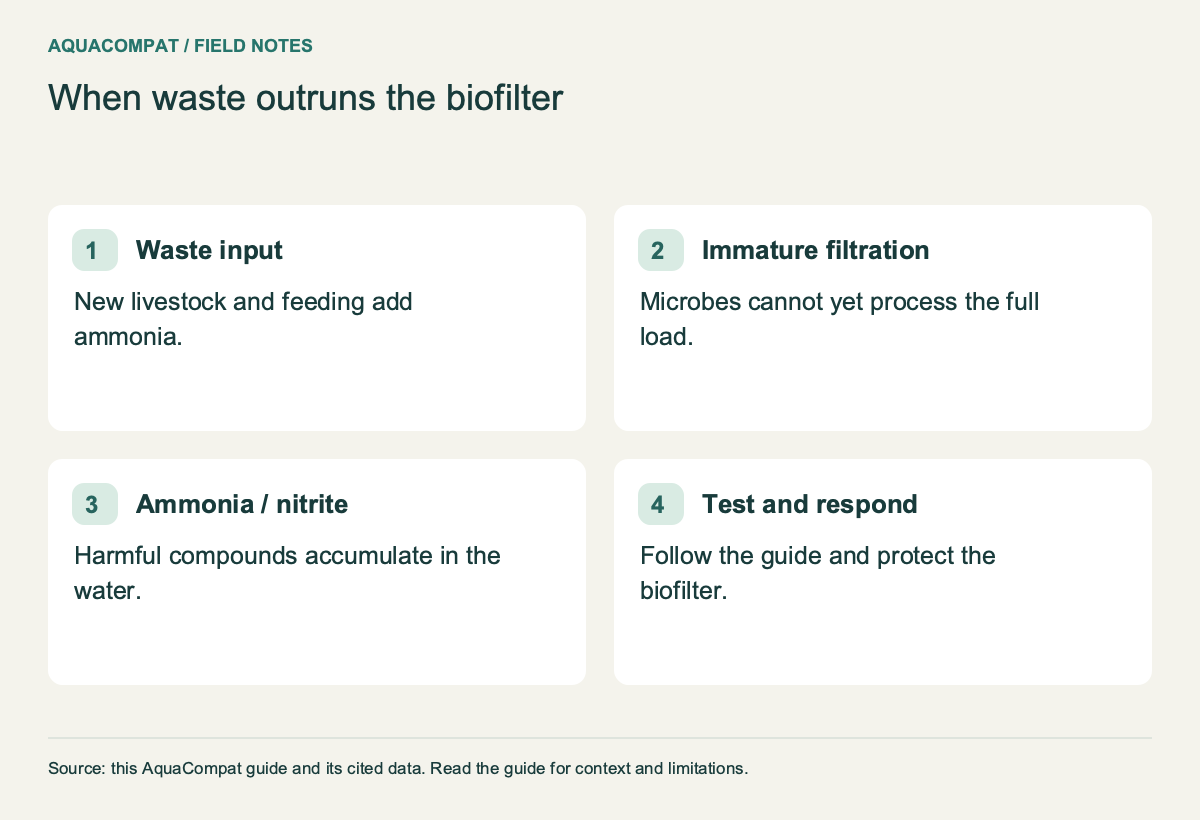
New tank syndrome is caused by stocking a tank before its nitrifying bacteria are established. Merck describes ammonia accumulating when a new tank is stocked before the biofilter works, and Practical Fishkeeping attributes it to too few waste-processing bacteria. The fish produce ammonia from day one; the bacteria that turn it into nitrite, and then nitrite into nitrate, take weeks to grow. How that conversion works is set out in the nitrogen cycle guide, so this page sticks to the problem and its fixes.
The time needed is the root of the problem. UF/IFAS gives 6–8 weeks for a new biofilter, Merck’s professional pages about six weeks and up to eight (6–8 weeks), and Practical Fishkeeping 4–6 weeks for most tanks. A tank stocked fully in its first week is weeks short of any of those figures. A milky bacterial bloom can appear in the same window, which is covered under cloudy aquarium water.
What ammonia and nitrite readings mean an emergency?
Any ammonia or nitrite reading in a stocked tank needs action, and the sources differ only on how drastic it should be. The thresholds below come from Practical Fishkeeping, Merck and UF/IFAS.
For scale, the US Environmental Protection Agency's 2013 criterion for long-term exposure in rivers and lakes is 1.9 mg/L of total ammonia nitrogen as a 30-day average at pH 7 and 20 °C, set to protect the most sensitive wild species, including snails. It is a regulatory benchmark for wild waters rather than an aquarium target, and in a warmer or more alkaline tank the same reading is more toxic.
| Reading | What the source says | Source |
|---|---|---|
| Any ammonia or nitrite above 0.0 ppm | Needs action | Practical Fishkeeping |
| 1 mg/L TAN (upper bound, less than) | Freshwater fish generally tolerate it | Merck (professional) |
| Total ammonia of 2 mg/L or more | Change at least 50 % of the water | Merck |
| Nitrite from 0.1 mg/L nitrite | Toxic | UF/IFAS |
| Un-ionized ammonia of 0.05 mg/L un-ionized ammonia | Gill damage begins | UF/IFAS and Merck |
How do you fix new tank syndrome with fish in the tank?
You fix it by keeping ammonia and nitrite low with water changes and reduced feeding while the bacteria catch up. The steps below follow Merck, UF/IFAS (FA031), SRAC 462 and Practical Fishkeeping.
- Test every day. Merck advises testing ammonia and nitrite frequently, sometimes daily, until both stay at zero. A liquid kit that reads both is compared in the aquarium test kits we compared.
- Stop or reduce feeding. UF/IFAS says stopping feed for one to three days does not usually harm fish, except fry, and it gives nitrification time to catch up.
- Make large water changes. Merck advises changing at least 50 % when total ammonia is 2 mg/L or higher; UF/IFAS suggests 25–50 %. Use dechlorinated water matched for temperature.
- Protect against nitrite with chloride. SRAC 462 advises a chloride to nitrite ratio of at least 10:1, and Merck notes that salt can halt deaths during a sudden nitrite rise, with many systems holding 1–3 ppt. Check species salt tolerance first.
- Keep oxygen up and the filter running. Low oxygen limits nitrifying bacteria; UF/IFAS advises raising it when it falls below 5 mg/L dissolved oxygen (minimum). Confirm the filter has not stopped.
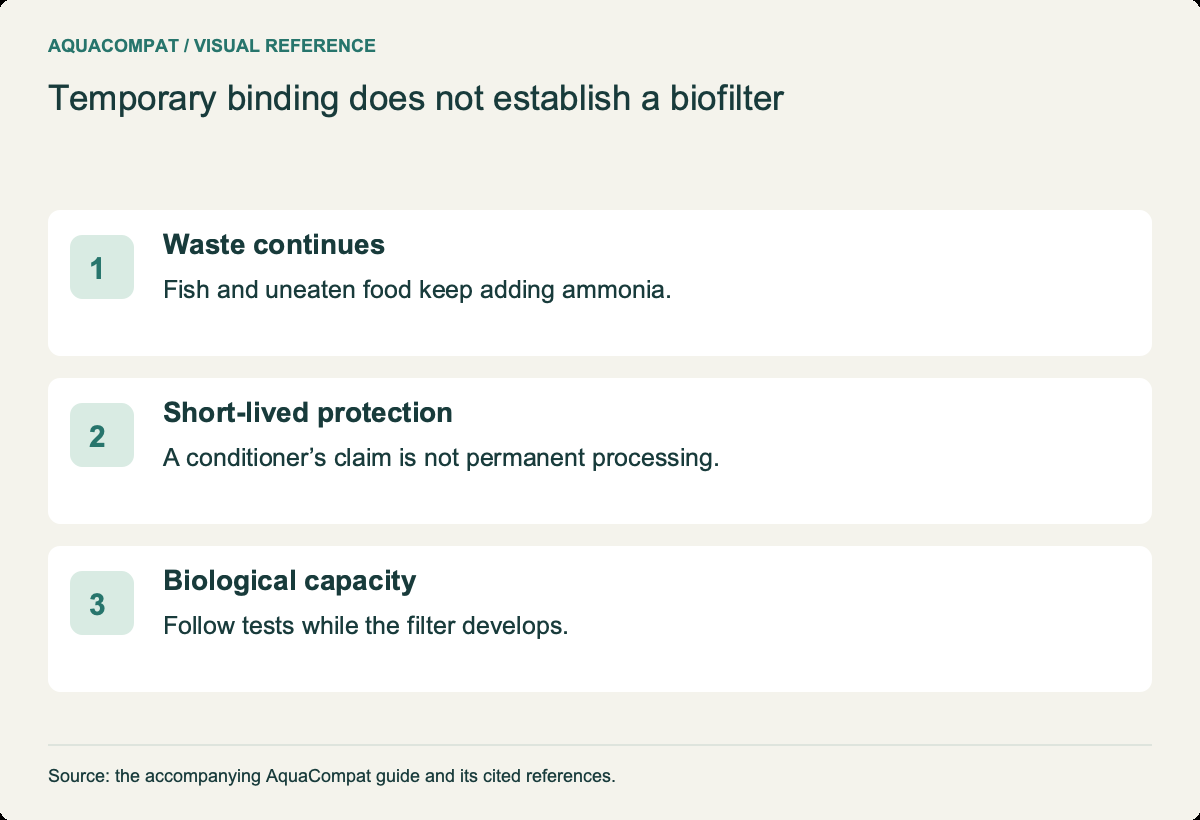
- Use an ammonia-binding conditioner as a stopgap. UF/IFAS says water changes and ammonia-binding products ease toxicity in the short term, but a properly sized biofilter is the long-term fix.
The sources disagree on how big a water change can be. Merck sets at least 50% at high ammonia, UF/IFAS 25 to 50%, and Practical Fishkeeping says up to 90% is acceptable if the new water matches the tank’s temperature and chemistry. The larger the change, the more that match matters.
A test kit and conditioner for new tank syndrome
The two products below cover the testing and stopgap steps. AquaCompat did not use or test either; the notes compare what each manufacturer publishes with the guidance above.
As an Amazon Associate I earn from qualifying purchases. Prices change often, so they are not shown here; the button opens the current listing.

API Freshwater Master Test Kit
- Reads
- pH, high range pH, ammonia, nitrite, nitrate
- Method
- liquid reagent
- Tests
- 800 tests
Fits: the daily testing Merck advises during new tank syndrome; it reads ammonia, nitrite, nitrate and pH, and pH matters because it decides how much of the ammonia is in the toxic form.
Skip it if: you need a published measurement range or resolution; those are not in the fact base, and the test kit comparison covers dedicated ammonia checkers for precise low readings.
Check price on Amazon
Seachem Prime
- Removes
- chlorine, chloramine
- Maker claim
- ammonia, nitrite, nitrate
- Dose
- 5 mL per 200 L (50 US gal) of new water
- Emergency dose
- up to 5x normal dose in emergencies
- Binding lasts
- up to 48 hours
Fits: the water changes and the stopgap step; Seachem says it removes chlorine and chloramine, detoxifies ammonia and nitrite, and allows up to five times the normal dose in nitrite emergencies.
Skip it if: you treat it as the cure; UF/IFAS calls ammonia-binding products a short-term aid, and the biofilter is the long-term fix. Seachem’s binding lasts up to 48 hours, so redose if readings stay up.
Check price on AmazonHow long does an ammonia-binding conditioner protect fish?
Seachem states that Prime’s binding lasts up to 48 hours, while Aquarium Co-Op says ammonia binders in general lock ammonia up for about 24 hours. Either way, the protection is temporary. Seachem’s normal dose is 5 mL per 200 L (50 US gal) of new water, and it allows up to 5x normal dose in emergencies. A binder buys time between water changes; it does not replace the bacteria. The water conditioner comparison sets Prime against other dechlorinators.
Which fish and invertebrates are most at risk in a new tank?
Fish in warm, alkaline water, shrimp, and species that cannot take salt need the most care. The cautions below come from UF/IFAS, Merck and the species data.
- Fish kept in warm, alkaline water. UF/IFAS explains that the toxic un-ionized form of ammonia rises with pH and temperature. UF/IFAS’s table puts the toxic share at 0.006 fraction of TAN (pH 7.0, 26 °C / 78.8 °F), against 0.0574 fraction of TAN (pH 8.0, 26 °C), at the same temperature. Kenyi cichlids are listed at pH 7.6–8.5, against pH 5.0–7.5 for neon tetras, so the same test reading is more dangerous in a Malawi cichlid tank. The aquarium pH guide lists ranges for other species.
- Shrimp. Cherry shrimp are listed as intolerant of any trace of ammonia or nitrite, and the shrimp data says to stock them only in fully cycled, established tanks. The cherry shrimp tank mates guide is the next step once a tank is mature.
- Salt-sensitive species. The salt step does not suit every tank. Mystery snails are sensitive to salt, and Merck names wild-caught Amazonian fish, elephantnose and other mormyrids as possibly intolerant of permanent low-level salt.
- Fish under medication. UF/IFAS warns that disease treatments, especially antibiotics, can harm the biofilter and prolong the problem.
- Fry. UF/IFAS’s one-to-three-day fast does not apply to fry.
Does a water conditioner cure new tank syndrome?
No: a water conditioner only eases ammonia toxicity for a day or two, and the biofilter is the only lasting fix. UF/IFAS describes water changes and ammonia-binding products as short-term relief and a properly sized biofilter as the long-term answer. A related mistake makes things worse: Practical Fishkeeping warns that rinsing filter media in chlorinated tap water kills the nitrifying bacteria, which can restart the problem in a tank that was nearly cycled. Rinse media in old tank water instead.
What else looks like new tank syndrome?
Old tank syndrome is the main look-alike, and it happens at the opposite end of a tank’s life. Merck describes long-neglected tanks in which pH crashes below 6.0, killing the nitrifying bacteria, with ammonia often above 10 mg/L. The signs in the fish can be similar, but the tank is old rather than new, and a low pH reading is the clue. Tap water is the other suspect: Merck reports adverse effects from as little as 0.02 mg/L chlorine, so a missed dose of dechlorinator after a water change is worth ruling out. The tap water guide covers chlorine and chloramine.
What if fish keep dying after the water tests clean?
Fish that keep dying after ammonia and nitrite are back to zero need an aquatic veterinarian, because damaged fish can become sick weeks after the water is corrected. The water and the fish recover on different timetables. A tank can read zero within days of large water changes, while fish damaged by ammonia and nitrite can become sick weeks later. Losses that continue once the readings are clean point to that damage, or to a secondary infection, rather than to the water.
Compare this with a tank where readings will not fall. If ammonia or nitrite keeps rising despite daily changes and reduced feeding, the filter may not be running properly, or something may still be harming the bacteria, such as antibiotics, low oxygen or filter media rinsed in tap water. The answer there is to keep up the water changes and reduced feeding and remove the cause, which a test kit can follow day by day.
When should you consult an aquatic vet about new tank syndrome?
You should contact an aquatic veterinarian if fish keep dying after ammonia and nitrite are back to zero. The veterinary guidance in the fact base points out that fish damaged by poor water can become sick weeks later, and a vet can diagnose the secondary problem rather than leaving you to guess at a medication that may set the biofilter back again.
How can you prevent new tank syndrome?
Cycling the tank before adding fish prevents new tank syndrome. Practical Fishkeeping and SRAC Publication 4502 recommend fishless cycling followed by gradual stocking, and the step-by-step method is in the guide on how to cycle a new aquarium (fishless method). After that, stock in stages so the bacteria can keep pace; the stocking calculator helps size each addition. Never rinse filter media in chlorinated tap water. The routine that keeps a cycled tank stable is set out in the maintenance schedule, and other problems are covered in the fish disease guides.
Questions people ask
How long does new tank syndrome last?
It lasts until the biofilter can process the tank’s waste. UF/IFAS gives six to eight weeks for a new biofilter, Merck about six weeks and up to eight, and Practical Fishkeeping four to six weeks for most tanks. Daily testing shows when ammonia and nitrite have stayed at zero, which is the end point Merck uses.
Can fish survive new tank syndrome?
The emergency steps on this page, water changes, reduced feeding and chloride against nitrite, aim to keep fish alive while the bacteria grow. The risk does not end with clean readings: the veterinary guidance in the fact base warns that damaged fish can become sick weeks after water quality is corrected, so watch them closely for several weeks.
Can I add more fish while the tank has new tank syndrome?
No. New tank syndrome means the biofilter cannot yet process the waste already in the tank, and more fish add more ammonia. Practical Fishkeeping and SRAC 4502 recommend cycling first and then stocking gradually, and UF/IFAS advises stocking gradually through the six to eight weeks a new biofilter needs.
Does adding bottled bacteria fix new tank syndrome?
The fact base has no source that tests bottled bacteria as a treatment for an ongoing new tank syndrome, so this page makes no claim either way. The steps the sources support are daily testing, reduced feeding, large water changes, chloride against nitrite, oxygen, and an ammonia binder as a stopgap.
Sources 42 documents from 18 publishers
- Amazon (amazon.com): “API Freshwater Master Test Kit 800-Test”
- API Fishcare (apifishcare.com): “API Freshwater Master Test Kit”
- Applesnail.net (applesnail.net): “Pomacea diffusa”; “How to take care of apple snails”; “Quick guide”; “Apple snail FAQ”
- Aquarium Co-Op (aquariumcoop.com): “How to Clear Up Cloudy Fish Tank Water with 5 Easy Methods”; “Does dechlorinator remove ammonia?”; “Care Guide for Cherry Shrimp”; “Care Guide for Mystery Snails”; “Betta fish tank mates”
- AquariumInfo.org (aquariuminfo.org): “Apple Snail”
- AquariumScience.org (aquariumscience.org): “6.2.3 Cloudy Water”
- Maidenhead Aquatics (fishkeeper.co.uk species data sheet) (fishkeeper.co.uk): “Kenyi data sheet”; “Neon Tetra data sheet”
- Merck Veterinary Manual (merckvetmanual.com): “Disorders and Diseases of Fish (pet owner version)”; “Environmental Diseases of Aquatic Animals in Aquatic Systems, Francis-Floyd, Yanong and Petty”; “Management of Aquarium Fish, Petty, Francis-Floyd and Yanong”
- Practical Fishkeeping (practicalfishkeeping.co.uk): “Problem solver: New Tank Syndrome”; “How to Cycle a Fish Tank: The Complete Guide”; “Why is my aquarium water cloudy?”; “Frequently asked questions on Neocaridina shrimps”; “An introduction to Shrimp”
- Seachem (seachem.com): “Prime”
- Seriously Fish (seriouslyfish.com): “Maylandia lombardoi”; “Paracheirodon innesi (Neon Tetra)”
- Shrimp and Snail Breeder (aquariumbreeder.com): “Red Cherry Shrimp: detailed guide, care, diet and breeding”; “Cherry Shrimp in a Community Tank”; “How Copper Affects Dwarf Shrimp”
- Shrimp Science (shrimpscience.com): “Red Cherry Shrimp - Care Guide”; “General Hardness (GH) For Shrimp Tanks”; “Carbonate Hardness (KH) For Shrimp Tanks”; “TDS For Shrimp Tanks”
- Southern Regional Aquaculture Center (srac.msstate.edu): “Nitrite in Fish Ponds, SRAC Publication No. 462, Durborow, Crosby and Brunson”; “How to Start a Biofilter, SRAC Publication No. 4502, DeLong and Losordo”; “SRAC Publication No. 466: Algae Blooms in Commercial Fish Production Ponds”
- University of Florida IFAS Extension (EDIS) (ask.ifas.ufl.edu): “Ammonia in Aquatic Systems (FA16/FA031), Francis-Floyd, Watson, Petty and Pouder”; “Teach Aquaculture Curriculum: Chlorine, Friend or Foe? (FA171), Chapman et al.”; “Ichthyophthirius multifiliis (White Spot) Infections in Fish (CIR920/FA006), Francis-Floyd, Yanong and Pouder”
- US Environmental Protection Agency (epa.gov): “Chloramines in Drinking Water”
- US Environmental Protection Agency, Office of Water (epa.gov): “Aquatic Life Ambient Water Quality Criteria for Ammonia - Freshwater (2013), fact sheet EPA 820-F-13-013”
- VIN / IAAAM Proceedings 1995 (vin.com): “Salt Tolerance in the Callichthyid Catfish (Corydoras aeneus), Murphy and Lewbart”
All sources accessed . Every number on this page comes from these documents.