How do you tell which kind of cloudy water you have?
You tell the kinds apart by colour and timing. Aquarium Co-Op suggests pouring a sample of tank water into a white cup to judge the colour. Practical Fishkeeping sorts cloudiness into material, biological, algal, chemical and gaseous types, and Aquarium Co-Op adds tannins. The table below matches each colour to its likely cause, from the most to the least common.
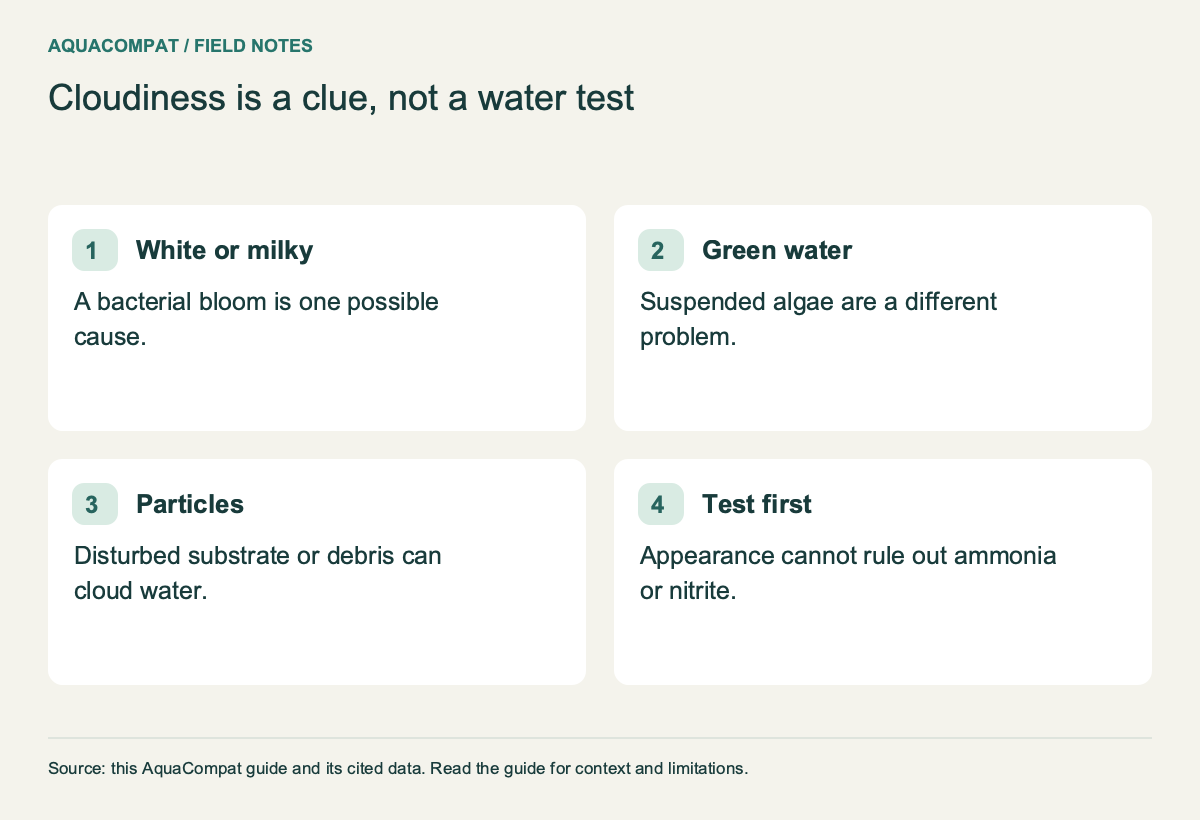
| What you see | Likely cause | When it appears | Usual fix |
|---|---|---|---|
| White or milky haze, like diluted milk | Bacterial bloom | While a new tank cycles, after overfeeding or after over-cleaning the filter | Feed less, leave the filter running and wait |
| White or grey powdery haze | Suspended particles | Right after filling, from unwashed substrate, new media or digging fish | Fine filter pads or a clarifier; often clears in 1–2 days |
| Green tint, pale to pea-soup | Free-floating algae | Any stage; the tint comes from suspended algae | UV clarifier, then water changes |
| Brown or yellow tint | Tannins | After adding driftwood or leaves | Water changes, carbon or Purigen, if the colour is unwanted |
| Milky mist of fine bubbles | Dissolved gas | A freshly filled cold tank; clears in about 24 hours | Wait; check filter connections if it persists |
| Whitish precipitate | Chemical | After a medication overdose or unmixed pH buffer | Water change |
What causes a bacterial bloom in a new tank?
A bacterial bloom is biological cloudiness: a white, milky haze that Practical Fishkeeping compares to diluted milk, and it is most common while a new tank is still cycling. Aquarium Co-Op and AquariumScience.org link it to the weeks when the filter’s bacterial colony is not yet established, to overfeeding, and to over-cleaning or replacing all the filter media at once. Practical Fishkeeping notes that biological cloudiness can go with high ammonia or nitrite, which is the part that can harm fish.
Timing is the key link to the nitrogen cycle guide. UF/IFAS (FA031) gives 6–8 weeks for a new biofilter to build enough nitrifying bacteria, and a milky haze in that window can go with the high ammonia or nitrite readings Practical Fishkeeping warns about. If fish are already in the tank, the haze is a warning to test for new tank syndrome, the ammonia and nitrite poisoning that affects fish in immature tanks. Cycling the tank before stocking avoids both problems, and the guide to cycling a new aquarium (fishless method) sets out the steps.
How do you clear cloudy aquarium water step by step?
You clear cloudy water by identifying the type first, because the fix for one kind can make another worse. The steps below follow Aquarium Co-Op, AquariumScience.org and Practical Fishkeeping.
- Identify the type and test the water. Judge the colour in a white cup, then test ammonia and nitrite. Practical Fishkeeping notes that biological cloudiness can go with high readings of either. A liquid kit is compared with strips in the guide to aquarium test kits.
- Bacterial bloom: let the filter mature. Aquarium Co-Op and AquariumScience.org say a bloom in a cycling tank usually clears in one to two weeks. Feed less, keep the filter running, and avoid big water changes or a UV unit, which both sources say can drag the bloom out.
- Particles: add fine mechanical filtration. Fine poly filter pads, or a clarifier or flocculant that clumps particles together, let the filter catch dust it would otherwise pass. Rinse new substrate before it goes in.
- Green water: use a UV clarifier. A UV sterilizer or clarifier clears suspended algae; follow it with water changes to remove the dead algae.
- Tannins: use chemical filtration if you want clear water. Water changes, activated carbon or Purigen remove the brown tint. Aquarium Co-Op treats this as optional, for owners who do not want the colour.
- Biological cloudiness with poor readings: change water daily. Where ammonia or nitrite is high, Practical Fishkeeping suggests 25% water changes every day for a week.
A test kit for cloudy water
No catalog product is specified for clearing a bacterial bloom, which the sources say clears on its own. What every cloudy tank needs is an ammonia and nitrite reading, so the one product below is a test kit. AquaCompat did not use or test it; the notes compare what API publishes.
As an Amazon Associate I earn from qualifying purchases. Prices change often, so they are not shown here; the button opens the current listing.

API Freshwater Master Test Kit
- Reads
- pH, high range pH, ammonia, nitrite, nitrate
- Method
- liquid reagent
- Tests
- 800 tests
Fits: a milky or green tank where you need to know whether ammonia or nitrite is behind the haze; API lists both among its parameters, alongside nitrate and pH.
Skip it if: you expect it to identify the cloudiness itself; it reads water chemistry, not particles, algae or tannins, and the fact base holds no verified measurement ranges for it.
Check price on AmazonShould you do water changes during a bacterial bloom?
It depends on the ammonia and nitrite readings, and the sources disagree. Aquarium Co-Op and AquariumScience.org advise against water changes during a bloom in a cycling tank, because they prolong it. Practical Fishkeeping recommends 25% daily water changes for a week when biological cloudiness comes with poor water quality. The two positions fit together once the test kit is in the picture: a bloom with zero ammonia and nitrite is cosmetic and can be left, while a bloom with rising readings is a water-quality emergency where the fish come first. UF/IFAS gives 0.1 mg/L nitrite as the point at which nitrite turns toxic, which is a reasonable line to act on.
Is cloudy water dangerous to fish and shrimp?
Cloudy water itself is rarely the danger; what comes with it can be. The risks below come from Practical Fishkeeping and SRAC Publication 466.
- Low oxygen. Heavy biological or algal cloudiness can lower dissolved oxygen, and SRAC 466 notes that algae blooms use oxygen at night. Fish gasping at the surface is the sign to add aeration. UF/IFAS advises raising oxygen when it falls below 5 mg/L dissolved oxygen (minimum).
- Ammonia and nitrite. A bloom in a new tank often goes with both. Cherry shrimp are listed as intolerant of any trace of ammonia or nitrite, which is why the shrimp data says to stock them only in fully cycled tanks; the cherry shrimp tank mates list covers the rest of their needs.
- Gas supersaturation. Practical Fishkeeping warns that a loose filter connection drawing in air can supersaturate the water and cause gas embolism in fish. A bubble mist that does not clear within a day in a filled tank is the clue.
Does a deep filter clean fix cloudy water?
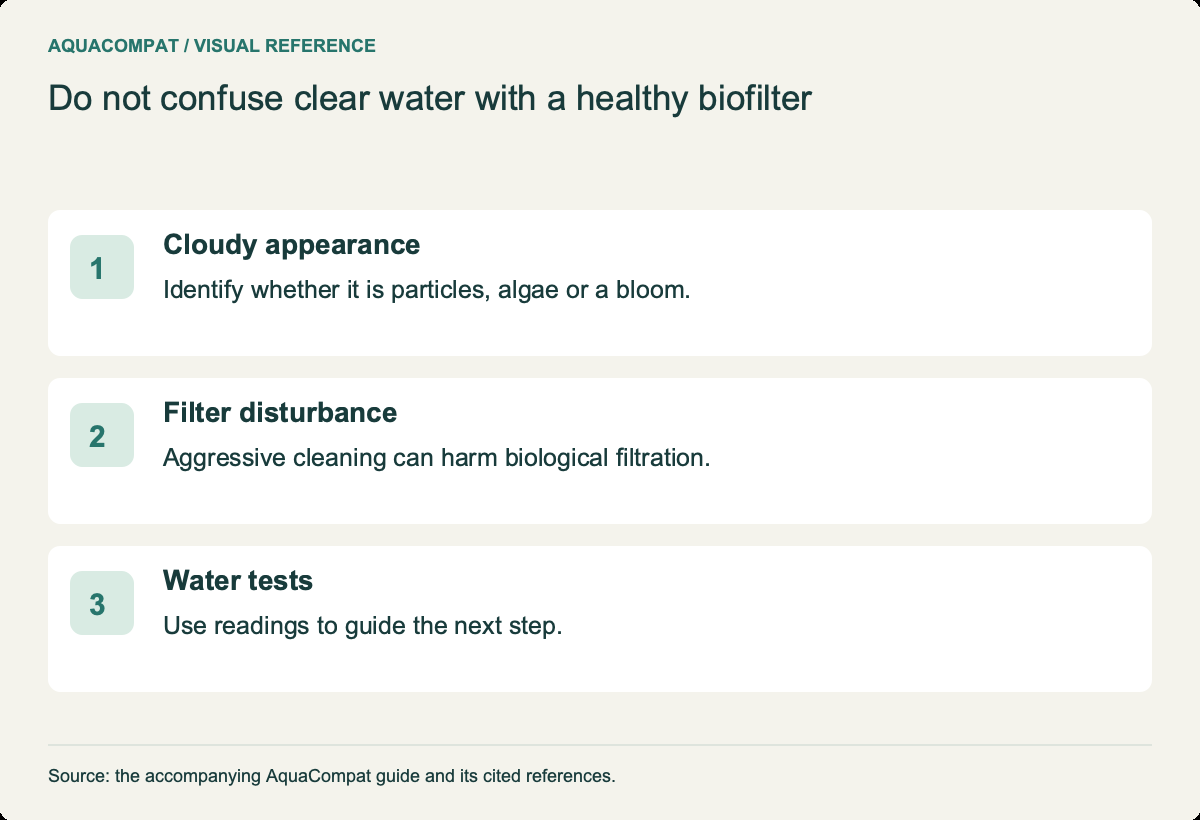
No: a deep clean of the filter is one of the commonest causes of a bacterial bloom, not a cure for it. Aquarium Co-Op and AquariumScience.org both warn against over-cleaning or replacing all the filter media at once, because removing the filter bacteria can set off a bloom. Rinse media gently in old tank water instead of tap water, replace media in stages, and keep the filter running through a bloom. The same advice protects the nitrifying bacteria described in the aquarium maintenance schedule.
What else looks like cloudy water?
Dirty glass and algae are the two most common look-alikes. Aquarium Co-Op notes that a film on the inside walls can look like cloudy water, so scrub the glass before treating the water itself. A green tint is algae, not bacteria, and needs a UV clarifier rather than patience; the guide to aquarium algae types covers it. White specks on the fish rather than haze in the water are a different problem again: scattered white spots on the skin and fins point to a parasite, covered in the ich (white spot disease) guide.
When is cloudy water a sign of something worse?
Cloudy water becomes serious when fish show distress, when the haze will not clear on the expected timeline, or when the test kit shows ammonia or nitrite. A white bloom in a fishless tank that clears in one to two weeks is harmless. The same haze in a stocked tank with fish gasping, lethargic or dying is a water-quality failure. In that case, test ammonia, nitrite and oxygen, follow Practical Fishkeeping’s daily 25% water changes while readings are high, and add aeration.
Some cases need more than water changes. Practical Fishkeeping links a whitish precipitate to medication overdoses and unmixed pH buffers, so recent dosing is the first thing to check. Persistent bubbles point to a filter leak that can cause gas embolism. If fish keep dying after the water tests normal, contact an aquatic veterinarian, because cloudy water is usually a water-quality issue rather than a disease, and a vet can look for the cause the test kit cannot show.
How can you prevent cloudy aquarium water?
Rinsing substrate, feeding less and leaving the filter bacteria undisturbed prevent most cloudy water. AquariumScience.org suggests feeding about 1% of fish body weight per day, and Practical Fishkeeping and Aquarium Co-Op both link overfeeding to blooms. Rinse substrate before it goes in, rinse filter media in old tank water rather than tap water, and never replace all of it at once.
New tanks need the most patience. UF/IFAS gives 6–8 weeks for a biofilter to mature and advises stocking gradually during that time. The aquarium stocking calculator helps keep the bioload in proportion to the tank. More tank problems are covered in the fish disease guides.
Questions people ask
How long does a bacterial bloom last?
Aquarium Co-Op and AquariumScience.org say a bloom in a cycling tank usually clears in one to two weeks. Both advise against big water changes or UV during that time, because they can drag it out. If ammonia or nitrite is high and fish are present, protect the fish with water changes first, as Practical Fishkeeping recommends.
Why is my aquarium cloudy right after filling it?
A white or grey haze right after filling is usually dust from unwashed substrate or new filter media, which Practical Fishkeeping and Aquarium Co-Op say often clears within one to two days. A fine milky mist in a freshly filled cold tank may be gas bubbles instead, which Practical Fishkeeping says clears within about 24 hours.
Is cloudy water bad for a betta or other single fish?
The haze itself is not the problem; the ammonia, nitrite or low oxygen that can come with it is. Test ammonia and nitrite in any cloudy tank with fish in it. Act on any reading rather than waiting for the bloom to clear.
Do water clarifiers work on cloudy aquarium water?
A clarifier or flocculant clumps fine particles so the filter can catch them, which suits particle cloudiness. Aquarium Co-Op and Practical Fishkeeping list it for that use. A UV clarifier suits green water instead. Neither is recommended for a bacterial bloom in a cycling tank, which the sources say clears on its own.
Does driftwood make aquarium water cloudy?
Driftwood and leaves release tannins that tint water brown or yellow rather than making it cloudy. Aquarium Co-Op suggests removing it only if you do not want the colour: water changes, activated carbon or Purigen remove the colour if you do not want it.
Sources 29 documents from 10 publishers
- Amazon (amazon.com): “API Freshwater Master Test Kit 800-Test”
- API Fishcare (apifishcare.com): “API Freshwater Master Test Kit”
- Aquarium Co-Op (aquariumcoop.com): “How to Clear Up Cloudy Fish Tank Water with 5 Easy Methods”; “Care Guide for Cherry Shrimp”; “Ich-X product guide”
- AquariumScience.org (aquariumscience.org): “6.2.3 Cloudy Water”
- Merck Veterinary Manual (merckvetmanual.com): “Disorders and Diseases of Fish (pet owner version)”; “Environmental Diseases of Aquatic Animals in Aquatic Systems, Francis-Floyd, Yanong and Petty”; “Management of Aquarium Fish, Petty, Francis-Floyd and Yanong”; “Parasitic Diseases of Fish, Petty, Francis-Floyd and Yanong”
- Practical Fishkeeping (practicalfishkeeping.co.uk): “Why is my aquarium water cloudy?”; “Problem solver: New Tank Syndrome”; “Frequently asked questions on Neocaridina shrimps”; “An introduction to Shrimp”
- Shrimp and Snail Breeder (aquariumbreeder.com): “Red Cherry Shrimp: detailed guide, care, diet and breeding”; “Cherry Shrimp in a Community Tank”; “How Copper Affects Dwarf Shrimp”
- Shrimp Science (shrimpscience.com): “Red Cherry Shrimp - Care Guide”; “General Hardness (GH) For Shrimp Tanks”; “Carbonate Hardness (KH) For Shrimp Tanks”; “TDS For Shrimp Tanks”
- Southern Regional Aquaculture Center (srac.msstate.edu): “SRAC Publication No. 466: Algae Blooms in Commercial Fish Production Ponds”; “Nitrite in Fish Ponds, SRAC Publication No. 462, Durborow, Crosby and Brunson”; “How to Start a Biofilter, SRAC Publication No. 4502, DeLong and Losordo”; “Ich (White Spot Disease), SRAC Publication No. 476, Durborow, Mitchell and Crosby”
- University of Florida IFAS Extension (EDIS) (ask.ifas.ufl.edu): “Ammonia in Aquatic Systems (FA16/FA031), Francis-Floyd, Watson, Petty and Pouder”; “Ichthyophthirius multifiliis (White Spot) Infections in Fish (CIR920/FA006), Francis-Floyd, Yanong and Pouder”; “Use of Copper in Marine Aquaculture and Aquarium Systems (FA165), Yanong”; “Use of Copper in Freshwater Aquaculture and Farm Ponds (FA-13), Watson and Yanong”
All sources accessed . Every number on this page comes from these documents.