What happens at each stage of the nitrogen cycle?
Each stage of the nitrogen cycle hands one nitrogen compound to a different group of bacteria, which turns it into something less toxic. Fish excrete ammonia mainly through their gills. Ammonia-oxidizing bacteria, such as Nitrosomonas and Nitrosospira, convert that ammonia into nitrite. Nitrite-oxidizing bacteria, such as Nitrobacter and Nitrospira, then convert nitrite into nitrate. UF/IFAS Extension (Francis-Floyd and colleagues) and SRAC Publication 4502 both describe the process this way.
The colony of nitrifying bacteria in a tank is called the biofilter, or biological filtration. A tank “cycles” when its biofilter is large enough to process all the ammonia its fish produce, with nitrite cleared as fast as it forms. Nitrification also needs oxygen and consumes alkalinity, which is why it lowers pH over time unless the water is buffered. That link between the nitrogen cycle and the other aquarium water parameters comes up again below.
The table summarises the three compounds in the order the cycle produces them, with the level at which published sources say each one starts to cause harm.
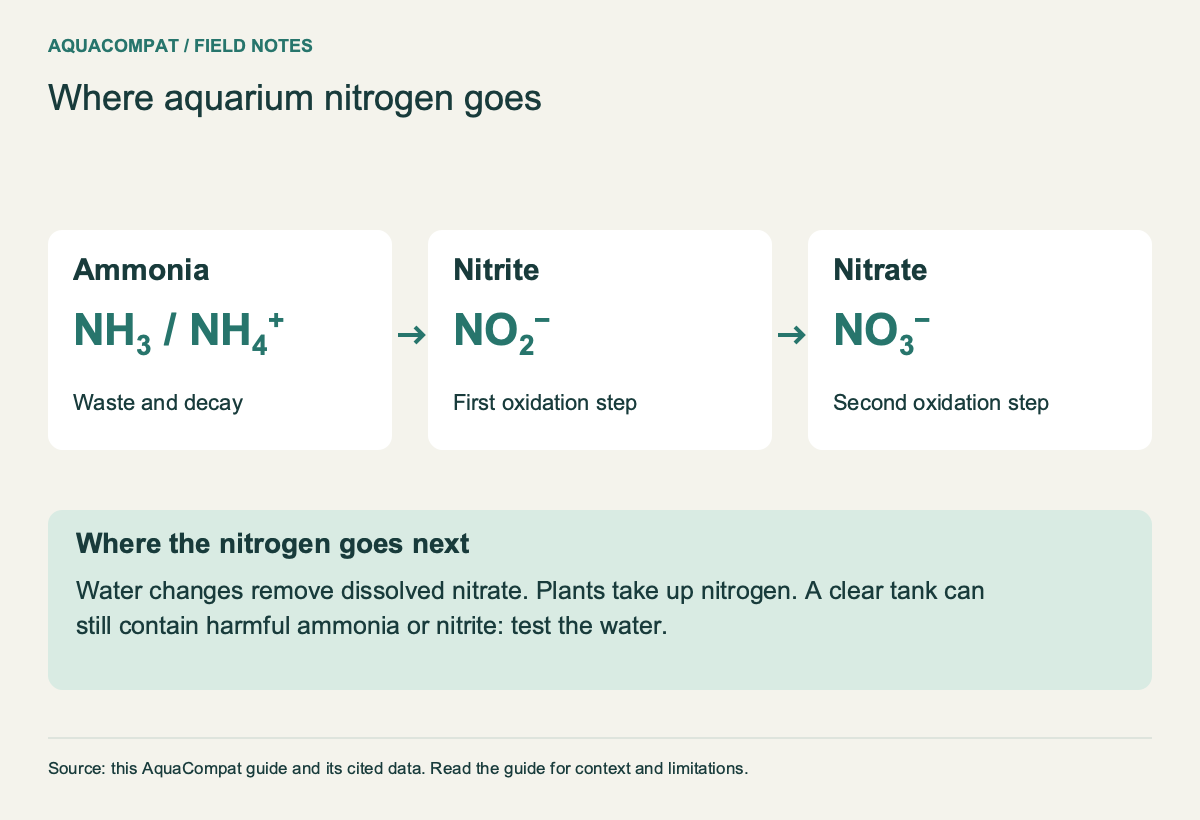
| Compound | Where it comes from | What removes it | Harmful from |
|---|---|---|---|
| Ammonia (NH3 / NH4+) | Fish gills, waste and decaying food | Ammonia-oxidizing bacteria (Nitrosomonas, Nitrosospira) | 0.05 mg/L un-ionized ammonia (gill damage) |
| Nitrite (NO2−) | Ammonia-oxidizing bacteria | Nitrite-oxidizing bacteria (Nitrobacter, Nitrospira) | 0.1 mg/L nitrite |
| Nitrate (NO3−) | Nitrite-oxidizing bacteria | Water changes | Sources disagree; see the nitrate section |
Why is ammonia more toxic in warm, alkaline water?
Ammonia is more toxic in warm, alkaline water because a larger share of it exists as un-ionized ammonia (NH3), the form that crosses the gills. Total ammonia in water is split between NH3 and the ionized ammonium ion (NH4+), and UF/IFAS describes un-ionized ammonia as 100 times more toxic (approx.) than ammonium. The un-ionized share rises with pH and temperature and falls slightly with salinity.
What do hobby test kits actually measure?
Hobby kits read total ammonia nitrogen (TAN), both forms together. To know how much of that reading is the dangerous form, you need the tank’s pH and temperature as well. UF/IFAS publishes a factor table, calculated from Emerson, Russo, Lund and Thurston (1975), that you multiply by the TAN reading. A few values from that table are shown below.
| Typical tank | Un-ionized fraction of total ammonia |
|---|---|
| Neutral, cool | 0.0039 fraction of TAN (pH 7.0, 20 °C / 68 °F) |
| Neutral, tropical | 0.006 fraction of TAN (pH 7.0, 26 °C / 78.8 °F) |
| Slightly alkaline, tropical | 0.0236 fraction of TAN (pH 7.6, 26 °C) |
| Alkaline, cool | 0.0381 fraction of TAN (pH 8.0, 20 °C) |
| Alkaline, tropical | 0.0574 fraction of TAN (pH 8.0, 26 °C) |
| Hard, alkaline and warm | 0.1495 fraction of TAN (pH 8.4, 28 °C / 82.4 °F) |
How much ammonia can fish tolerate?
Fish tolerate very little ammonia, and the exact limit depends on which form you measure. For un-ionized ammonia, UF/IFAS and the Merck Veterinary Manual both put gill damage from 0.05 mg/L un-ionized ammonia, and at about 2 mg/L un-ionized ammonia sensitive fish typically die. For the total reading most aquarists actually take, Merck states that freshwater fish can usually tolerate 1 mg/L TAN (upper bound, less than).
Limits written for rivers and lakes give a sense of scale. The US EPA’s 2013 freshwater ammonia criteria, stated at pH 7 and 20 °C, recommend no more than 17 mg/L of total ammonia nitrogen as a one-hour average and 1.9 mg/L as a 30-day average. The EPA notes that pH and temperature change ammonia’s toxicity, and the figures were set to protect wild species including unusually sensitive mussels and snails, so treat them as context rather than an aquarium target.
The table above shows why the same test result can mean different things in different tanks. A TAN reading in a soft-water tank near neutral pH carries far less un-ionized ammonia than the same reading in a hard, alkaline tank kept warm for African cichlids or livebearers. Owners of alkaline tanks therefore have the least margin while a biofilter is immature, and the water parameter overlap tool shows which species are normally kept at the high-pH end.
Hobby and veterinary sources also differ on when to act. Practical Fishkeeping treats any ammonia reading above zero as needing action, while Merck’s professional edition says freshwater fish usually tolerate total ammonia under the level given above. Both positions agree that a reading which keeps rising means the biofilter is not keeping up.
How does nitrite harm fish?
Nitrite harms fish by stopping their blood from carrying oxygen. SRAC Publication 462 (Durborow, Crosby and Brunson) explains that nitrite enters through the gills and converts hemoglobin into methemoglobin, which cannot carry oxygen. The blood turns brown, a condition called brown blood disease, and fish gasp at the surface even when the water holds enough oxygen. UF/IFAS and Merck both say nitrite can be toxic from 0.1 mg/L nitrite.
Why does chloride protect fish from nitrite?
Chloride competes with nitrite at the gills, so salt reduces how much nitrite a fish absorbs. The two main sources express the dose differently. SRAC 462 gives a ratio, 10 chloride:nitrite ratio (minimum, 10:1), and notes that sick fish may need more. The Merck Veterinary Manual instead notes that salt can halt deaths during a sudden nitrite rise and that many aquaria hold 1–3 ppt salt as a relatively permanent treatment. Merck also warns that some fish, such as wild-caught Amazonian species and elephantnose fish, may not tolerate permanent low-level salt, so salt is a species decision, not a default.
How much nitrate is safe in a freshwater aquarium?
No single safe nitrate figure exists, because the published limits differ widely. The most cautious aquarium figure comes from the Merck Veterinary Manual, whose normal reference range for freshwater systems is 20 mg/L (freshwater reference range, less than). Practical Fishkeeping and Aquarium Co-Op suggest keeping nitrate below about 40 ppm, or within that margin of your tap water. UF/IFAS records that nitrate was traditionally considered non-toxic up to 200 mg/L nitrate (traditional view), but adds that newer research suggests it may be more harmful than that view assumed. SRAC 4502, written for fish farms, still calls nitrate non-toxic at the levels usual in recirculating systems.
The sources therefore conflict: UF/IFAS questions the old high tolerance, SRAC 4502 does not, and Merck sets the lowest reference figure. For a home aquarium, the conservative Merck range is the safer target. Environmental guidelines for wild water go lower still: the Canadian Council of Ministers of the Environment’s 2012 long-term guideline for protecting freshwater life is 13 mg/L nitrate (3.0 mg/L as nitrate-nitrogen), set to protect the most sensitive lake and river species over indefinite exposure rather than aquarium fish. Merck also notes that most test kits report nitrate-nitrogen (NO3-N); multiplying that reading by 4.4 converts it to nitrate (NO3), so check which unit your kit uses before comparing it with any limit.
How does nitrate leave the tank?
Nitrate leaves a normal aquarium mainly through water changes, because the nitrogen cycle stops at nitrate. UF/IFAS warns that in closed systems with little water exchange, nitrate can exceed 250 mg/L. Practical Fishkeeping’s rule of about 25 % weekly a week suits most tanks, adjusted for stocking and feeding.
| Source | Nitrate guidance |
|---|---|
| Merck Veterinary Manual | 20 mg/L (freshwater reference range, less than) |
| Practical Fishkeeping; Aquarium Co-Op | Below about 40 ppm |
| UF/IFAS Extension FA031 | Traditional tolerance of 200 mg/L nitrate (traditional view), now questioned |
| SRAC Publication 4502 | Non-toxic at usual recirculating-system levels |
How long does the nitrogen cycle take to establish?
A new biofilter takes roughly four to eight weeks to establish, depending on which source you follow. UF/IFAS gives 6–8 weeks. The Merck Veterinary Manual gives about six weeks for complete establishment and up to eight in a tropical tank, summarised as 6–8 weeks. Practical Fishkeeping says most aquariums take 4–6 weeks. Dr Tim’s Aquatics, a bacteria manufacturer, gives 30–45 days for fishless cycling without its bacterial product, and SRAC Publication 452 allows at least a month for activation.
These figures conflict less than they seem: the veterinary and extension sources describe a biofilter reaching full capacity, while the hobby figure describes when most tanks first pass a completion test. Dr Tim’s and Practical Fishkeeping share the same test: a cycle is complete when a full ammonia dose is converted to nitrate within 24 hours, with no detectable nitrite. The dosing and testing routine that gets a tank to that point is set out in how to cycle a new aquarium with the fishless method, so it is not repeated here.
What conditions do nitrifying bacteria need?
Nitrifying bacteria need oxygen, alkalinity, a stable warm temperature and freedom from chlorine. Each requirement below comes from a published source and explains a common reason a cycle stalls.
- Oxygen. Nitrification needs oxygen, and UF/IFAS advises raising aeration if dissolved oxygen falls below 5 mg/L dissolved oxygen (minimum).
- Alkalinity. The bacteria consume alkalinity (carbonate hardness, or KH). Merck says alkalinity of 50 mg/L or less inhibits the biofilter and recommends at least 100 mg/L as CaCO3 (minimum). In soft water, KH can run out during cycling and pH can crash low enough to stop bacterial work.
- Temperature. Warmth speeds nitrifier growth, but SRAC 4502 limits any increase to 2–3 °C above operating temperature (max).
- No chlorine. Chlorine kills nitrifying bacteria, so filter media should never be rinsed in untreated tap water.
Chloramine-treated tap water adds a twist. Neutralising chloramine with sodium thiosulfate frees ammonia, so conditioners that also bind ammonia are recommended; the comparison of aquarium water conditioners notes which products do both. Disease treatments, especially antibiotics, can also harm the biofilter, and UF/IFAS advises testing ammonia and nitrite more often after any course of medication.
How do you monitor ammonia, nitrite and nitrate?
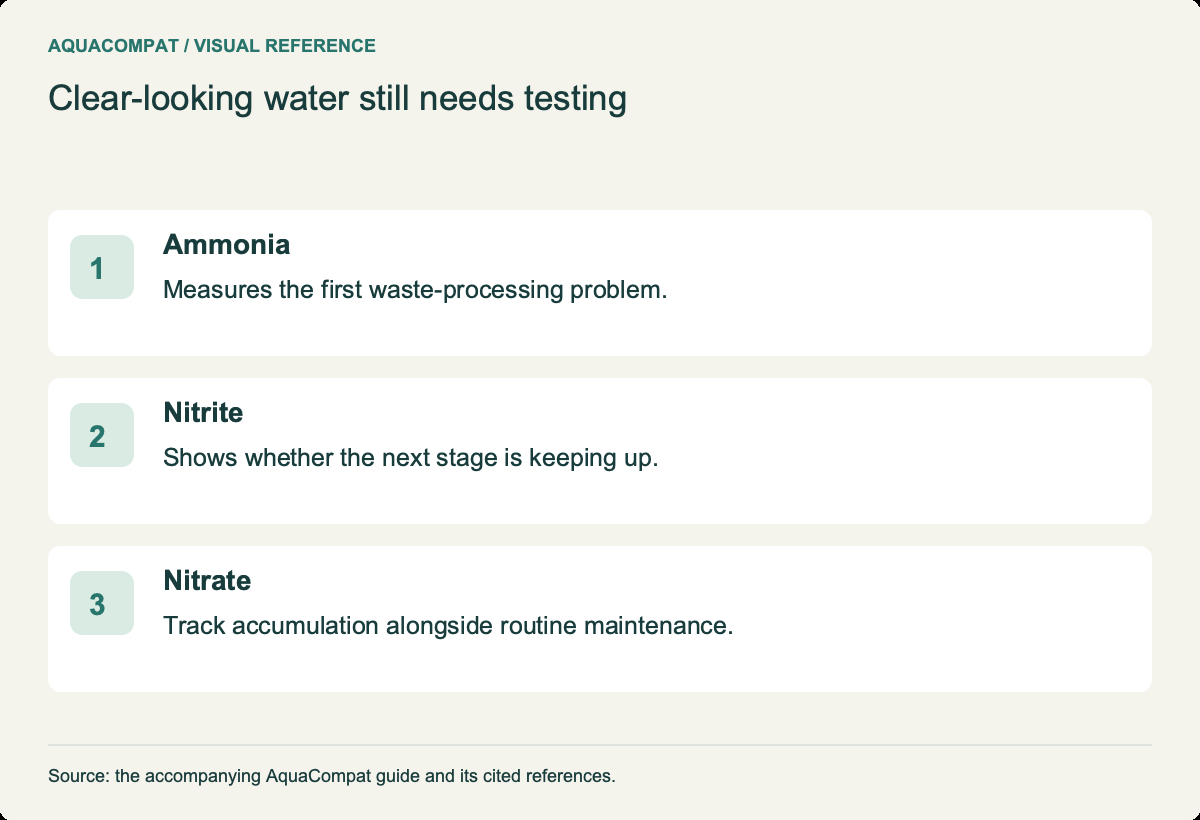
You monitor the nitrogen cycle with a liquid or strip test kit that reads total ammonia, nitrite and nitrate, plus a pH test and a thermometer. Ammonia and nitrite are colourless, so only a test can confirm them. Merck’s maintenance schedule lists testing pH, alkalinity, ammonia, nitrite and nitrate at each water change, with a change every 2 weeks (interval) as its baseline interval.
Read the three results as a sequence. Rising ammonia with no nitrite means the first bacterial group has not yet established. Falling ammonia with rising nitrite means the first group is working and the second is lagging. Zero ammonia, zero nitrite and slowly rising nitrate means the cycle is running and water changes are now the main control. If you are choosing equipment, the guide to choosing aquarium test kits compares kits by what they measure and in which unit.
Does clear water mean the nitrogen cycle is working?
No: clear water says nothing about ammonia or nitrite, because both are colourless. Practical Fishkeeping stresses that a test kit is the only way to confirm them, and a sparkling new tank can hold enough ammonia to burn gills. The reverse misconception is just as common. A white, milky haze in a cycling tank is usually a bacterial bloom, which Aquarium Co-Op and AquariumScience.org say normally clears as the filter matures. Cloudiness of that kind can accompany high ammonia or nitrite, so it is a reason to test, not proof of failure. The causes and fixes are covered in the guide to cloudy aquarium water.
What happens when the nitrogen cycle fails?
A nitrogen cycle fails in one of two opposite ways: it never gets established, or an established one collapses. The first is a new tank problem; the second belongs to old, neglected tanks.
New tank: the biofilter is too small
When fish go into a tank before its bacteria are established, ammonia and then nitrite build up faster than they can be converted. Merck places this in the first weeks after setup. Signs include gasping at the surface, lethargy and unexplained deaths. That emergency, and how to manage it with water changes and reduced feeding, is covered under new tank syndrome.
Old tank: the pH collapses
An established cycle can also fail years later. The Merck Veterinary Manual describes old tank syndrome: when water is only topped up instead of changed, organic acids build up, nitrification keeps consuming alkalinity, and pH falls sharply, sometimes below 5, killing the nitrifying bacteria. With the bacteria gone, ammonia climbs again. Removing old water at each change, not just replacing what evaporates, prevents it.
Shrimp make the contrast sharper. Shrimp Science advises that any trace of ammonia or nitrite is dangerous to cherry shrimp and that they belong only in fully cycled, established tanks, so a cycle that is merely passing for fish may still be too young for invertebrates.
Where does the nitrogen cycle fit with the rest of tank care?
The nitrogen cycle is the base layer of water quality: once ammonia and nitrite stay at zero, temperature, pH and hardness decide which species suit the tank. Start a new tank with the fishless method, test until the completion standard is met, then keep nitrate in check with regular water changes. The other water chemistry and setup guides explain each parameter in the same way.
Questions people ask
Can I add fish while the nitrogen cycle is still running?
Adding fish before the biofilter can clear a full ammonia dose within 24 hours exposes them to ammonia and nitrite as the bacteria catch up. The Merck Veterinary Manual and UF/IFAS both recommend allowing the biofilter time to establish and stocking gradually afterwards. If fish are already in an uncycled tank, follow the new tank syndrome steps: frequent tests, reduced feeding and water changes.
Can cleaning the filter restart the nitrogen cycle?
It can set the cycle back. Aquarium Co-Op and AquariumScience.org advise against over-cleaning or replacing all filter media at once, because removing the bacteria can trigger a bloom while the colony regrows. Chlorine is the bigger threat: rinsing media in untreated tap water kills nitrifying bacteria, so rinse it gently in old tank water instead and replace media in stages.
Why has my pH dropped since the tank cycled?
Nitrification consumes alkalinity and releases acid, so pH drifts down over time in an established tank unless the water is buffered. Merck recommends keeping alkalinity at 100 mg/L as CaCO3 (minimum) for a healthy biofilter. Regular water changes replace the carbonate the bacteria use up; tanks with very soft tap water lose it fastest.
Is nitrite or ammonia more dangerous?
Both are dangerous at low levels, but nitrite is often harmful at smaller test readings: UF/IFAS lists nitrite as toxic from 0.1 mg/L nitrite. Ammonia’s danger depends on pH and temperature, because only the un-ionized fraction is highly toxic. In a soft, neutral tank a small ammonia reading is less urgent than the same nitrite reading; in a warm alkaline tank both are urgent.
Do I still need water changes once the tank is cycled?
Yes. The cycle ends at nitrate, which keeps accumulating, and UF/IFAS notes it can exceed 250 mg/L in closed systems with little exchange. Water changes are the main way nitrate leaves a home aquarium, and they also replace the alkalinity the bacteria consume.
Sources 34 documents from 13 publishers
- Aquarium Co-Op (aquariumcoop.com): “Guide to Aquarium Water Changes”; “Does dechlorinator remove ammonia?”; “How to Clear Up Cloudy Fish Tank Water with 5 Easy Methods”; “Care Guide for Cherry Shrimp”
- AquariumScience.org (aquariumscience.org): “6.2.3 Cloudy Water”
- Canadian Council of Ministers of the Environment (ccme.ca): “Canadian Water Quality Guidelines for the Protection of Aquatic Life: Nitrate Ion”
- Dr Tim's Aquatics (manufacturer) (drtimsaquatics.com): “Fishless Cycling”
- Merck Veterinary Manual (merckvetmanual.com): “Environmental Diseases of Aquatic Animals in Aquatic Systems, Francis-Floyd, Yanong and Petty”; “Management of Aquarium Fish, Petty, Francis-Floyd and Yanong”; “Disorders and Diseases of Fish (pet owner version)”; “Routine Health Care of Fish (pet owner version)”
- Practical Fishkeeping (practicalfishkeeping.co.uk): “How to Cycle a Fish Tank: The Complete Guide”; “Problem solver: New Tank Syndrome”; “How often should I change my water?”; “Why is my aquarium water cloudy?”; “Frequently asked questions on Neocaridina shrimps”; “An introduction to Shrimp”
- Seachem Laboratories (manufacturer) (seachem.com): “Prime”
- Shrimp and Snail Breeder (aquariumbreeder.com): “Red Cherry Shrimp: detailed guide, care, diet and breeding”; “Cherry Shrimp in a Community Tank”; “How Copper Affects Dwarf Shrimp”
- Shrimp Science (shrimpscience.com): “Red Cherry Shrimp - Care Guide”; “General Hardness (GH) For Shrimp Tanks”; “Carbonate Hardness (KH) For Shrimp Tanks”; “TDS For Shrimp Tanks”
- Southern Regional Aquaculture Center (srac.msstate.edu): “How to Start a Biofilter, SRAC Publication No. 4502, DeLong and Losordo”; “Nitrite in Fish Ponds, SRAC Publication No. 462, Durborow, Crosby and Brunson”; “Recirculating Aquaculture Tank Production Systems: Management of Recirculating Systems, SRAC Publication No. 452”; “SRAC Publication No. 466: Algae Blooms in Commercial Fish Production Ponds”; “Interactions of pH, Carbon Dioxide, Alkalinity and Hardness in Fish Ponds, SRAC Publication No. 464, Wurts and Durborow”
- University of Florida IFAS Extension (EDIS) (ask.ifas.ufl.edu): “Ammonia in Aquatic Systems (FA16/FA031), Francis-Floyd, Watson, Petty and Pouder”; “Teach Aquaculture Curriculum: Chlorine, Friend or Foe? (FA171), Chapman et al.”
- US Environmental Protection Agency (epa.gov): “Chloramines in Drinking Water”
- US Environmental Protection Agency, Office of Water (epa.gov): “Aquatic Life Ambient Water Quality Criteria for Ammonia - Freshwater (2013), fact sheet EPA 820-F-13-013”
All sources accessed . Every number on this page comes from these documents.