- Temperature overlap
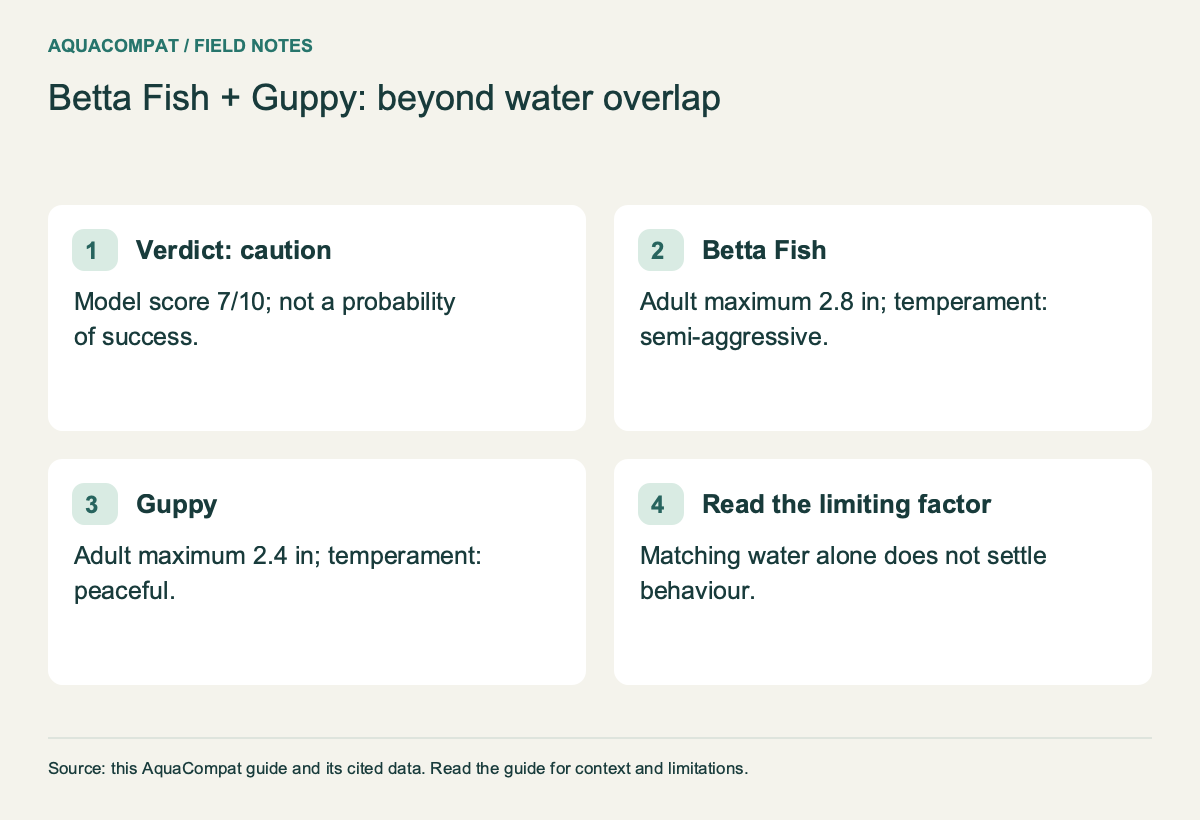
- 7/10
- pH overlap
- 10/10
- Hardness overlap
- 5/10
- Temperament
- 4/10
- Size and predation
- 10/10
- Swim level
- 10/10
- Smallest tank together
- 20 US gal (76 L)
Scores come from published water ranges, adult size, temperament and swim level. How the score works.
Where do bettas and guppies overlap in water parameters?
Bettas and guppies overlap at 72–82 °F (22–28 °C), pH 7.0–8.0 and a general hardness of 8–15 dGH. That is a wide shared band, which is why water chemistry is not what limits this pairing. On its own the betta takes 72–86 °F (22–30 °C) and pH 6.0–8.0, while the guppy takes 68–82 °F (20–28 °C) and pH 7.0–8.0. The guppy’s range sits on the hard, alkaline side, so the shared pH band is set by the guppy’s lower limit.
Which temperature and pH should a betta and guppy tank run at?
A shared betta and guppy tank should run in the middle of the overlap rather than at either edge. The sources pull in slightly different directions within it. Aquarium Co-Op suggests about 80 °F for a betta, while its guppy guide recommends 76–78 °F and reports that guppies live about 18 months at 82 °F against 2–3 years at 76–78 °F. A heater set in the high 70s °F therefore suits both species better than the warm end the betta alone would tolerate. The aquarium temperature ranges by species guide shows where both fish sit beside other tropical species.
For pH, the overlap only exists because domestic bettas tolerate alkaline water. Seriously Fish gives pH 6.0–8.0 for bettas generally but notes that wild-collected fish prefer 5.0–7.0, which would not overlap with the guppy’s range at all. Pet-shop bettas are domestic strains, so the overlap above applies to them. Guppies need hard, mineral-rich water according to Aquarium Co-Op, and the GH and KH explainer covers how to read hardness on a test kit.
How do a betta’s temperament and a guppy’s fins interact?
The betta’s aggression toward long-finned fish is the main reason this pairing is risky. Seriously Fish states that a male betta may attack fish with trailing fins or a betta-like body shape, treating them as rivals, and it calls the species unsuitable for a standard community tank. UF/IFAS EDIS (FA212) describes what that rivalry looks like between two males: flaring, then biting fins. A male guppy, with its long, brightly coloured tail, can trigger the same response. Seriously Fish also observes that ornamental betta strains appear more aggressive than wild Betta populations, and every shop betta is an ornamental strain.
The risk runs in one direction. Seriously Fish calls the guppy a very peaceful fish, and both Seriously Fish and Aquarium Co-Op list guppies as victims of fin-nippers, never as nippers themselves. Our betta data records that fin damage from a betta comes from rival aggression rather than habitual nipping, which is why it tends to be aimed at one fish rather than spread across the tank.
Individual bettas vary. The care sources behind our betta fish care guide note that some individuals tolerate peaceful nano fish in planted 10–20 gallon tanks, while others attack anything that resembles a rival. There is no way to know which kind of betta you have before the fish meet, which is the honest reason this page cannot promise a result.
Do they compete for the same part of the tank?
Bettas prefer the upper third of the tank, according to Aquarium Co-Op, while guppies swim all over it. That spread lowers crowding, but it also means guppies pass through the betta’s preferred zone constantly. Male guppies chase females without pause, as both Seriously Fish and Aquarium Co-Op describe, so a guppy group is a busy, colourful presence that keeps crossing the betta’s water.
What tank size do bettas and guppies need together?
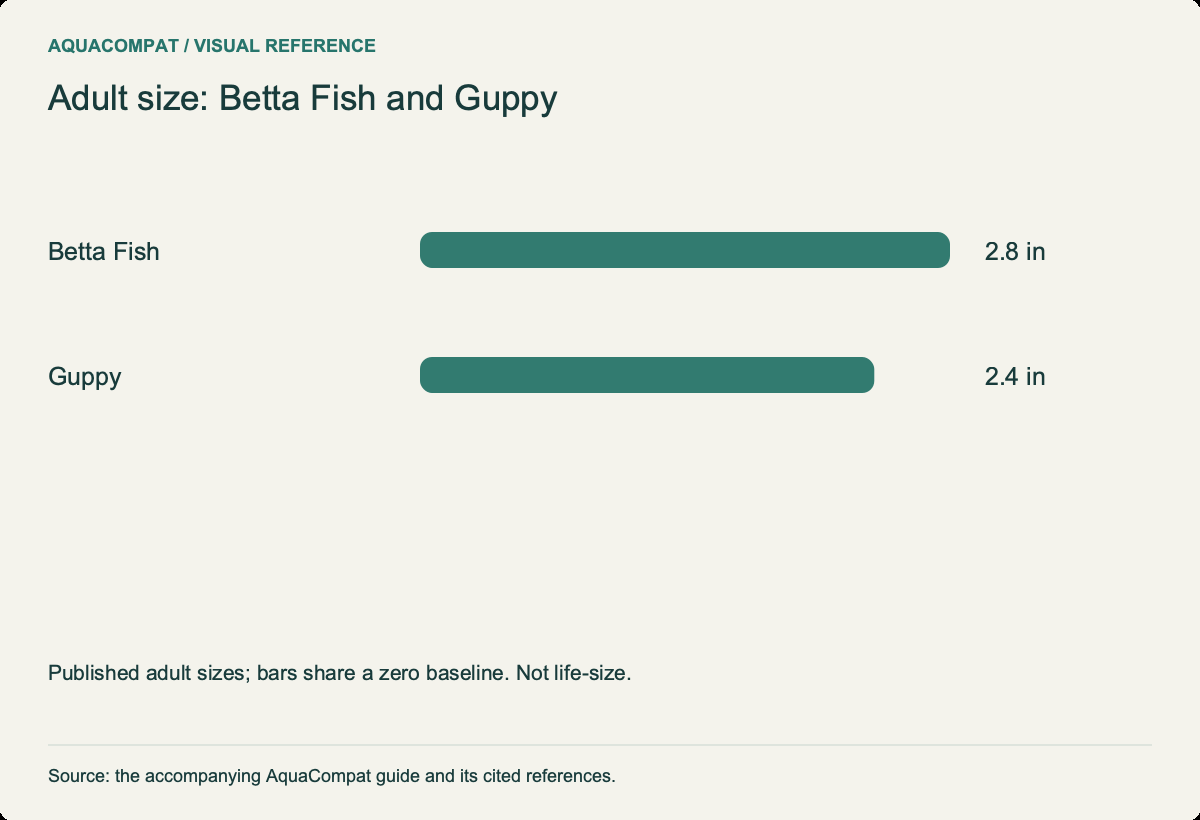
Bettas and guppies need at least 20 US gal (76 L) together in our data. Each species alone needs less: the betta 10 US gal (38 L) and the guppy 10 US gal (38 L), both based on Seriously Fish’s 45 × 30 cm footprint. Our method takes the larger single-species figure, adds a margin because the betta is semi-aggressive, and rounds up to the next common tank size. The extra space gives a guppy somewhere to get out of the betta’s sight, which a small tank cannot do.
The guppy’s breeding rate is the second reason not to go small. Aquarium Co-Op reports births roughly every 30 days, and FishBase records broods of 20–40 young, so a group that starts at a suitable size can outgrow a small tank within months. Aquarium Co-Op prefers 10–20 gallons for guppies alone for that reason. Long-finned bettas also cannot swim well in strong currents, so the filter for a shared tank should be gentle, per Aquarium Co-Op.
A 10-gallon tank is the most common beginner size, and it is below our shared figure for this pair. The best fish for a 10-gallon community tank guide lists what fits at that size, and the aquarium stocking calculator checks a full stocking list against volume.
Can bettas and guppies eat the same food?
Bettas and guppies can eat many of the same foods, though their diets are not identical. The betta is a carnivore: FishBase lists zooplankton and mosquito and insect larvae in its wild diet, and Seriously Fish describes it as a predator of invertebrates. It accepts dried foods but benefits from live or frozen daphnia, brine shrimp and bloodworm. The guppy is an omnivore that eats insects, zooplankton and detritus in the wild, according to FishBase, and Seriously Fish says tank-bred guppies take most foods.
Small frozen foods such as daphnia and brine shrimp therefore suit both fish, and a betta pellet and a small flake can be offered side by side. Feeding is also a good moment to watch the tank: a betta that flares or chases at mealtimes is showing the rival response described above.
How many guppies should live with a betta, and should they be male or female?
Keep one betta and a group of at least 5 guppies. The betta group size is 1: UF/IFAS EDIS and Aquarium Co-Op both say male bettas fight on sight and must never share a tank. Guppies are the opposite, a shoaling livebearer that FishBase recommends keeping in groups of five or more.
The sex mix matters for two reasons. First, Aquarium Co-Op advises about one male guppy to every two or three females, so that males do not harass any one female, and Seriously Fish gives the same advice. Second, the trailing fins that a betta may treat as a rival’s belong to male guppies; the guppy data describes long-finned males as the fin-nippers’ target. No source in our data compares how bettas treat female guppies with how they treat males, so a female-only group is a reasonable idea rather than a proven fix.
A female-only group is not a reliable way to avoid fry either. Seriously Fish reports that female guppies can keep producing broods for six months or more after a single mating, with no male present, so females bought from a mixed shop tank may already be carrying young.
What goes wrong when a betta and guppies don’t get along?
When the pairing fails, the usual sign is a male guppy with torn or shortened fins and a betta that patrols and flares at it. Because the betta’s aggression is aimed at fish it reads as rivals, one or two guppies often take most of the damage while the rest look fine. The only reliable fix is separation: rehome the guppies or move the betta to its own tank.
The second failure is the guppy’s own reproduction. Our betta data records that bettas eat small fish, and Maidenhead Aquatics warns that tankmates too tiny may be mistaken for a snack. Newborn guppy fry are that size, and Aquarium Co-Op notes adult guppies also eat their own fry unless dense cover is provided. A shared tank tends to swing between too many guppies, if fry survive, and a betta hunting fry if they do not.
A closely related pairing shows how size changes the outcome. Endler’s livebearers look like small guppies but reach only 1 in (2.5 cm), and the betta and endler pair scores 3/10 because the size gap adds predation to the fin risk. The guppy and Endler’s livebearer comparison sets the two side by side. At the far end, can betta fish and goldfish live together explains a pairing that fails on temperature alone, since the two share no temperature range at all.
Which tank mates work better with a betta than guppies?
Short-finned, calm species score higher with a betta than guppies do in our data. Each of these avoids the trailing fins that the betta’s rival response targets:
- Harlequin Rasbora: 7/10. Aquarium Co-Op recommends harlequins as betta tank mates for their easygoing temperament, and Seriously Fish calls them very peaceful.
- Nerite Snail: 7/10. A peaceful algae grazer that, per Shrimp and Snail Breeder, competes with other snails only for food.
- Bristlenose Pleco: 7/10. A bottom dweller that Aquarium Co-Op describes as eating only animals already dead, and that stays out of the betta’s upper water.
- Corydoras: 7/10. PlanetCatfish calls the bronze cory a perfect citizen for community tanks; it needs a group and a larger tank, at 40 US gal (151 L) with a betta.
Neon tetras are the next most asked-about option; can betta fish and neon tetra live together covers why their narrower shared temperature band keeps that pair from the top of the list. The ranked list of all betta fish tank mates shows every species we cover with its score. If you already keep guppies and want company for them instead, the guppy tank mates page ranks species that suit hard, alkaline water, including mollies; can guppy and molly live together covers that livebearer pairing. Any other combination can be scored in the compatibility checker.
Questions people ask
Will a betta eat guppy fry?
It can. Our betta data records that bettas eat very small fish, and Maidenhead Aquatics warns that tankmates too tiny may be mistaken for a snack. Newborn guppies fall into that range. Adult guppies eat their own fry as well, according to Aquarium Co-Op, so fry in a shared tank survive mainly where dense plants give them cover. If you want to raise guppy fry, a separate tank is more dependable.
Can a female betta live with guppies?
The sources in our data describe the rival attack on trailing-finned fish as male behaviour, but the betta profile also records that females can be aggressive. No source compares female bettas with male guppies directly. Treat a female betta with the same caution as a male: a tank of at least 20 US gal (76 L), plenty of plants and a second tank ready if fins start to tear.
Do guppies nip betta fins?
No source in our data describes guppies as fin-nippers. Seriously Fish calls the guppy very peaceful, and both Seriously Fish and Aquarium Co-Op list guppies as the victims of fin-nipping species such as tiger barbs. In a betta and guppy tank, fin damage on the betta usually points to a different tank mate rather than to the guppies.
Is a betta and guppy tank better with only female guppies?
Possibly, but it is not proven. The long, trailing fins that a betta may read as a rival belong to male guppies, so females present less of that trigger. However, no source we use tests this, and Seriously Fish notes that females can keep producing broods for six months or more after one mating, so a female-only group may still produce fry.
What should I do if my betta starts attacking my guppies?
Separate them. Seriously Fish describes the attack as a rival response to trailing fins, and a male guppy’s fins will not change, so the trigger stays in the tank as long as both fish do. Move the guppies to their own tank of at least 10 US gal (38 L), or give the betta its own tank of at least 10 US gal (38 L). Seriously Fish advises keeping bettas alone in any case.
Sources 37 documents from 10 publishers
- Aquarium Co-Op (aquariumcoop.com): “Betta Fish Care Guide”; “Guppy Care Guide”; “Top 5 Dither Fish to Help Shy or Aggressive Fish in Freshwater Tanks”; “Care Guide for Dwarf Gouramis”; “10 Best Top-Dwelling Fish for Your Freshwater Community Aquarium”; “Endler's Livebearer Care Guide”; “Care Guide for Harlequin Rasboras and Lambchop Rasboras”; “Care Guide for Nerite Snails”; “Care Guide for Plecostomus”; “Care Guide for Cory Catfish”
- FishBase (fishbase.se): “Betta splendens, Siamese fighting fish: species summary”; “Poecilia reticulata, Guppy: species summary”; “Length-weight relationships for Poecilia reticulata”; “Poecilia wingei, Endlers guppy: species summary”; “Trigonostigma heteromorpha summary page”; “Osteogaster aenea, Bronze corydoras”
- Maidenhead Aquatics (fishkeeper.co.uk species data sheet) (fishkeeper.co.uk): “Guppy data sheet”; “Siamese Fighting Fish/Betta data sheet”; “Harlequin Rasbora data sheet”; “Zebra Nerite Snail”
- PlanetCatfish (via Internet Archive snapshot, 2025) (web.archive.org): “Ancistrus sp. (3) Common Bristlenose Catfish Cat-eLog data sheet”; “Osteogaster aenea (Bronze Cory) Cat-eLog data sheet”
- Practical Fishkeeping (practicalfishkeeping.co.uk): “Quick guide to livebearers”; “A guide to the small rasboras from the genus Trigonostigma”; “Bristlenose catfish: the hardworking Ancistrus”; “What can I keep in my hard water aquarium?”
- Seriously Fish (seriouslyfish.com): “Betta splendens”; “Poecilia reticulata”; “Poecilia wingei”; “Trigonostigma heteromorpha (Harlequin)”; “Ancistrus sp. '3' (Common Bristlenose Catfish)”; “Osteogaster aenea (Bronze Cory)”
- Shrimp and Snail Breeder (aquariumbreeder.com): “Cherry shrimp in a community tank: how to make it successful”; “Nerite Snails: detailed guide, care, diet and breeding”
- Tropical Fish Hobbyist Magazine (tfhmagazine.com): “Betta splendens”
- UF/IFAS EDIS (ask.ifas.ufl.edu): “Evolution, Culture, and Care for Betta splendens (FA212)”
- Wikipedia (en.wikipedia.org): “Vittina natalensis”
All sources accessed . Every number on this page comes from these documents.