What temperature do common aquarium fish need?
Most aquarium fish in the chart are tropical species that need heated water, but the exact band differs by species, and a few sit well outside the usual tropical range. Coldwater goldfish are at the cool end, discus and angelfish at the warm end, and community fish such as tetras, rasboras, corydoras and livebearers fill the middle. The chart is ordered from the coolest lower limit to the warmest, so species that can share a heater setting sit near each other.
Each range is the band where at least two published care sources agree, mainly Seriously Fish, FishBase, the Maidenhead Aquatics data sheets and Aquarium Co-Op. Where sources disagree, our species data keeps each source’s own figure, and the most useful of those differences are discussed below.
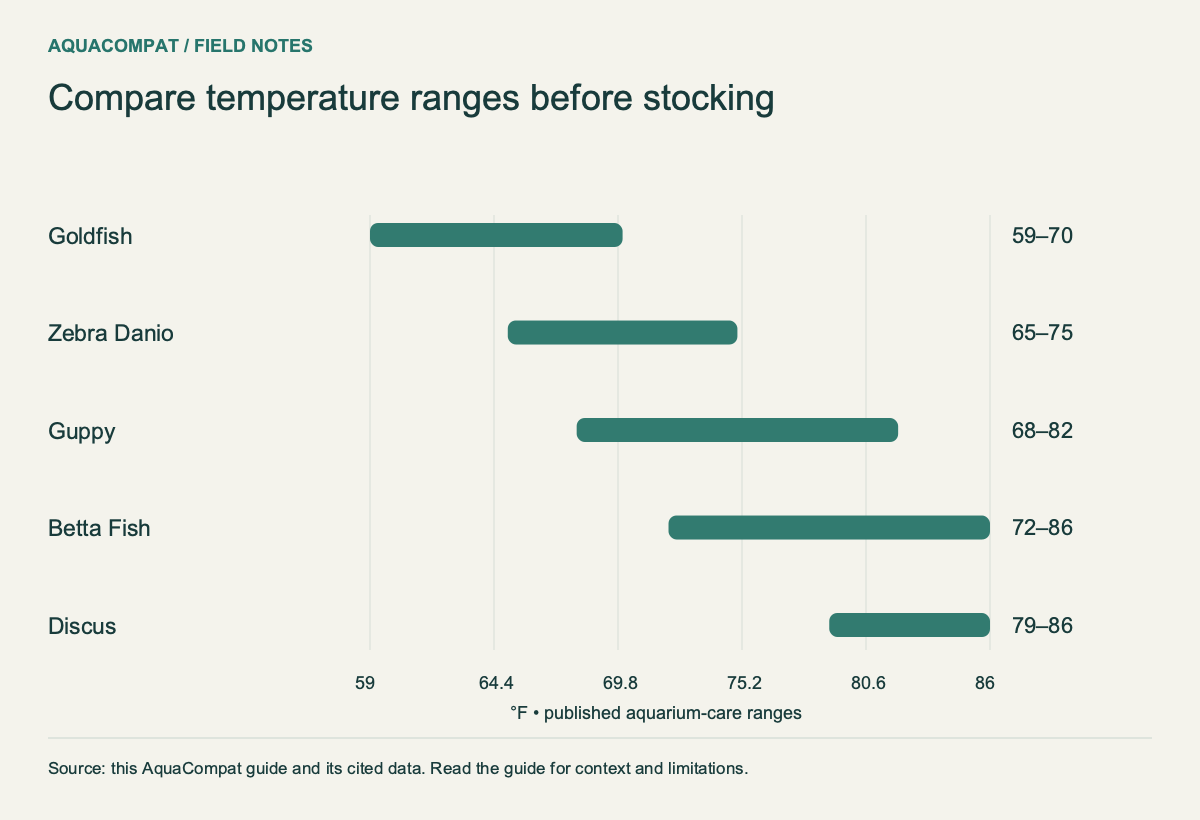
| Species | Group | Temperature range |
|---|---|---|
| Goldfish | Coldwater | 59–70 °F (15–21 °C) |
| Zebra Danio | Danio | 65–75 °F (18–24 °C) |
| Amano Shrimp | Invertebrate | 65–81 °F (18–27 °C) |
| Platy | Livebearer | 68–77 °F (20–25 °C) |
| GloFish Tetra | Tetra | 68–79 °F (20–26 °C) |
| Guppy | Livebearer | 68–82 °F (20–28 °C) |
| Crystal Red Shrimp | Invertebrate | 70–74 °F (21–23 °C) |
| Neon Tetra | Tetra | 70–77 °F (21–25 °C) |
| Mystery Snail | Invertebrate | 70–78 °F (21–26 °C) |
| Cherry Shrimp | Invertebrate | 70–79 °F (21–26 °C) |
| Corydoras | Bottom dweller | 70–81 °F (21–27 °C) |
| Molly | Livebearer | 70–82 °F (21–28 °C) |
| Galaxy Rasbora | Rasbora | 72–78 °F (22–26 °C) |
| Bristlenose Pleco | Bottom dweller | 72–79 °F (22–26 °C) |
| Harlequin Rasbora | Rasbora | 72–79 °F (22–26 °C) |
| Nerite Snail | Invertebrate | 72–79 °F (22–26 °C) |
| Dwarf Gourami | Labyrinth fish | 72–81 °F (22–27 °C) |
| Chili Rasbora | Rasbora | 72–82 °F (22–28 °C) |
| Betta Fish | Labyrinth fish | 72–86 °F (22–30 °C) |
| Peacock Cichlid | Cichlid | 73–79 °F (23–26 °C) |
| Cardinal Tetra | Tetra | 73–84 °F (23–29 °C) |
| Kuhli Loach | Bottom dweller | 74–79 °F (23–26 °C) |
| Oscar | Cichlid | 74–80 °F (23–27 °C) |
| Kenyi Cichlid | Cichlid | 75–79 °F (24–26 °C) |
| Yellow Lab | Cichlid | 75–79 °F (24–26 °C) |
| Assassin Snail | Invertebrate | 75–80 °F (24–27 °C) |
| Endler's Livebearer | Livebearer | 75–81 °F (24–27 °C) |
| Angelfish | Cichlid | 75–86 °F (24–30 °C) |
| Discus | Cichlid | 79–86 °F (26–30 °C) |
What temperature should a tropical aquarium be?
A tropical aquarium should sit inside the overlap of the species it holds, which for most community fish falls within the hobby range of 75–80 °F. The published general figures differ slightly. Merck gives 77 °F; the retailer All Pond Solutions gives 24–27 °C; Aquarium Co-Op says most tropical fish thrive at about 78–80 °F and that discus and some cichlids prefer about 85 °F. Our temperature data stores the hobby span as 75–80 °F.
Those general figures are a starting point, not a setting. Several popular tropical fish top out at or just below Merck’s figure: the neon tetra at 70–77 °F (21–25 °C) and the platy at 68–77 °F (20–25 °C). Others need more warmth, such as the discus. A heater sized for the tank holds the chosen setting more steadily, and the guide to choosing aquarium heaters by tank size covers wattage.
What temperature do tetras need?
Tetras differ more than their similar shapes suggest. Neon tetras are listed at 70–77 °F (21–25 °C), the coolest of the three tetras we cover. Cardinal tetras run warmer at 73–84 °F (23–29 °C), a range on which Seriously Fish and Aquarium Co-Op agree. GloFish tetras, a genetically modified line of the black skirt (black widow) tetra, are listed at 68–79 °F (20–26 °C). A neon and cardinal school can share water in the narrower overlap of 73–77 °F (23–25 °C).
What temperature do angelfish need?
Angelfish need warm water, listed at 75–86 °F (24–30 °C). Seriously Fish and the Maidenhead data sheet both give that range, while Aquarium Co-Op prefers the upper part of it. That warmth is one reason angelfish share water easily with other warm-water fish, and the page on angelfish tank mates ranks options.
What temperature do guppies need?
Guppies tolerate a wide band, listed at 68–82 °F (20–28 °C), but Aquarium Co-Op recommends a narrower 76–78 °F. Its guppy guide reports that guppies live about 18 months at 82 °F against 2–3 years at 76–78 °F, so the warm end shortens their lives. The guppy tank mates page lists species that share that middle band.
What temperature do goldfish need?
Goldfish need cool, unheated water, listed in our data at 59–70 °F (15–21 °C). That range is where Aquarium Co-Op’s 50–70 °F and the Ornamental Aquatic Trade Association’s optimum for fancy goldfish, 15–23 °C, overlap. SRAC Publication 7201 gives a broader optimum of 65–75 °F for goldfish and koi together, and some sources go warmer still: Practical Fishkeeping suggests 72–75 °F for good growth, and fishkeeping.co.uk says fancy goldfish do better near 72 °F.
Goldfish also tolerate far more than their optimum. SRAC 7201 says goldfish and koi can survive 32–95 °F if changes are gradual, but adds that outside the optimum their immunity, feeding and growth can drop. Practical Fishkeeping notes that fancy varieties are less hardy than single-tailed goldfish. This gap between tropical and coldwater needs is why goldfish rarely share a tank with tropical fish; the page on whether bettas and goldfish can share a tank works through one example, and the best goldfish tank mates page lists what suits a coldwater tank.
Which aquarium fish don’t need a heater?
Goldfish are the clearest example of an aquarium fish that does not need a heater. Aquarium Co-Op states that goldfish need no heater in a room-temperature home. A few tropical species can also live unheated in a warm enough room, according to the sources below.
- Goldfish. Coldwater fish listed at 59–70 °F (15–21 °C); adding heat moves them away from their optimum rather than toward it.
- Endler’s livebearers. Listed at 75–81 °F (24–27 °C), but Aquarium Co-Op says they can live unheated at room temperature.
- Betta fish. UF/IFAS EDIS (FA212) says an unheated container suits a betta only where the room air stays at about 71.6 °F or above, the bottom of its 72–86 °F (22–30 °C) range.
- Zebra danios. Listed at 65–75 °F (18–24 °C), among the coolest ranges of any tropical fish in the chart, though no source in our data addresses keeping them unheated.
Whether any of these fish needs a heater in your home depends on the room. If the room stays inside the species’ range all year, the heater mainly adds a safety margin; if the room cools at night or in winter, the tank cools with it. A thermometer in the tank tells you which applies.
How do you choose a temperature for a mixed tank?
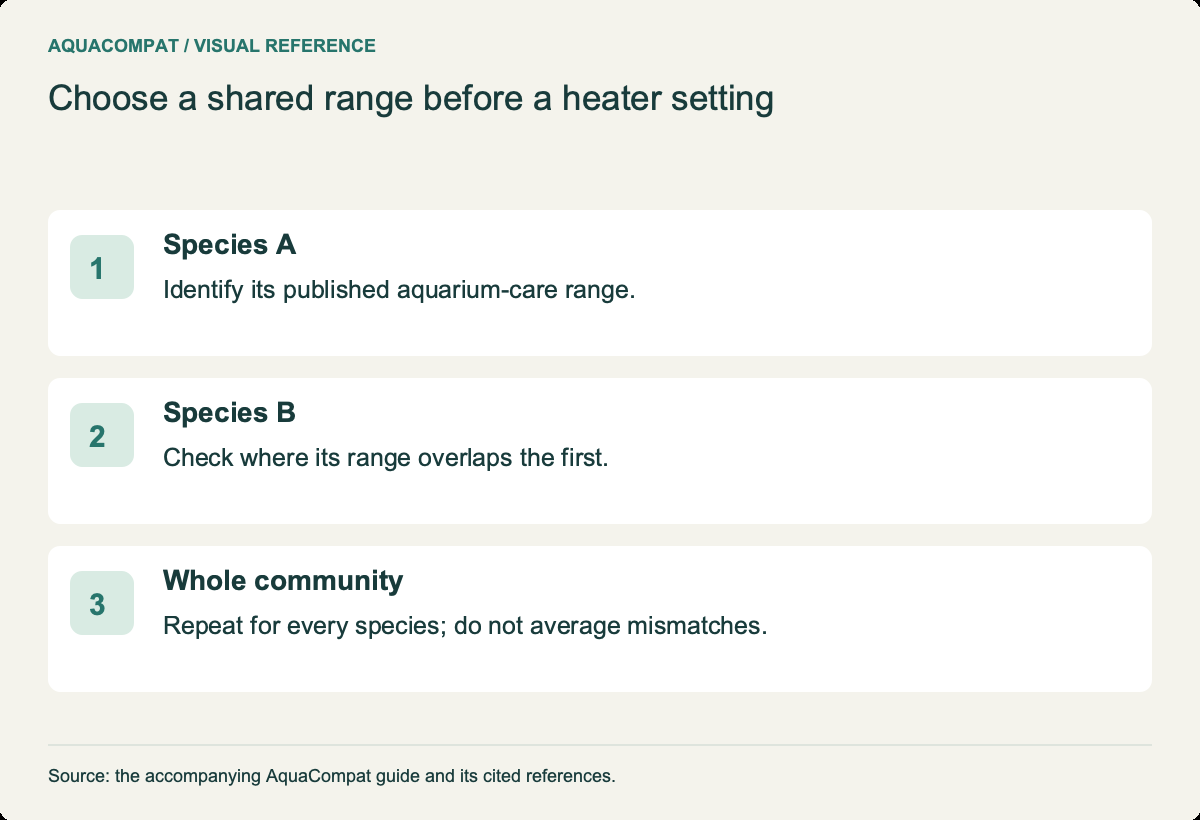
Choose a temperature inside the band that every species in the tank shares, and aim for the middle of that band. Some pairs share a wide band: bettas and cardinal tetras overlap at 73–84 °F (23–29 °C). Others share only a few degrees, such as bettas and neon tetras at 72–77 °F (22–25 °C), which is the main reason the page on bettas and neon tetras scores that pair below its betta and cardinal equivalent. The tank mate compatibility checker shows the shared temperature for any two species we cover.
Temperature is only one of the ranges to match. pH and hardness bands have to overlap too, and the aquarium pH guide sets out the species ranges for that side of the water.
How do you keep aquarium temperature stable?
Keep aquarium temperature stable with a heater sized for the tank, a separate thermometer, and slow changes whenever water or fish move. Hobby sizing rules put heater wattage at about 5 W/gal to hold the water 10 °F above the room with a lid, or 1 W/L in a normally heated room. Aquarium Co-Op and All Pond Solutions publish these figures, and they disagree slightly; no university extension source sets one.
Changes should be gradual. Merck gives a general rule of no more than 1 °F or °C per hour during handling and transport. UF/IFAS (FA119) advises acclimating slowly over two hours or more when the temperature difference exceeds 10 °C, though its own summary uses a lower threshold of about 5.5 °C. The step-by-step process is in the guide to acclimating new fish. Water changes count too: new water should be close to tank temperature. Alongside the thermometer, keep the routine readings from the aquarium test kits we recommend, because temperature changes how other parameters behave.
How does temperature change water chemistry and fish health?
Warmer water makes ammonia more toxic, holds less oxygen and speeds up biological processes in the tank. USGS oxygen-solubility tables (2020) show that fresh water saturated with air at sea-level pressure holds 9.09 mg/L of dissolved oxygen at 20 °C (68 °F) but only 7.56 mg/L at 30 °C (86 °F). UF/IFAS figures show that at pH 7.0 the toxic un-ionized share of total ammonia is 0.0039 fraction of TAN (pH 7.0, 20 °C / 68 °F) at 20 °C but 0.006 fraction of TAN (pH 7.0, 26 °C / 78.8 °F) at 26 °C. A tank kept warm therefore has less margin while its biofilter is immature, as explained in the nitrogen cycle guide.
Warmth also speeds nitrifying bacteria, which is why some keepers raise the temperature while cycling a new tank. SRAC Publication 4502 limits that increase to 2–3 °C above operating temperature (max), and the guide to cycling a new aquarium (fishless method) covers the full routine.
Does temperature affect ich?
It does. SRAC Publication 476 says ich typically cannot reproduce properly above 85 °F, yet it also reports a Florida case that killed fish at 92 °F, and it notes that a 15 °F change above or below the outbreak temperature can end an episode. Raising heat is therefore not a reliable cure on its own, and many species in the chart cannot tolerate it. The ich treatment guide sets out safer options.
Do you need an aquarium chiller?
A chiller is only relevant when the room regularly pushes the tank above the top of its species’ ranges, and the fish most exposed to that are the ones with low upper limits. In our chart those are goldfish at 59–70 °F (15–21 °C), zebra danios at 65–75 °F (18–24 °C), neon tetras at 70–77 °F (21–25 °C) and platies at 68–77 °F (20–25 °C). A warm-water community of angelfish, discus or cardinal tetras has far more headroom.
Our fact base holds no chiller specifications and no published guidance on cooling aquariums, so this guide does not recommend a chiller or a cooling method. What the sources do support is choosing species to suit the room. If your home runs warm in summer, fish whose ranges extend into the low 80s °F, such as cardinal tetras at 73–84 °F (23–29 °C) or angelfish at 75–86 °F (24–30 °C), need less intervention than cool-water species. For goldfish, SRAC 7201’s survival range is wide, but immunity and feeding can drop outside the optimum, so a warm summer room is a reason to watch them closely.
Is warmer water always better for tropical fish?
No. Warmer water is not automatically better, even for tropical fish. Aquarium Co-Op’s guppy guide is the clearest published example: it reports guppies living about 18 months at 82 °F against 2–3 years at 76–78 °F, even though 82 °F sits inside the guppy’s listed range. Warmer water also raises the toxic share of any ammonia present, as shown above. For most community tanks, the middle of the shared range is a better target than the top.
What happens when the temperature is wrong for a species?
Fish kept outside their range are stressed, and the published sources describe the effects for both directions. Kept too warm, guppies live shorter lives in Aquarium Co-Op’s figures, and ammonia becomes more toxic. Kept outside their own optimum, goldfish can lose immunity, appetite and growth, according to SRAC 7201, and a tropical fish in an unheated room depends entirely on how warm the room stays. A sudden change in either direction adds shock, which Merck’s 1 °F or °C per hour rule is meant to prevent. The other water chemistry and setup guides cover the parameters that interact with temperature.
Questions people ask
What is a good temperature for a community fish tank?
For most tropical community tanks, a setting near Merck’s 77 °F works, as long as it sits inside every species’ range. Check the chart: neon tetras top out at that figure, so a tank with neons should sit a little lower, while a tank of cardinal tetras and corydoras can run a degree or two warmer.
What temperature is too cold for tropical fish?
Below the lower limit in the chart for the species you keep. Each species’ lower limit is in the chart; bettas, for example, are listed at 72–86 °F (22–30 °C), and UF/IFAS says an unheated betta container needs room air of about 71.6 °F or above. Discus need the most warmth, at 79–86 °F (26–30 °C).
Do goldfish need a heater?
Usually not. Aquarium Co-Op says goldfish need no heater in a room-temperature home, and their listed range is 59–70 °F (15–21 °C). SRAC 7201 puts the optimum for goldfish and koi at 65–75 °F. A heater may help only in a room that gets very cold, and changes should be gradual.
How fast can I change my aquarium temperature?
Slowly. Merck’s general rule is a maximum change of 1 °F or °C per hour during handling and transport. When adjusting a heater setting, move it in small steps and check the thermometer before the next change. The same rule applies when moving fish between tanks: UF/IFAS advises acclimating over two hours or more when the temperature gap is large.
Should I raise the temperature to treat ich?
Not as a treatment on its own. SRAC 476 says ich typically cannot reproduce properly above 85 °F but also records a case that killed fish at 92 °F. Many species in the chart, including neon tetras and goldfish, are listed well below 85 °F, so the heat itself would stress them.
Sources 117 documents from 22 publishers
- All Pond Solutions (allpondsolutions.co.uk): “Aquarium Heater Buying Guide”
- Applesnail.net (applesnail.net): “How to take care of apple snails”
- Aquarium Co-Op (aquariumcoop.com): “Care Guide for Fancy Goldfish”; “Care Guide for Zebra and Leopard Danios”; “Amano Shrimp Care Guide”; “Care Guide for Mystery Snails”; “Care Guide for Cherry Shrimp”; “Care Guide for Cory Catfish”; “Celestial Pearl Danio care guide”; “Care Guide for Plecostomus”; “Care Guide for Dwarf Gouramis”; “Chili Rasbora care guide”; “Care Guide for Cardinal Tetras”; “Care Guide for Kuhli Loaches”; “Oscar Fish Care Guide”; “Care Guide for Assassin Snails”; “How to Choose the Right Aquarium Heater”; “Care Guide for GloFish”; “Freshwater Angelfish Care Guide”; “Guppy Care Guide”; “Top 5 Dither Fish to Help Shy or Aggressive Fish in Freshwater Tanks”; “Goldfish Tank Mates”; “Endler's Livebearer Care Guide”; “Betta Fish Care Guide”; “Ich-X product guide”
- AquariumInfo.org (aquariuminfo.org): “Apple Snail”
- Chewy (Hilary Jaffe) (chewy.com): “How To Acclimate Fish the Right Way”
- Dr Tim's Aquatics (manufacturer) (drtimsaquatics.com): “Fishless Cycling”
- FishBase (fishbase.se): “Danio rerio summary page”; “Symphysodon aequifasciatus, Blue discus: species summary”; “Gymnocorymbus ternetzi summary (Bayesian length-weight estimate)”; “Paracheirodon innesi summary page”; “Pterophyllum scalare, Freshwater angelfish: species summary”; “Length-weight relationships for Pterophyllum scalare”; “Poecilia reticulata, Guppy: species summary”; “Length-weight relationships for Poecilia reticulata”; “Carassius auratus, Goldfish: species summary”; “Length-weight relationships for Carassius auratus”; “Poecilia wingei summary (Bayesian length-weight estimate)”; “Betta splendens, Siamese fighting fish: species summary”
- fishkeeping.co.uk (fishkeeping.co.uk): “Goldfish Size, Life Expectancy and Tank Recommendations”; “Keeping Goldfish - The Right Way”
- GloFish (Spectrum Brands) (glofish.com): “GloFish FAQs”; “International Use and License Notice”
- Maidenhead Aquatics (fishkeeper.co.uk species data sheet) (fishkeeper.co.uk): “Platy data sheet”; “Black Widow Tetra (Black Skirt Tetra) data sheet”; “Guppy data sheet”; “Neon Tetra data sheet”; “Molly data sheet”; “Harlequin Rasbora data sheet”; “Zebra Nerite Snail”; “Oscar data sheet”; “Kenyi data sheet”; “Yellow Labidochromis data sheet”; “Angelfish data sheet”
- Merck Veterinary Manual (merckvetmanual.com): “Special Considerations for Fish (pet owner version)”; “Environmental Diseases of Aquatic Animals in Aquatic Systems (Francis-Floyd, Yanong, Petty)”; “Providing a Home for Fish (pet owner version)”; “Management of Aquarium Fish, Petty, Francis-Floyd and Yanong”; “Parasitic Diseases of Fish, Petty, Francis-Floyd and Yanong”
- Ornamental Aquatic Trade Association (OATA) (ornamentalfish.org): “How to look after fancy goldfish”; “How to look after goldfish in an aquarium / fish tank”
- PlanetCatfish (via Internet Archive snapshot, 2025) (web.archive.org): “Osteogaster aenea (Bronze Cory) Cat-eLog data sheet”; “Ancistrus sp. (3) Common Bristlenose Catfish Cat-eLog data sheet”
- Practical Fishkeeping (practicalfishkeeping.co.uk): “Amano shrimp: Spineless heroes (Nathan Hill)”; “Frequently asked questions on Neocaridina shrimps”; “Bristlenose catfish: the hardworking Ancistrus”; “Quick guide to livebearers”; “How long will my fish live?”; “What water temperature do goldfish need?”; “How can I breed goldfish in my aquarium?”; “Endler's livebearers are nearly all hybrids!”; “How to Cycle a Fish Tank: The Complete Guide”
- Seriously Fish (seriouslyfish.com): “Danio rerio (Zebra Danio)”; “Xiphophorus maculatus”; “Gymnocorymbus ternetzi (Black Widow Tetra)”; “Poecilia reticulata”; “Paracheirodon innesi (Neon Tetra)”; “Osteogaster aenea (Bronze Cory)”; “Poecilia sphenops”; “Danio margaritatus (Celestial Pearl Danio)”; “Ancistrus sp. '3' (Common Bristlenose Catfish)”; “Trigonostigma heteromorpha (Harlequin)”; “Trichogaster lalius”; “Boraras brigittae”; “Betta splendens”; “Aulonocara stuartgranti”; “Aulonocara baenschi”; “Paracheirodon axelrodi (Cardinal Tetra)”; “Pangio semicincta ('Kuhli' Loach)”; “Astronotus ocellatus”; “Maylandia lombardoi”; “Labidochromis caeruleus”; “Poecilia wingei”; “Pterophyllum scalare”; “Symphysodon aequifasciatus”
- Shrimp and Snail Breeder (aquariumbreeder.com): “Crystal Red Shrimp: detailed guide, care, diet and breeding”; “Red Cherry Shrimp: detailed guide, care, diet and breeding”; “Nerite Snails: detailed guide, care, diet and breeding”; “Assassin Snail: detailed guide, care, diet and breeding”; “Cherry Shrimp in a Community Tank”
- Shrimp Science (shrimpscience.com): “Amano Shrimp”; “Crystal Red Shrimp - Care Guide”; “Red Cherry Shrimp - Care Guide”
- Southern Regional Aquaculture Center (srac.msstate.edu): “SRAC 7201: Species Profile: Koi and Goldfish (Watson, Hill, Pouder)”; “How to Start a Biofilter, SRAC Publication No. 4502, DeLong and Losordo”; “Nitrite in Fish Ponds, SRAC Publication No. 462, Durborow, Crosby and Brunson”; “Recirculating Aquaculture Tank Production Systems: Management of Recirculating Systems, SRAC Publication No. 452”; “Ich (White Spot Disease), SRAC Publication No. 476, Durborow, Mitchell and Crosby”
- UF/IFAS EDIS (ask.ifas.ufl.edu): “Evolution, Culture, and Care for Betta splendens (FA212)”; “FA119: On-Farm Transport of Ornamental Fish (Crosby, Hill, Martinez, Watson, Pouder, Yanong)”
- University of Florida IFAS Extension (EDIS) (ask.ifas.ufl.edu): “Ammonia in Aquatic Systems (FA16/FA031), Francis-Floyd, Watson, Petty and Pouder”; “Ichthyophthirius multifiliis (White Spot) Infections in Fish (CIR920/FA006), Francis-Floyd, Yanong and Pouder”; “Use of Copper in Marine Aquaculture and Aquarium Systems (FA165), Yanong”; “Use of Copper in Freshwater Aquaculture and Farm Ponds (FA-13), Watson and Yanong”
- US Geological Survey (pubs.usgs.gov): “Chapter A6.2. Dissolved Oxygen, Techniques and Methods book 9, chapter A6.2 (revised October 2020)”
- Wikipedia (en.wikipedia.org): “Vittina natalensis”
All sources accessed . Every number on this page comes from these documents.