What makes a good tank mate for a goldfish?
A good goldfish tank mate lives comfortably in cool water, is too large to be swallowed, and can match the goldfish at feeding time without being nipped. The goldfish (Carassius auratus) is a domesticated member of the carp family (Cyprinidae) from East Asia, and that history shapes every criterion below.
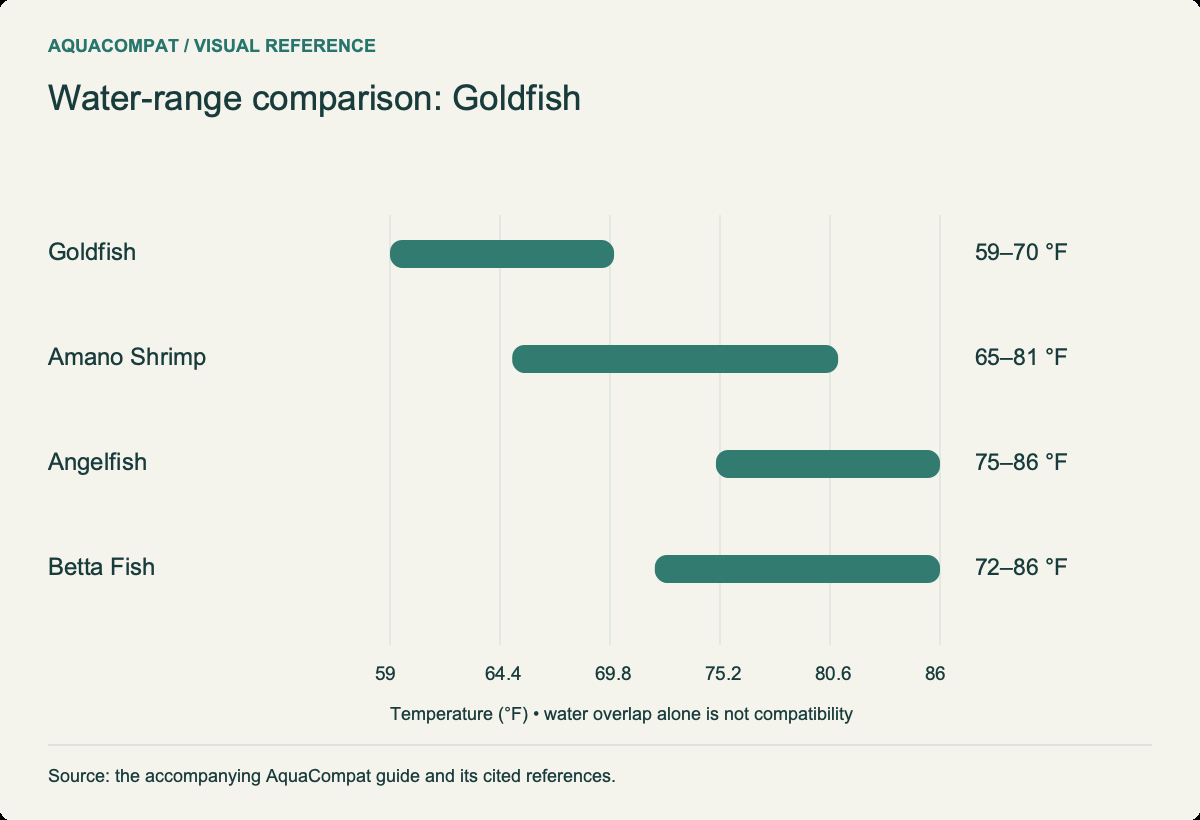
- Coldwater tolerance. Our goldfish range is 59–70 °F (15–21 °C). Aquarium Co-Op gives 50–70 °F and says no heater is needed, while OATA gives 59–73.4 °F as optimal for fancy goldfish. Most community fish need water warmer than that.
- Too big to eat. fishkeeping.co.uk says goldfish eat anything that fits in their mouth, and OATA reports adults of about 25 cm in aquaria; our data uses 10 in (25.4 cm). Small fish kept with young goldfish become food as the goldfish grow.
- Matched speed. OATA’s goldfish and fancy goldfish care sheets warn that fast single-tails such as commons and comets outcompete slow fancy goldfish for food, and OATA reports boisterous goldfish nipping the fins of slower fancies.
- Able to live with heavy waste. Aquarium Co-Op, OATA and fishkeeping.co.uk all describe goldfish as heavy waste producers that need strong filtration and weekly water changes of 20–30%.
Aquarium Co-Op also describes goldfish as peaceful fish that do poorly with aggressive barbs and large cichlids, so the risk runs both ways. This guide belongs to our tank mates by species series, which applies the same checks to every species.
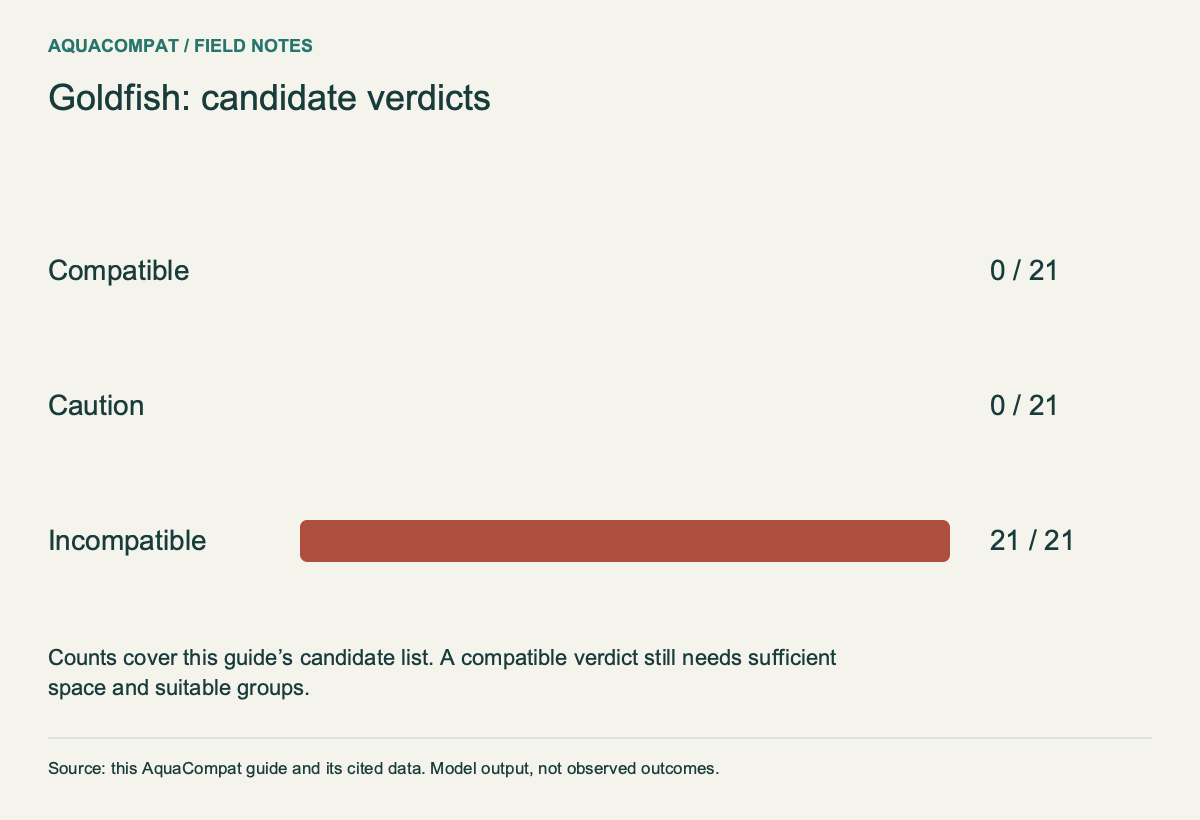
| Species | Verdict | Score | Shared temperature | Shared pH | Smallest tank |
|---|---|---|---|---|---|
| Amano Shrimp | incompatible | 3/10 | 65–70 °F (18–21 °C) | pH 6.0–7.5 | 55 US gal (208 L) |
| Bristlenose Pleco | incompatible | 3/10 | no overlap | pH 6.0–7.2 | 55 US gal (208 L) |
| Corydoras | incompatible | 3/10 | 70–70 °F (21–21 °C) | pH 6.5–7.5 | 55 US gal (208 L) |
| GloFish Tetra | incompatible | 3/10 | 68–70 °F (20–21 °C) | pH 6.0–7.0 | 55 US gal (208 L) |
| Mystery Snail | incompatible | 3/10 | 70–70 °F (21–21 °C) | pH 7.2–8.0 | 55 US gal (208 L) |
| Nerite Snail | incompatible | 3/10 | no overlap | pH 7.2–8.0 | 55 US gal (208 L) |
| Zebra Danio | incompatible | 3/10 | 65–70 °F (18–21 °C) | pH 6.0–8.0 | 55 US gal (208 L) |
| Angelfish | incompatible | 3/10 | no overlap | pH 6.0–8.0 | 90 US gal (341 L) |
| Cherry Shrimp | incompatible | 3/10 | 70–70 °F (21–21 °C) | pH 6.5–8.0 | 55 US gal (208 L) |
| Discus | incompatible | 3/10 | no overlap | pH 6.0–7.6 | 75 US gal (284 L) |
| Molly | incompatible | 3/10 | 70–70 °F (21–21 °C) | pH 7.5–8.0 | 55 US gal (208 L) |
| Oscar | incompatible | 3/10 | no overlap | pH 6.0–8.0 | 125 US gal (473 L) |
| Platy | incompatible | 3/10 | 68–70 °F (20–21 °C) | pH 7.0–8.0 | 55 US gal (208 L) |
| Cardinal Tetra | incompatible | 3/10 | no overlap | pH 6.0–7.5 | 55 US gal (208 L) |
| Dwarf Gourami | incompatible | 3/10 | no overlap | pH 6.0–7.5 | 75 US gal (284 L) |
| Guppy | incompatible | 3/10 | 68–70 °F (20–21 °C) | pH 7.0–8.0 | 55 US gal (208 L) |
| Harlequin Rasbora | incompatible | 3/10 | no overlap | pH 6.0–7.5 | 55 US gal (208 L) |
| Kuhli Loach | incompatible | 3/10 | no overlap | pH 6.0–7.0 | 55 US gal (208 L) |
| Neon Tetra | incompatible | 3/10 | 70–70 °F (21–21 °C) | pH 6.0–7.5 | 55 US gal (208 L) |
| Betta Fish | incompatible | 3/10 | no overlap | pH 6.0–8.0 | 75 US gal (284 L) |
| Endler's Livebearer | incompatible | 3/10 | no overlap | pH 7.0–8.0 | 55 US gal (208 L) |
Why are other goldfish the best goldfish tank mates?
Other goldfish are the best goldfish tank mates because they share the same cool water, the same diet and the same appetite, so none of them is food for the others. fishkeeping.co.uk says goldfish are best kept with goldfish, and OATA says they can be kept alone or in groups, which is why our minimum group size is 1.
Single-tailed and fancy goldfish
The one rule within the species is to keep body types apart. Single-tailed goldfish, such as commons, comets and shubunkins, are fast swimmers. Fancy goldfish are slower, and Practical Fishkeeping says they are less hardy than single-tailed types. OATA’s two goldfish care sheets both warn that single-tails outcompete fancies for food, and OATA reports fin-nipping of the slower fish. A tank of fancies or a tank of single-tails works better than a mix.
How much room each goldfish needs
Goldfish tanks grow with every fish added. Our minimum of 48 US gal (182 L) is fishkeeping.co.uk’s figure for a first single-tailed goldfish, about 180 litres, plus 55 litres (about 12 US gallons) for each extra fish, in a tank at least 120 cm long; the same source says single-tails are better suited to a pond at full size. Fancy goldfish need less. Aquarium Co-Op gives 20 gallons for one fancy plus at least 10 gallons per extra fish, fishkeeping.co.uk gives 140 litres (37 US gallons) plus 45 litres per extra, and OATA gives 100 litres (26.4 US gallons) plus 50 litres per extra for any adult goldfish.
Which tropical fish come closest to sharing goldfish water?
A few tropical species overlap with the cool end of the goldfish range, but most of them also face a second problem. The table below lists every species in our data whose temperature range touches the goldfish range, ordered from the widest overlap to the narrowest.
| Species | Shared temperature | Score | Other problem |
|---|---|---|---|
| Amano Shrimp | 65–70 °F (18–21 °C) | 3/10 | Aquarium Co-Op lists goldfish among fish that eat amano shrimp |
| Zebra Danio | 65–70 °F (18–21 °C) | 3/10 | Small enough for a goldfish to eat |
| Guppy | 68–70 °F (20–21 °C) | 3/10 | Small, long-finned and a nipping target |
| Platy | 68–70 °F (20–21 °C) | 3/10 | Small enough to be at risk |
| GloFish Tetra | 68–70 °F (20–21 °C) | 3/10 | Small enough to be at risk |
| Corydoras | 70–70 °F (21–21 °C) | 3/10 | Aquarium Co-Op lists goldfish among cory predators |
| Cherry Shrimp | 70–70 °F (21–21 °C) | 3/10 | Dwarf shrimp are eaten |
| Neon Tetra | 70–70 °F (21–21 °C) | 3/10 | Small enough for a goldfish to eat |
| Molly | 70–70 °F (21–21 °C) | 3/10 | None recorded beyond temperature |
| Mystery Snail | 70–70 °F (21–21 °C) | 3/10 | None recorded beyond temperature |
Can goldfish live with zebra danios or guppies?
Neither pairing is safe, although both look possible on temperature alone. Zebra danios have the widest overlap of any fish in our data, at 65–70 °F (18–21 °C), because their own range is 65–75 °F (18–24 °C). The pairing still scores 3/10: a zebra danio grows to 2 in (5.1 cm), small enough for an adult goldfish to swallow.
Guppies score 3/10. They share only 68–70 °F (20–21 °C), at the bottom of the guppy’s range and the top of the goldfish’s, so neither species would be kept at its preferred temperature. A guppy reaches 2.4 in (6.1 cm), and its long fins match the kind of slow, finned fish OATA reports goldfish nipping. Our guide to guppy tank mates lists tropical fish that suit guppies instead.
Platies and GloFish tetras share a similar narrow band and score 3/10 and 3/10. In every case the size gap matters more over time, because goldfish keep growing long after these fish reach adult size.
Which fish should never live with goldfish?
Tropical fish that need warm water should never live with goldfish, and nor should any fish small enough to swallow. Most species in our data fail on at least one of those counts, and many on both.
Warm-water fish
Bettas, angelfish, discus, oscars, dwarf gouramis, bristlenose plecos, kuhli loaches, cardinal tetras and harlequin rasboras share no temperature range with goldfish. The betta, for example, needs 72–86 °F (22–30 °C), and discus 79–86 °F (26–30 °C). Keeping either species in goldfish water, or goldfish in theirs, means one of them lives outside its range permanently. The full reasoning for the most searched of these pairings is in the guide to bettas and goldfish compatibility, and the list of fish that live with bettas shows where the betta does belong.
Small fish
Neon tetras, cardinal tetras, Endler’s livebearers and harlequin rasboras are small enough to eat as well as needing warmer water. The Endler’s livebearer reaches only 1 in (2.5 cm) and the neon tetra 1.2 in (3 cm). fishkeeping.co.uk says goldfish eat anything that fits in their mouth, and our goldfish data notes that small fish kept with juvenile goldfish become food as the goldfish grow.
Corydoras
Corydoras score 3/10. They share only 70–70 °F (21–21 °C), and Aquarium Co-Op lists goldfish among the fish that eat corydoras. Our goldfish data adds that spiny catfish such as corydoras can lodge in a goldfish’s gills if swallowed, so the danger runs to both fish.
Do goldfish need a heater, and which other fish don't?
Goldfish do not need a heater in a room-temperature home, according to Aquarium Co-Op, the clearest statement of that kind in our data. SRAC fact sheet 7201 gives an optimum of 65–75 °F for goldfish and says they survive 32–95 °F if changes are gradual, though immunity, feeding and growth can drop outside the optimum. Tropical fish, by contrast, need water kept near 77 °F according to the Merck Veterinary Manual.
The search for fish that do not need a heater has a short answer in our data. Aquarium Co-Op says Endler’s livebearers can live unheated at room temperature, but our Endler range is 75–81 °F (24–27 °C), Seriously Fish and Practical Fishkeeping set the lower limit at 75 °F, and Endlers are small enough for a goldfish to eat. Zebra danios (65–75 °F (18–24 °C)) and amano shrimp (65–81 °F (18–27 °C)) have the coolest lower limits among the tropical species, but no source in our data says they can go without a heater. Read the aquarium temperature guide by species before leaving any tropical fish unheated, and size equipment with the guide to aquarium heaters by tank size.
Warmer is not always better for goldfish either. Practical Fishkeeping reports good growth at 72–75 °F, and fishkeeping.co.uk says fancy goldfish do better near 72 °F, both above Aquarium Co-Op’s upper figure. Our displayed range uses the overlap of Aquarium Co-Op and OATA.
Can goldfish live in a small tank with tank mates?
No. The idea that goldfish suit small starter tanks or bowls is the most common goldfish misconception, and OATA and fishkeeping.co.uk both warn that goldfish grow large enough to outgrow small tanks quickly. Our goldfish data records an adult size of 10 in (25.4 cm), a minimum tank of 48 US gal (182 L) for a single-tailed fish, and a lifespan of 6–20 years; FishBase records a maximum age of 41 years.
Adding tank mates makes the space problem worse. In our data every goldfish pairing calculates at 55 US gal (208 L) or more, because the shared figure starts from the larger minimum and rounds up to the next common tank size. A 10-gallon tank suits small tropical fish instead, and the fish for a 10-gallon community tank we recommend guide starts from species that fit. The aquarium maintenance schedule covers the weekly water changes a goldfish tank needs.
Can goldfish live with shrimp and snails?
Goldfish are a poor match for shrimp and an uncertain one for snails. Shrimp are eaten, and snails are limited by temperature.
Shrimp
Shrimp and Snail Breeder says all dwarf shrimp are on the goldfish menu, and Aquarium Co-Op lists goldfish among the fish that eat amano shrimp. Amano shrimp still score 3/10, the highest goldfish result in our data, because they are larger, at 2 in (5.1 cm), and share 65–70 °F (18–21 °C). Cherry shrimp score 3/10. The guide to cherry shrimp tank mates covers fish that leave shrimp alone.
Snails
No source in our goldfish data says whether goldfish eat snails, so the snail verdicts rest on temperature. Nerite snails need 72–79 °F (22–26 °C) and share no temperature with goldfish, and mystery snails meet the goldfish range only at 70–70 °F (21–21 °C). Our page on which fish suit aquarium snails lists better companions.
What tank size do goldfish need with tank mates?
Every goldfish pairing in our data needs at least 55 US gal (208 L), and pairings with warm-water fish such as bettas need 75 US gal (284 L) or more, though those pairings fail on temperature anyway. No goldfish tank mate fits a 5, 10 or 20-gallon tank in our data.
For goldfish-only tanks, the figures in the section on other goldfish apply: a single fancy goldfish can start at the 20 gallons Aquarium Co-Op gives, while single-tailed goldfish start at 48 US gal (182 L) and grow toward pond size. The stocking calculator checks a planned group against a tank, and the species compatibility checker scores any species not listed here against goldfish.
Plan for the adult fish from the start, because released goldfish survive. The USGS Nonindigenous Aquatic Species database (revised 2026) lists goldfish as established or reported in the wild in 49 US states, every state except Alaska, so an outgrown goldfish needs a larger tank, a pond or a new keeper, never a local waterway.
Questions people ask
Will a goldfish eat guppies?
It can. Our goldfish data records that goldfish eat anything that fits in their mouths, and a guppy reaches only 2.4 in (6.1 cm), so a grown goldfish puts guppies at risk. The two also share just 68–70 °F (20–21 °C) of temperature, at the edge of both ranges, and OATA reports goldfish nipping long fins like the guppy’s. The pairing is rated incompatible.
Can a betta live with a goldfish?
No. The pairing scores 3/10 because a betta needs 72–86 °F (22–30 °C) and a goldfish 59–70 °F (15–21 °C), so they share no temperature range. fishkeeping.co.uk also says goldfish eat anything that fits in their mouth. The betta and goldfish compatibility guide covers the pairing in full.
Can goldfish live with a pleco?
Not the bristlenose pleco, the only pleco in our data. The pairing scores 3/10 because the bristlenose needs 72–79 °F (22–26 °C), which shares no range with goldfish. Our data does not cover other pleco species, so we cannot score them.
Can fancy goldfish live with common goldfish?
It is not recommended. OATA and its fancy goldfish care sheet say fast single-tailed goldfish such as commons and comets outcompete slow fancy varieties for food, and OATA reports single-tails nipping the fins of fancies. Keep each body type with its own kind, and size the tank for the type you keep.
What is the best tank mate for a goldfish?
Another goldfish of the same body type. fishkeeping.co.uk says goldfish are best kept with goldfish, and every other species in our data either needs warmer water, is small enough to eat, or both. The closest non-goldfish result is the amano shrimp at 3/10, and even that carries a predation warning.
Sources 106 documents from 25 publishers
- All Pond Solutions (allpondsolutions.co.uk): “Aquarium Heater Buying Guide”
- Applesnail.net (applesnail.net): “How to take care of apple snails”; “Quick guide”; “Pomacea diffusa”; “Apple snail FAQ”
- Aqualog (aqualog.de): “Discus (lexicon profile)”
- Aquarium Co-Op (aquariumcoop.com): “Care Guide for Fancy Goldfish”; “Goldfish Tank Mates”; “Care Guide for Amano Shrimp”; “Care Guide for Zebra and Leopard Danios”; “Guppy Care Guide”; “Care Guide for Platy Fish: Feeding, Breeding, and Tank Mates”; “Care Guide for GloFish”; “Care Guide for Cory Catfish”; “Care Guide for Cherry Shrimp”; “Care Guide for Mollies: Feeding, Breeding, and Tank Mates”; “Care Guide for Mystery Snails”; “10 Best Top-Dwelling Fish for Your Freshwater Community Aquarium”; “Top 5 Dither Fish to Help Shy or Aggressive Fish in Freshwater Tanks”; “Betta Fish Care Guide”; “Care Guide for Dwarf Gouramis”; “Discus Fish Care Guide”; “What Is Neon Tetra Disease and How Can It Be Prevented?”; “Neon and Cardinal Tetras: Beginner Schooling Fish”; “Endler's Livebearer Care Guide”; “How to Choose the Right Aquarium Heater”; “Care Guide for Nerite Snails”; “Betta fish tank mates”; “Care Guide for Plecostomus”
- AquariumInfo.org (aquariuminfo.org): “Apple Snail”
- Crustacean Research 49 (Hamasaki et al. 2020) (jstage.jst.go.jp): “Dietary effects of phytoplankton and zooplankton on larval survival, duration and growth of four Caridina species”
- Crustacean Research 50 (Kondo, Hamasaki, Dan 2021) (jstage.jst.go.jp): “Larval performance of three amphidromous shrimp species in the genus Caridina under different temperature and salinity conditions”
- FishBase (fishbase.se): “Carassius auratus, Goldfish: species summary”; “Length-weight relationships for Carassius auratus”; “Danio rerio summary page”; “Poecilia reticulata, Guppy: species summary”; “Xiphophorus maculatus summary (Bayesian length-weight estimate)”; “Osteogaster aenea, Bronze corydoras”; “Paracheirodon innesi summary (Bayesian length-weight estimate)”; “Length-weight relationships for Poecilia reticulata”; “Gymnocorymbus ternetzi summary (Bayesian length-weight estimate)”; “Symphysodon aequifasciatus summary (Bayesian length-weight estimate)”; “Betta splendens, Siamese fighting fish: species summary”; “Poecilia wingei summary (Bayesian length-weight estimate)”; “Length-weight relationships for Osteogaster aenea”
- fishkeeping.co.uk (fishkeeping.co.uk): “Goldfish Size, Life Expectancy and Tank Recommendations”; “Keeping Goldfish - The Right Way”
- GloFish (Spectrum Brands) (glofish.com): “GloFish FAQs”; “International Use and License Notice”
- Maidenhead Aquatics (fishkeeper.co.uk species data sheet) (fishkeeper.co.uk): “Guppy data sheet”; “Platy data sheet”; “Black Widow Tetra (Black Skirt Tetra) data sheet”; “Neon Tetra data sheet”; “Molly data sheet”; “Siamese Fighting Fish/Betta data sheet”; “Discus data sheet”; “Amano Shrimp”; “Zebra Nerite Snail”
- Merck Veterinary Manual (merckvetmanual.com): “Special Considerations for Fish (pet owner version)”; “Environmental Diseases of Aquatic Animals in Aquatic Systems (Francis-Floyd, Yanong, Petty)”
- Neotropical Ichthyology (Crampton 2008) (scielo.br): “Ecology and life history of an Amazon floodplain cichlid: the discus fish Symphysodon”
- Ornamental Aquatic Trade Association (OATA) (ornamentalfish.org): “How to look after fancy goldfish”; “How to look after goldfish in an aquarium / fish tank”
- PlanetCatfish (via Internet Archive snapshot, 2025) (web.archive.org): “Osteogaster aenea (Bronze Cory) Cat-eLog data sheet”; “Ancistrus sp. (3) Common Bristlenose Catfish Cat-eLog data sheet”
- Practical Fishkeeping (practicalfishkeeping.co.uk): “What water temperature do goldfish need?”; “How can I breed goldfish in my aquarium?”; “Amano shrimp: Spineless heroes (Nathan Hill)”; “Quick guide to livebearers”; “What can I keep in my hard water aquarium?”; “Frequently asked questions on Neocaridina shrimps”; “How long will my fish live?”; “Endler's livebearers are nearly all hybrids!”; “An introduction to Shrimp”; “Will these snails starve without algae?”; “What can I add for algae control?”; “Bristlenose catfish: the hardworking Ancistrus”
- Practical Fishkeeping (Julian Dignall) (practicalfishkeeping.co.uk): “Focus on commonly kept Corydoras”
- Seriously Fish (seriouslyfish.com): “Danio rerio (Zebra Danio)”; “Poecilia reticulata”; “Xiphophorus maculatus”; “Gymnocorymbus ternetzi (Black Widow Tetra)”; “Osteogaster aenea (Bronze Cory)”; “Paracheirodon innesi (Neon Tetra)”; “Poecilia sphenops”; “Poecilia latipinna”; “Poecilia wingei”; “Betta splendens”; “Symphysodon aequifasciatus”; “Ancistrus sp. '3' (Common Bristlenose Catfish)”
- Shrimp and Snail Breeder (aquariumbreeder.com): “Cherry Shrimp in a Community Tank”; “Amano Shrimp: detailed guide, care, diet and breeding”; “Red Cherry Shrimp: detailed guide, care, diet and breeding”; “How Copper Affects Dwarf Shrimp”; “Nerite Snails: detailed guide, care, diet and breeding”
- Shrimp Science (shrimpscience.com): “Amano Shrimp”; “Red Cherry Shrimp - Care Guide”; “General Hardness (GH) For Shrimp Tanks”; “Carbonate Hardness (KH) For Shrimp Tanks”; “TDS For Shrimp Tanks”
- Southern Regional Aquaculture Center (srac.msstate.edu): “SRAC 7201: Species Profile: Koi and Goldfish (Watson, Hill, Pouder)”
- Tropical Fish Hobbyist Magazine (tfhmagazine.com): “Betta splendens”
- U.S. Geological Survey (nas.er.usgs.gov): “Carassius auratus (Goldfish) species profile, Nonindigenous Aquatic Species Database”
- UF/IFAS EDIS (ask.ifas.ufl.edu): “Evolution, Culture, and Care for Betta splendens (FA212)”
- Wikipedia (en.wikipedia.org): “Vittina natalensis”
All sources accessed . Every number on this page comes from these documents.